vegetable gardens not big but there’s a science to making gravy
In the book Sundog, Jim Harrison writes of an May Morning in Michigan’s Upper Peninsula;
A cold dawn with the wind shifting to the north in the night.
I tried to scrape frost from my windshield with my fingernails.
No wonder vegetable gardening isn’t a big item up here, while the making of gravy is a science.
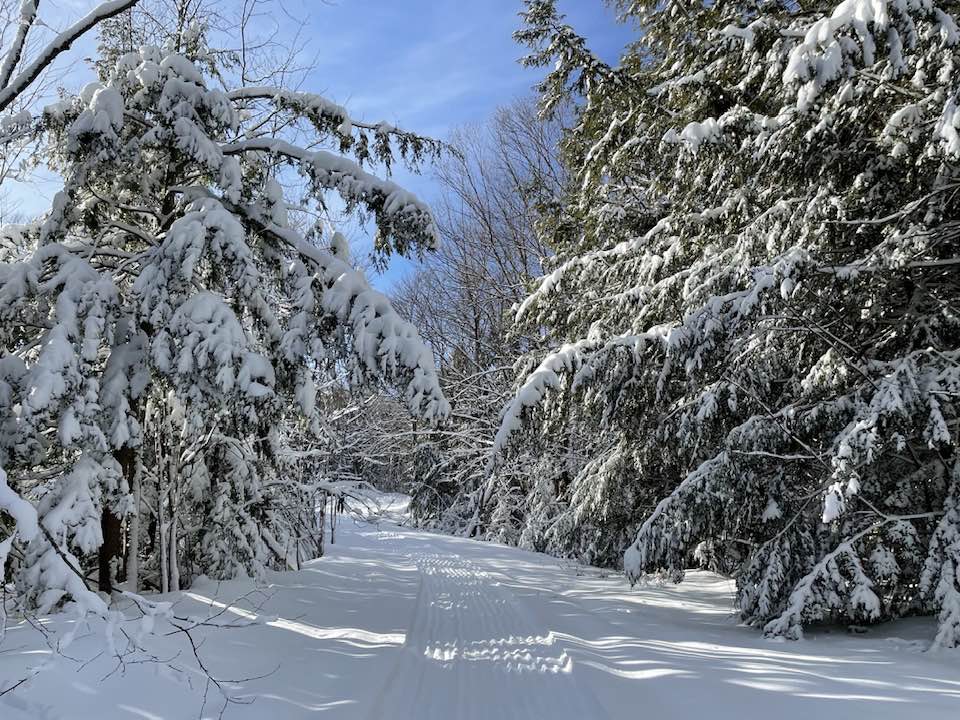
I stole this image of a ski trail up there above the bridge, the Mackinaw Bridge I mean, was taken by my friend Katie who live up there and swears that she loves it.
For myself, I guess, all I need is the picture and that is as close as I want to get.
Mr. Harrison, and he was the UP’s biggest fan, said this:
Above the Straits of Mackinac, the Upper Peninsula sat alone, perhaps the least-known land mass in the United States.
In this age where every niche on earth has been discovered and rediscovered countless times, there is an open secret why the upper Midwest is generally ignored: it is relatively charmless, and it competes with Siberia for the least hospitable climate on earth.
On the other side of the river, the road entered an enormous swamp some thirty miles in width, with very few other cars on the road. For a while the lack of any traffic caused a vertigo as if I had been abandoned.
Apparently on a Thursday night in May in the Upper Peninsula no one goes anywhere, but then where would they go?
[Enter] the UP, as it’s called, [You] enter a timbered-over, rock-strewn waste, a land so dense and desolate it became obvious to me that the most redoubtable survivalist couldn’t survive.
On the other hand I live in resort town and it is the off season.
Apparently on a Monday night in January in the Low Country no one goes anywhere, but then where would they go?
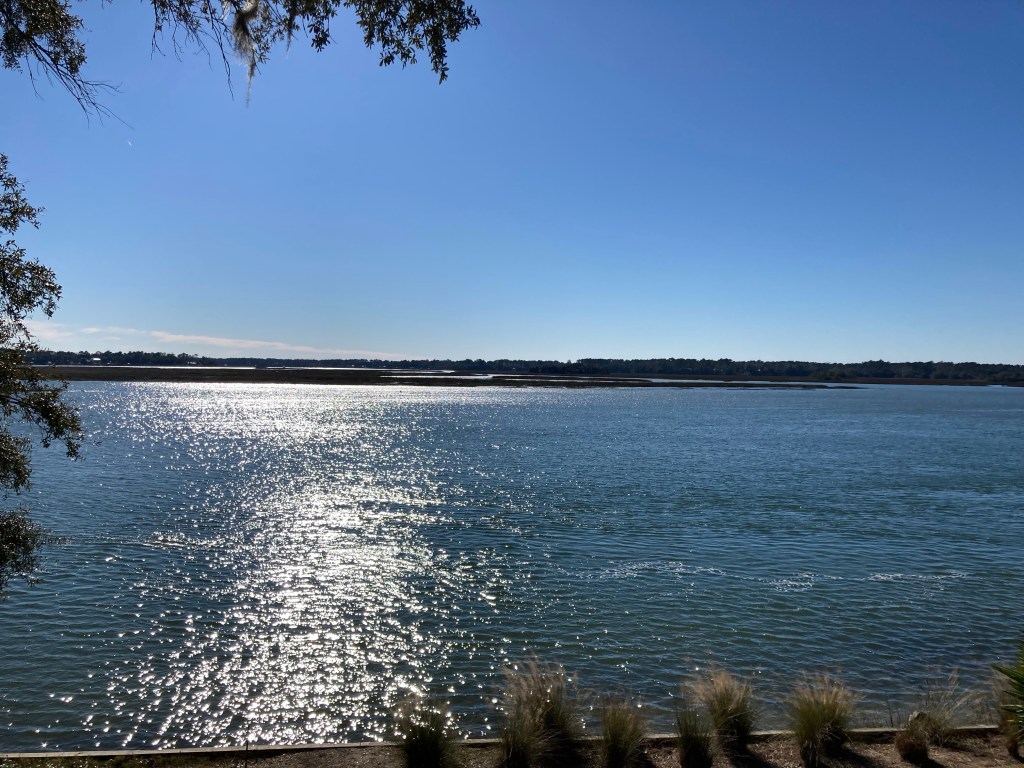
The picture makes a nice contrast to my usual ocean side views.
The Google says where I am and where this this picture was taken are about 1200 miles and about 14 degrees of latitude apart distance wise.
But where it really counts, the google says it is 7 degrees Fahrenheit right now up north while it is 67 degrees down here.
No wonder vegetable gardening isn’t a big item up here, while the making of gravy is a science.
brilliant sunny day cloudless December blue skies but can’t see the cold
We were out and about on Christmas Day in the Low Country of South Carolina, it was a brilliant sunny day.
The December sky was a deep blue.
And it was COLD!
I was standing on the bluff overlooking the May River, thinking of the hot hot hot days in the past that I have stood there.
I stood there in the Bluffton Breeze that is always blowing across the river to the Bluff.
It was for the Bluffton Breeze that people moved to Bluffton South Carolina in the first place with many of the area families building summer homes here to catch the refreshing breeze off the river.
Standing there on this brilliant sunny Christmas Day, I felt frozen.
I felt frozen and it came to me that, you can’t see cold.
Or can you?
I was reminded of the Weatherball of Grand Rapids, Michigan, where I grew up.
The Weatherball was this giant stainless steel ball on top of a bank building in downtown Grand Rapids.
It changed color with the weather.
And you could see it from all over the city.
There was a little rhyme that everyone in Grand Rapids could recite.
Weatherball red – warm weather ahead
Weatherball blue – cold weather in view
Weatherball green – no change foreseen
And it worked, though maybe not in the way the designers designed it.
I what I mean is, take for example, August in Grand Rapids, a soupy humid month.
80 degree days with 90% humidity is the norm.
When I was kid and my family would drive into Grand Rapids from the west on Lake Michigan Drive and get on the freeway that came across John Ball Park, the entire downtown would open up in front of us like a panorama.
The city would be hidden in a thick, humid haze.
And shining in this swampy morass was the Weatherball.
Glowing a smoky red in the haze, somehow the Weatherball made it seem warmer, stickier and more humid.
In the winter time, we would go sledding on a hill at Crestview School.
Nighttime the sky would be crystal clear and Orion would stretch over and all around us, from the top of the hill, we could see the lights of the city.
And shining above on the lights was the Weatherball.
Glowing a bright light blue, somehow the Weatherball made it seem colder, crisper and more freezing.
Perception drove reality and you could see warm and you could see cold.
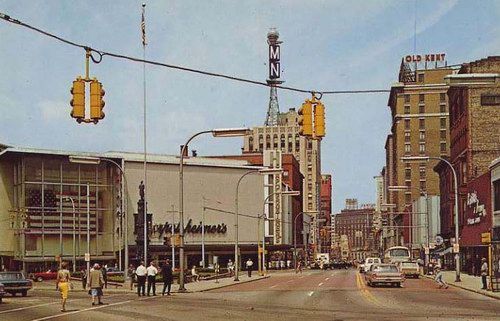
At some point, the Michigan National Bank that owned the building where the Weatherball was located (the letter M N B blinked just below the Weatherball) made the decision that the Weatherball had to come down.
Somewhere along the line, I met someone who told me that it was their Dad, as a brand new-in-town Michigan National Bank Vice President, made the decision.
This person told me that their Dad was told that the giant tower on top of the building was starting to sway and when it rocked in high winds, the roof of the building was showing signs wear and tear and there was good chance the Weatherball could come crashing down.
This person said that their Dad made the decision to take down the Weatherball and spent the rest of his career with Bank being known as the ‘Man who wrecked the Weatherball.’
He may have been one of the most, well, I was going to say hated but that is a too strong term, yet anyone who heard the story did hate the guy so I will say, one of the most hated men who figured in the List of Great Things Grand Rapids Lost.
Other things on this list include the Grand Rapids City Hall which is almost more famous for an incident during its demolition when a young lady hand cuffed herself to a wrecking ball.
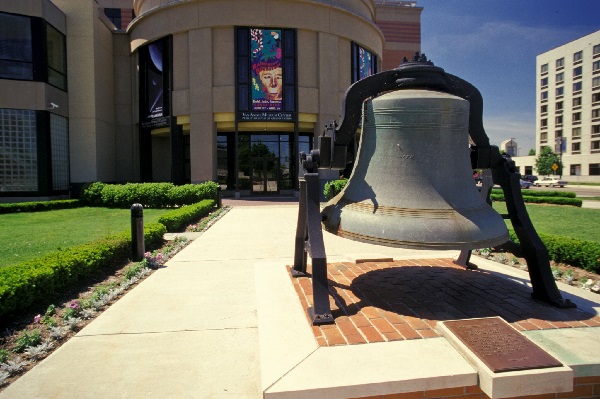
A lesser know incident that took place during the demolition was that two guys took sledgehammers and made their way up to the old bell town of City Hall and with the sledges, range the City Hall Bell one last time.
You can see this bell to this day outside the entrance to the Grand Rapids Public Museum and if you look closely you will the surface dotted with circles the size of 50 cent pieces where the sledge hammers made contact.
I had done some research on that bell when I worked for the Local History Collections of the Grand Rapids Public Library and I remember talking about to Bob, one of the security guards at the Library who was retired from the Grand Rapids Police Department.
I told Bob the story of the guys with the sledgehammers and he responded, “Do I remember that I night! I was the first cop on the scene and I had to make my way through the half demolished building and up the bell tower stair way with no railing using a flash light! It was crazy! I thought I was going to fall of the stairs or that the place was going to come down.”
I told my boss, then City Historian, L. Gordon Olson, that we had to make a oral history interview with Bob but nothing came of it.
And speaking of Gordon Olson, he WAS the most hated man who figured in the List of Great Things Grand Rapids Lost.
It was Gordon, you see, as Assistant Director of the Grand Rapids Public Museum, who had the whale removed from the original Museum building on Washington St.
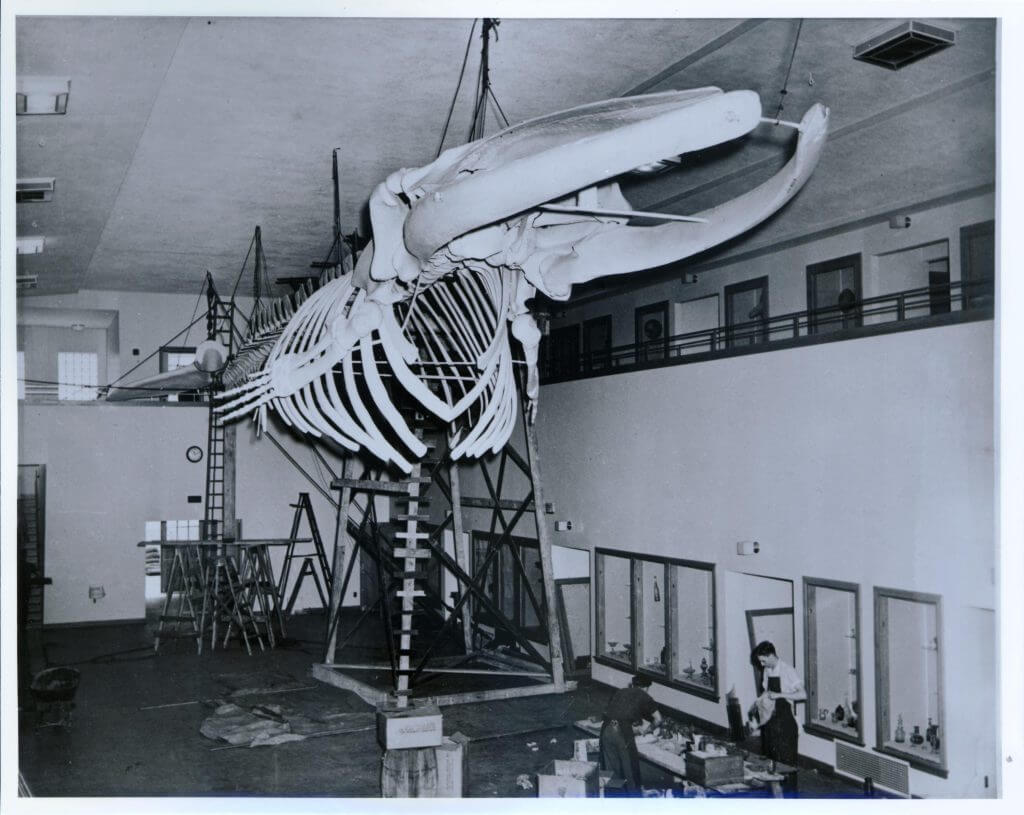
Around 1900, the Public Museum acquired a complete whale skeleton (the origin of which is a little murky but chances are it was purchased from the State of Florida when Florida shut down their pavilion at the Great Columbian Exposition in Chicago).
The whale bones were on separate stands and the Museum would pack the whole thing off the Kent County Fair in Comstock Park and wrap the bones in canvas so you could take the Jonah experience and walk through the whale.
When a new building was built during the depression, the whale was proudly hung in the main gallery of the museum until the late 1970’s when Gordon had it taken down.
Gordon told me that if ever he spoke anywhere at any city function or gathering, and that fact that he was the guy who removed the whale was mentioned, he would get booed.
The boos might have toned down once the new museum was built and the whale skeleton was restored but for anyone who grew up with the old museum and pitching pennies on the whale’s tail from the 2nd floor gallery, Gordon was not well liked.
Gordon told me that he was caught in a bad spot and that the whale bones had started disintegrating and falling to the floor and it was only a matter of time before some one got hurt.
The funny part of the story is that Gordon told me how a giant scaffold had to be built at some expense to remove the skeleton.
Gordon said that about a month after the whale came down and the scaffold removed, he noticed a guy walking around the gallery, looking up at the ceiling.
Gordon knew what he was looking for but went up to him and asked anyway.
The man did indeed ask if there had been a whale hanging there at one time.
Gordon told him yes and that it had just recently been removed.
The man nodded and then asked how did they take it down?
It turned out the man was the guy who had hung the whale in the first place.
He pointed out some ring bolts still in the ceiling and showed Gordon how the skeleton had been suspended in such a way that had ropes been tied up through those bolts and PULLED UP, the entire frame was designed to then unlock and be lowered to the floor.
As I said, the whale was saved and can seen to this day at the new Grand Rapids Public Museum.
I am also happy to say that when I worked at WZZM, a co-worker did some research and found that the original Weatherball was sitting in a scrap metal yard and the station was able to buy the Weatherball, have the neon fixed and the restored Weatherball returned to the Grand Rapids skyline from a cell tower next to the WZZM station.
Maybe on brilliant sunny days in December in South Carolina you can’t see cold.
But I know what cold looks like.
It’s light blue and glows in a clear colder, crisper and more freezing way than you could have imagined it.
And because of that blue light, the coldness is clear and colder, crisper and more freezing way than you could have imagined it.
And if you are in Grand Rapids, Michigan in December, at night and you look west, you can see it too.
rain starts today at one p.m. partly cloudy expect thunderstorms
Woke up this morning in the traditional sense of the word to deep blue sky and sunshine here in the Low Country of South Carolina.
For new readers, its called the Low Country because itssssssssssssss low.
While I am in 3rd floor room, the ground floor is about 8 feet above sea level and the sea is less than a mile away.
My office is about 5 blocks from the ocean and a recent disaster assessment came back with the recommendation that having the corporate servers located in a basement room below sea level might not be the best idea.
The last two or three weeks, the Low Country has been stuck in a dismal weather pattern of overcast gray skies, 95% humidity and temps in the 90’s with thunderstorms possible at any time of day on short notice.
Understanding that living in the south and along the ocean, there are prices to pay.
But day after day after of this gray dismal swamp is starting to get to me.
SO it was with a ray of sunshine in my heart that my day was started by a ray of sunshine in my eyes.
Than I ruined it by picking up my dumb smart phone and checking the weather.
Rain by 1PM.
Hot.
Humid.
Expect thunderstorms.
CNBC’s annual ‘America’s Top States for Business’ study, which pays particular attention to quality of life, has recently ranked South Carolina as the fourth worst state in the nation to live in.
The report stated:
The ranking points to generalized, statewide issues bringing down the Palmetto State’s ranking regarding topics such as health care and resources, crime and voting rights.
With 2.19 hospital beds per 1,000 residents, according to Becker’s Hospital Review, South Carolina finished near the bottom for health care resources.
For the 2022 ‘Life, Health & Inclusion Score’, the state pulled in only 83 out of 325 points, scoring an “F” grade.
The study does provide some relief by listing air quality as a livability strength.
Weather otherwise was not included.
I haven’t lived here long enough to know if this is the norm or if this weather pattern is part of the world wide weather/climate patterns.
Problem is no one has lived here very long.
Population here is up to near 50,000 folks.
30 years ago, it was 900.
And those folks who you happen to meet who did grew up here don’t seem to be very much weather aware as you know, it’s just something that happens everyday.
I will say this is a resort community and has been for the last 50 years or so.
I find it difficult to accept that thousands upon thousands of folks would make the effort to spend a week here in July and August if, traditionally, it was all in an effort to spend a week under gloomy gray skies in hot humid conditions while waiting for it rain.
So its hot.
So its humid.
So its going to rain.
It isn’t snow.
And as I say to my friends who live in the land of Devil’s Dandruff, no one says you to live here.
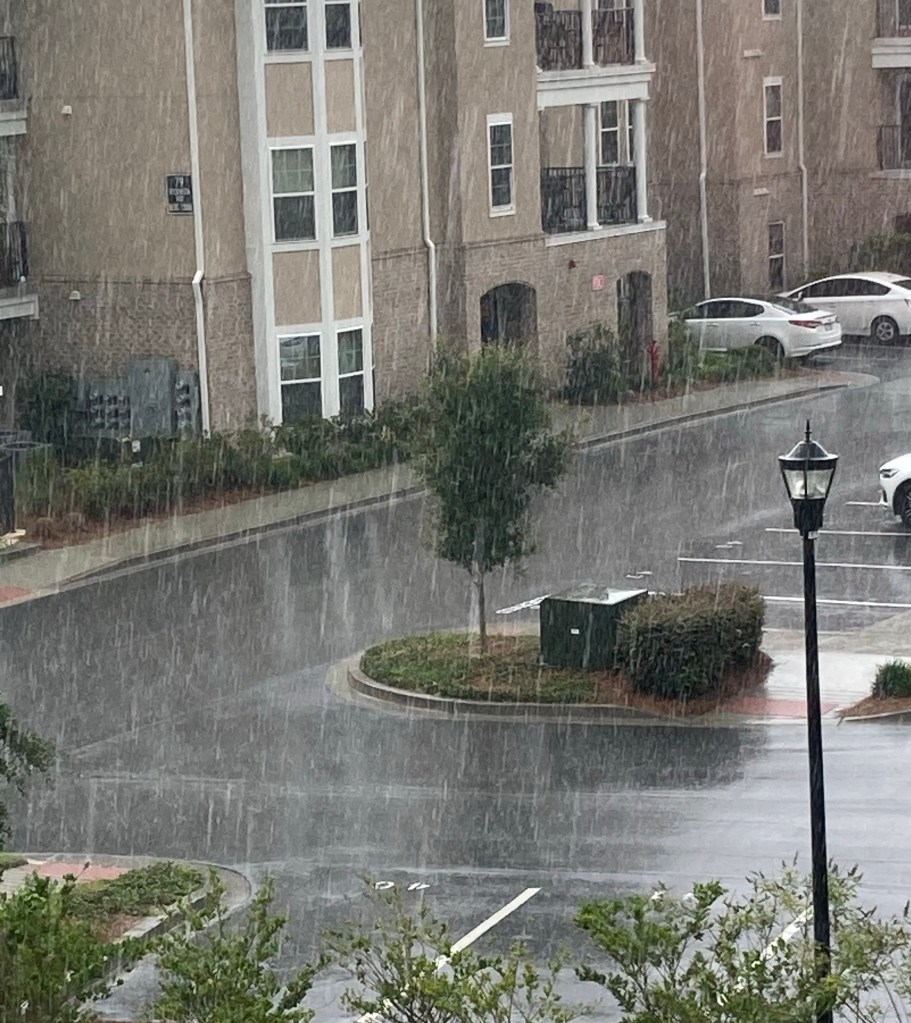
like a low-hung cloud it rains so fast all at once falls and cannot last
Adapted on a rainy morning in the low country from John Dryden’s Palamon and Arcite or The Knight’s Tale– Book Three where the poet writes:
But, like a low-hung cloud, it rains so fast, That all at once it falls, and cannot last. The face of things is changed, and Athens now, That laughed so late, becomes the scene of woe:


 No Haiku For You