
Doctor, sometimes I
feel as if travelling two
hundred miles an hour
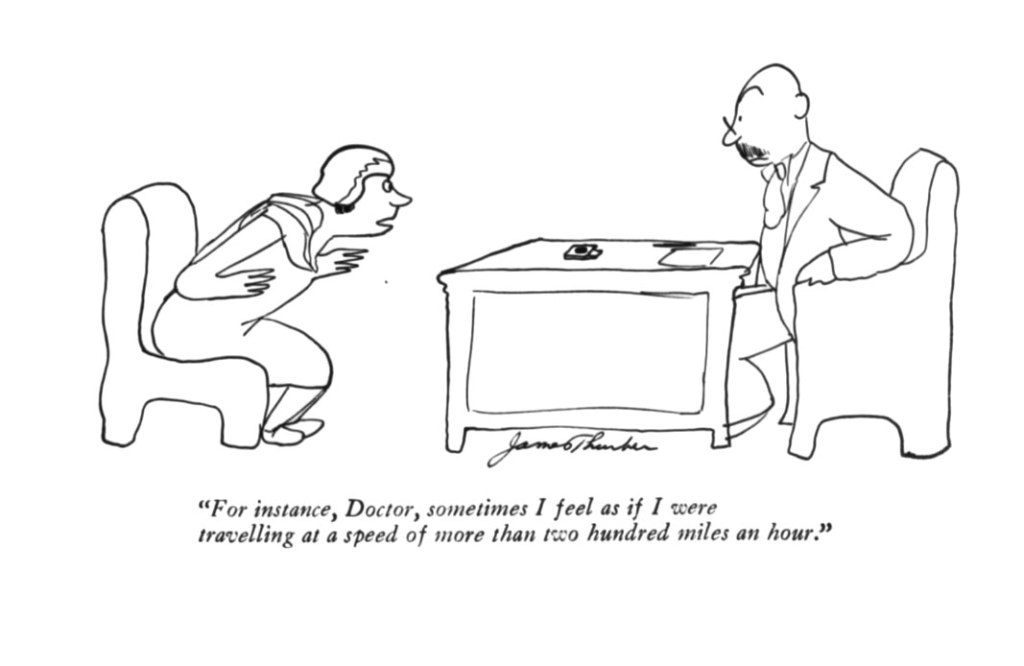
See More James Thurber at For Muggs and Rex.
Doctor, sometimes I
feel as if travelling two
hundred miles an hour
See More James Thurber at For Muggs and Rex.
mirror mirror on
the wall which college team most
popular of all
According to the article The Athletic, Which college football team has the most fans? Why (we think) Michigan edges Ohio State, The staff of the Athletic wrote:
The Wolverines weren’t merely a decisive No. 1 in points. They ranked in the top four in every category except sports betting. Even with our imperfect categories and metrics, the across-the-board performance gives us enough confidence to call Michigan the most popular college football team in the country.
Knowing college football fans, that won’t settle the debate — nor should it. So let the arguments begin.
Well, well, well.
They are several tables in the article the list all the data but it was the table that listed largest alumni body and I was shocked to see that the United States College/University with the world’s largest living alumni is … Indianan University.
The ranking shows:
790,033 – IU
775,000 – Penn St
668,000 – Michigan
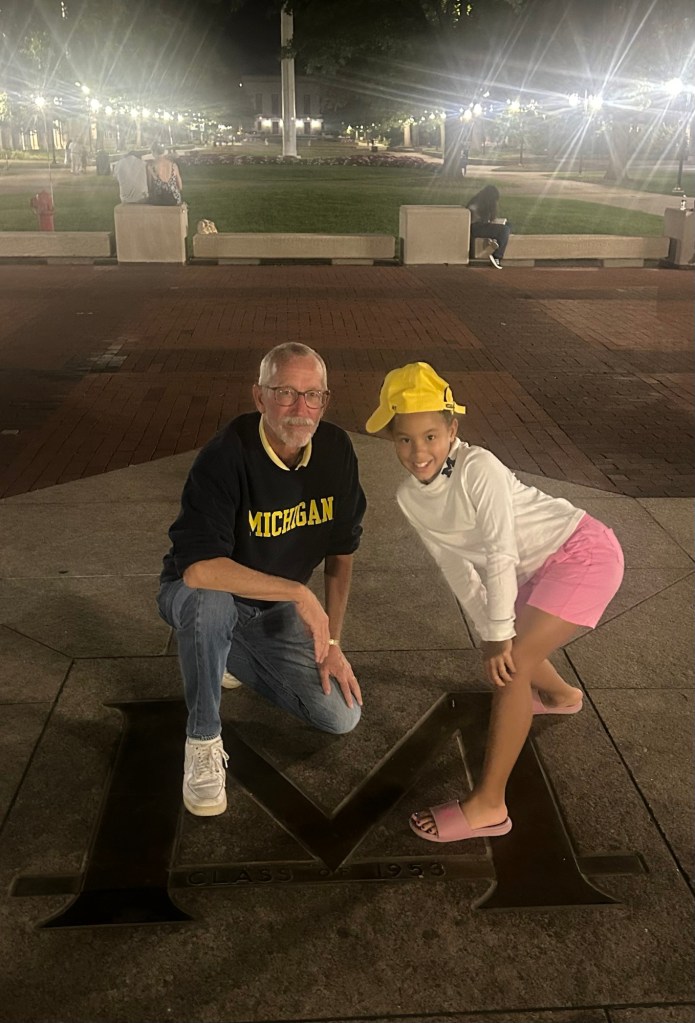
If you grew up a Michigan fan like I did and you listened to a radio announcer named Bob Ufer (Ufer-of-M … get it) and one of his stock phrases was that MEEEEEECHIGAN had the world’s largest living alumni.
Maybe it’s just a case of semantics.
A good friend of mine loved to go to football games and look for … large people … and yell MICHIGAN HAS WORLD’S LARGEST LIVING ALUMNI … AND THERE HE IS!
But I have to say, I gots no issues with the findings in this article!
Go Blue!
be dizzy now turn
your head upside down see how
world looks upside down
Spring is when the grass turns green and glad.
Spring is when the new grass comes up and says, “Hey, hey!
Hey, hey!”
Be dizzy now and turn your head upside down and see how
the world looks upside down.
Be dizzy now and turn a cartwheel, and see the good earth
through a cartwheel.
Tell your feet the alphabet.
Tell your feet the multiplication table.
Tell your feet where to go, and, and watch ‘em go and come back.
Can you dance a question mark?
Can you dance an exclamation point?
Can you dance a couple of commas?
And bring it to a finish with a period?
Can you dance like the wind is pushing you?
Can you dance like you are pushing the wind?
Can you dance with slow wooden heels
and then change to bright and singing silver heels?
Such nice feet, such good feet.
Lines Written for Gene Kelly To Dance To by Carl Sandburg as published in The Complete Poems of Carl Sandburg (revised and updated).
Dancing feet?
Such good feet?
Spring is when the grass turns green and glad.
Spring is when the new grass comes up and says, “Hey, hey!
Hey, hey!”
Spring is when the new grass puts so much pollen in the air that I am dizzy now and I turn my head upside down and see how the world looks upside down and can’t breath and think my head is going to explode.
I can’t dance a question mark?
I can’t dance an exclamation point?
I can’t dance a couple of commas?
And I can’t bring it to a finish with a period?
I can’t even breath.
growing good of the world
is partly dependent on
unhistoric acts
Adapted from the line:
The growing good of the world is partly dependent on unhistoric acts; and that things are not so ill with you and me as they might have been, is half owing to the number who lived faithfully a hidden life, and rest in unvisited tombs.
In the George Eliot Novel, Middlemarsh.
According to Wikipedia, Middlemarch, A Study of Provincial Life is a novel by English author George Eliot. It appeared in eight installments (volumes) in 1871 and 1872. Set in Middlemarch, a fictional English Midlands town, in 1829 to 1832, it follows distinct, intersecting stories with many characters. Issues include the status of women, the nature of marriage, idealism, self-interest, religion, hypocrisy, political reform, and education. Leavened with comic elements, Middlemarch approaches significant historical events in a realist mode: the Reform Act 1832, early railways, and the accession of King William IV. It looks at medicine of the time and reactionary views in a settled community facing unwelcome change. Eliot began writing the two pieces that formed the novel in 1869–1870 and completed it in 1871. Initial reviews were mixed, but it is now seen widely as her best work and one of the great English novels.
Notice the pronoun in the last sentence.
… now seen widely as her best work and one of the great English novels.
You see, George Eliot was the pen name of one Mary Ann Evans.
Who, again according to Wikipedia, … was known by her pen name George Eliot, was an English novelist, poet, journalist, translator, and one of the leading writers of the Victorian era.[3] She wrote seven novels: Adam Bede (1859), The Mill on the Floss (1860), Silas Marner (1861), Romola (1862–1863), Felix Holt, the Radical (1866), Middlemarch (1871–1872) and Daniel Deronda (1876). As with Charles Dickens and Thomas Hardy, she emerged from provincial England; most of her works are set there. Her works are known for their realism, psychological insight, sense of place and detailed depiction of the countryside. Middlemarch was described by the novelist Virginia Woolf as “one of the few English novels written for grown-up people” and by Martin Amis and Julian Barnes as the greatest novel in the English language.
Pronouns.
Really?
The number of headlines today that start with that man’s name is beyond understand until you grasp, that is what they want.
LOOK AT THE MAN behind the curtain.
WATCH WHAT he is doing, while the real people in charge remove pronouns and other acts so egregious it is beyond words.
And as long as the focus is on that man, they are winning.
Even this morning, the Toronto Star led with, WHO WILL STAND UP TO THAT MAN …
As long as the focus is on the man, the real damage and the real danger is hidden, right there in plain sight.
I guess it is right that the growing good of the world is partly dependent on unhistoric acts; and that things are not so ill with you and me as they might have been, is half owing to the number who lived faithfully a hidden life, and rest in unvisited tombs.”
laissez faire and let
laissez faire what I believe in
fits just right today …
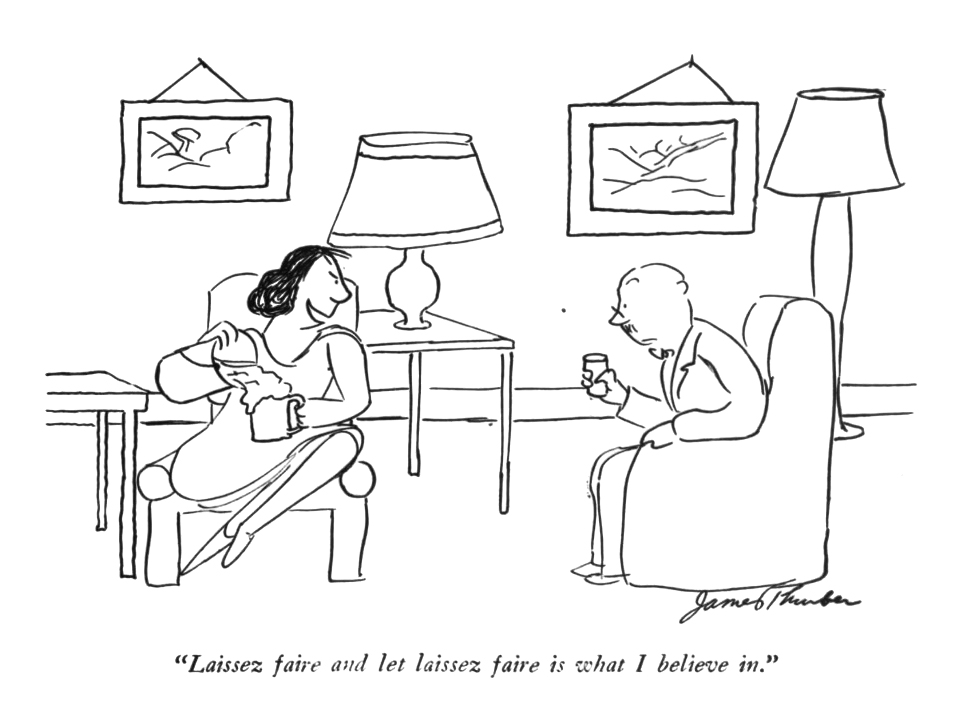
I do miss what someone like Thurber would have done with the current political climate.
I once said that the New Yorker was the Saturday Night Live of its era …
I’ll stand with that.
After all, laissez faire and let laissez faire!
Bella Ciao Baby!
Check out all the Thurber drawings at https://muggsandrex.wordpress.com/
 No Haiku For You