2.27.2024 – as a way of life

as a way of life
that disappeared long ago
production doubled

Technology is the main driver of rural decline, Schaller and Waldman argue. Indeed, American farms produce more than five times as much as they did 75 years ago, but the agricultural work force declined by about two-thirds over the same period, thanks to machinery, improved seeds, fertilizers and pesticides. Coal production has been falling recently, but thanks partly to technologies like mountaintop removal, coal mining as a way of life largely disappeared long ago, with the number of miners falling 80 percent even as production roughly doubled.

From The Mystery of White Rural Rage, Feb. 26, 2024 By Paul Krugman, an Opinion Columnist for the New York Times.

There is much to digest in this short essay.

But the line that stayed with me was coal mining as a way of life largely disappeared long ago.

To me and my limited experience with hard work, I would like to think that if coal mining as a way of life largely disappeared long ago, it would be a good thing.

One spring weekend back in the day in Grand Rapids, Michigan where I grew up, my Mom told me and my two younger brothers (I grew up in a family of 11 kids, with 8 boys and three girls, I was 8th and the three after me were all boys and we were known as the Four Little Boys until one year we signed our collective Christmas gift to our parents as ‘The Boys’ – but I digress) that a friend needed some help.

This some help turned out to be leveling the bottom of a pit that had just been dug for the basement of a house they were building.

We drove over there the feller there pointed to bottom of a square mud hole.

We had to use a ladder to get down into the hole where we found three shovels.

The ground the hole was dug in was pretty much clay.

The clay at the bottom of the pit had hardened into a crust that we had to hammer at with out shovels until we broke through to mud.

The feller pointed out some high spots and some low spots and told us to get at it.

I am not sure how long we worked.

I do remember that my brother Pete slammed his shovel into the clay like a harpoon, trying to break through, for about 10 minutes and then said, “I’m done.”

But we kept at it and after an afternoon of slogging, we climbed up out of the hole.

It was the hardest work I have ever done.

I think I got home and found a catalog of liberal arts college classes and never ever again in my life picked up an honest shovel.

Snow shoveling doesn’t count here.

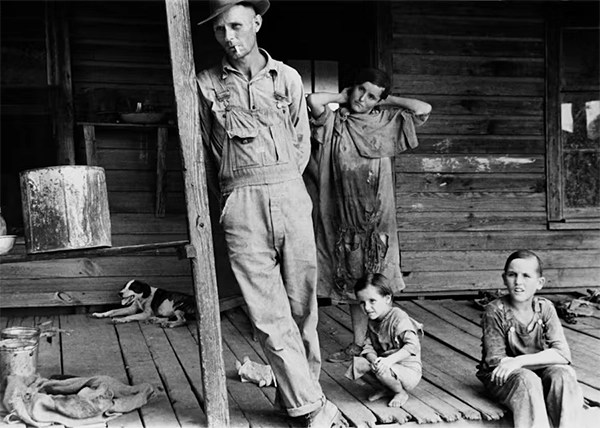
I think coal miners and I think ‘The Depression’ and the photography of Walker Evans.

On one website about Mr. Evans, the blogger writes:

Many of Evans’ early photographs revealed the influence of European modernism, particularly in their formalism and emphasis on dynamic graphic structures.

But Evans gradually moved away from this highly aestheticized style to develop his own evocative but more reticent notions of realism.

He focused on the role of the viewer and the poetic resonance of ordinary subjects.

The poetic resonance of ordinary subjects.

Coal mining as a way of life largely disappeared long ago.

Maybe what I am after is to say that the poetic resonance of coal mining as a way of life largely disappeared long ago.

Mr. Krugman writes, “Technology eliminates some jobs, but it has always generated enough new jobs to offset these losses, and there’s every reason to believe that it will continue to do so for the foreseeable future.

I understand this a little as it seems that these coal mining jobs are replaced with service industry jobs.

I remember talking with a waitress in Charleston, WVA recently who said she had three jobs, two in restaurants and then a motor newspaper delivery route.

I think of what I call the Ralph Kramden Conjecture.

Ralph Kramden was a character portrayed by Jackie Gleason in the 1955 TV Show, the Honeymooners.

Mr. Kramden was married and lived in Brooklyn with his wife, Alice.

Mr. Kramden was able to support this lavish lifestyle through his job as a New York City Bus Driver.

But He was able to support himself and wife at a certain social level on his salary alone.

Could someone today support a two person family in Brooklyn on $27.83 / hour that is the listed NYC Bus Driver Salary.

Where have these jobs gone?

What has replaced them?

Or is this just one more example of a job that as a way of life largely disappeared long ago.

2.22.2024 – ‘Tis Washington’s health

‘Tis Washington’s health
our hero to bless, for he is
our glory and pride

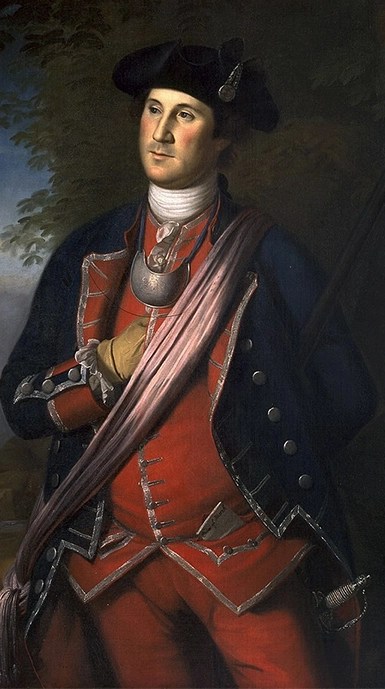
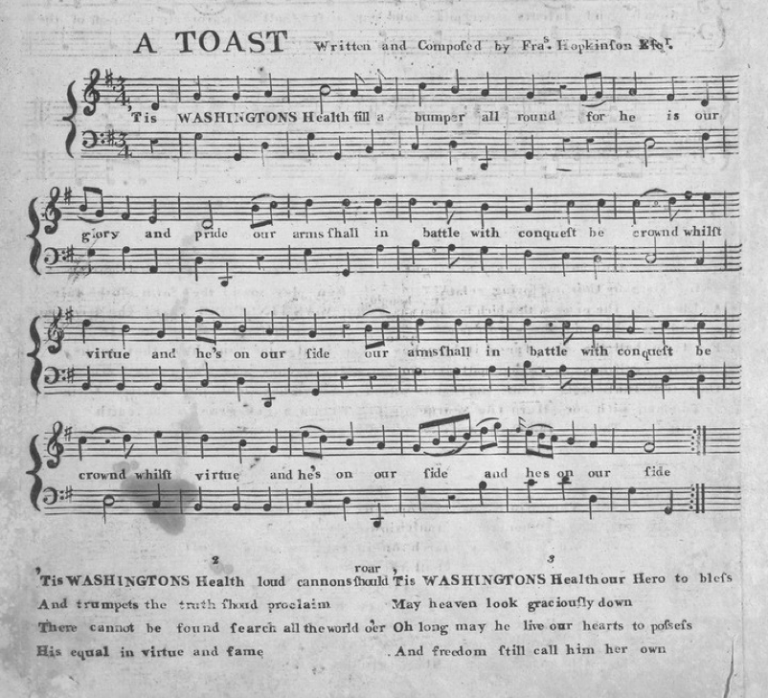
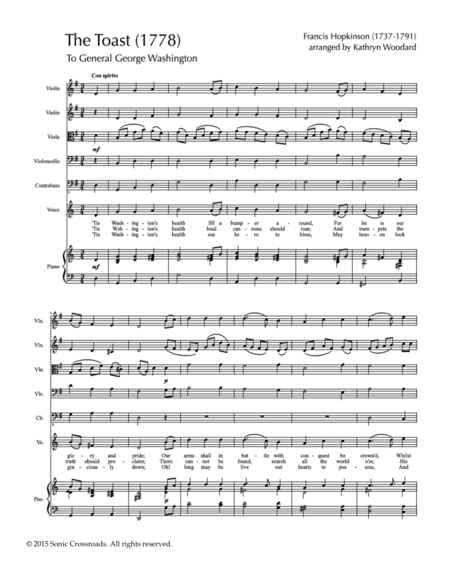
In honor of his birthday today, here is a ‘A Toast’ To General George Washington” written by Francis Hopkinson (1737-1791) who was an American statesman and signer of the Declaration of Independence. He also is known as the first American composer of classical music and this is a tribute to General George Washington composed in 1778. (Full score of the arrangement is provided as well as a vocal score and string parts is further down.)

At one time in the history of this country there were five Federal holidays.

New Year’s Day
Independence Day
Thanksgiving Day
Christmas Day
George Washington’s Birthday

I totally agree that Mr. Lincoln also deserves a day but lumping all President’s together and giving them a day is like the people who moved from Ohio to California and raised the IQ of both places.

Having a day for all Presidents raised up some fellers (hello Mr. Harding, Mr. WH Harrison (30 days of being President), Mr. Pierce and others …) but lowered others.

For me, General Washington should come out on top.

As one of my Professor’s back in college, you go into researching Washington with the idea of exposing the man and the myth and the more you get into the record, the myth was more often than not, true.

First in War.

First in Peace.

First in the hearts of his countrymen.

Here are the lyrics to “A Toast” and you can listen to it by clicking here.

‘Tis Washington’s health–fill a bumper all round,
For he is our glory and pride.
Our arms shall in battle with conquest be crown’d
Whilst virtue and he’s on our side.

‘Tis Washington’s health–loud cannons should roar,
And trumpets the truth should proclaim:
There cannot be found, search all the world o’er,
His equal in virtue and fame.

‘Tis Washington’s health–our hero to bless,
May heaven look graciously down:
Oh! Long may he live, our hearts to possess,
And freedom still call him her own.

2.8.2024 – God, it is something

God, it is something
face the sun know you are free
hear the undersong

IT is something to face the sun and know you are free.
To hold your head in the shafts of daylight slanting the earth
And know your heart has kept a promise and the blood runs clean:
It is something.
To go one day of your life among all men with clean hands,
Clean for the day book today and the record of the after days,
Held at your side proud, satisfied to the last, and ready,
So to have clean hands:
God, it is something,
One day of life so
And a memory fastened till the stars sputter out
And a love washed as white linen in the noon drying.
Yes, go find the men of clean hands one day and see the life, the memory, the love they have, to stay longer than the plunging sea wets the shores or the fires heave under the crust of the earth.
O yes, clean hands is the chant and only one man knows its sob and its undersong and he dies clenching the secret more to him than any woman or chum.
And O the great brave men, the silent little brave men, proud of their hands—clutching the knuckles of their fingers into fists ready for death and the dark, ready for life and the fight, the pay and the memories — O the men proud of their hands.

Clean Hands by Carl Sandburg as printed in Smoke and steel, (New York, Harcourt, Brace and Howe, 1920)

Yes, go find the men of clean hands one day and see the life, the memory, the love they have, to stay longer than the plunging sea wets the shores or the fires heave under the crust of the earth

On June 17, 1785, Thomas Jefferson wrote to James Monroe, “I sincerely wish you may find it convenient to come here. The pleasure of the trip will be less than you expect but the utility greater. It will make you adore your own country, it’s soil, it’s climate, it’s equality, liberty, laws, people and manners. My god! How little do my countrymen know what precious blessings they are in possession of, and which no other people on earth enjoy.”

Two years before the Constitution, they were both future Presidents but that was a job that didn’t even exist yet.

As I drive to work and face the sun with clean hands I feel the sun on my face but cannot help but hear the sob and its undersong.

I read the news and I think, My God! How little do my countrymen know what precious blessings they are in possession of.

2.1.2024 – everything changes

everything changes
everything changed yet almost
nothing changed at all

I’ve come to think of our current condition as a kind of long Covid, a social disease that intensified a range of chronic problems and instilled the belief that the institutions we’d been taught to rely on are unworthy of our trust.

The result is a durable crisis in American civic life.

Just look at the election cycle we are about to fall into: It seems like the world turned upside down several times, and yet here we are facing the prospect of another contest between Joe Biden and Donald Trump, as though the country hasn’t moved forward an inch.

Everything changed, and yet almost nothing changed at all.

From the Guest Opinion essay, “Why America Can’t Recover From That First Awful Covid Year” by Eric Klinenberg in the New York Times (Jan. 31 2024).

I live near the seashore and I walk the beach whenever I can.

One of the redeeming aspects of my job is that the office where I work is about 5 blocks from the beach and I can walk down to the east coast of the United States of America on my lunch break.

Over 330 million people in America and a fairly small percentage can be found actually standing on either the east or west coast at any one moment.

I understand and embrace the privilege.

Being this close to the ocean, it is odd that the tide becomes such a part of your life.

You are aware of its highs and lows.

Here in the low country of South Carolina, known as the low country as it usually less than 10 feet about sea level, when the tide is out the pluff mud, the top layer of land in the salt marshes is exposed.

You don’t need to see low tide to know its low tide, you just have to smell it and it smells like pluff mud.

One of my grand daughters got a good whiff and said ‘someone farted.’

I told her nope, that down here that just means its low tide.

Twice a day, the tide comes in and goes back out.

The beach is made and remade as the tide power washes the beach and scours everything in its path.

Tons of seawater plow across the sand and wipes away everything and then retreats, leaving a brand new beach.

Everything is changed.

At the same time, though.

It is the same beach.

Nothing changed at all.

More and more, history I realize, is just as subject to the tide as is the beach.

1.23.2024 – CHANCE! Do Not Pass Go!

CHANCE! Do Not Pass Go!
Go To Jail, Do Not Collect …
Two Hundred Dollars

The Standard Monopoly deck consists of 32 Cards: 16 Community Chest and 16 Chance Cards. 1 of those Chance cards is a Go to Jail. So when you pull a Chance card, you have a 1 in 16 chance of being sent directly to jail.

Oddly enough, Chance is ranked as 39th out of 40 possible squares anyone playing Monopoly might land on with any given throw.

At least that is how I read the data in the Probabilities in the Game of Monopoly.

I think that sounds a bit low for a game board of 40 squares where three of them are Chance but I leave that to those who like math more than I do.

But consider the concept.

At anytime you can land on Chance.

You select an orange card.

1 out of 16 of those cards will send you to jail.

Any of those cards, and you have to take one, will impact your turn and could impact your game.

To much like real life except of the act of drawing your card and knowing the moment where ‘destiny takes a hand’ is upon you.

Yesterday we landed on Chance and got the Go to Jail card.

Well not jail, but the next best thing, the Emergency Room.

The how and the why is incidental to this essay but let me say that all is well.

The point being is that me and my wife and one of our sons sat in the ER waiting room from 7PM to 2AM in downtown Charleston, SC.

We sat there, that is, once we found it.

Construction changed the location of the entrance to the ER but not the information on the current road signs that direct you to the ER or in the info available in Google Maps (How many times can you hear ‘Go To the Route’ before you throw your phone out the window).

I had stop and GET OUT to ask directions THREE TIMES – once from Security in the Parking Garage – once from a EMT driver in a parked ambulance and once from a lady in the hall just to GET TO ER – the PLACE WHERE BABIES ARE BORN and the PLACE WHERE HEART ATTACK VICTIMS ‘Every Minute Counts’ Go.

But I digress as we did persevere and we did get checked in and did join the group in the waiting room in a downtown ER in a minor major American city late at night.

And I was reminded that an ER, like being on a jury, is some of the best live performance theater available in America today and that either place is the LAST place you want other people making decisions about your future …