as well equipped for life right now if had never gone to school at all
Of course I had always known men of no schooling who were hugely successful in the mere making of money.
But it took a longer time for me to find out that a man could say “would have went” and still be welcome at more tables,
… have a surer and a more aristocratic taste in matters of painting and music,
… and reveal in all ways a greater gift for living the good life than most of the Ph.D’s of my acquaintance.
Indeed, as I look about me among my neighbors,
… I find myself wondering whether I have anything at all to show for the score of years I spent in going to school,
… whether I would not be as well equipped for life right now if I had never gone to school at all.
From the essay, I Might Just as Well Have Played Hooky as published in Long Long Ago by Alexander Woollcott, (New York, The Viking Press, 1943). Originally published in the American Legion Magazine, January, 1931.
A greater gift for living the good life?
Can we flip that to a question and ask, “Is there a greater a gift than living the good life?”
Hmmmmmmmmmmmmmmmmmmmmmmmm …
I am reminded of one of my favorite Carl Sandburg poems, titled Happiness:
I asked the professors who teach the meaning of life to tell me what is happiness. And I went to famous executives who boss the work of thousands of men. They all shook their heads and gave me a smile as though I was trying to fool with them And then one Sunday afternoon I wandered out along the Desplaines river And I saw a crowd of Hungarians under the trees with their women and children and a keg of beer and an accordion.
Am I thinking too much.
Am I over thinking this whole mess, the politics, the climate, the weather, everybody having a gun and NCAA Conference realignment?
As baseball great Ted Williams once said, “If you don’t think so good … don’t think so much.“
strive to learn before they die what they are running from, and to, and why …
The Shore and the Sea
A single excited lemming started the exodus, crying, “Fire!” and running toward the sea. He may have seen the sunrise through the trees, or waked from a fiery nightmare, or struck his head against a stone, producing stars. Whatever it was, he ran and ran, and as he ran he was joined by others, a mother lemming and her young, a night watch lemming on his way home to bed, and assorted revelers and early risers.
“The world is coming to an end!” they shouted, and as the hurrying hundreds turned into thousands, the reasons for their headlong flight increased by leaps and bounds and hops and skips and jumps.
“The devil has come in a red chariot!” cried an elderly male. “The sun is his torch! The world is on fire!”
“It’s a pleasure jaunt,” squeaked an elderly female.
“A what?” she was asked.
“A treasure hunt!” cried a wild-eyed male who had been up all night. “Full many a gem of purest ray serene the dark unfathomed caves of ocean bear.”
“It’s a bear!” shouted his daughter. “Go it!” And there were those among the fleeing thousands who shouted “Goats!” and “Ghosts!” until there were almost as many different alarms as there were fugitives.
One male lemming who had lived alone for many years refused to be drawn into the stampede that swept past his cave like a flood. He saw no flames in the forest, and no devil, or bear, or goat, or ghost. He had long ago decided, since he was a serious scholar, that the caves of ocean bear no gems, but only soggy glub and great gobs of mucky gump. And so he watched the other lemmings leap into the sea and disappear beneath the waves, some crying “We are saved!” and some crying “We are lost!” The scholarly lemming shook his head sorrowfully, tore up what he had written through the years about his species, and started his studies all over again.
MORAL: All men should strive to learn before they die what they are running from, and to, and why.
From Further Fables for Our Time by James Thurber, published in Great Britain 1956 by Hamish Hamilton Ltd.
why would think that these nine people best to judge, weigh policy judgments?
Chief Justice John Roberts of the United States Supreme Court asked this question from the bench in the case, Grants Pass v. Johnson, “Why would you think that these nine people are the best people to judge and weigh those policy judgments?”
I know I know I know … standing, procedure, precedent … Stare decisis … all that stuff, but boil it down.
Why would you think that these nine people are the best people to judge and weigh those policy judgments?
I am reminded of Justice Oliver Wendell Holmes, Jr. who said in a letter, “If my fellow citizens want to go to Hell I will help them. It’s my job (Letter to Harold J. Laski, March 4, 1920).
While I think this current court embraces the first part of the quote quite well, If their fellow citizens want to go to Hell, they will help them.
It is that 2nd part of the sentence.
WHY?
Because, IT’S THEIR JOB!
The New York Times reports that the court will issue 61 decisions this session.
The NYT stated that in the 1980’s the court averaged 160 decisions a session.
What a staggering work load.
I can understand the need for luxury vacations with a pace like that.
But in a different sense, I agree with Justice Roberts.
I grew up in a different time where respect for some things, the Church, the Flag and the Supreme Court was not a question but just accepted.
Seemingly it has all gone away and fast.
Today?
Why would I think that these nine people are the best people to judge and weigh any judgments?
hope, a heartspun word … a tattered flag, the rainbow, and a dream of time
Hope is a tattered flag and a dream of time. Hope is a heartspun word, the rainbow, the shadblow in white The evening star inviolable over the coal mines, The shimmer of northern lights across a bitter winter night, The blue hills beyond the smoke of the steel works, The birds who go on singing to their mates in peace, war, peace, The ten-cent crocus bulb blooming in a used-car salesroom, The horseshoe over the door, the luckpiece in the pocket, The kiss and the comforting laugh and resolve— Hope is an echo, hope ties itself yonder, yonder. The spring grass showing itself where least expected, The rolling fluff of white clouds on a changeable sky, The broadcast of strings from Japan, bells from Moscow, Of the voice of the prime minister of Sweden carried Across the sea in behalf of a world family of nations And children singing chorals of the Christ child And Bach being broadcast from Bethlehem, Pennsylvania And tall skyscrapers practically empty of tenants And the hands of strong men groping for handholds And the Salvation Army singing God loves us …
From The People, Yes, by Carl Sandburg, 1936, Harcourt, Brace and Company, New York, for Flag Day, 2024.
In fond remembrance for a symbol I grew up with but now seems to have been moved beyond my reach.
I am reminded of this passage from the book, Glory Road by Bruce Catton.
Catton writing about the time just before the battle of Gettysburg.
Colonel Strong Vincent, leading a brigade in the V Corps, took his men through a little town, where the moonlight lay bright on the street, and in every doorway there were girls waving flags and cheering.
The battle flags were broken out of their casings and the men went through the town in step with music playing, and Gettysburg lay a few miles ahead.
Vincent reined in his horse and let the head of the column pass him, and as the colors went by he took off his hat, and he sat there quietly, watching the flags moving on in the silver light, the white dresses of the girls bright in the doorways, shimmering faint in the cloudy luminous dusk under the shade trees on the lawns.
To an aide who sat beside him the colonel mused aloud: There could be worse fates than to die fighting here in Pennsylvania, with that flag waving overhead.
This march took Col. Vincent and his brigade into battle on July 2nd, at place now known as Little Round Top.
Catton writes:
This was the brigade of Colonel Strong Vincent, who had sat in the moonlight a couple of nights earlier to reflect that a man could do worse than die on Pennsylvania soil under the old flag.
This was a day on which crisis followed crisis.
While they were hitting the 20th Maine the Confederates were also working around the right of Vincent’s line.
They made better progress here, and the right-flank regiment, 16th Michigan, was broken and driven back.
Vincent ran down into the melee to rally his men and the Rebels shot him dead, and once more the way was open for Confederate conquest of Little Round Top.
Under the old flag …
This was the 3rd Brigade of the 1st Division of the 5th Corps of the Army of the Potomac.
Mr. Catton was from the state of Michigan.
One of the regiments in this 3rd Brigade was the 16th Michigan made up of farm boy volunteers from Genesee County, Michigan.
One of those volunteers was my Great Great Grand Father.
He fought under the old flag as was wounded in action a year before Gettysburg and was out of the army by that time.
Under the old flag.
Flag Day, indeed.
I want my flag back.
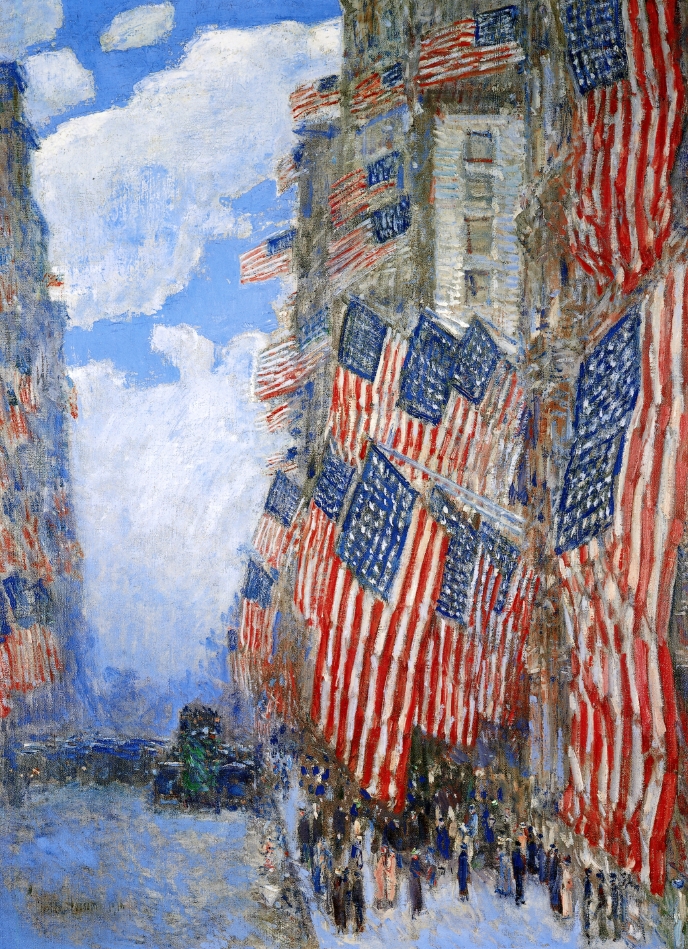
According to Wikipedia, “The most distinctive and famous works of Hassam’s later life comprise the set of some thirty paintings known as the “Flag series”. He began these in 1916 when he was inspired by a “Preparedness Parade” (for the US involvement in World War I), which was held on Fifth Avenue in New York (renamed the “Avenue of the Allies” during the Liberty Loan Drives of 1918). Thousands participated in these parades, which often lasted for over twelve hours.”
do you remember when the only thing to fear was fear – fear itself?
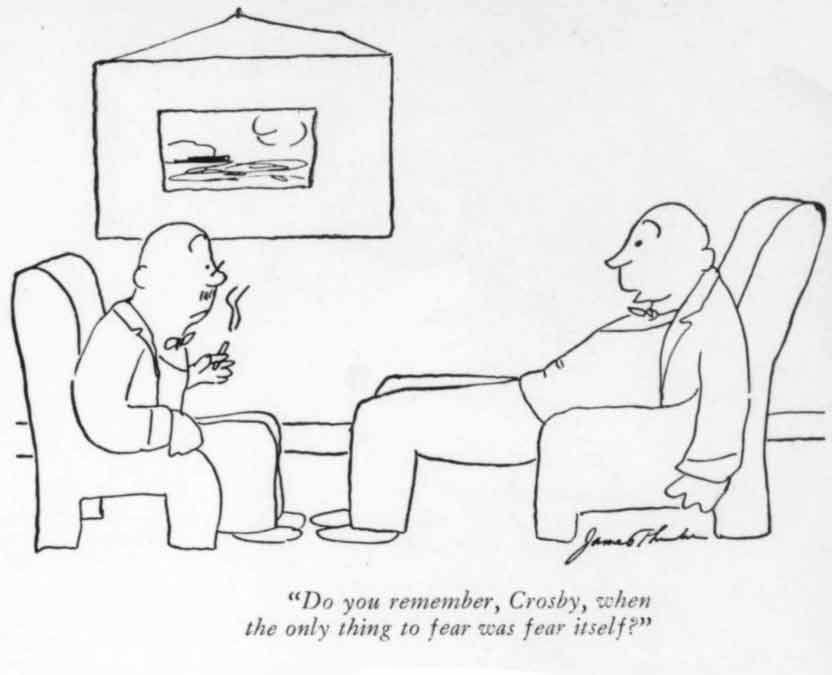
First off, for today, do you remember, when the only thing to fear was fear itself?
Reminds me of Former President Obama when commented on this other fellers effort to find Mr. Obama’s birth certificate saying, “Remember when we thought that was as crazy as it could get?“
But I digress.
Two stories, thoughts behind this Thurber drawing.
One focuses on the thought behind this caption.
Do you remember, Crosby, when the only thing to fear was fear itself?
The caption and drawing appeared in the New Yorker Magazine on October 10, 1948.
Three weeks before election day, 1948 or Truman vs. Dewey.
The caption references the 1st of 4 inaugural addresses of Franklin D. Roosevelt when President Roosevelt faced down the Great Depression .
FDR’s speech writer had paraphrased Henry David Thoreau who had written the sentence, “Nothing is so much to be feared as fear,” in his journal entry for September 7, 1851.
Now Mr. Dewey was painting a dark picture of the world with himself as the only way to fix it.
And poor Mr. Truman at the time with no one on his side.
On person wrote, “To err is Truman.”
Well sir, Truman won and the old joke was that FDR actually was elected five times.
Another joke is that when FDR died, a Republican laughed at the Democrat asking who would get to run now and the Democrat replies, oh we will dig up somebody and the Republican says, no no no, please don’t!
Such was the era when that caption was written.
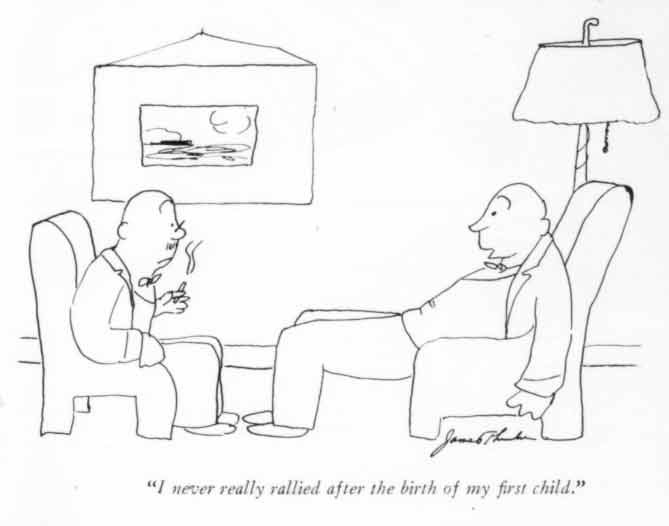
The other story behind this drawing is that it is the second time the New Yorker ran the drawing.
It first appeared in the May 11, 1935 edition with the caption, “I never really rallied after the birth of my first child.”
By 1948, Thurber’s eye problems were getting worse and for the most part he was blind and couldn’t see to draw.
The editor of the New Yorker, Harold Ross, worried about Thurber’s finances and tried to come up with a way to reprint old Thurber drawings and pay him.
In his book on working with the editor, The Years with Ross, Thurber writes of this effort:
He began by taking my drawings as a joke, went through a phase in which he dismissed them as “a passing fancy, a fad of the English,” and ended up doing his darnedest, as my disability increased, to keep the drawings going by every kind of ingenious hook and crook. After I got so I could no longer see to draw, even with black grease crayon on large sheets of yellow paper, Ross began a campaign, recorded in a series of letters he wrote me, to reprint old drawings of mine with new captions. First he suggested reversing the old cuts, a simple mechanical maneuver; then, with the aid of others in the office who knew about such things, he experimented with taking figures or furniture out of one drawing and putting them in another, arriving at a dozen permutations of men, women, and dogs, chairs, bridge lamps, and framed pictures, upon which he must have spent hours of thought with his confederates in this conspiracy of consolation.
I did think up a few new captions for old drawings, but whatever device of recomposition was used, some readers got on to it.
In the last seven years of his life Ross wrote me dozens of letters and notes about my drawings. In one he said he had found out that the New Yorker had published three hundred and seven of my captioned drawings, of which one hundred and seventy-five had been printed in one or another of my books. He wanted to know if I would permit new captions by outsiders on those rearranged originals of mine. “There is a caption here on a sketch by an idea man,” he wrote me, “that it is thought might do for a re-used drawing of yours, as follows: (Two women talking) ‘Every time she tells a lie about me, I’m going to tell the truth about her.’ Now that I’ve got it on paper, it may not sound so hot, but it might do. The women in your drawings used to say some pretty batty things.” He wanted to pay me the full rate I had got for originals, but I said no on a project in which I would have no real creative part.
Fascinating in way.
Two captions.
One drawing.
Lots of stories.
Oh, and by the way, BOY HOWDY but do I you remember when the only thing to fear was fear itself? and “I never really rallied after the birth of my first child.”


 No Haiku For You