I’ve got the best seat put my hands up when he was seven yards down field
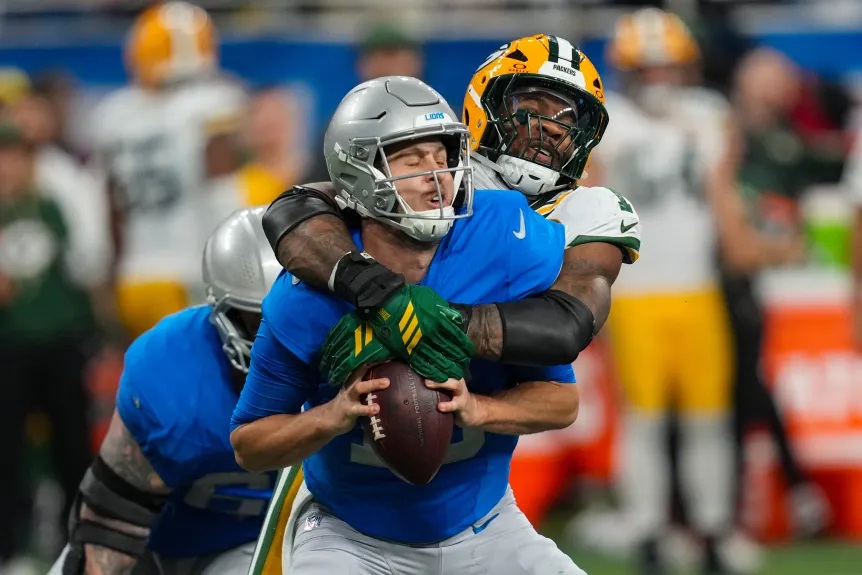
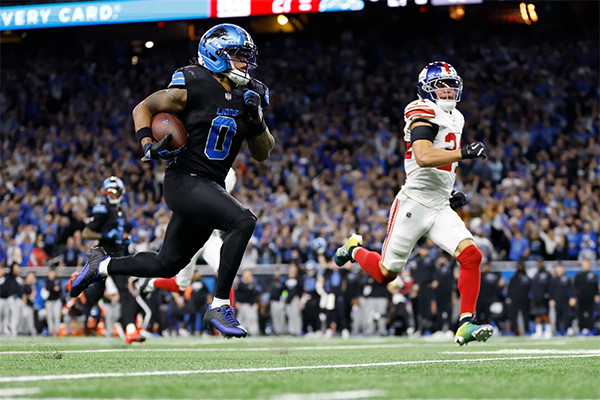
Jahmyr Gibbs rescues Lions with long TD run in OT for 34-27 win over Giants by Larry Lage DETROIT (AP) — Jahmyr Gibbs to the rescue. Gibbs ran for a 69-yard touchdown on the first snap of overtime and had a career-high 264 yards from scrimmage along with three scores, lifting the Detroit Lions to a much-needed 34-27 win over the New York Giants on Sunday. “He bailed us out in a big way,” Detroit coach Dan Campbell Detroit took advantage. With 28 seconds left, Jake Bates kicked a career-long 59-yard field goal that matched a franchise record, giving Jared Goff another opportunity to put the ball in Gibbs’ hands. In overtime, Goff handed the ball to Gibbs for a run up the middle, Detroit’s much-maligned offensive line opened a huge hole, and one of the NFL’s fastest players took it from there. “I’ve got the best seat in the field,” Goff said. “I put my hands up when he was about seven yards down the field.”
Detroit Lions running back Jahmyr Gibbs (0) runs past New York Giants safety Dane Belton (24) for a touchdown in overtime of an NFL football game in Detroit, Sunday, Nov. 23, 2025. (AP Photo/Rey Del Rio)
Kind of like wanting to see an overtime basketball game where one team comes out of nowhere and scores 20 points, I love it when you see something unexpected in OT.
Like a 70 yard run from scrimmage on the 1st play.
Especially when its my team.
I think I saw Goff with his hands up calling touchdown a few seconds after the handoff.
That was fun.
Back in 1996, Brian Griese took over after halftime of the Ohio State game down 0 to 9 and on the 2nd play of the 2nd half, from the Michigan 20, Griese threw an in route to Tai Streets at about the 30 yard line.
The OSU defender fell down and Streets took two more steps and calling the game for ABC Sports, Keith Jackson said, simply, “he’s wide open and gone for a touchdown.”
At that point, Streets was at the 50 yard line but Jackson had seen enough football in his life that unless there was an earthquake and some 200 foot ravine suddenly opened up, Streets was going to score.
50 yards of watching your team, knowing its a touchdown.
Jackson, unlike most sportscasters, shut up and let everyone live in that moment as Streets ran down the middle of the field to the endzone.
And for some reason, no one said, AND NO FLAGS.
Maybe back then, just because they had flags those guys didn’t think they needed to call a penalty on every play.
when no leadership there are no rules, no rules there are no boundaries
When I was a kid there were college athletic conferences that were set up regionally across America.
They had to be regional as the teams would travel to wherever the colleges were located for games.
In the early part of a college football season, you might see a team from up north play a team from down south or out west but once the season got underway, the focus was on your team and your conference and those other teams in your conference.
At the end of the season, the best teams were invited to holiday bowl games that were the highpoint of local festivals.
And when it was all over, sports writers would get together and select a mythical best team in the nation or ‘National Champion’.
This provided the fans with a chance to argue out the selection the entire off season.
This allowed fans to exult or complain.
This allowed for some really great football in the late fall.
But the grown ups got involved.
The idea of a mythical national champion was horrific to some folks when it was so obvious that it could all be settled on the field.
It worked for the NFL.
With its 32 teams, 2 conferences, and its 4 divisions and set schedule.
And it worked for state high school playoffs with, in the state of Michigan, its 8 classes, and 8 divisions (and the fact that schools started playing a week before labor day so a nine game schedule and 5 game playoff led to championship games on Thanksgiving weekend).
So why not college?
Why not?
The plan that worked in the NFL and in High School would only work if the existing college platform was blown up.
But you can’t do that as the fans won’t like it.
So why let’s just have the final top two teams selected by the sports writers play a game and be done with it?
But you can’t do that as the fans won’t like it.
So why let’s just have the final top four teams selected by the sports writers play a game and be done with it?
But you can’t do that as the fans won’t like it.
So why let’s just have the final top twelve teams selected by the sports writers play a game and be done with it?
Okay lets try this, how do you select that top 12?
That’s were we are.
And this is what sports writer, Matt Hayes wrote in his USA Today Article, It’s blowout city in mid-November. And I blame the CFP anarchy:
“... because no one knows what in the world the College Football Playoff selection committee wants. Or how it works. Or what it takes to earn one of the coveted seven at-large spots in the 12-team field.
The committee chairman (whoever it is this week) says things like strength of schedule, game control, efficiency, net rate success and any of the many other nonsensical metric garbage it feeds the breathless looking for answers.
The whole point of this selection committee exercise was to eliminate decades-old crutches used to pick the national champion, or the teams who play for the national championship.
Yet here we are, stuck in the past, with the same tired process shrouded in something called game control. And net YPP (yards per play).
And any other nonsense they can shovel at us to avoid admitting there’s no leadership. No rules, no boundaries.
And apparently, no need for the head-to-head metric. Or the one metric that should be used, but isn’t: Who have you beaten?
With one week to go in the season and teams fighting to for their win lost records we got watch games that included:
I am told I am old or older and not with it with what the young football fan’s want.
Did they enjoy this weekend?
Do they enjoy an endless chatter of talking heads offering up as many opinions as any political talking head offers up about the current state of affairs.
Do they enjoy the clouds of data and numbers thrown up in a gray fog.
This has all made the sport MORE enjoyable, watchable, embraceable by the fan?
I am reminded of the quote of General Patton in the movie where the actor George C. Scott says the line, “God, how I hate the 20th century.”
I am also reminded of an old quote about Little League Baseball attributed to Hall of Fame Pticher and Manager, Bob Lemon, when he said, Baseball was made for kids, and grown-ups only screw it up.
What I wanted was that story that said who plays who in college football and which team is expected to win.
USAToday used to help me out with a story that listed the Top 25 games as picked by their 6 college football reporters.
Each pick was shown by the teams logo.
Took a long time for the story to load online but once it popped, there were all the logos in nice straight lines, usually all matching except when someone went a little crazy and picked, you know, Michigan over OSA last year.
That used to be the lead story on USAToday on Saturdays but this week, I had to search for and it wasn’t easy to find.
Scrolling through the New York Times, I came across and clicked on the article, College football Week 8 projected scores: Model predicts every FBS vs. FBS game, thinking this would tell me what I want to know.
Who wins, who loses today.
What I got was a game by game listing of something called the XMOV, the BETMGMLINE, the XTOTAL and the BETMGMTOTAL.
Most of the XMOV scores were negative numbers.
For a sport where points are score by 1,2,3 and 6, one game showed an XMOV score of -0.5.
I have no clue what I was looking at and in the case of the -0.5 game, does the means San Jose State should win or lose?
I just don’t know.
To paraphrase Grantland Rice, Its not whether you win or lose, but how you bet the game.
Sports betting and the immediacy of the world wide web and the constant presence of the hand held device is beyond and doubt a match up devised, produced and supported by Hell.
But is new or just its overwhelming presence.
Recently I was paging through the memoirs of Alistair McAlpine, a British businessman, politician and author who was an advisor to Prime Minister Margaret Thatcher.
His book is titled, Once a Jolly Bagman and he relates this story of his Father, who was addicted to betting on horse racing.
Television was not much favoured by my father until he discovered that not only could you watch the racing at one racecourse, but by changing channels you could see what was happening on another racecourse at the far end of the country. Within the year my father’s bookmakers at Henley-on-Thames had installed a direct telephone line to my father and his television. Shortly afterwards (undoubtedly aided by the large sums of money my father had spent with him), Sam Cowan, a bookmaker in the then small town of Henley, opened a London office. My father was rather pleased by his telephone, for his calls to the bookmaker were free and he could also listen to what was happening on a third racecourse via the Bookies Blower and the telephone link. The idea that our family should sit over their meals and ‘make’ conversation with each other came to an abrupt halt just before two o’clock on Saturday afternoon, at which time my father moved to the sitting room where he remained, cigar in hand, until five-thirty, switching channels, a telephone tucked under his chin, with the Sporting Life laid across his knees and his head and shoulders shrouded in cigar smoke illuminated by the flickering black-andwhite light of the screen. It is not hard to imagine how much his pleasure was increased when the broadcasts began to be in colour and he could spot by the jockey’s colours how a particular horse, neglected in the race reader’s commentary, was doing.
Dating this from the description would put in the early 1950’s but then he is writing about Great Britain so maybe this was in 1980.
But sports betting and the latest media has been matched up forever.
All through history, a match up devised, produced and supported by Hell.
Witness the movie The Sting where they convince the mark they can intercept horse racing results that are sent by the latest and greatest … telegraph wire.
I just wanted to know who might win today.
I don’t understand the over and under or the xtotal or xmov or anything like that.
Who might win.
Who might lose.
I am so confused.
Some where in my mind is a memory of a Bob Newhart show where Jerry the Dentist wants to make a bet on a football game and he explains the over/under and this and that of sports betting (back in 1978).
Bob listens and finally says something like … “tell you what Jerry. I’ll bet you a quarter.“
all count the same, some … feel little bit different and this is one of those
“They all count the same, but there are some that feel a little bit different. And this is one of those”
− Troy Aikman, on ESPN, after the Lions 38-20 win over Baltimore
I watched last night.
I watched the Detroit Lions pull off a 4 down goal line stand that was one for the ages.
Then I watched the Lions give the ball right back after a typical for me Lions 3 and out and then I watched the Lions give up a score to tie the game.
In my mind, the score had changed to 21-7 Lions and now it was 14-14.
A lot of game to go to be sure, but my old Lions Fan brain kicked in and I said to myself, ‘Same Old Lions.”
I am here to apologize.
I am here to say I was wrong.
I am here to say, I believe and I won’t doubt again.
And I want to say thank you to the Lions for the break away from everything else on my mind and thank you for the respite.
That 4th and 2 pass, well Boy Howdy, I will not doubt again.
As Troy Aikman said as time wound down, “They all count the same, but there are some that feel a little bit different. And this is one of those.”
Which I thought was pretty good.
As much as I know about TV and behind the scenes producers and production meetings and planned one-liners, I felt that in this moment, Troy Aikman, who has experienced his share of the “thrill of victory and the agony of defeat” spoke from the heart, spontaneously.
Mr. Aikman enjoyed the joy with which the Detroit Lions and their coach, Dan Campbell, play the game.
As Mr. Aikman looked at the crowd, the packed stadium, the roaring fans and the home team all in black, a team named for a bird in a poem written by one of America’s darkest poets (who was from Baltimore), and the visiting team comes in, bets all their chips and lays down the winning hand and Mr. Aikman said, “They all count the same, but there are some that feel a little bit different. And this is one of those”
You live long enough, you get to write a sentence like this:
Monday Night was why so much of America loves the Detroit Lions.
Mr. Albom closed with:
Bright Lights, Big Lions. America loves a good show. And America, more and more, loves this team. Go watch the tape of this game again. You’ll see why.
Once again folks, these just aren’t the same old Lions.
mark against your name marks not that won or lost, but how you played the game
Adapted from the poem “Alumnus Football” by Grantland Rice as it printed in the book, The Sportlight, (New York: D. Appleton and Company, 1917).
The final stanza goes:
Then came the final whistle, And the end of all the strife, And Bill Jones, the brave half-back, Was carried from the game of life. But when the Great Scorer comes To write against your name, He marks — not that you won or lost — But how you played the Game.
And it’s that last line, how you played the Game, that comes to mind this morning.
It’s not yet fall, it’s not even Labor Day, but College Football has started and it starts with finding the T shirts and the hats and the memories of past games and past rituals.
Back in the day, a favorite fall ritual on a Sunday morning after my team won it’s game on Saturday was to drive downtown to Elliott’s News Stand in Grand Rapids, Michigan, where I grew up, and get newspapers from out of town.
Not sure how back then, but you could get newspapers from almost every major American city east of the Mississippi River.
I wanted a New York Times and maybe a Chicago Tribune and if possible, the local paper from whatever town where the team my school had beat on Saturday was located.
My favorite time was when I needed to find editions of the Columbus Post Dispatch or the Lansing State Journal.
I loved reading the viewpoints of my team as written by the other side.
I wanted to read how they played the Game.
I wanted the who, what, where, why and how they played the Game.
In 1995, I had got a Macintosh Performa Computer and a modem and got a free internet access account from something called iserve.net and learned how to access information on the recently created World Wide Web.
I had to use something called a LYNX browser and you only had text and the early websites often had issues not display a lot of coded gobblygok but with a little patience, I found I could get to the few newspapers then online.
The Detroit News was one of them and I could read all their stories about my team at detnews.com.
From such little acorns, giant Oak trees grow.
By the year 2000, I was working in the online world and ALL newspapers were online and I was no longer driving downtown to buy print newspapers.
No one knew it, but the tide had shifted and was going out on print media.
By chance, I started working for a TV station with corporate ties to the Detroit News and I found myself in meetings with the online staff on how we could improve the product.
Occasionally the revenue model would be discussed and how this would all work out but no one saw anything but a bright future.
Readers started using the web and abandoning the print editions because the web version was free.
No worries said the papers, much like someone on the Titanic thinking the big ship couldn’t sink, we can make up the revenue from ads.
After being in online news for 20 years, let me tell you, the only people who made money from online advertising where the people who managed the online advertising.
By 2009, the rug was being pulled out from Newspapers and I watched as more and more of the people I worked with the newspaper side were let go or ‘repurposed’ or made redundant.
This cycle kept going until it caught up with me and I found myself being called into a Tuesday online meeting with an HR rep and told my last would be Friday.
It’s a long story but this was the 2nd time I had this meeting with that company but the 1st time it happened I was offered a way out if I accepted another position in Atlanta, but I digress.
Still, my Sunday Morning ritual continued.
Newspapers continued to wrestle with the revenue models of pay-windows or limited access to free atricles.
I had become accustomed to going to the websites for the Detroit News and the Detroit Free Press and clicking on what articles I could and ignoring those marked SUBSCRIBER ACCESS ONLY.
This morning those links were gone.
This morning almost every article I clicked gave the 1st paragraph and then required me to login as a subscriber.
And I am resistant.
I would pay for those newspapers at Elliott’s.
Why wouldn’t I pay for subscriber access?
If I could answer that question for myself, I would think the Newspapers would be glad to know the answer.
Earlier this week The Atlanta Journal Constitution announced they would no longer print a newspaper.
Their reported numbers are dismal.
According to a New York Times story:
About 40,000 subscribers receive the print newspaper, down from 94,000 in 2020. At its height, in 2004, the paper’s Sunday edition had a circulation of about 630,000. The paper is printed at a facility in Gainesville, Ga., that The Journal-Constitution does not own. About 30 staff members, half of them part-time workers, would lose their jobs as a result of the change, a company spokeswoman said.
…. an ambitious goal of reaching 500,000 paid digital subscribers by the end of 2026, a figure that would make the business sustainably profitable.
The paper is not on a pace to hit that goal. It has about 115,000 total paid subscribers, with 75,000 of those digital-only subscribers, a figure that’s up from about 55,000 at the end of 2023, according to a company spokeswoman.
“The bottom has fallen out of the entire industry,” Mr. Morse said. “Our organic traffic from Google has dropped 40 percent in the last year. Never could have predicted that.”
The folks at the AJC hold to the importance of news saying:
“Everything we’re doing is designed to protect the journalism, to build the best products we can and to get it in front of the most people,” Mr. Morse said.
Now, searching for a description of the yesterday’s game, I came across a handful of stories.
Just about all of them were pre game stories on how to BET THE GAME.
Or they were post game stories about how BETTING ON THE GAME turned out.
If they weren’t on betting, most of the stories were the current puff pieces of the athletes thoughts on Cracker Barrel or Taylor Swift of their favorite online reels.
I don’t have a lot of answers and maybe I am not even sure what the questions might be.
As Andrew Morse, The Atlanta Journal-Constitution President and Publisher, was quoted, “Unless news organizations have the courage to disrupt themselves faster than the marketplace is disrupting the industry, really important institutions that have existed for generations will cease to exist.”
In no small way, I fill a part of the reason this is happening.
But all I wanted to know is how they played the game.