10.27.2024 – had fallen asleep

had fallen asleep
year ago and woke up today,
would have missed little

Adapted from the opening paragraphs in the New York Times Opinion Piece, The Election Is Happening Too Soon by David Brooks.

Mr. Brooks wrote:

I had hoped this election would be a moment of national renewal. I had hoped that the Democrats could decisively defeat MAGA populism and send us down a new national path.

That’s clearly not going to happen. No matter who wins this election, it will be close, and this is still going to be an evenly and bitterly divided nation.

In retrospect, I think I was expecting too much of politics. When certain sociological and cultural realities are locked in, there is not much politicians can do to redirect events. The two parties and their associated political committees have spent billions this year, and nothing has altered the race. The polls are just where they were at the start. If you had fallen asleep a year ago and woke up today, you would have missed little of consequence, except that it’s Kamala Harris leading the blue 50 percent of the country now and not Joe Biden.

It’s clearer to me now that most of the time politicians are not master navigators leading us toward a new future. They are more like surfers who ride the waves created by people further down in the core society.

When I was in college and studying the history of the United States, a theme pounded into my head by one of my favorite Professors was that the number one job of the President was to ‘educate the people’.

This Professor felt that with the correct information, the people would understand and support the President’s goals and the current administration’s efforts to reach those goals.

Another way to put, was that the President’s role was to provide leadership.

What a concept.

Leadership.

Mr. Brooks writes, “Politicians, especially when running for office, are professional opportunists, trying to please voting blocs. They are rarely visionaries.”

I like that.

Professional Opportunists.

Even when its seems both parties are just a bunch of lemmings running in opposite directions and the reason there are running in that opposite direction is mostly because it IS the opposite direction, with both sides heading for the cliff, the candidates see which way the crowds are moving, get in front of their group and yell, ‘Follow Me (to the cliff’s edge).’

When certain sociological and cultural realities are locked in, there is not much politicians can do to redirect events.

The two parties and their associated political committees have spent billions this year, and nothing has altered the race.

The polls are just where they were at the start.

And this is how we choose our leaders.

It sure doesn’t seem to be because of any leadership qualities on where we might, as a country, be going.

As Mr. Thurber reminds in his Fable, The Wolf who Went Places, “Where most of us end up there is no knowing, but the hellbent get where they are going.”

10.12.2024 – leave your cares behind

leave your cares behind
here’s the perfect chance – troubles …
they cannot find you

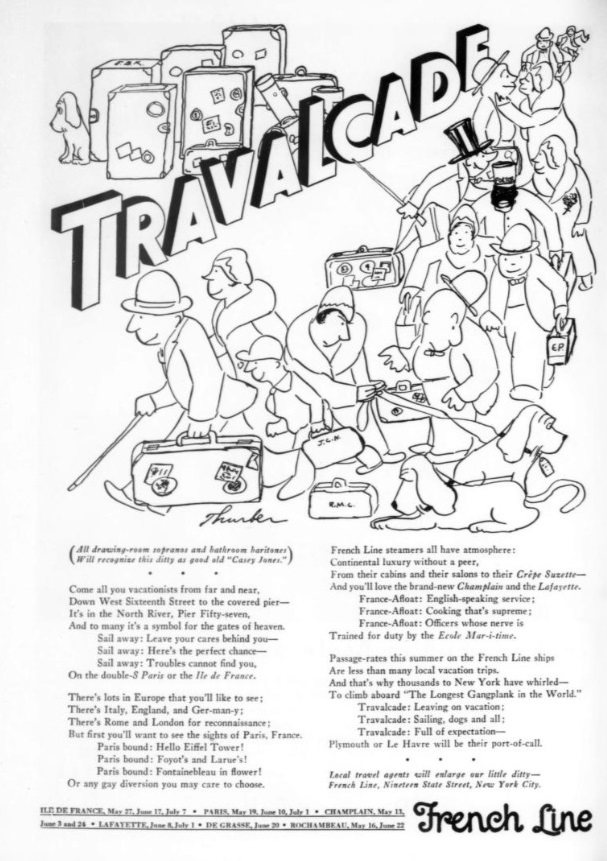
From an ad in the New Yorker Magazine on May 6, 1933 for traveling on the French Line.

The ad featured a drawing by James Thurber.

Travelcade! Full of expectations?

Not interested or at least not as interested as leaving my cares behind me and that troubles cannot find me.

My daughter is working to get back on her feet best she can with two little girls to look out for.

Two weeks ago everything was looking good.

She had a substitute teaching job / semi-permanent on call but still paid hourly but with the promise that she would be working every day.

Because she was working, she was able to qualify for reduced day care for the girls.

Things were full of expecatations.

Then Helene hit.

They were without power or fresh water for days.

Internet and phone just now being restored.

Schools have been closed and will be closed until next Tuesday.

No substitute teaching jobs.

Then she was informed that she had to get the girls into day care, when it opened as you had to use it once a week or lose your spot.

When she showed up with the girls, she was told she also had to pay for day care for the weeks they were closed or lose her qualification for the reduced cost program.

Even though the day care was closed by the storm.

Her rental insurance would not cover the cost of food lost when the power went out as it was only a tropical storm, not a hurricane.

And FEMA rejected her claim for assistance.

Where do you go to get on the French Line today?

8.13.2024 – never known woman

never known woman
who could weep about her age
way men I know can

Well, the characteristic fear of the American writer is not so much that as it is the process of aging.

The writer looks in the mirror and examines his hair and teeth to see if they’re still with him.

“Oh my God,” he says, “I wonder how my writing is. I bet I can’t write today.”’

The only time I met Faulkner he told me he wanted to live long enough to do three more novels.

He was 53 then, and I think he has done them.

Then Hemingway says, you know, that he doesn’t expect to be alive after sixty.

But he doesn’t look forward not to being.

When I met Hemingway with John O’Hara in Costello’s Bar 5 or 6 years ago we sat around and talked about how old we were getting.

You see it’s constantly on the minds of American writers.

I’ve never known a woman who could weep about her age the way the men I know can.

From Interview: THE ART OF FICTION: JAMES THURBER.
Paris Review, 3 (Fall, 1955), 34-49. Illustrated

This snippet made laugh.

I could picture Thurber in his mid 50’s, sitting in a bar with Mr. Hemingway and Mr. O’Hara and that alone is a picture to make me smile.

And that they were worrying about how old they were getting and that Mr. Thurber thought it was funny to the point of saying “I’ve never known a woman who could weep about her age the way the men I know can,” is but itself funny enough to make me laugh out loud.

For sure Mr. Thurber, who was being interviewed for this interview by George Plimpton, was having a great time tossing off the names of Faulkner, Hemingway and O’Hara with the confidence that he COULD toss off these names.

(I am reminded of the a story of Hollywood Movie Director John Ford going on a duck hunt with Clark Gable and William Faulkner and the conversation got around to writing and Gable says to Faulkner, ‘Who are the best writers right now?” Faulkner replies, “Oh Hemingway, Fitzgerald, Steinbeck … and myself.” Gable says “Oh, Mr. Faulkner, do you write?” “Yes,” says Faulkner, “Mr. Gable … what do you do?” … The kicker is John Ford swore both were on the level.)

BUT I DIGRESS …

As a kind of post script to the James Thurber story, The Paris Review included this photo.

Notice the caption.

Notice it says CONSIDERABLY REDUCED.

By 1961, James Thurber was pretty much blind in both eyes.

One eye was damaged playing William Tell when he was a kid and the other eye went due to sympathetic eye syndrome.

When he died, EB White wrote in his New Yorker Magazine Obituary:

I am one of the lucky ones; I knew him before blindness hit him, before fame hit him, and I tend always to think of him as a young artist in a small office in a big city, with all the world still ahead. It was a fine thing to be young and at work in New York for a new magazine when Thurber was young and at work, and I will always be glad that this happened to me.

His mind was never at rest, and his pencil was connected to his mind by the best conductive tissue I have ever seen in action. The whole world knows what a funny man he was, but you had to sit next to him day after day to understand the extravagance of his clowning, the wildness and subtlety of his thinking, and the intensity of his interest in others and his sympathy for their dilemmas — dilemmas that he instantly enlarged, put in focus, and made immortal, just as he enlarged and made immortal the strange goings on in the Ohio home of his boyhood.

He was both a practitioner of humor and a defender of it. The day he died, I came on a letter from him, dictated to a secretary and signed in pencil with his sightless and enormous “Jim.” “Every time is a time for humor,” he wrote. “I write humor the way a surgeon operates, because it is a livelihood, because I have a great urge to do it, because many interesting challenges are set up, and because I have the hope it may do some good.” Once, I remember, he heard someone say that humor is a shield, not a sword, and it made him mad. He wasn’t going to have anyone beating his sword into a shield. That “surgeon,” incidentally, is pure Mitty. During his happiest years, Thurber did not write the way a surgeon operates, he wrote the way a child skips rope, the way a mouse waltzes.

Thurber looked in the mirror and asked I bet I can’t write today and then spit in the mirror and said I am going to write anyway.

And he did.