
news from Washington
forces me to conclusion
brother Ed’s in charge

This was Washington in 1943 …
A simpler, gentler time.
More Thurber at https://muggsandrex.wordpress.com/
news from Washington
forces me to conclusion
brother Ed’s in charge
This was Washington in 1943 …
A simpler, gentler time.
More Thurber at https://muggsandrex.wordpress.com/
what it must be like
live where feel antipathy
to your own country
In the article, The New Yorker at 100: ‘We live in a world of misinformation … a lack of verification. Our readers want what we do’, written by Andrew Anthony for the Guardian, the editor of the New Yorker Magazine is quoted thusly:
Even so, [David] Remnick says he’s not experienced anything before like the second term of Donald Trump.
“It’s not one event,” he says. “It’s 10 events a day. It’s 20 astonishing posts on Truth Social in a given week.
I lived in the Soviet Union for four years and one of the things that always emotionally struck me was what it must be like to live in a place where you feel such antipathy to your own country.
One feels a sense of shame to hear one’s own president brand a heroic figure like Zelenskyy a dictator, and to see how he deals in an opposite way with Vladimir Putin.
But how to cover that on a human level, on a factual level, on an institutional level, is a challenge.”
Growing up in America, I remember a joke told about a feller in China who wanted to move to America.
When he applied for his visa, he was asked, “Don’t you love your Country?”
“Yes!,” he said, “I would say I LOVE my Country!”
“Don’t you love your Government?”
“Yes!,” he said, “I would say I LOVE my Government!”
“Don’t you love your Leaders?”
“Yes!,” he said, “I would say I LOVE my Leaders!”
“So why do you want to leave?”
“I want to live somewhere where I DON’T HAVE TO SAY THAT!”
Why does it feel like we are going to find out what it’s like to live outside that somewhere.
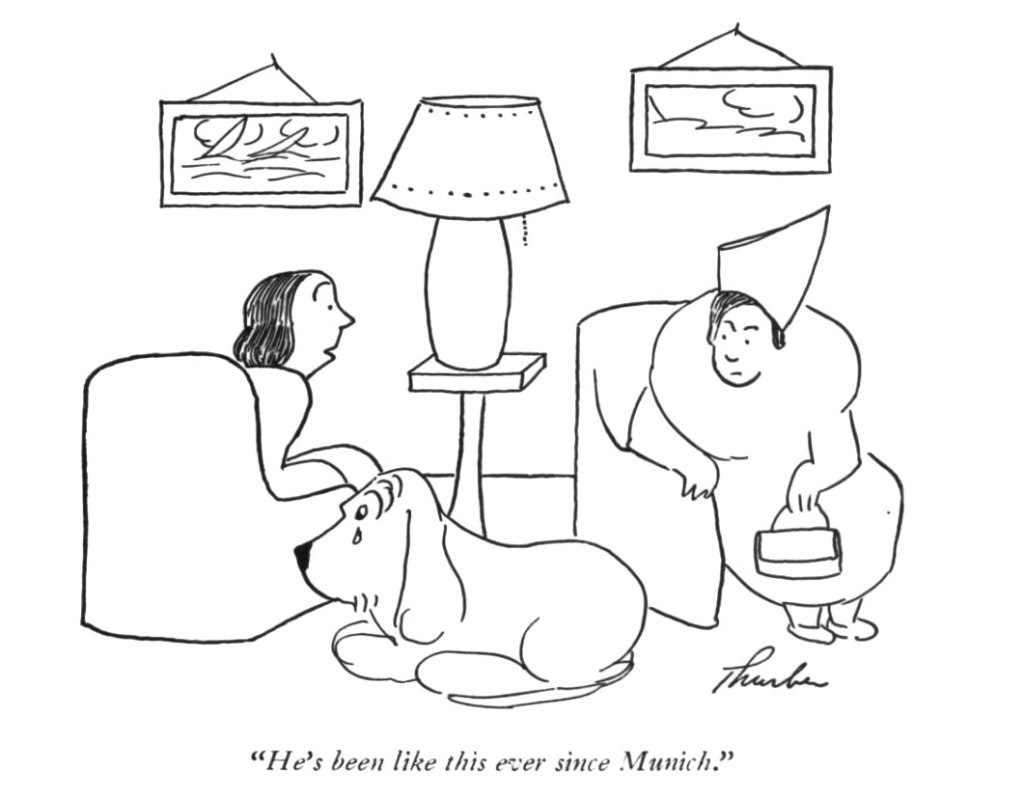
See more Thurber Drawings at For Muggs and Rex.
are vast and complex
reaches between cat feet of
Fog and Remembrance Rock
Adapted from a letter by James Thurber to a Librarian in Asheville, North Carolina on January 30th, 1952, where Thurber writes:
Nobody ever gives me time to get things done, and such a project as yours can’t be batted off. I wouldn’t want to start writing in January something about Carl Sandburg to be finished in January. He may seem as easy to describe as a face carved on a mountain, but there are vast and complex reaches between the cat feet of the “Fog” and ‘‘Remembrance Rock.” I like to think of him informally, without putting on my stiff Sunday critical shirt and shoes. He was up here not too long ago, playing his guitar and singing, sometimes with me, late into the night, although it seemed early. I was proud to have taught him a new verse about Casey Jones, who went through Toledo on an open switch. He is an American institution, not easy to describe within the limits of January. Let the glib boys do that, and give him my love and fond wishes that he will go on forever.
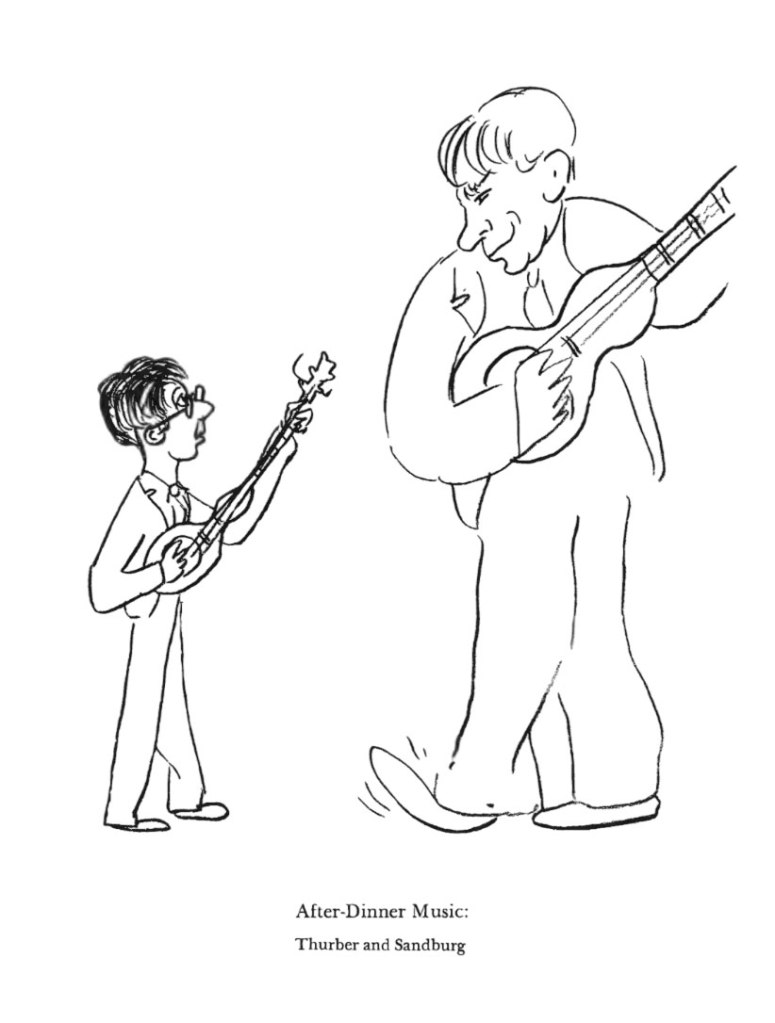
Mr. Thurber also remembered the evening singing with Sandburg with a drawing.
Just fun thinking of the two of them in the same room.
Fog you ask??
Fog is …
The fog comes
on little cat feet.
It sits looking
over harbor and city
on silent haunches
and then moves on.
Remembrance Rock is Carl Sandburg’s only novel. Sandburg described it as an epic, weaving the mystery of the American Dream with the costly toil and bloody struggles that gone to keep alive and carry further that Dream.
And there are vast and complex reaches between the two.
strive to learn before
we die what we are running
from, and to, and why

The Shore and the Sea
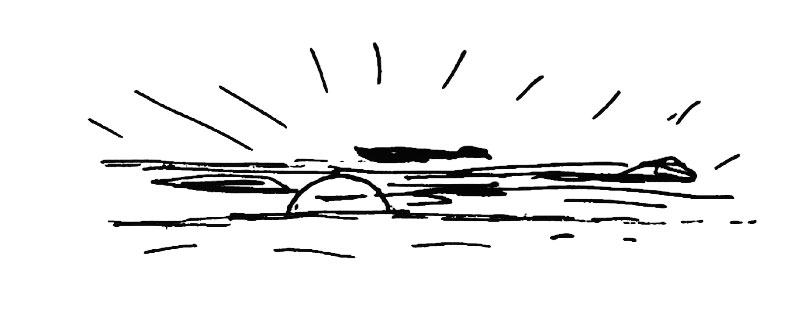
A single excited lemming started the exodus, crying, “Fire!” and running toward the sea. He may have seen the sunrise through the trees, or waked from a fiery nightmare, or struck his head against a stone, producing stars. Whatever it was, he ran and ran, and as he ran he was joined by others, a mother lemming and her young, a night watch lemming on his way home to bed, and assorted revelers and early risers.
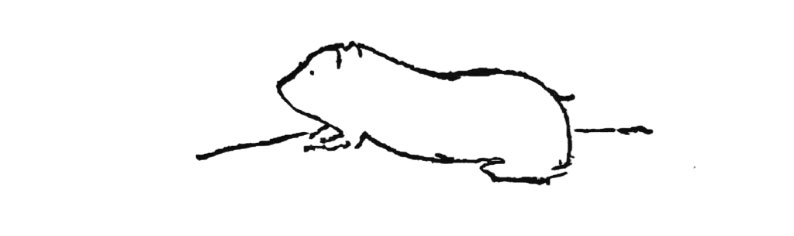
“The world is coming to an end!” they shouted, and as the hurrying hundreds turned into thousands, the reasons for their headlong flight increased by leaps and bounds and hops and skips and jumps.
“The devil has come in a red chariot!” cried an elderly male. “The sun is his torch! The world is on fire!”
“*Tt’s a pleasure jaunt,” squeaked an elderly female.
“A what?” she was asked.
“A treasure hunt!” cried a wild-eyed male who had been up all night. “Full many a gem of purest ray serene the dark unfathomed caves of ocean bear.”
“It’s a bear!” shouted his daughter. “Go it!”
And there were those among the fleeing thousands who shouted “Goats!” and “Ghosts!” until there were almost as many different alarms as there were fugitives.
One male lemming who had lived alone for many years refused to be drawn into the stampede that swept past his cave like a flood. He saw no flames in the forest, and no devil, or bear, or goat, or ghost. He had long ago decided, since he was a serious scholar, that the caves of ocean bear no gems, but only soggy glub and great gobs of mucky gump. And so he watched the other lemmings leap into the sea and disappear beneath the waves, some crying ‘““We are saved!” and some crying “We are lost!” The scholarly lemming shook his head sorrowfully, tore up what he had written through the years about his species, and started his studies all over again.
MORAL: All men should strive to learn before they die what they are running from, and to, and why.
As published in Further Fables for Our Time by James Thurber (Hamish Hamilton Ltd, London, 1956).
See more Thurber Drawings at For Muggs and Rex.
government of the
orioles, by, for foxes
must perish from earth
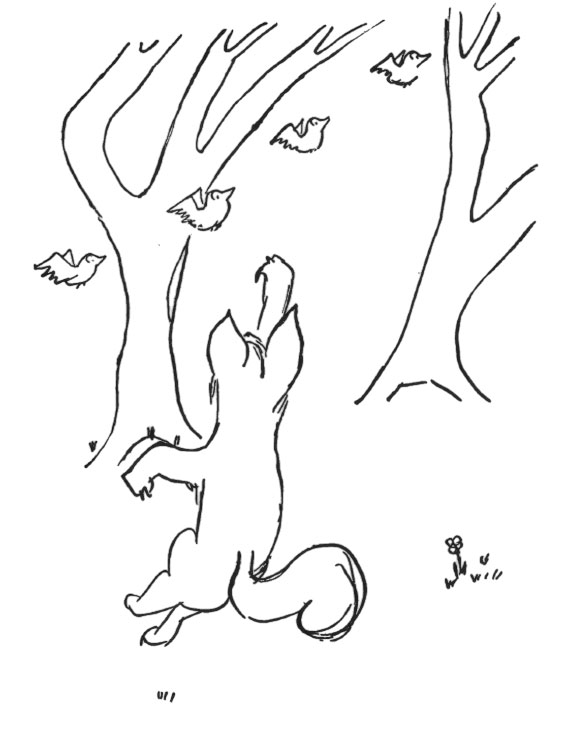
The Birds and the Foxes
Once upon a time there was a bird sanctuary in which hundreds of Baltimore orioles lived together happily. The refuge consisted of a forest entirely surrounded by a high wire fence. When it was put up, a pack of foxes who lived nearby -protested that it was an arbitrary and unnatural boundary. However, they did nothing about it at the time because they were interested in civilizing the geese and ducks on the neighboring farms.
When all the geese and ducks had been civilized, and there was nothing else left to eat, the foxes once more turned their attention to the bird sanctuary. Their leader announced that there had once been foxes in the sanctuary but that they had been driven out. He proclaimed that Baltimore orioles belonged in Baltimore. He said, furthermore, that the orioles in the sanctuary were a continuous menace to the peace of the world. The other animals cautioned the foxes not to disturb the birds in their sanctuary. So the foxes attacked the sanctuary one night and tore down the fence that, surrounded it. The orioles rushes out and were instantly killed and eaten by the foxes.
The next day the leader of the foxes, a fox from whom God was receiving daily guidance, got upon the rostrum and addressed the other foxes. His message was simple and sublime. “You see before you,” he said, “another Lincoln. We have liberated all those birds!”
Moral: Government of the orioles, by the foxes, and for the foxes, must perish from the earth.
From Fables for Our Time by James Thurber as reprinted in The Thurber Carnival, Harper Brothers, New York, 1945.
See more Thurber Drawings here …
 No Haiku For You