
Doctor, sometimes I
feel as if travelling two
hundred miles an hour
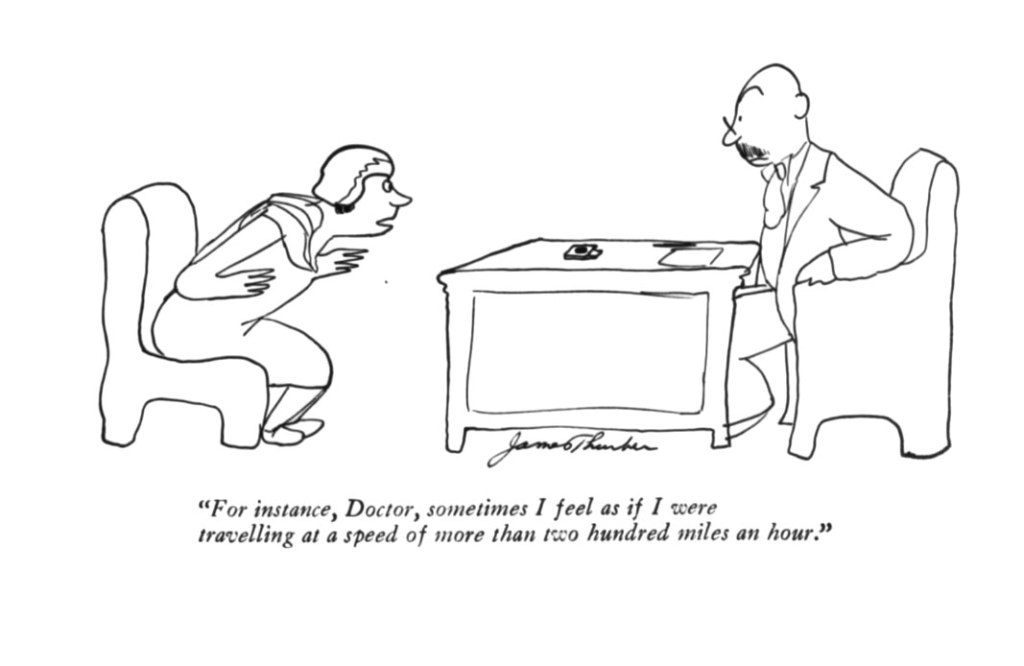
See More James Thurber at For Muggs and Rex.
Doctor, sometimes I
feel as if travelling two
hundred miles an hour
See More James Thurber at For Muggs and Rex.
news from Washington
forces me to conclusion
brother Ed’s in charge

This was Washington in 1943 …
A simpler, gentler time.
More Thurber at https://muggsandrex.wordpress.com/
what it must be like
live where feel antipathy
to your own country
In the article, The New Yorker at 100: ‘We live in a world of misinformation … a lack of verification. Our readers want what we do’, written by Andrew Anthony for the Guardian, the editor of the New Yorker Magazine is quoted thusly:
Even so, [David] Remnick says he’s not experienced anything before like the second term of Donald Trump.
“It’s not one event,” he says. “It’s 10 events a day. It’s 20 astonishing posts on Truth Social in a given week.
I lived in the Soviet Union for four years and one of the things that always emotionally struck me was what it must be like to live in a place where you feel such antipathy to your own country.
One feels a sense of shame to hear one’s own president brand a heroic figure like Zelenskyy a dictator, and to see how he deals in an opposite way with Vladimir Putin.
But how to cover that on a human level, on a factual level, on an institutional level, is a challenge.”
Growing up in America, I remember a joke told about a feller in China who wanted to move to America.
When he applied for his visa, he was asked, “Don’t you love your Country?”
“Yes!,” he said, “I would say I LOVE my Country!”
“Don’t you love your Government?”
“Yes!,” he said, “I would say I LOVE my Government!”
“Don’t you love your Leaders?”
“Yes!,” he said, “I would say I LOVE my Leaders!”
“So why do you want to leave?”
“I want to live somewhere where I DON’T HAVE TO SAY THAT!”
Why does it feel like we are going to find out what it’s like to live outside that somewhere.
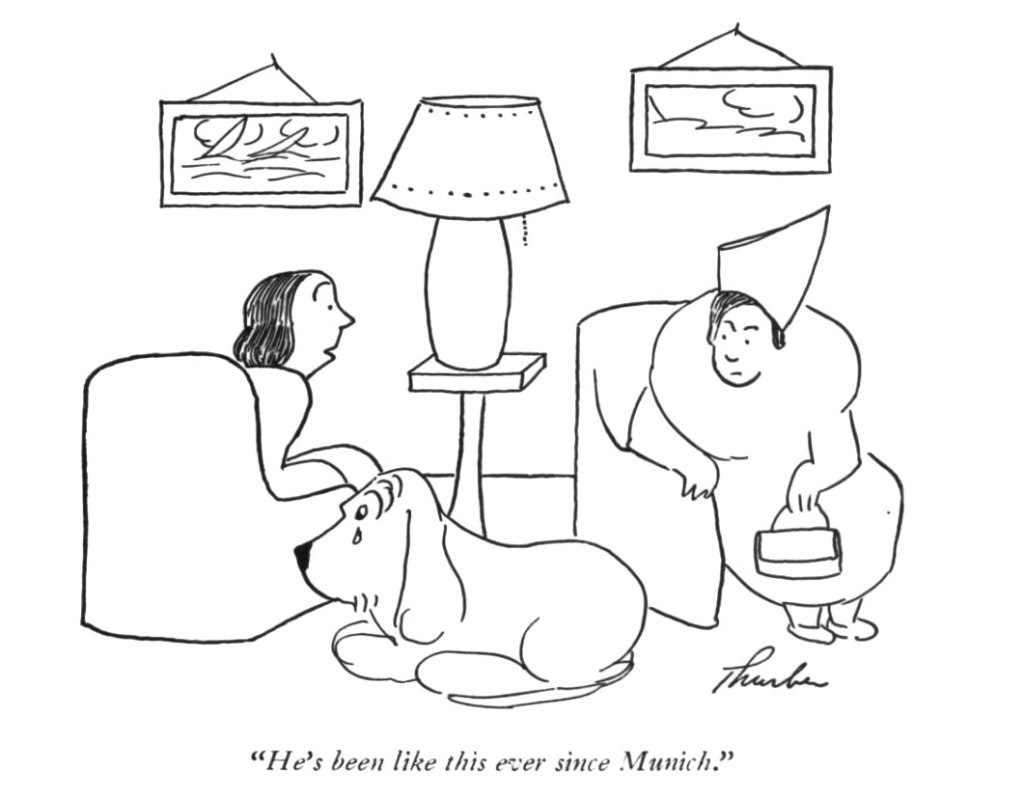
See more Thurber Drawings at For Muggs and Rex.
these are heroes then
on the street you see them
who will die fighting
These are heroes then — among the plain people—
Heroes, did you say? And why not? They
give all they’ve got and ask no questions and
take what comes and what more do you
want?
On the street you can see them any time, some
with jobs, some nothing doing, here a down-
and-out, there a game fighter who will die
fighting
From the The People, Yes: #19 by Carl Sandburg (Harcourt, Brace and Co., New York, 1936).
Asking that simple question, while the Bible saws way back even in the OLD Testament:
Do not go over your vineyard a second time or pick up the grapes that have fallen. Leave them for the poor and the foreigner. I am the Lord your God. (Leviticus 19:10)
Note the poor AND the foreigner!
So why do Republicans hate the poor and the foreigner?
To whom much is given … much will be … they know the rest and persist.
Here is the complete #19 of The People, Yes!
The people, yes, the people.
Everyone who got a letter today
And those the mail-carrier missed.
The women at the cookstoves preparing meals,
in a sewing corner mending, in a basement
laundering, woman the homemaker.
The women at the factory tending a stitching
machine, some of them the mainstay of the
jobless man at home cooking, laundering.
Streetwalking jobhunters, walkers alive and keen,
sleepwalkers drifting along, the stupefied and
hopeless down-and-outs, the game fighters
who will die fighting,
Walkers reading signs and stopping to study
windows, the signs and windows aimed
straight at their eyes, their wants,
Women in and out of doors to look and feel, to
try on, to buy and take away, to order and
have it charged and delivered, to pass by on
account of price and conditions.
The shopping crowds, the newspaper circulation.
the bystanders who witness parades, who
meet the boat, the tram, who throng in
wave lines to a fire, an explosion, an accident—
The people, yes—
Their shoe soles wearing holes in stone steps, their
hands and gloves wearing soft niches in ban-
isters of granite, two worn foot-tracks at the
general-delivery window.
Driving their cars, stop and go, red light, green
light, and the law of the traffic cop’s fingers,
on their way, loans and mortgages, margins to
cover.
Payments on the car, the bungalow, the radio, the
electric icebox, accumulated interest on loans
for past payments, the writhing point of
where the money will come from,
Crime thrown m their eyes from every angle,
crimes against property and person, crime in
the prints and films, crime as a lurking
shadow ready to spring into reality, crime as
a method and a technic.
Comedy as an offset to crime, the laughmakers,
the odd numbers m the news and the movies,
original clowns and imitators, and in the best
you never know what’s coming next even
when it’s hokum.
And sports, how a muff in the seventh lost yes-
terday’s game and now they are learning to
hit Dazzy’s fadeaway ball and did you hear
how Foozly plowed through that line for a
touchdown this afternoon^
And daily the death toll of the speed wagons, a
cripple a minute in fenders, wheels, steel and
glass splinters, a stammering witness before a
coroner’s jury, ‘It happened so sudden I
don’t know what happened “
And in the air a decree life is a gamble, take a
chance, you pick a number and see what you
get anything can happen in this sweepstakes
around the corner may be prosperity or the
worst depression yet who knows? nobody:
you pick a number, you draw a card, you
shoot the bones
In the poolrooms the young hear, “‘Ashes to
ashes, dust to dust, If the women don’t get
you then the whiskey must,” and in the
churches, “We walk by faith and not by sight,”
Often among themselves in their sessions of can-
dor the young saying, “Everything’s a racket,
only the gyp artists get by ”
And over and beyond the latest crime or comedy
always that relentless meal ticket saying
don’t-lose-me, hold your job, glue your mind
on that job or when your last nickel is gone
you live on your folks or sign for relief,
And the terror of these unknowns is a circle of
black ghosts holding men and women in toil
and danger, and sometimes shame, beyond
the dreams of their blossom days, the days
before they set out on their own
What IS this “occupational disease” we hear
about? It’s a sickness that breaks your health
on account of the work you’re in That’s all
Another kind of work and you’d have been
as good as any of them You’d have been
your old self
And what is this “hazardous occupation”? Why
that’s where you’re liable to break your neck
or get smashed on the job so you’re no good
on that job any more and that’s why you
can’t get any regular life insurance so long as
you’re on that job
These are heroes then — among the plain people—
Heroes, did you say? And why not? They
give all they’ve got and ask no questions and
take what comes and what more do you
want?
On the street you can see them any time, some
with jobs, some nothing doing, here a down-
and-out, there a game fighter who will die
fighting.
are vast and complex
reaches between cat feet of
Fog and Remembrance Rock
Adapted from a letter by James Thurber to a Librarian in Asheville, North Carolina on January 30th, 1952, where Thurber writes:
Nobody ever gives me time to get things done, and such a project as yours can’t be batted off. I wouldn’t want to start writing in January something about Carl Sandburg to be finished in January. He may seem as easy to describe as a face carved on a mountain, but there are vast and complex reaches between the cat feet of the “Fog” and ‘‘Remembrance Rock.” I like to think of him informally, without putting on my stiff Sunday critical shirt and shoes. He was up here not too long ago, playing his guitar and singing, sometimes with me, late into the night, although it seemed early. I was proud to have taught him a new verse about Casey Jones, who went through Toledo on an open switch. He is an American institution, not easy to describe within the limits of January. Let the glib boys do that, and give him my love and fond wishes that he will go on forever.
Mr. Thurber also remembered the evening singing with Sandburg with a drawing.
Just fun thinking of the two of them in the same room.
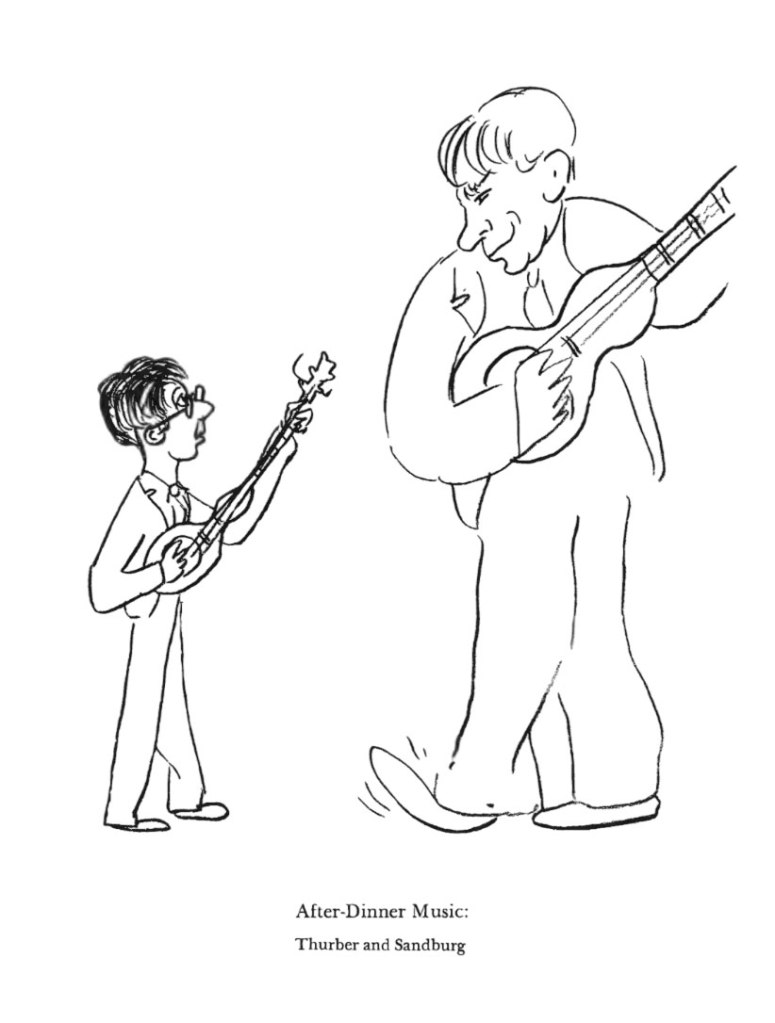
Fog you ask??
Fog is …
The fog comes
on little cat feet.
It sits looking
over harbor and city
on silent haunches
and then moves on.
Remembrance Rock is Carl Sandburg’s only novel. Sandburg described it as an epic, weaving the mystery of the American Dream with the costly toil and bloody struggles that gone to keep alive and carry further that Dream.
And there are vast and complex reaches between the two.
 No Haiku For You