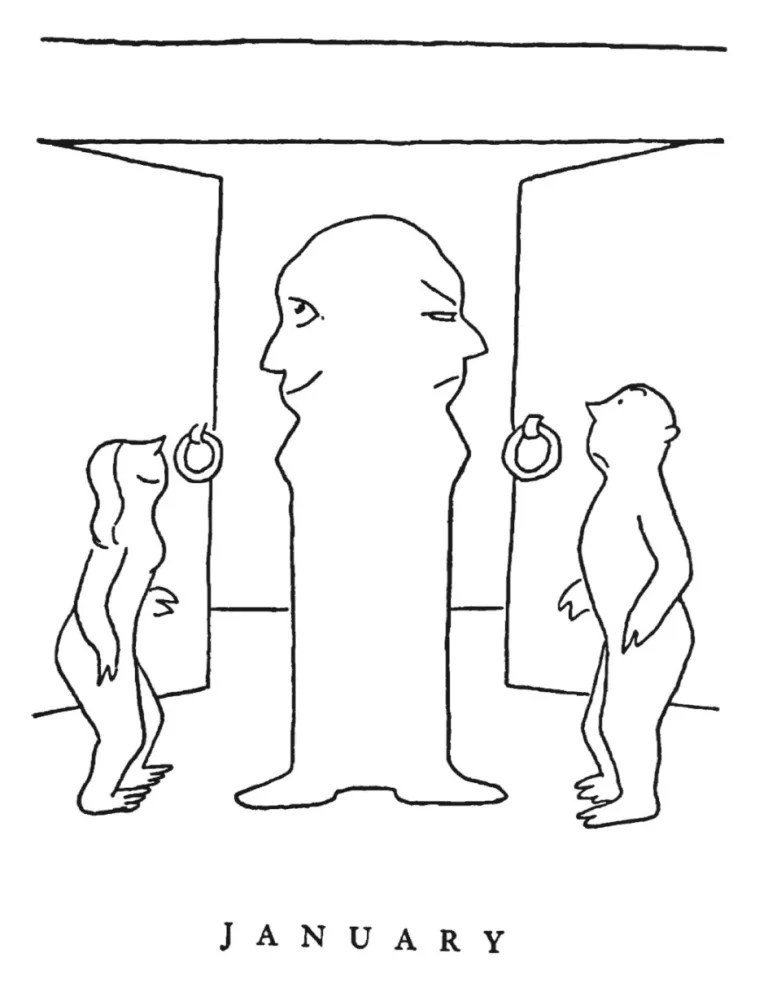
burning with a hard, gemlike flame – it’s something they learn in school, I think
First published on June 18th, 1938, in the New Yorker Magazine.
The drawing was republished in one of the editions of Thurber’s book, Men Women and Dogs with the caption:
It’s a strange mood she’s in, kind of a cross between Baby Doll and Elizabeth Barrett Browning.
No explanation for the change but it would be difficult to get into a haiku.
According to Wikipedia: Baby Doll is a 1956 American black comedy film directed by Elia Kazan and starring Carroll Baker, Karl Malden and Eli Wallach. It was produced by Kazan and Tennessee Williams, and adapted by Williams from two of his own one-act plays: 27 Wagons Full of Cotton and The Unsatisfactory Supper. The plot focuses on a feud between two rival cotton gin owners in rural Mississippi.
Filmed in Mississippi in late 1955, Baby Doll was released in December 1956. It provoked significant controversy, mostly because of its implied sexual themes, and the National Legion of Decency condemned the film.
WOW!
Kind of a cross between Baby Doll and Elizabeth Barrett Browning or burning with a hard, gemlike flame that might be something learned in school.
make us one new dream us who forget out of storms let us have one star
Sunrise in storms clouds over Pinckney Island, South Carolina on Thursday morning.
Adapted from a Prayer after World War by Carl Sandburg, in Smoke and Steel as published in The Complete Poems of Carl Sandburg, by Carl Sandburg, Harcourt, Brace, New York, 1950.
Wandering oversea dreamer, Hunting and hoarse, Oh daughter and mother, Oh daughter of ashes and mother of blood, Child of the hair let down, and tears, Child of the cross in the south And the star in the north,
Keeper of Egypt and Russia and France, Keeper of England and Poland and Spain, Make us a song for to-morrow. Make us one new dream, us who forget, Out of the storm let us have one star.
Struggle, Oh anvils, and help her. Weave with your wool, Oh winds and skies. Let your iron and copper help, Oh dirt of the old dark earth.
Wandering oversea singer, Singing of ashes and blood, Child of the scars of fire, Make us one new dream, us who forget. Out of the storm let us have one star.
belongs to a church … on certain Sundays enjoys chanting Nicene creed
This is the Nicene Creed …
I believe in one God, the Father almighty, maker of heaven and earth, of all things visible and invisible.
I believe in one Lord Jesus Christ, the Only Begotten Son of God, born of the Father before all ages. God from God, Light from Light, true God from true God, begotten, not made, consubstantial with the Father; through him all things were made. For us men and for our salvation he came down from heaven, and by the Holy Spirit was incarnate of the Virgin Mary, and became man. For our sake he was crucified under Pontius Pilate, he suffered death and was buried, and rose again on the third day in accordance with the Scriptures. He ascended into heaven and is seated at the right hand of the Father. He will come again in glory to judge the living and the dead and his kingdom will have no end.
I believe in the Holy Spirit, the Lord, the giver of life, who proceeds from the Father and the Son, who with the Father and the Son is adored and glorified, who has spoken through the prophets.
I believe in one, holy, catholic and apostolic Church. I confess one Baptism for the forgiveness of sins and I look forward to the resurrection of the dead and the life of the world to come.
Amen.
This may be the key phrase …
He will come again in glory to judge the living and the dead and his kingdom will have no end.
Onion Days in Chicago Poems by Carl Sandburg, (1916)
Mrs. Gabrielle Giovannitti comes along Peoria Street every morning at nine o’clock With kindling wood piled on top of her head, her eyes looking straight ahead to find the way for her old feet.
Her daughter-in-law, Mrs. Pietro Giovannitti, whose husband was killed in a tunnel explosion through the negligence of a fellow-servant, Works ten hours a day, sometimes twelve, picking onions for Jasper on the Bowmanville road.
She takes a street car at half-past five in the morning, Mrs. Pietro Giovannitti does, And gets back from Jasper’s with cash for her day’s work, between nine and ten o’clock at night.
Last week she got eight cents a box, Mrs. Pietro Giovannitti, picking onions for Jasper, But this week Jasper dropped the pay to six cents a box because so many women and girls were answering the ads in the Daily News.
Jasper belongs to an Episcopal church in Ravenswood and on certain Sundays He enjoys chanting the Nicene creed with his daughters on each side of him joining their voices with his.
If the preacher repeats old sermons of a Sunday, Jasper’s mind wanders to his 700-acre farm and how he can make it produce more efficiently And sometimes he speculates on whether he could word an ad in the Daily News so it would bring more women and girls out to his farm and reduce operating costs.
Mrs. Pietro Giovannitti is far from desperate about life; her joy is in a child she knows will arrive to her in three months.
And now while these are the pictures for today there are other pictures of the Giovannitti people I could give you for to-morrow, And how some of them go to the county agent on winter mornings with their baskets for beans and cornmeal and molasses.
I listen to fellows saying here’s good stuff for a novel or it might be worked up into a good play.
I say there’s no dramatist living can put old Mrs. Gabrielle Giovannitti into a play with that kindling wood piled on top of her head coming along Peoria Street nine o’clock in the morning.
I repeat, this is the key phrase …
He will come again in glory to judge the living and the dead and his kingdom will have no end.
The Jasper’s of this world can hear if they want to.
Dr. Hibben objected that the author of an article, “Sketches from a Madhouse” by William Mode Spackman of the class of 1927 and editor of the Nassau, the student Literary Magazine, was one of the most sacriregious and and obscene pieces of writing he had ever seen.
Inside that article in something called, Preface for the American Public, Dr. Hidden says that Spackman attacks what he calls COSMIC INANITIES as “all faculties, deans, directors, lictors, hangman, all Philadelphians, both Cabinet and society, all rules, regulations, totems, taboos, and mumbo-jumberies, all credos, standards, debarments, band and prohibitions.
Dr, Hidden tells the New York Times that “I understand that he has been reading a good deal of James Joyce’s ‘Ulysses’ and T. S. Eliiot and other of the modernists in literature. He has evidently been well soaked in this type of literature and has tried to go the writers one better.”
Such problems American Universities had back then doncha think?
I had never heard of Mr. Spackman but wikipedia says:
William Mode Spackman (May 20, 1905 – August 3, 1990) was an American writer. He was born in Coatesville, Pennsylvania, the son of George Harvey Spackman and Alice Pennock Mode. A graduate of the Friends School of Wilmington, Delaware and in 1927 Princeton University (B.A.; later also an M.A.), he was also a Rhodes Scholar at Balliol College, Oxford. In 1929, he married Mary Ann Matthews (1902–1978); they had three children: Peter (1930–1995), Ann (1932–1961), and Harriet (born 1934). Spackman was awarded a Rockefeller Fellowship to study public opinion at Columbia University. Spackman also taught classics briefly at New York University and worked in radio.
Spackman’s literary success came relatively late in life. He wrote about romance from a realistic rather than a romantic perspective. Highly praised by critics like John Leonard, John Updike, and Stanley Elkin, he has been called a “Fabergé of novelists” and his works have been called “delicate comedies.” The characters in his novels are school friends, their associations, often in New York City, and the women with whom they spent time.
But when he died, it was this incident the NYT remembered, writing in Mr. Spackman’s OBIT on August 9, 1990:
The author, who was born in 1905 in Coatesville, Pa., was removed as editor of Princeton’s Nassau Literary Magazine while an undergraduate. The university president, John Grier Hibben, suppressed an issue that contained what he called the ”most sacrilegious and obscene articles” he had ever seen in print. About Mr. Spackman, he said: ”I understand that he has been reading a good deal of James Joyce’s ‘Ulysses’ and T. S. Eliiot and other of the modernists in literature. He has evidently been well soaked in this type of literature and has tried to go the writers one better.”
After graduation, Mr. Spackman became a Rhodes Scholar at Balliol College, Oxford. Later he worked as a Rockefeller Fellow in opinion research at Columbia University, as a radio writer, as a public relations executive and a literary critic. He also taught classics at New York University and the University of Colorado. His other novels are ”A Difference in Design,” and ”A Little Decorum.” ”On the Decay of Humanism” is a volume of essays.
The obit also said this:
Alice Quinn, poetry editor of The New Yorker magazine, who was his editor at Alfred A. Knopf, said yesterday, ”Mr. Spackman was a radiant human being and a radiant writer, a writer of great charm and high style, who took as his subject men and women who really liked and enjoyed each other.”
I had never heard of him.
I have now.
I will have to read his stuff and find out if he had been reading a good deal of James Joyce’s ‘Ulysses’ and T. S. Eliiot and other of the modernists in literature and if He had evidently been well soaked in this type of literature and has tried to go the writers one better.