change the world and have hell of a good time – planning my day’s difficult
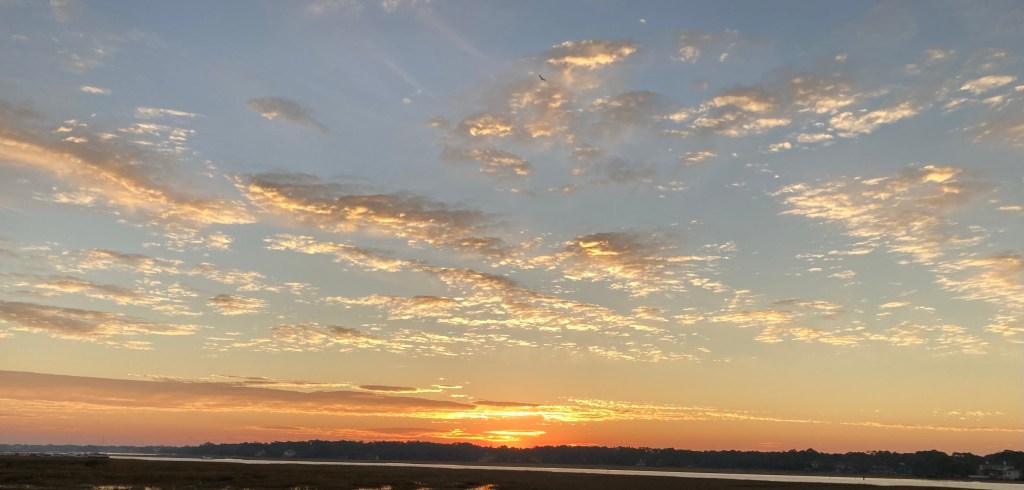
I took this image of the sunrise on Thursday as I drove over the Cross Island Parkway Bridge on Thursday.
I have to point out that had I waited another one or two seconds I would have reached the top of the bridge and the sun was the much more spectacular above the flat line of the Atlantic Ocean.
As I quote Alice Walker so often from her book the Color Purple, “I think it pisses God off if you walk by the color purple in a field somewhere and don’t notice it. People think pleasing God is all God cares about. But any fool living in the world can see it always trying to please us back.”
I have to append that to read, “I think it pisses God off if you walk by a sunrise somewhere and don’t notice it. People think pleasing God is all God cares about. But any fool living in the world can see it always trying to please us back.”
After taking the photo, I needed a quote on sunrise or getting up in the morning and I found this online, “I get up every morning determined to both change the world and have one hell of a good time. Sometimes this makes planning my day difficult.”
It was attributed to E. B. White.
That made me think, hmmmmmmmmmmmmmmmm.
It sounded familiar but I checked the wording and I had never used it before.
I checked online for the source and I checked and I checked and I checked until my checker was sore.
And then I found that Andy White never said “I get up every morning determined to both change the world and have one hell of a good time. Sometimes this makes planning my day difficult.”
But he did say:
If the world were merely seductive, that would be easy.
If it were merely challenging, that would be no problem.
But I arise in the morning torn between a desire to improve (or save) the world and a desire to enjoy (or savor) the world.
This makes it hard to plan the day.
I cited E. B. White: Notes and Comment, interview with Israel Shenker, July 11, 1969; New York Times; quoted in E. B. White: A Biography, by Scott Elledge, p. 3
And I did use that quote back in May.
And I used it one another haiku about sunrise viewed on a drive to work.
In May, I said:
rise in morning torn desire improve, enjoy world makes day hard to plan
Versus
change the world and have hell of a good time – planning my day’s difficult
I sure can imagine Mr. White having and saying he was having a hell of good time.
And I know of one scholar who says getting a quote kind of close but not word for word shows that maybe you didn’t memorize but that the thought certainly stuck in your head was more important.
Change the world and have one hell of a good time.
booksellers about as uncommercial breed of people possible
In a world gone crazy, when I am grasping at anything that points the compass in a positive direction, I found the recent article in the New York Times, Barnes & Noble Sets Itself Free ByMaureen O’Connor to be something of a word of hope.
To quote Big Bill or better to quote Portia in the Merchant of Venice, So shines a good deed in a naughty world.
Or maybe best to quote Willy Wonka and say, “So shines a good deed in a weary world.”
At least, for a moment, this story about how Barnes and Noble is pushing the chain to act more like the indie stores it was once notorious for displacing under the direction of a new CEO, James Daunt.
“The curious trick has been that if you actually let the local book-selling teams do what they think is best, you suddenly get much better bookstores,” Mr. Daunt said. Then he quickly added a caveat: “About a quarter of them become dramatically better, and a quarter become dramatically worse — but it is much easier to focus on that quarter and improve them.”
The change goes along with his strategy of embracing the mind-set of his typical employee. “Booksellers are about as uncommercial a breed of people as it’s possible to come across,” Mr. Daunt said. “The irony is that the less concerned we are with the commercial, the better it works commercially.
“You need to love books, and you need to know how our customers shop for books,” says a long term Barnes and Noble employee.
I read and I believe it, but only because I want to believe it.
I spent 12 years working for a chain bookstore.
For many employee’s it was a job.
For me and many employee’s and many of my good good friends that I worked with, it was a calling.
And it was a fight against those who went into it as business and tried to make it business while we tried to keep the faith.
So to read, “The curious trick has been that if you actually let the local book-selling teams do what they think is best, you suddenly get much better bookstores.” almost makes me want to cry.
I worked for Waldenbooks.
But I lived in Michigan.
If you loved books and you lived in the State of Michigan, at some point in your life you ended up at Border’s Book Store, a stand alone, independent love-affair with books in Ann Arbor, Michigan.
If you went down that path, you also at some point ended up at John King Used Books in Detroit but that’s another story.
Among booksellers in the State of Michigan, Border’s was the gold standard.
It had sofa’s and chairs and probably some sort of cafe before Starbucks.
They had a service desk set up and staffed by three people, in the pre computer era, who did nothing but researched hard to find titles so a customer could order the book.
They had floor upon floor of books.
The had an art print / map section and I still have prints on my office wall that I purchased there, using my grocery money instead of using my grocery money for groceries.
When I started with at my bookstore in a mall, I saw how it could embrace some of what Border’s was.
I fought for chairs in the store.
I fought for more and more copies of different books rather than 100 copies of the same bestseller.
We worked to create displays of content that meant something.
I started as a bookseller then assistant Manager and finally, Manager.
Though I used label tape and put the title, GUY IN CHARGE on my name tag.
One of the many, many things I did that got me trouble.
My battles can be kind of summed up when I made a display of books for Valentine’s Day.
Regardless of the topic or author, I took over a wall and made a display of every red book we had in the store.
My District Manager came in, took one look at Car Repair manuals next to Novels next to books on Knitting but ALL WITH RED COVERS surrounded by cardboard hearts and he ran back out to his car to get his camera.
“That’s the type of thinking we want to see Mike!,” he told me.
I banged a big red American Heritage dictionary against my head.
“This is Walden’s, Mike”, he would say, “Not Border’s.“
The really funny part of this story is that after I was asked to leave the employ of company, another long story, Walden’s relocated it’s headquarters from Stamford, CT to ANN ARBOR and then bought out Border’s and in an effort to change the brand, changed the name of the Company TO Border’s Books!
In the end I guess I won.
To read Booksellers are about as uncommercial a breed of people as it’s possible to come across is a tonic to my soul.
Some where I have a book, I think it’s an autographed copy of Lake Wobegone by Garrison Keillor.
It was picked up for me by a Waldenbooks Regional Vice President.
Her office was in Ann Arbor and I got to know her when I worked at the Walden’s in Ann Arbor when I was in College.
I was allowed to switch back and forth between Grand Rapids, where I lived and Ann Arbor.
I would have long talks with this VP on bookselling as a calling and she would explain bookselling as a business.
She knew I liked Keillor and arranged to get an autographed copy when he made an appearance at some other Walden’s.
Inscribed above the author’s autograph was this sentiment.
“To the most un-corporate person I know.”
And she signed it.
When James Thurber’s dog Mugg’s (The Dog that Bit People) died, he writes, “Mother wanted to bury him in the family lot under a marble stone with some such inscription as “Flights of angels sing thee to thy rest” but we persuaded her it was against the law. In the end we just put up a smooth board above his grave along a lonely road. On the board I wrote with an indelible pencil “Cave Canem.” Mother was quite pleased with the simple classic dignity of the old Latin epitaph.“
To the most un-corporate person I know.
Should I have a tombstone someday, I would be quite pleased with the simple classic dignity of that sentiment.
computers often in reality too dumb to avoid hurting us
Inspired by the guest Opinion Essay, “Autonomous Vehicles Are Driving Blind” by Julia Angwin a contributing Opinion writer to the New York Times and an investigative journalist and the passage, “There’s an irony here: So many headlines have focused on fears that computers will get too smart and take control of the world from humans, but in our reality, computers are often too dumb to avoid hurting us.”
Ms. Angwin writes, “For all the ballyhoo over the possibility of artificial intelligence threatening humanity someday, there’s remarkably little discussion of the ways it is threatening humanity right now. When it comes to self-driving cars, we are driving blind.”
Ms. Angwin explains, “The National Highway Traffic Safety Administration regulates the hardware (such as windshield wipers, airbags and mirrors) of cars sold in the United States. And the states are in charge of licensing human drivers. To earn the right to drive a car, most of us at some point have to pass a vision test, a written test and a driving test. The A.I. undergoes no such government scrutiny before commanding the wheel.”
I am reminded of The Glass in the Field by James Thurber from Fables for Our Time and Famous Poems Illustrated: as in appeared in The Thurber Carnival.
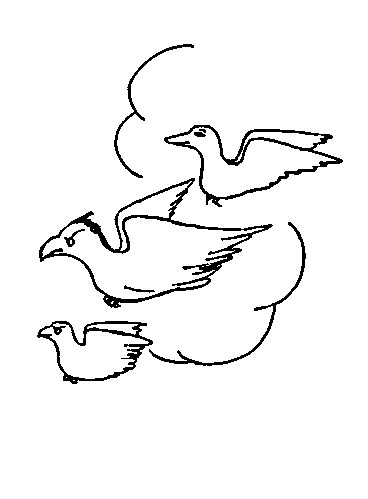
A short time ago some builders, working on a studio in Connecticut, left a huge square of plate glass standing upright in a field one day. A goldfinch flying swiftly across the field struck the glass and was knocked cold. When he came to he hastened to his club, where an attendant bandaged his head and gave him a stiff drink. “What the hell happened?” asked a sea gull. “I was flying across a meadow when all of a sudden the air crystallized on me,” said the goldfinch. The sea gull and a hawk and an eagle all laughed heartily. A swallow listened gravely. “For fifteen years, fledgling and bird, I’ve flown this country,” said the eagle, “and I assure you there is no such thing as air crystallizing. Water, yes; air, no.” “You were probably struck by a hailstone,” the hawk told the goldfinch. “Or he may have had a stroke,” said the sea gull. “What do you think, swallow?” “Why, I–I think maybe the air crystallized on him,” said the swallow. The large birds laughed so loudly that the goldfinch became annoyed and bet them each a dozen worms that they couldn’t follow the course he had flown across the field without encountering the hardened atmosphere. They all took his bet; the swallow went along to watch. The sea gull, the eagle, and the hawk decided to fly together over the route the goldfinch indicated. “You come, too,” they said to the swallow. “I–I–well, no,” said the swallow. “I don’t think I will.” So the three large birds took off together and they hit the glass together and they were all knocked cold.
they foolishly sought power riding the tiger ended up inside
“… remember that, in the past, those who foolishly sought power by riding the back of the tiger ended up inside.”
From the inaugural address of John F. Kennedy, on January 20, 1961.
It is worth pointing out that the paragraph with this quote in it starts out, “To those new states whom we welcome to the ranks of the free …”
Today, I don’t think of new states but old states.
Our state.
This Country.
This Country that is in such a state that I don’t think Mr. Kennedy could ever had dreamed in his worst dreams.
This Nation has a Constitution of checks and balances.
The checks and balances are the Executive, Legislative and Judicial branches of government.
Like a three legged stool, each branch both supports and checks the others.
Of late …
The Supreme Court of the United States of America, a branch of Government I always took for granted as being above Government and the one branch that could be counted on to do the right thing has been marginalized by politics, greed and social media.
The Supreme Court seems to be broken and it doesn’t work like as it was planned to work.
In the Legislative Branch, the United States Senate is deadlocked so that any one Senator can prevent, delay or change the daily business of the Senate.
While that isn’t great, it is better than what the United States House of Representatives did when they themselves, the members of the House, took the House out the Legislative branch part of the equation and pretty much ceased to exist as a functioning part of Government.
The Legislative Branch seems to be broken and it doesn’t work like as it was planned to work.
Within the Executive Branch of the Government, multiple Government Agencies are held in question and from Health to Education their existence is in doubt.
The Department of Justice, say that out loud, the DEPARTMENT OF JUSTICE is seemingly dismissed by half the Country.
The US Military, part of the Executive Branch is being denied promotions and the Soldiers and Sailors themselves, the Men and Women who DEFEND this Country have to worry about whether or not they might get paid.
The Executive Branch seems to be broken and it doesn’t work like as it was planned to work.
On top of all this, the whole thing is based on free and fair elections.
Elections were supposed to give us all a voice in Government by selecting between the best and brightest candidates the two party system could offer.
Everyone seems to be in agreement who the next two candidates for President will be.
Everyone seems to be in agreement the no one really wants either candidate.
These are the best the Two Party system can come up with?
The Two Party system seems to be broken and it doesn’t work like as it was planned to work.
Regardless of your party affiliation, is there anyone left in the United States today that feels they can trust the next election?
Elections seem to be broken and it doesn’t work like as it was planned to work.
The Checks and Balances no longer work and I can see easily how a faction within this country will endorse the idea that we, as a nation, need to step away from the Constitution and bring in somebody as a caretaker, a benign, good natured, the best interests of the people at heart, type of … Dictator to take over until we can get things sorted out.
What scares the stuff out of me as I am starting to think that this was the plan all along.
I am hoping I am wrong.
I am hoping that this Country, this Nation can rise above this.
I am hoping that those who feel the need for a caretaker, a benign, good natured, the best interests of the people at heart, type of … Dictator keep in mind what Mr. Kennedy said.
“… remember that, in the past, those who foolishly sought power by riding the back of the tiger ended up inside.”
few generations role of defending freedom maximum danger
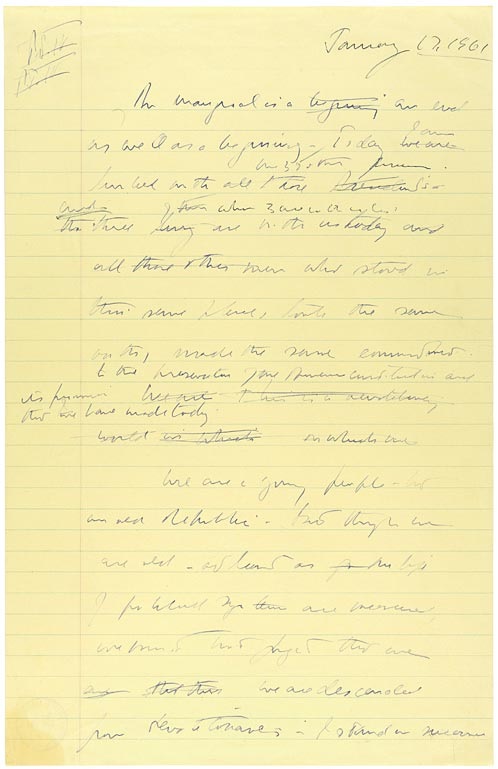
On January 20, 1961, President John F. Kennedy delivered his inaugural address in a message that rings loud and clear for today.
The stunning difference is that President Kenney was speaking to the World at large when today I feel his call for Freedom needs to be heard here in America.
To that end, I am writing a series of Haiku based on that inaugural address.
Also anyone who follows this blog, knows that when I miss a few days, I will create a series of posts based on the same text to catch myself up to date.
This is one of those series.
If you really want to scare yourself or make yourself think in such a way as to scare yourself, read this speech and William Shakespeare’s playJulius Caesar at the same time.
Today’s Haiku is taken from the passage (and yes I used to many words in the third line but my blog, my rules):
In the long history of the world, only a few generations have been granted the role of defending freedom in its hour of maximum danger. I do not shrink from this responsibility–I welcome it. I do not believe that any of us would exchange places with any other people or any other generation. The energy, the faith, the devotion which we bring to this endeavor will light our country and all who serve it–and the glow from that fire can truly light the world.
Here is the complete text of from that address on January 20, 1961.
Vice President Johnson, Mr. Speaker, Mr. Chief Justice, President Eisenhower, Vice President Nixon, President Truman, Reverend Clergy, fellow citizens:
We observe today not a victory of party but a celebration of freedom–symbolizing an end as well as a beginning–signifying renewal as well as change. For I have sworn before you and Almighty God the same solemn oath our forbears prescribed nearly a century and three-quarters ago.
The world is very different now. For man holds in his mortal hands the power to abolish all forms of human poverty and all forms of human life. And yet the same revolutionary beliefs for which our forebears fought are still at issue around the globe–the belief that the rights of man come not from the generosity of the state but from the hand of God.
We dare not forget today that we are the heirs of that first revolution. Let the word go forth from this time and place, to friend and foe alike, that the torch has been passed to a new generation of Americans–born in this century, tempered by war, disciplined by a hard and bitter peace, proud of our ancient heritage–and unwilling to witness or permit the slow undoing of those human rights to which this nation has always been committed, and to which we are committed today at home and around the world.
Let every nation know, whether it wishes us well or ill, that we shall pay any price, bear any burden, meet any hardship, support any friend, oppose any foe to assure the survival and the success of liberty.
This much we pledge–and more.
To those old allies whose cultural and spiritual origins we share, we pledge the loyalty of faithful friends. United there is little we cannot do in a host of cooperative ventures. Divided there is little we can do–for we dare not meet a powerful challenge at odds and split asunder.
To those new states whom we welcome to the ranks of the free, we pledge our word that one form of colonial control shall not have passed away merely to be replaced by a far more iron tyranny. We shall not always expect to find them supporting our view. But we shall always hope to find them strongly supporting their own freedom–and to remember that, in the past, those who foolishly sought power by riding the back of the tiger ended up inside.
To those people in the huts and villages of half the globe struggling to break the bonds of mass misery, we pledge our best efforts to help them help themselves, for whatever period is required–not because the communists may be doing it, not because we seek their votes, but because it is right. If a free society cannot help the many who are poor, it cannot save the few who are rich.
To our sister republics south of our border, we offer a special pledge–to convert our good words into good deeds–in a new alliance for progress–to assist free men and free governments in casting off the chains of poverty. But this peaceful revolution of hope cannot become the prey of hostile powers. Let all our neighbors know that we shall join with them to oppose aggression or subversion anywhere in the Americas. And let every other power know that this Hemisphere intends to remain the master of its own house.
To that world assembly of sovereign states, the United Nations, our last best hope in an age where the instruments of war have far outpaced the instruments of peace, we renew our pledge of support–to prevent it from becoming merely a forum for invective–to strengthen its shield of the new and the weak–and to enlarge the area in which its writ may run.
Finally, to those nations who would make themselves our adversary, we offer not a pledge but a request: that both sides begin anew the quest for peace, before the dark powers of destruction unleashed by science engulf all humanity in planned or accidental self-destruction.
We dare not tempt them with weakness. For only when our arms are sufficient beyond doubt can we be certain beyond doubt that they will never be employed.
But neither can two great and powerful groups of nations take comfort from our present course–both sides overburdened by the cost of modern weapons, both rightly alarmed by the steady spread of the deadly atom, yet both racing to alter that uncertain balance of terror that stays the hand of mankind’s final war.
So let us begin anew–remembering on both sides that civility is not a sign of weakness, and sincerity is always subject to proof. Let us never negotiate out of fear. But let us never fear to negotiate.
Let both sides explore what problems unite us instead of belaboring those problems which divide us.
Let both sides, for the first time, formulate serious and precise proposals for the inspection and control of arms–and bring the absolute power to destroy other nations under the absolute control of all nations.
Let both sides seek to invoke the wonders of science instead of its terrors. Together let us explore the stars, conquer the deserts, eradicate disease, tap the ocean depths and encourage the arts and commerce.
Let both sides unite to heed in all corners of the earth the command of Isaiah–to “undo the heavy burdens . . . (and) let the oppressed go free.”
And if a beachhead of cooperation may push back the jungle of suspicion, let both sides join in creating a new endeavor, not a new balance of power, but a new world of law, where the strong are just and the weak secure and the peace preserved.
All this will not be finished in the first one hundred days. Nor will it be finished in the first one thousand days, nor in the life of this Administration, nor even perhaps in our lifetime on this planet. But let us begin.
In your hands, my fellow citizens, more than mine, will rest the final success or failure of our course. Since this country was founded, each generation of Americans has been summoned to give testimony to its national loyalty. The graves of young Americans who answered the call to service surround the globe.
Now the trumpet summons us again–not as a call to bear arms, though arms we need–not as a call to battle, though embattled we are– but a call to bear the burden of a long twilight struggle, year in and year out, “rejoicing in hope, patient in tribulation”–a struggle against the common enemies of man: tyranny, poverty, disease and war itself.
Can we forge against these enemies a grand and global alliance, North and South, East and West, that can assure a more fruitful life for all mankind? Will you join in that historic effort?
In the long history of the world, only a few generations have been granted the role of defending freedom in its hour of maximum danger. I do not shrink from this responsibility–I welcome it. I do not believe that any of us would exchange places with any other people or any other generation. The energy, the faith, the devotion which we bring to this endeavor will light our country and all who serve it–and the glow from that fire can truly light the world.
And so, my fellow Americans: ask not what your country can do for you–ask what you can do for your country.
My fellow citizens of the world: ask not what America will do for you, but what together we can do for the freedom of man.
Finally, whether you are citizens of America or citizens of the world, ask of us here the same high standards of strength and sacrifice which we ask of you. With a good conscience our only sure reward, with history the final judge of our deeds, let us go forth to lead the land we love, asking His blessing and His help, but knowing that here on earth God’s work must truly be our own.


 No Haiku For You