no matter how thick or how thin you slice it, it is still baloney
On August 23, 1936, a book review in the New York Times was headlined, “Carl Sandburg Writes in the True Accent of the People; His New Poem Displays and Develops the Popular Sayings That Americans Live By THE PEOPLE, YES.”
According to Wikipedia, The People, Yes is a book-length poem written by Carl Sandburg and published in 1936. The 300 page work is thoroughly interspersed with references to American culture, phrases, and stories (such as the legend of Paul Bunyan). Published at the height of the Great Depression, the work lauds the perseverance of the American people in notably plain-spoken language. It was written over an eight-year period. It is Sandburg’s last major book of poetry.
Written in 1936.
Containing the sayings that Americans live by.
One of those lines is “No matter how thick or how thin you slice it, it’s still baloney.”
Published almost 100 years ago.
In the words of that old Virginia Slims cigarette commercial, “We’ve come a long way, baby!”
I watch the news.
I read the papers.
I look at the magazines.
All I can think is, No matter how thick or how thin you slice it, it’s still baloney.
Who knew you could say such a fine line of words and be quoting Carl Sandburg.
I can go down to the beach and stand with my feet in the Atlantic Ocean waves and face Algeria across the water.
Looking out, the entire country is behind me.
Turning around and I face the entire country all the way to the Pacific Ocean.
I want scream, “WAKE UP CANTCHA!!! GEE WHIZ”
The next line in the poem is, “I would if I could and I could if I would but if I couldn’t how could I, could you?”
I guess I will just turn away and look out.
At least I can see the sun rise.
If I said the poem, The People, Yes, was a bit nonsensical, it would only serve to make it more fit for reading today.
it is something to face the sun know you are free one day of life so
Based on the poem Clean Hands by Carl Sandburg in Smoke and Steel, 1922.
IT is something to face the sun and know you are free. To hold your head in the shafts of daylight slanting the earth And know your heart has kept a promise and the blood runs clean: It is something. To go one day of your life among all men with clean hands, Clean for the day book today and the record of the after days, Held at your side proud, satisfied to the last, and ready, So to have clean hands: God, it is something, One day of life so And a memory fastened till the stars sputter out And a love washed as white linen in the noon drying. Yes, go find the men of clean hands one day and see the life, the memory, the love they have, to stay longer than the plunging sea wets the shores or the fires heave under the crust of the earth. O yes, clean hands is the chant and only one man knows its sob and its undersong and he dies clenching the secret more to him than any woman or chum. And O the great brave men, the silent little brave men, proud of their hands – clutching the knuckles of their fingers into fists ready for death and the dark, ready for life and the fight, the pay and the memories – O the men proud of their hands.
Belle Riviere – the french named it – a woman easy to look at
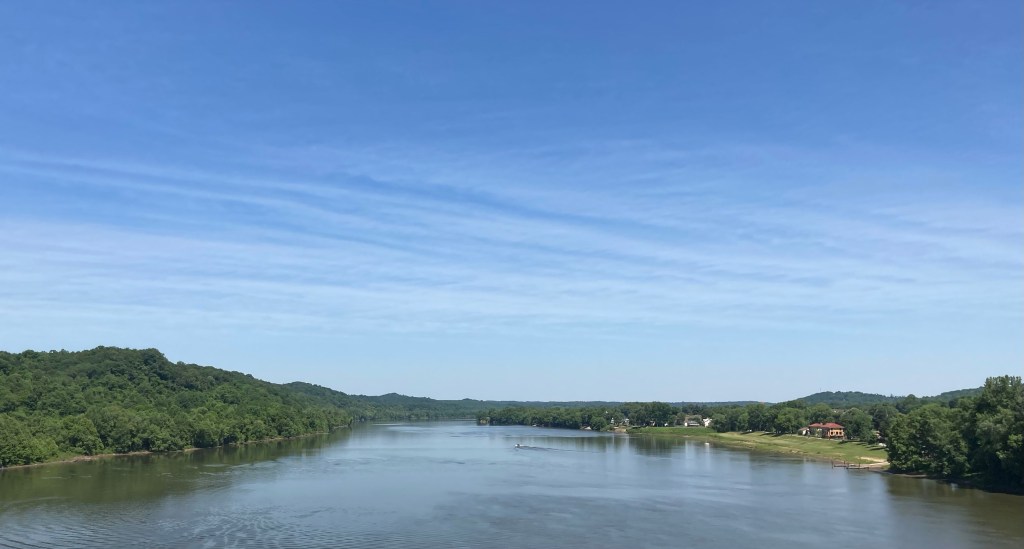
We crossed the Ohio River again recently.
I was reminded of the poem, Whiffs of the Ohio River at Cincinnati, by Carl Sandburg from the collection, Good Morning, America.
The part in particular that goes:
When I asked for fish in the restaurant facing the Ohio river, with fish signs and fish pictures all over the wooden, crooked frame of the fish shack, the young man said, ‘Come around next Friday — the fish is all gone today’
So, I took eggs, fried, straight up, one side, and he murmured, humming, looking out at the shining breast of the Ohio river, ‘And the next IS something else, and the next is something else’
The customer next was a hoarse roustabout, handling nail kegs on a steamboat all day, asking for three eggs, sunny side up, three, nothing less, shake us a mean pan of eggs
And while we sat eating eggs, looking at the shining breast of the Ohio river in the evening lights, he had his thoughts and I had mine thinking how the French who found the Ohio river named it La Belle Riviere meaning a woman easy to look at.
as mysterious as great the perpetual rhythm of the tides
In “Notes for a Preface“, an essay written by Carl Sandburg for the the book “Complete Poems of Carl Sandburg“, Mr. Sandburg wrote, “The Spanish poet Lorca saw one plain apple infinite as the sea. “The life of an apple when it is a delicate flower to the moment when, golden russet, it drops from the tree into the grass is as mysterious and as great as the perpetual rhythm of the tides . . .“
According to Wikipedia: Federico del Sagrado Corazón de Jesús García Lorca (5 June 1898 – 19 August 1936), known as Federico García Lorca was a Spanish poet, playwright, and theatre director.
García Lorca achieved international recognition as an emblematic member of the Generation of ’27, a group consisting of mostly poets who introduced the tenets of European movements (such as symbolism, futurism, and surrealism) into Spanish literature. He was murdered by Nationalist forces at the beginning of the Spanish Civil War. His remains have never been found.
In the poem, Ballad of the Water of the Sea, Lorca writes:
The sea smiles from far off. Teeth of foam, lips of sky.
Folly Field Beach at high tide – Hilton Head Island May 30, 2022
Murdered by the nationalistic or Franco’s forces during the Spanish Civil War, those types of fellers have always had it for the poets and artists and such.
The smart people I guess.
I am reminded of the story of the Pol Pot regime in Cambodia.
When they took over Cambodia they knew they had to cut off opposition and the best way to do that was get rid of the smart people, the people who could think, the people who would ask questions and start other people asking questions.
And so they did.
They soldiers of Pol Pot went from town to town and executed all the smart people.
the sky and the sea put on a show, every day they put on a show
Adapted from Carl Sandburg’s, Thimble Islands, which was published in “Good morning, America” by New York, Harcourt, Brace and Company, 1928.
In searching for the full text of this poem to copy and paste into this essay, I came across a 269 page document from the Office of Education in Washington, DC that had been written by the University of Oregon, titled The Whole Poem Teacher.
Printed in 1971, the first two paragraphs of the introduction state:
In the lessons preceding this one, your class has concentrated on various poetic techniques, isolating them more or less from the total fabric of the poem for the purposes of examination and identification. Such a process is necessary, but it is a rather sterile exercise if it stops there. For the goal of all this investigation has been not the ability to identify poetic devices, but to enjoy more fully the experience of reading a poem. To achieve this goal, it is necessary to “put back” all the isolated elements into the whole poem.
To borrow a useful distinction made by the poet:-critic John Ciardi, we want our students to be able to answer not only the question, “What does this poem mean?” but also the question, “How does this poem mean?” Answering the first question only leads to bad paraphrase and moral- abstracting. Answering the first question in terms of the second, on the other hand, leads to close and intelligent reading, to appreciation of the internal dynamics of the poem, and consequently to a far more sensitive perception of the poem’s “meaning.” For in poetry the way something is said is part of what is being said.
Wanting to avoid the introduction tearing out scene of Dead Poets Society, I think this is rather good as it does not impose a scale but plays on the readers interpretation.
“How does this poem mean?” and “… in poetry the way something is said is part of what is being said.” is good even as it brackets that oh so ponderous statement, “leads to close and intelligent reading, to appreciation of the internal dynamics of the poem, and consequently to a far more sensitive perception of the poem’s ‘meaning.‘”
The document was part of the Oregon Elementary English Project and according to the first line of the abstract, This curriculum guide is intended to introduce fifth and sixth grade children to the study of poetry.
Fifth and sixth grade children?
All I can say about that is to paraphrase the Book of Psalms, Lord Byron and Stephen Vincent Benét (all at the same time!), By the rivers of Babylon, There I sat down and wept, When I remembered Zion.
Here is the Sandburg poem:
THIMBLE ISLANDS
The sky and the sea put on a show Every day they put on a show There are dawn dress rehearsals There are sweet monotonous evening monologues The acrobatic lights of sunsets dwindle and darken The stars step out one by one with a bimbo, bimbo.
The red ball of the sun hung a balloon in the west. And there was half a balloon, then no balloon at all, And ten stars marched out and ten thousand more, And the fathoms of the sky far over met the fathoms of the sea far under, among the thimble islands
In the clear green water of dawn came a float of silver filaments, feelers circling a pink polyp’s mouth. The feelers ran out, opened and closed, opened and closed, hungry and searching, soft and incessant, floating the salt sea inlets sucking the green sea water as land roses suck the land air
Frozen rock humps, smooth fire-rock humps – Thimbles on the thumbs of the wives of prostrate sunken giants – God only knows how many sleep in the slack of the seven seas
There in those places under the sun balloons, and fathoms, filaments, feelers –
The wind and the rain sew the years stitching one year into another




 No Haiku For You