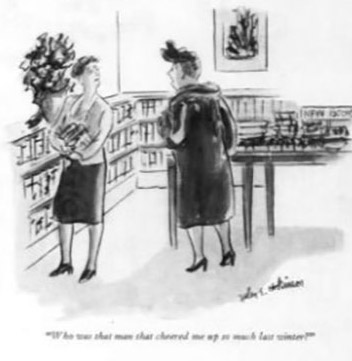
10.23.2025 – I cried over things

I cried over things
knowing no beautiful things,
not one, not one … lasts

Adapted from:

I cried over beautiful things knowing no beautiful thing lasts.
The field of cornflower yellow is a scarf at the neck of the copper sunburned woman,
The mother of the year, the taker of seeds.
The northwest wind comes and the yellow is torn full of holes,
New beautiful things come in the first spit of snow on the northwest wind,
And the old things go, not one lasts.

Autumn by Carl Sandburg in Chicago Poems as published in The Complete Poems of Carl Sandburg, (Harcourt Brace and Company, New York, 1950).

It’s just a building, I know.

And I know it was MASSIVELY renovated under Mr. Truman.

But understand, without much structural attention since being turned over to John Adams and being burned by the Brits in 1812, that building was falling down.

According to wikipedia:

By late 1948, three main options were considered for replacement of the White House:

  • Demolish and rebuild the interior, keeping the exterior walls intact.
  • Demolish the building entirely and construct a new executive mansion.
  • Demolish the building entirely, salvage the exterior walls and rebuild them and a new interior.

Two of the options were DEMOLISH ENTIRELY.

And the decision was made to Demolish and rebuild the interior, keeping the exterior walls intact.

Also from Wikipedia, Historic preservation of buildings during this time was not as strict or defined as it became later. For its time, simply not demolishing the entire structure was deemed “preservation”. Winslow envisioned many of the interior items – from doors, trim, woodwork, and ornamental plaster – would be reused. Most were carefully dismantled, labelled, catalogued, and stored. Much of the paneling was reinstalled in the main public rooms, but other historic elements were simply copied to accommodate increasing cost and time constraints. Many of the original materials that were not deemed of significantly identifiable historic value, such as marble fireplace mantels, or not deemed to be readily reused, such as pipes, were sent to landfills.

So is it the building where Mrs. Adams hung her laundry up in to dry, where Lincoln walked and FDR rolled?

Well not really, but there is this scene in my memory that I read about where Carl Sandburg, visited FDR in what is now the Yellow Room but in that day, was FDR’s study.

Sandburg, according to the story, stood at a window, hand on the window frame, and said something like, “This is where Lincoln stood, looking south to Virginia.”

FDR asked, “How can you know?”

Sandburg responded, “… I can tell.”

That window, the window Mr. Lincoln looked through, the window that Sandberg rested his hand on, that’s still there.

Still there … for now.

10.5.2025 – she predicts either

she predicts either
a war or the end of the
world in October

I know how she feels.

So I had to add another “a” to make it work.

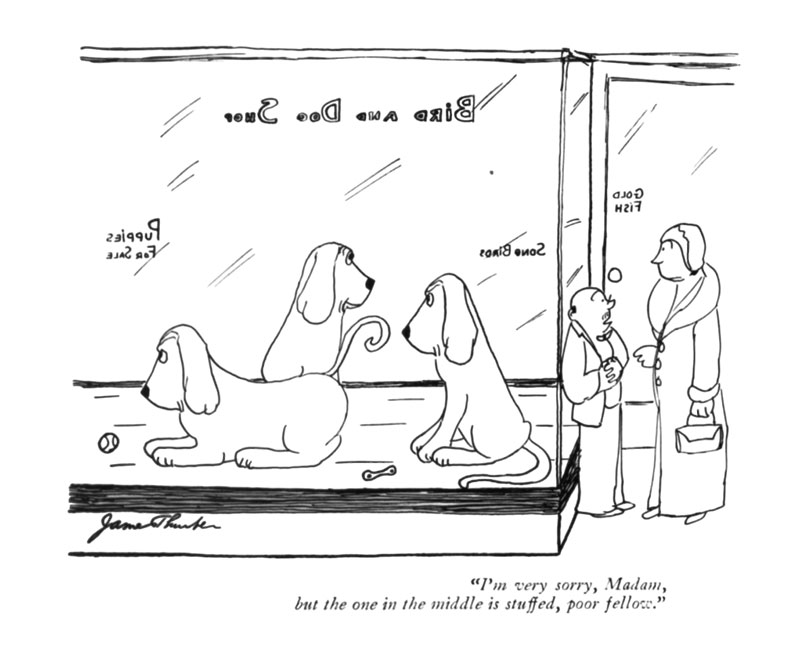
Thurber, depending on the time of day, might have forgiven me.

More Thurber here at formuggsandrex.com.

Reading some odd stuff online I came across in review of the book of Thurber Letters titled The Thurber Letters: The Wit, Wisdom and Surprising Life of James Thurber , edited by Harrison Kinney,

In a reviewer states, Thurber never warmed to William Shawn.

Shawn took over as Editor of the New Yorker when Harold Ross died.

I also recently came across the fact that after three years, Shawn dropped out of the University of Michigan and went to New York to find his fortune.

Thurber never graduated from Ohio State after being a student there for five years.

Both institutions wrestled with how to handle these famous but non-degree holding alums.

But did it also sprout the roots of a non-working relationship?

Some one’s PhD dissertation is waiting to be written.

9.25.2025 – wearing gloves because

wearing gloves because
I don’t want to leave any
fingerprints around

This image was first published in the New Yorker Magazine, 88 years ago today on September 25, 1937.

As I read over my last couple of months of Haiku and posts, I wonder and I worry; have I left too many fingerprints around?

You can peruse almost all of James Thurber’s published drawing online at my Thurber Page, For Muggs and Rex.

Been reading Brendan Gill’s, Here at the New Yorker and its unflattering take on James Thurber.

All I can say is echo EB White’s Obit which began with the line, I am one of the lucky ones; I knew him before blindness hit him, before fame hit him

As for these posts and thoughts, I am typing with gloves on.

I don’t want to leave any fingerprints.

On the other hand …

In the movie Casablanca, when the Germans enter Paris, Ilsa says, “Richard, if they find out your record. It won’t be safe for you here.”

Richard Blaine responds, “I’m on their blacklist already, their roll of honor.

Not a bad list to make I guess.

9.22.2025 – in the middle way

in the middle way
only fight to recover what
has been lost and found

East Coker, V (last section):

So here I am, in the middle way, having had twenty years—
Twenty years largely wasted, the years of l’entre deux guerres
Trying to use words, and every attempt
Is a wholly new start, and a different kind of failure
Because one has only learnt to get the better of words
For the thing one no longer has to say, or the way in which
One is no longer disposed to say it. And so each venture
Is a new beginning, a raid on the inarticulate
With shabby equipment always deteriorating
In the general mess of imprecision of feeling,
Undisciplined squads of emotion. And what there is to conquer
By strength and submission, has already been discovered
Once or twice, or several times, by men whom one cannot hope
To emulate—but there is no competition—
There is only the fight to recover what has been lost
And found and lost again and again: and now, under conditions
That seem unpropitious. But perhaps neither gain nor loss.
For us, there is only the trying. The rest is not our business.”

From Four Quartets by T. S. Eliot (1888-1965), (Harcourt, Brace & Company: New York, 1943) by T. S. Eliot (1888-1965).

I was out walking today in the low country South Carolina town of Bluffton.

Bluffton is part of the reason that this part of South Carolina is showing the fastest growth of almost anywhere in the United States.

Its a small town that back in 1990 had less than 900 people and now has over 40,000.

Things are coming to town like stoplights and roundabouts and sidewalks.

All things going modern and very fast.

Yet, as I walked down the sidewalk I noticed the east west straight line path of the sidewalk took a big loop that was out of line.

See, someone on the town planning commission noticed that make a nice, straight sidewalk, the city would have to take down a long leaf pine tree.

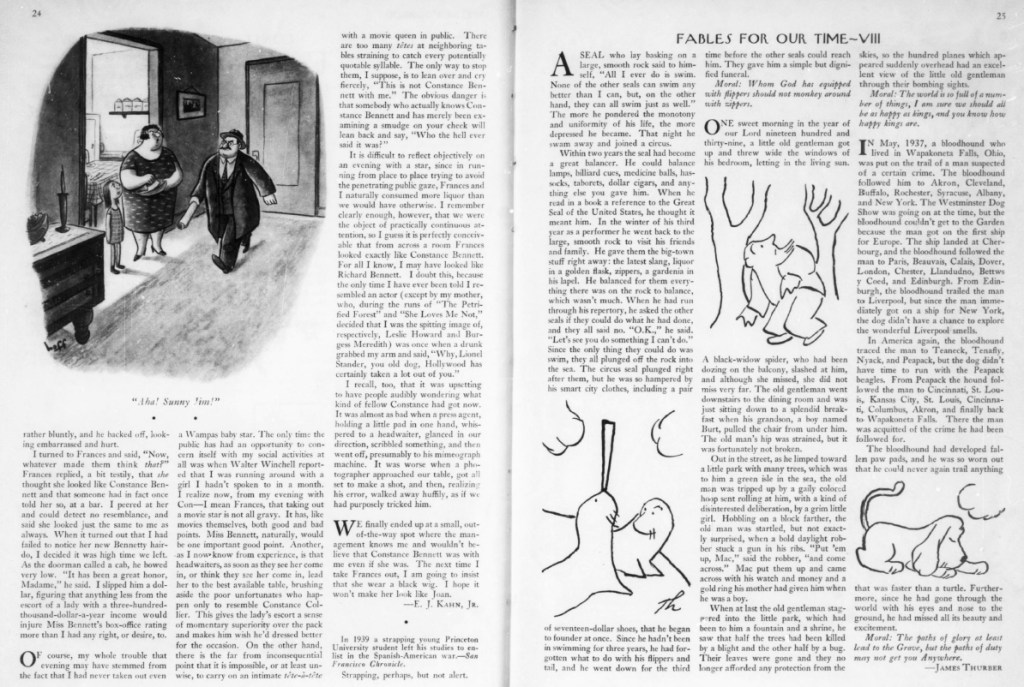
There are two types of pine trees that grow in the low country.

The lob lolly pine, the lumbermans delight, is fast-growing, especially in its first 50 years. Because of this, it’s heavily used in timber and pulpwood plantations where trees are typically harvested at 25–35 years old.

The long leaf pine can is much slower to mature. In its “grass stage,” it may stay low to the ground for up to 5–7 years, putting energy into its root system before shooting upward.

These trees can stick around for 250 to 300 years and some have been documented to have lived 400 years.

In an age when you can’t fight city hall, someone decided this tree which was here before we were and will most likely be here when we are gone, was worth making the effort to make a loop in a stretch of sidewalk.

For some reason, I found comfort in this.

For some reason, I found confidence that there is something here worth the fight.

Maybe we will lose again and again and again.

For us, there is only the trying.

The rest is not our business.

The trees will last longer than we do.

9.20.205 – vituperation

vituperation
and invective failing to
get to the point

A federal judge tossed Donald Trump’s $15bn defamation lawsuit against the New York Times, book publisher Penguin and two Times reporters, and said the suit was filled with “vituperation and invective” and violated civil procedure in federal cases for failing to get to the point.

From the article, Judge strikes down Trump’s $15bn lawsuit against the New York Times by George Chidi in the Guardian.

The Judge who tossed the lawsuit wrote:

A complaint is a mechanism to fairly, precisely, directly, soberly, and economically inform the defendants — in a professionally constrained manner consistent with the dignity of the adversarial process in an Article III court of the United States — of the nature and content of the claims. A complaint is a short, plain, direct statement of allegations of fact sufficient to create a facially plausible claim for relief and sufficient to permit the formulation of an informed response. Although lawyers receive a modicum of expressive latitude in pleading the claim of a client, the complaint in this action extends far beyond the outer bound of that latitude.

This complaint stands unmistakably and inexcusably athwart the requirements of Rule 8. This action will begin, will continue, and will end in accord with the rules of procedure and in a professional and dignified manner.

The Judge told the President’s lawyers to go back to school and AI most likely and come up with a complaint that meets existing standards and gave them 4 weeks to do it.

It is not over but just one more sign for one side, that we are dealing with a clown car of staffers who couldn’t get a job in a meat marker which is really unfair to folks who work in a meat marker and for the other side, that left leaning commie pinko woke judges are standing in the way of might makes what is right.

Just another brick in the wall.

Still I live for the day to read a historical account of this administration that by ALL accounts, it was filled with “vituperation and invective”, failing to get to the point.

To quote Big Bill:

It is a tale
Told by an idiot, full of sound and fury,
Signifying nothing.

Macbeth (Act 5 Scene 5).

See all the Thurber Drawings I could identity at Muggs and Rex – Click here!