just be by myself feel evening breeze, gaze at moon I lost my senses
Stay at home.
Quaruntine.
Is it any wonder we are losing our senses.
As someone said, the problem with common sense is that is it so uncommon.
The words of that old cowboy poet, Cole Porter, keep coming back to my mind.
Okay, so Cole Porter stole the words or came by the words in such a way that a court had to decide they were his.
Not the Roy Rodgers way now is it.
But the words are there anyhow they came to be.
I just don’t like fences.
Oh give me land, lots of land, and the starry skies above Don’t fence me in Let me ride through the wide open country that I love Don’t fence me in
Let me be by myself in the evening breeze And listen to the murmur of the cottonwood trees Send me off forever but I ask you please Don’t fence me in
Just turn me loose, let me straddle my old saddle on Underneath the western skies On my cayuse, let me wander over yonder Till I see the mountains rise
I want to ride to the ridge where the West commences To many words, gaze at the moon till I lose my senses And I can’t look at hobbles and I can’t stand fences Don’t fence me in
Oh give me land, lots of land, and the starry skies above Don’t fence me in Let me ride through the wide open country that I love Don’t fence me in
(for what its worth, Mr. Porter said it was his least favorite song. Go figure?)
all those who knew him, followed him, watched these things stood a distance
Adapted from the verse; “But all those who knew him, including the women who had followed him from Galilee, stood at a distance, watching these things.” Luke 23:49 (NIV)
I have long held that the book of Luke is the result of what is now called ‘Oral History.’
In other words, not only did Luke go an interview as many eyewitnesses as he could, but he crafted those interviews into the narrative that is the Book of Luke in the New Testament.
Luke himself wrote, “… I myself have carefully investigated everything from the beginning, I too decided to write an orderly account for you … “
I am convinced that included in those who Luke interviewed was Mary.
I am convinced that all the stories told from Mary’s point view are based on 1st person interviews with Mary.
I imagine that Luke did his investigation some 50 or 60 years after the death of Christ.
I imagine that at that time, Mary was living in the city of Ephesus, in the home of the Apostle John.
And I feel in my heart that when it came to Good Friday, 50 or 60 years, it was still too much for Mary to describe.
I doubt I will ever see Michelangelo’s Pieta.
But I remember driving back from the beach at Grand Haven, Michigan.
That well traveled route takes you through Spring Lake, Michigan and past St. Mary’s Catholic Church.
On this time it was getting dark and for the first time I noticed a flood lit statue on the corner of the church property.
I remember thinking, “WHAT???” and making an illegal u turn to double back and pull into the church.
Being me, I was scoffing to beat the band.
“OH RIGHT, SURE”, I said as I got out of the car and walked up to the statue.
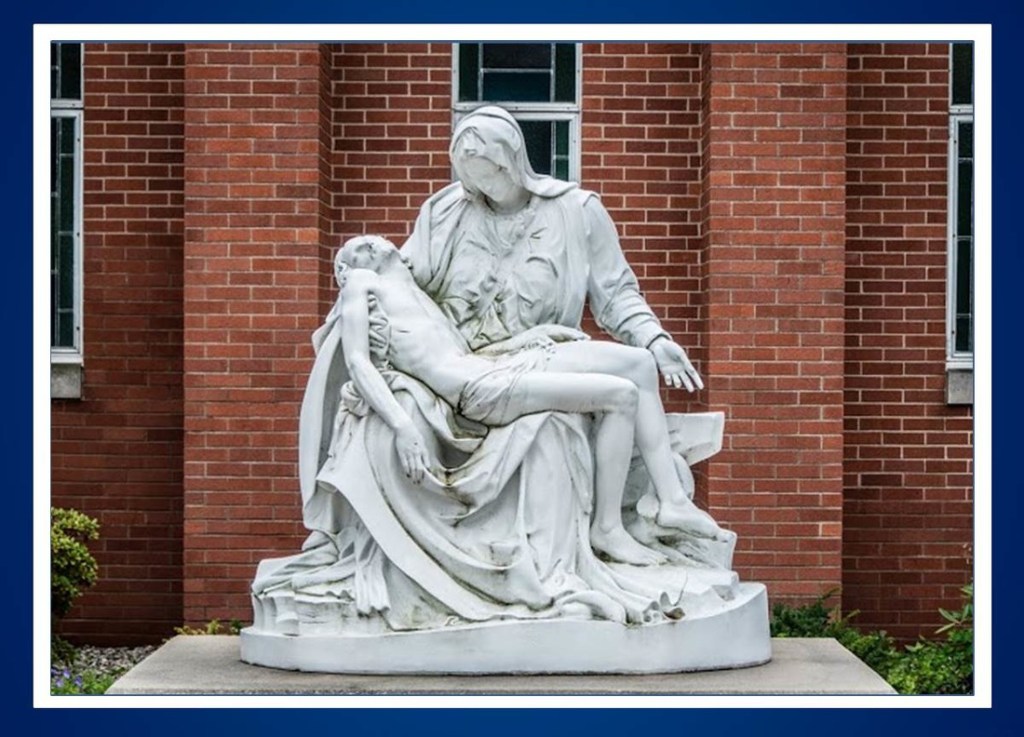
There in front of my, in bright white fiberglass, flood lit glory was a full size copy of the Pieta.
I wanted to shake my head.
I wanted to say, ‘”Are you kidding me?”
But, even in fiberglass.
Even all the same shade of white.
Even with the blaze of floodlights.
The power.
The magic.
The feeling.
To an extent, still came through.
I couldn’t do anything but look.
Its power was overwhelming and drew me like a magnet.
I walked up close.
I could see the same passion of love, a love beyond explaining and like no other.
In her face was also a suffering.
Here, as predicted by the Angel, was a picture of a soul pierced by a sword.
And it was just a copy.
Fiber glass copy of the Pieta by Michelangelo in Spring Lake, Michigan
I cannot fathom what it would be like to see the real thing.
The idea that back in the day (1600-1700) you could walk up to and around the sculpture is more than my poor brain can imagine.
“Here is perfect sweetness in the expression of the head, harmony in the joints and attachments of the arms, legs, and trunk, and the pulses and veins so wrought, that in truth Wonder herself must marvel that the hand of a craftsman should have been able to execute so divinely and so perfectly, in so short a time, a work so admirable; and it is certainly a miracle that a stone without any shape at the beginning should ever have been reduced to such perfection as Nature is scarcely able to create in the flesh.“, so wrote Giorgio Vasari in his 1558 book “The Lives of the Most Excellent Painters, Sculptors, and Architects“
When asked by Luke, Mary could not put her feelings of Good Friday into words.
Somehow, 1500 years later, Michelangelo found expression for those feelings in stone.
I am not going to ever see it in stone.
I guess I will just enjoy and be happy with the fact that I did see a glimpse of those expressions in fiberglass.
POST SCRIPT: As I wrote this and looked at online photos of the Pieta, the radio was playing Handel’s Eternal Source of Light Divine – It was an unexpected Good Friday moment that caused to stop breathing so I wouldn’t interrupt the music.
Lomax and Lomax Ruth Crawford Seeger, Copeland Bonaparte’s Hoedown
Trivia is dangerously close to trivial in the dictionary.
I look at trivia through its roots of tri and via.
Tri means “three” and via means “road” or “path”.
By combining these two roots we discover that the word Trivia actually means “Three Paths”.
The word Trivia itself goes back to the latin, trivium, a place where three roads meet.
I thoroughly enjoy a good tale of Trivia.
A story of how random unknown paths came together to result in something familiar.
The World Wide Web has made it easier to stitch these stories together.
There is so much online.
Maybe all information has just 7 degrees of separation but that is for another time.
Few things I do online make me happier than a navigating the information super highway to find and put together pieces of a puzzle.
Even when there wasn’t a puzzle just five minutes earlier.
An odd fact presented that needs to the next odd fact that leads to the next that results in a fascinating (to me anyway) piece of trivia.
This happened last weekend.
And it happened by accident.
Few pieces of modern American Classical Music have as wide spread recognition as Aaron Copland’s HOEDOWN from the Ballet Rodeo.
I have been familiar with the piece since about as long as I can remember.
While Copland is famous for adapting American Folk Song (Simple Gifts : Appalachian Spring) in my mind I assumed that the music of Hoe Down was all Copland.
It was, for me, his musical signature, if you will.
If you don’t know Copland’s name, you do know this piece of music.
Saturday night I was goofing off online, surfing the world wide web in a stream of conscious random search as new thoughts and questions were presented by whatever I happened to read.
I wanted to hear a piece of music and I opened up YouTube and found the piece and was able to listen to it.
This is a reoccurring theme in this blog that whatever bit of music or song you want to hear, it is just clicks away.
No King or Emperor of Industry Titan ever had command of such resources at their beck and call.
Neither here nor there, but I was thinking of the theme to HBO’s John Adams.
I looked at the YouTube screen as I listened and as YouTube does, several other pieces of music were recommended based on my search.
One fiddle piece caught my eye and I clicked on it.
A trio of two fiddle players and a guitar player were standing around a microphone.
Before any music started, the leader of the trio had to give the life history of the piece they were about to play.
Oh brother.
My attention was called away and I let this video play on as this feller went on and on about this piece called Bonaparte’s Retreat.
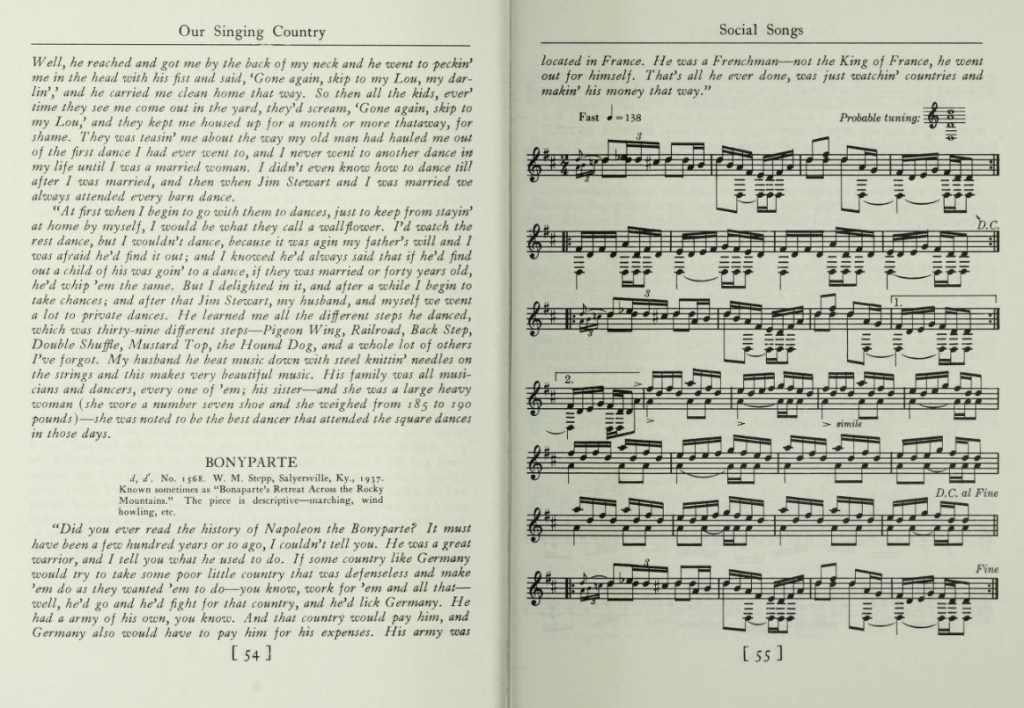
The feller related how it had been recorded by Alan Lomax in 1937.
Big Deal.
Who?
The feller related that the sheet music had been transcribed from the recording by Ruth Crawford Seeger.
Big Deal.
Who?
And the feller went on that it was this sheet music that Aaron Copland used when he composed the section, Hoe Down, of his ballet score, Rodeo.
Wait.
What?
The feller went on to say that this original recording was available on YouTube.
Really.
In seconds I am listening to Bonaparte’s Retreat recorded in 1937.
A little bit shocked but for some reason pleased and excited.
Where was this recording from?
Being the smart guy that I am I knew this had to be a part of the WPA’s depression era writer’s or theater project.
WRONG.
It was due to the work of a the Archive of American Folk Song at the Library of Congress.
And mostly due to the work of just three people, Ruth Crawford Seeger, Alan Lomax and his father, John Lomax.
Now Ruth Crawford married Charles Seeger and Charles had a step-son named Pete.
Pete Seeger came to be quite a name by himself in the folk music scene but that is another story.
Crawford Seeger worked closely with John and Alan Lomax at the Archive of American Folk Song at the Library of Congress to preserve and teach American folk music.
Alan Lomax comes into the picture through the work of his father John.
Alan Lomax (January 31, 1915 – July 19, 2002) according to Wikipedia, was an American ethnomusicologist, best known for his numerous field recordings of folk music of the 20th century. He was also a musician himself, as well as a folklorist, archivist, writer, scholar, political activist, oral historian, and film-maker.
Few words better than ethnomusicologist to have on your resume.
Alan got his start traveling around with his Dad, John Lomax, helping with the field recording of music and folksongs.
They used a state-of-the-art (for 1933), 315 pound phonograph uncoated-aluminum disk recorder in the trunk of their Ford sedan.
And why did John Lomax get into all this in the first place?
As a kid, John Lomax enjoyed singing … cowboy songs.
I had never heard of these three people.
Pete Seeger of course.
And Mr. Copland.
I Ruth Crawford Seeger and Alan and John Lomax now.
By a chance hearing of a story recorded who knows where and loaded to YouTube who knows when, I was able to find a digital copy of the recording and see a copy of the transcription.
In my era, this would have been grad school level research and resulted in an scholarly article.
Today, in seconds, at the clicks of my fingers, it all came together.
A chance hearing and a new window into an old world is opened up.
I shouldn’t get so much satisfaction out of this, but I do.
An odd but real pleasure.
Sometimes, it all fits together.
Technology CAN BE a wonderful thing and I can still be wowed by it.
Call me Larry Lightbulb, but I think it is marvelously cool.
As a final footnote, the Archive of American Folk Song at the Library of Congress lost Congressional funding in 1942.
Mozart, his music library recorded sound and we have it all
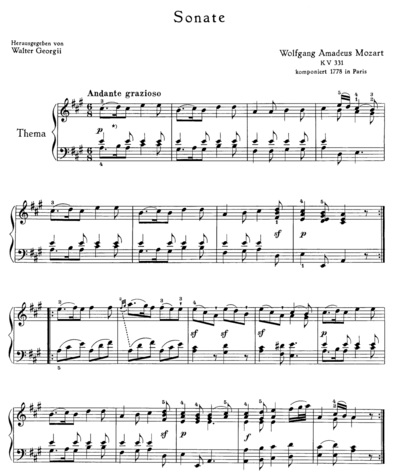
In the movie, Amadeus, Antonio Salieri shuffles through pages of sheet music penned by Mozart and says, ” … music, finished as no music is ever finished. Displace one note and there would be diminishment. Displace one phrase and the structure would fall.”
I often think that had only the 1st measures of this piece survived, Mozart would still be according greatness.
Simple.
Magical.
Simply magical.
What kept this arrangement of notes hidden until Mozart came along?
I like to tell myself that if I ever I managed an accomplishment to equal just the first page of the score of this piece, I could die quite pleased with my life.
I can barely read music.
I have no natural sense of rhythm (no lie, I have to count between stanzas of the Michigan Fight Song or I am yelling, HAIL, HAIL, all by myself).
No musical ability.
But I have the music.
All of it.
Writing the obituary of another musical giant, Alistair Cooke wrote about Duke Ellington, “He has left us, in the blessed library of recorded sound a huge anthology of his music, which never got stuck in the groove from his 28th birthday to his 75th.
When I was in college, my roommate was not only a jazz maniac but also one of the very first knowledgeable jazz critics, and when he left Cambridge – as I did in the summer of 1932 – he wrote in the university weekly a tribute to the Duke. “Bands may come,” he wrote, “and bands may go, but the Duke goes on forever.” In other words, we thought it a marvel that the Duke had ridden out all fashions and lasted five long years. In fact, his music grew and developed through an incredible 47 years, and we have it all.“
Duke Ellington – 31 May 1974 – Letter to America by Alistair Cooke – READ IT HERE – HEAR IT HERE


 No Haiku For You