due to the rising theme over sustained chords that begins the quartet
No. 4 (“Sunrise”) The Quartet No. 63 in B♭ major, Op. 76, No. 4, is nicknamed Sunrise due to the rising theme over sustained chords that begins the quartet.
The opening of the movement begins in a way that seemingly contradicts the allegro con spirito marking. Violin II, viola, and cello sustain a tonic chord while the first violin plays the melody (the “sunrise” motif) on top. In measure 7, the same instruments sustain a dominant seventh chord while the first violin again plays a rising solo on top. In measure 22, all instruments reach forte, and allegro con spirito character is apparent through the sixteenth-note movement and lively staccato eighth notes trading off between the parts. In measure 37, the opening sunrise theme returns, this time with the solo in the cello and the sustained chords in the violins and viola. The lively sixteenth-note section returns in measure 50, beginning with sixteenth notes in the cello which move to the viola, and finally, the violins. In measure 60, all instruments drop to piano for a six-measure staccato eighth-note section before jumping to an all sixteenth-note fortissimo in measure 66 to finish off the exposition.
sang a song they brought … this tune always reminds me of these buoyant days …
Winston Churchill wrote a 6 volume auto biography of his time as British Prime Minister during World War 2.
The 2nd volume, Their Finest Hour, covers the year 1940.
The Battle of Britain, the Battle of the Atlantic and the war in the deserts of North Africa.
In describing the success of some Australia units fighting in the desert, Mr. Churchill writes:
To complete this episode of desert victory, I shall intrude upon the New Year. The attack opened early on January 3. One Australian battalion, covered by a strong artillery concentration, seized and held a lodgment in the western perimeter. Behind them engineers filled in the anti-tank ditch. Two Australian brigades carried on the attack and swept east and southeastward. They sang at that time a song they had brought with them from Australia which soon spread to Britain.
Reading this, I am sure you might be thinking of some song of Australian origin, Waltzing Matilda or … or … well, when talking about songs of Australian origin, I guess that’s it.
Doesn’t matter because that is not where Mr. Churchill was going.
And I bet if I offered you $100 and 100 guesses you would not come up with the words Mr. Churchill recorded in his book.
“Have you heard of the wonderful wizard, The wonderful Wizard of Oz, And he is a wonderful wizard, If ever a wizard there was.”
So he got the words a little wrong.
I have always heard that the single most influential movie of all time is the Wizard of Oz but this was a new look for me.
Mr. Churchill then goes on to say, “This tune always reminds me of these buoyant days. By the afternoon of the 4th, British tanks “Matildas” as they were named—supported by infantry, entered Bardia, and by the 5th all the defenders had surrendered. Forty-five thousand prisoners and 462 guns were taken.“
From what I read, Mr. Churchill ‘wrote’ by dictating to stenographers as he figured out passages of prose.
Also, from what I have read, he like to have an audience as he dictated as it gave him more of a feel for an audience.
Also, he liked to work late at night in his library.
So the scene that comes to mind is the image of Winston Churchill, cigar in hand, singing “We’re of to see the Wizard … The Wonderful Wizard of Oz” as he replays in his mind, the story of World War 2.
Now think of all the songs of World War 2.
Think what songs brought back memories.
For Mr. Churchill?
As he write, “This tune always reminds me of these buoyant days.”
believe it or not won’t find it so hot if you ain’t got that do re mi …
Walked in the office the other day singing:
Hilton Head is a garden of Eden, a paradise to live in or see; But believe it or not, you won’t find it so hot If you ain’t got the do re mi.
Everyone once they got past the singing part thought it was pretty good.
A guy can go far today on nothing but Grouch Marx, Mark Twain and Woody Guthrie as most folks have never heard of these guys and think your humor is original.
Here are the real and complete lyrics to Woody Guthrie’s Do Re Mi.
Lots of folks back East, they say, is leavin’ home every day, Beatin’ the hot old dusty way to the California line. ‘Cross the desert sands they roll, gettin’ out of that old dust bowl, They think they’re goin’ to a sugar bowl, but here’s what they find Now, the police at the port of entry say, “You’re number fourteen thousand for today.”
Oh, if you ain’t got the do re mi, folks, you ain’t got the do re mi, Why, you better go back to beautiful Texas, Oklahoma, Kansas, Georgia, Tennessee. California is a garden of Eden, a paradise to live in or see; But believe it or not, you won’t find it so hot If you ain’t got the do re mi.
You want to buy you a home or a farm, that can’t deal nobody harm, Or take your vacation by the mountains or sea. Don’t swap your old cow for a car, you better stay right where you are, Better take this little tip from me. ‘Cause I look through the want ads every day But the headlines on the papers always say:
If you ain’t got the do re mi, boys, you ain’t got the do re mi, Why, you better go back to beautiful Texas, Oklahoma, Kansas, Georgia, Tennessee. California is a garden of Eden, a paradise to live in or see; But believe it or not, you won’t find it so hot If you ain’t got the do re mi.
as at the moment one is sure that all is lost, look at what is gained!
… he had barely started to turn away from the house when Roxane Coss closed her eyes and opened her mouth. In retrospect, it was a risky thing to do, both from the perspective of General Alfredo, who might have seen it as an act of insurrection, and from the care of the instrument of the voice itself. She had not sung in two weeks, nor did she go through a single scale to warm up. Roxane Coss, wearing Mrs. Iglesias’s slacks and a white dress shirt belonging to the Vice President, stood in the middle of the vast living room and began to sing “O Mio Babbino Caro” from Puccini’s Gianni Schicchi. There should have been an orchestra behind her but no one noticed its absence. No one would have said her voice sounded better with an orchestra, or that it was better when the room was immaculately clean and lit by candles. They did not notice the absence of flowers or champagne, in fact, they knew now that flowers and champagne were unnecessary embellishments. Had she really not been singing all along? The sound was no more beautiful when her voice was limber and warm. Their eyes clouded over with tears for so many reasons it would be impossible to list them all. They cried for the beauty of the music, certainly, but also for the failure of their plans. They were thinking of the last time they had heard her sing and longed for the women who had been beside them then. All of the love and the longing a body can contain was spun into not more than two and a half minutes of song, and when she came to the highest notes it seemed that all they had been given in their lives and all they had lost came together and made a weight that was almost impossible to bear. When she was finished, the people around her stood in stunned and shivering silence. Messner leaned into the wall as if struck. He had not been invited to the party. Unlike the others, he had never heard her sing before.
The priest knew he committed the sin of pride and still he was overjoyed at having been able to play a role in bringing in the music. He was still too dizzy from the sound of Roxane’s voice to express himself properly. He looked to see if the windows were open. He hoped that Manuel had been able to hear a line, a note, from where he stood on the sidewalk. What a blessing he had received in his captivity. The mysteries of Christ’s love had never been closer to him, not when he said the mass or received communion, not even on the day he took holy orders. He realized now he was only just beginning to see the full extent to which it was his destiny to follow, to walk blindly into fates he could never understand. In fate there was reward, in turning over one’s heart to God there was a magnificence that lay beyond description. At the moment one is sure that all is lost, look at what is gained!
From the book Bel Canto by Ann Patchett. New York, Harper Collins, 2001.
What a blessing he had received in his captivity.
The mysteries of Christ’s love had never been closer to him, not when he said the mass or received communion, not even on the day he took holy orders.
He realized now he was only just beginning to see the full extent to which it was his destiny to follow, to walk blindly into fates he could never understand.
In fate there was reward, in turning over one’s heart to God there was a magnificence that lay beyond description.
At the moment one is sure that all is lost, look at what is gained!
What words about music have been more true?
I loved this book.
I don’t know that I could have ended it the way it ended but I can’t imagine it could have ended any other way.
Joy, beautiful spark Daughter from Elysium, magic together
Adapted from the 1st stanza of Schiller’s Ode to Joy.
200 years ago today, The Symphony No. 9 in D minor, Op. 125, a choral symphony, the final complete symphony by Ludwig van Beethoven, composed between 1822 and 1824, was first performed in Vienna.
According to Wikipedia, “Although the performance was officially directed by Michael Umlauf, the theatre’s Kapellmeister, Beethoven shared the stage with him. However, two years earlier, Umlauf had watched as the composer’s attempt to conduct a dress rehearsal for a revision of his opera Fidelio ended in disaster. So this time, he instructed the singers and musicians to ignore the almost completely deaf Beethoven. At the beginning of every part, Beethoven, who sat by the stage, gave the tempos. He was turning the pages of his score and beating time for an orchestra he could not hear.”
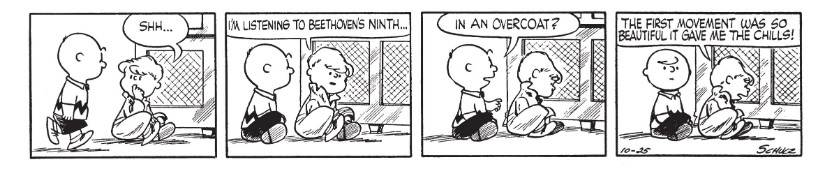
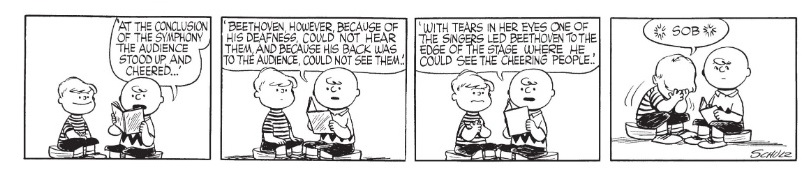
Before ever I had heard this piece of music I had read these comic strips.
They first ran in newspapers in 1957 but as a kid, I read them in a book of Peanuts comic strips that I found on a shelf in our house.
Though I wasn’t even 10 years old, I caught the imagery of the scene and I asked my Dad or Mom what it was all about.
I think my Mom gave me a short thumbnail sketch of the life of Mr. Beethoven and that he was deaf.
I remember thinking that it is was fascinating that music might give someone chills and I asked my Dad if we had this piece of music.
He found a record and played it for me and I think I grabbed a jacket in case I got chills which he thought was pretty funny.
I also checked out Mr. Beethoven at the library and found that the story told in the last panel, that Beethoven was there when the piece debuted and didn’t know that the audience was cheering until some one turned him around, was, if not true, was true enough of what happened that night.
Growing up in my family, my Mom and Dad provided a home filled with music.
We had a piano and an organ that would have been at home in Wrigley Field.
(I would often catch my Dad playing the Star Spangled Banner and knew he was pretending to be playing at a ball game … not that he would admit it)
There were two record players, my Dad’s which we were not supposed to touch and another one out on counter top that we all had access to.
That counter top ran the length the Living Room and it was buried in stacks and stacks of LP records.
We were all encouraged to take up a musical instrument but I found out that my lack of rhythm meant I would never play an instrument or sing.
Instead I just listened.
I remember once in third grade, the Grand Rapids Public School Music Teacher (who came once a month) played the class a Charles Ives modern classical piece that was supposed to be a scene in his life where two bands passed each other in a parade and what that sounded like.
I raised my hand and asked if Charles Ives could hear?
The Music Teacher kinda squinted at me and answered, “Yes”, she was sure Mr. Ives could hear.
To which I replied, “And he wrote THAT and Beethoven was deaf and wrote all those symphonies.”
The Music Teacher stared at me, I was 10, with a cropped haircut, brand new brown plastic glassed and my front tooth had just been chipped off in half.
I sure looked the part.
She looked over at my 3rd grade teacher who just shrugged as if to say, ‘Don’t ask me.”
And the Music Teacher went on with her lesson.
It was one of those days when my drummer was beating a different tune really loud.
But I digress.
200 years ago.
No one knows really but I think that scene in the movie, Immortal Beloved, on the life of Mr. Beethoven, might not look like the debut of the 9th Symphony really did, but I bet it captures the mood.
200 Years ago tonight and the world heard a new sound.
Before that night no one had heard the signature melody that also become the hymn, Joyful, Joyful, we adore thee …
Hard to imagine.
More than 50 years late, I still find it all fascinating.
Here are the lyrics in English …
O friends, not these tones! But let’s strike up more agreeable ones, And more joyful.
Joy! Joy!
Joy, beautiful spark of Divinity, Daughter of Elysium, We enter, drunk with fire, Heavenly one, thy sanctuary! Thy magic binds again What custom strictly divided; All people become brothers, Where thy gentle wing abides.
Whoever has succeeded in the great attempt, To be a friend’s friend, Whoever has won a lovely woman, Add his to the jubilation! Yes, and also whoever has just one soul To call his own in this world! And he who never managed it should slink Weeping from this union!
All creatures drink of joy At nature’s breasts. All the Just, all the Evil Follow her trail of roses. Kisses she gave us and grapevines, A friend, proven in death. Ecstasy was given to the worm And the cherub stands before God.
Gladly, as His suns fly through the heavens’ grand plan Go on, brothers, your way, Joyful, like a hero to victory.
Be embraced, Millions! This kiss to all the world! Brothers, above the starry canopy There must dwell a loving Father. Are you collapsing, millions? Do you sense the creator, world? Seek him above the starry canopy! Above stars must He dwell



 No Haiku For You