
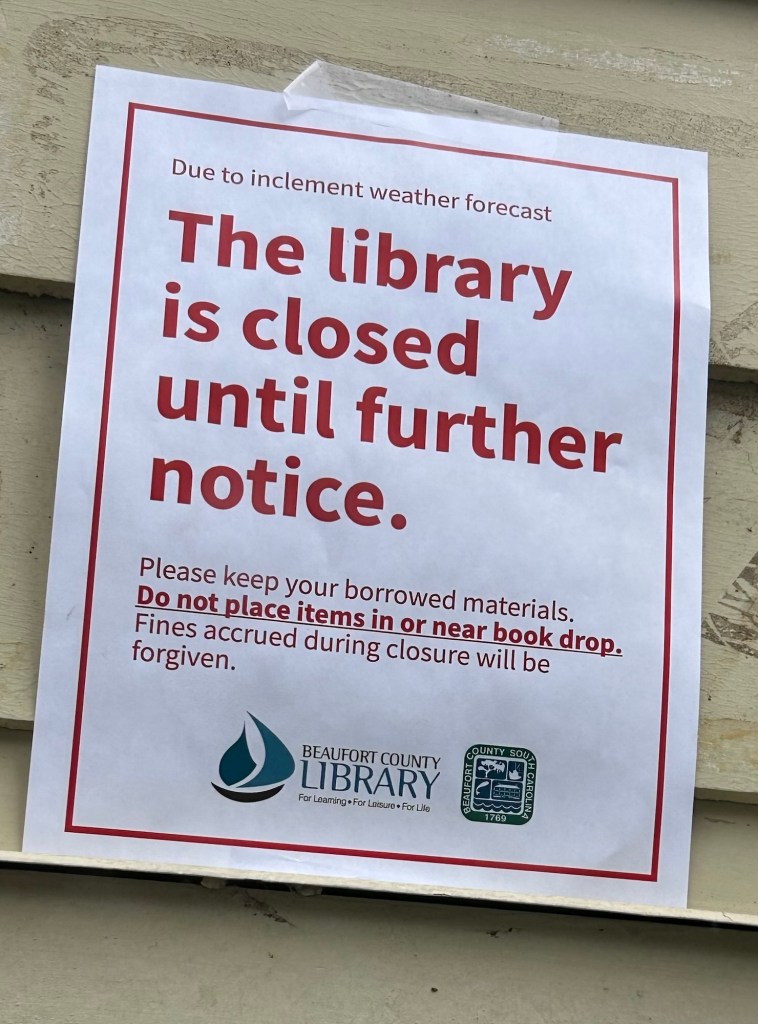
library closed
fines accrued during closure
will be forgiven
Watching the weekend weather, all the maps showed the cold and wet and snow swoop down out of the north … and come up short of our little corner of South Carolina.
That was close enough for most Government offices and businesses down here.
I got a number of emails and texts
And on Saturday afternoon some sort of visible precipitation started to fall, emergency emails and text messages poured into my phone.
As temperatures fall below freezing tonight, melt water may freeze and create icy spots on paved surfaces such as bridges and overpasses, primary and secondary roads, parking lots, sidewalks and driveways. Black ice is difficult to see and distinguish from dry surfaces. The deceptive nature of black ice can catch you unaware while you are driving or walking, causing you to lose control of your motor vehicle or to slip and fall.
And
Motorists are urged to use extreme caution, especially on roads that are less traveled, shaded areas, bridges, and overpasses, where ice may not be visible.
They talk an awful lot about ‘black ice’ down south and most locals will say that from birth they are told to stay away from the dread ‘black ice’.
I am convinced that the locals are convinced that if they drive on black ice, the car blows up.
But we got out.
The coffee shop we drove to … was closed.
Roads we wanted to use … were blocked.
We got to the library to see the building all dark and a sandwich board outside the front door saying that due to the weather, the library was closed.
We drove around back to use the drive-thru book return to see that THE BOOK RETURN was closed due to weather.
Now that was something new.
Never had I seen weather so bad that library books couldn’t be returned.
Not to worry though, as the sign said, fines accrued during closure will be forgiven.
WOW.
I was shocked.
And reminded of the time I was working with a sweet little lady name Rose at the Cascade Branch of the Kent District library.
A patron came in with an unusual hard cover red bound book and engaged Rose in a long conservation about overdue books, damaged books and late fees.
I listened but stayed out of the conversation and let Rose handle the whole thing.
The patron explained and they talked and the patron explained and Rose listened.
The patron smiled and explained and Rose listened.
I kept to myself and just stayed out of it.
The conversation wound down as did the Patron and Rose took the red bound book, walked over to the cash register and rang up an amount and the patron paid up and left.
At the end of the library day, we would close the doors and do some clean up, straighten chairs and wait for whoever was in charge to finish closing up.
We would all end up in the back room by the door and we would chat for a few minutes.
With everyone else in a group standing there, including Diane, the wonderful Library Director, I asked, “Rose, what was the deal with that lady’s book?”
“OH,” said Rose, “Her kids got a bird guide and then left it out on their back deck in the rain.”
“What did she say she did?” I asked (all so innocent).
“OH,” said Rose, “She said the binding fell apart so she took it to a rare book dealer to be rebound.”
Hence the bright red hardbound cover of this ordinally paper bound bird book.
“Gosh,” says I, “what did she say that cost?”
By now everyone on the staff knew I was up to something and were waiting to hear this through.
“OH,” said Rose, “She said it cost $30 to be rebound and it took a while, so it was late.”
“Wow,” I said, letting that sink in.
Then I said …
“Rose … how much of a fine did you charge her?”
“Oh,” said Rose, “$4.00.”
Rose, that poor sweet lady, looked all confused as everyone broke out laughing and Diane looked at me, shaking her head with one hand over her mouth.
“Well,” said Rose, “she maxed out. $4.00 was the most I could get.”



 No Haiku For You