was good night and day, winter, summer, spring and fall, dull days and bright days
Adapted from the passage:
Mr. Zuckerman took fine care of Wilbur all the rest of his days, and the pig was often visited by friends and admirers, for nobody ever forgot the year of his triumph and the miracle of the web.
Life in the barn was very good—night and day, winter and summer, spring and fall, dull days and bright days.
It was the best place to be, thought Wilbur, this warm delicious cellar, with the garrulous geese, the changing seasons, the heat of the sun, the passage of swallows, the nearness of rats, the sameness of sheep, the love of spiders, the smell of manure, and the glory of everything.
From the book, Charlotte’s Web by E.B. White (Harper and Row: New York, 1952).
Thinking of the seasons and wondering if this line of words may be the best ever at described what happens and the earth spins around the sun every 365 days.
Night and day, winter and summer, spring and fall, dull days and bright days.
telling myself, I was impressed, had to be some impression in it
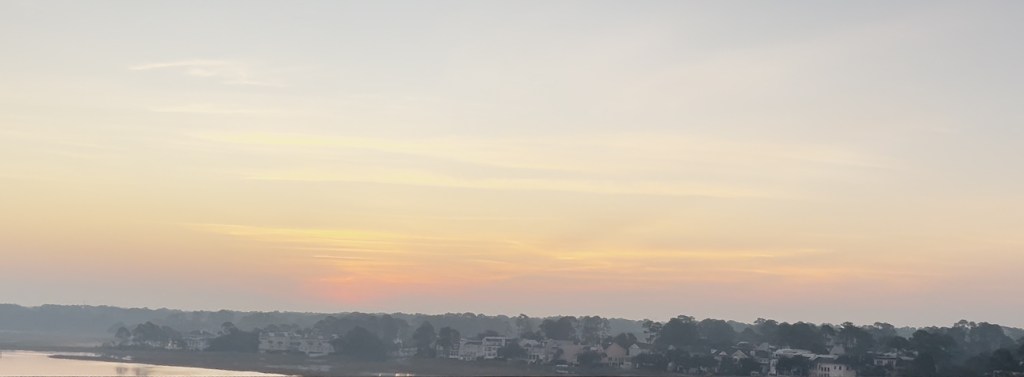
Impressions of Sunrise over Hilton Head, 11/20/2205
Impression I was certain of it. I was just telling myself that, since I was impressed, there had to be some impression in it — and what freedom, what ease of workmanship! A preliminary drawing for a wallpaper pattern is more finished than this seascape.
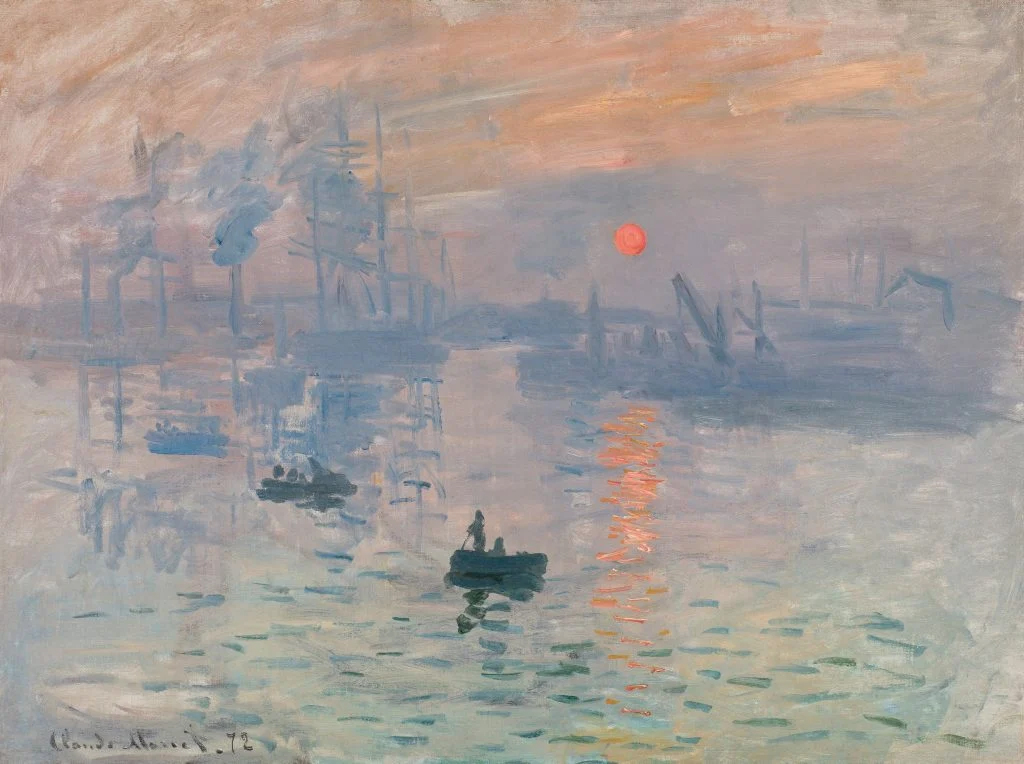
Louis Leroy’s review of the painting, Impression, Sunrise, was printed in Le Charivari on 25 April 1874.
Claude Monet, Impression, Sunrise (1872)
According to Wikipedia, While the movement and the painting initially garnered controversy, Monet’s Impression, Sunrise gave rise to the name and recognition of the Impressionist movement, arguably exemplifying more than any other work or artist the Impressionist movement as a whole in style, subject, and influence.
Driving to work this morning I could see the sunrise.
I was just telling myself that, since I was impressed, there had to be some impression in it.
Jesus says clearly at the end of the world, we’re going be asked …
Jesus says very clearly at the end of the world, we’re going to be asked, you know, how did you receive the foreigner? Did you receive him and welcome him or not? And I think that there’s a deep reflection that needs to be made in terms of what’s happening.
“When the Son of Man comes in his glory, and all the angels with him, he will sit on his glorious throne. All the nations will be gathered before him, and he will separate the people one from another as a shepherd separates the sheep from the goats. He will put the sheep on his right and the goats on his left.
“Then the King will say to those on his right, ‘Come, you who are blessed by my Father; take your inheritance, the kingdom prepared for you since the creation of the world. For I was hungry and you gave me something to eat, I was thirsty and you gave me something to drink, I was a stranger and you invited me in, I needed clothes and you clothed me, I was sick and you looked after me, I was in prison and you came to visit me.’
“Then the righteous will answer him, ‘Lord, when did we see you hungry and feed you, or thirsty and give you something to drink? When did we see you a stranger and invite you in, or needing clothes and clothe you? When did we see you sick or in prison and go to visit you?’
“The King will reply, ‘Truly I tell you, whatever you did for one of the least of these brothers and sisters of mine, you did for me.’
“Then he will say to those on his left, ‘Depart from me, you who are cursed, into the eternal fire prepared for the devil and his angels. For I was hungry and you gave me nothing to eat, I was thirsty and you gave me nothing to drink, I was a stranger and you did not invite me in, I needed clothes and you did not clothe me, I was sick and in prison and you did not look after me.’
“They also will answer, ‘Lord, when did we see you hungry or thirsty or a stranger or needing clothes or sick or in prison, and did not help you?’ “He will reply, ‘Truly I tell you, whatever you did not do for one of the least of these, you did not do for me.’
No one who reads these posts can be unaware that I accept the Bible as the inspired Word of God.
By that I mean, while people on earth wrote the words down, the words themselves came from God.
With that in mind, I join the long line of folks who accept God as one of the greatest writers ever.
Consider that we can show these manuscripts are 1,000s of years old and have been translated and re translated over and over again and still the impact of the WORDS and the sentence structure and the plot and the narrative that comes through in this short passage in Americanized English, is truly amazing as writing.
The power of the words and the story survives and comes through.
You can see a Stephen King plot where someone is in court and defiantly says to a Judge, “when did I see you hungry or thirsty or a stranger or needing clothes or sick or in prison, and did not help you?“
And the Judge hits the gavel and says quietly, “Truly I tell you, whatever you did not do for one of the least of these, you did not do for me.”
The echoes of this simple sentence reverberate down to the basement of any library.
If you read this in the King James English, its line out of Shakespeare.
I was a stranger,
and ye took me not in:
naked,
and ye clothed me not:
sick, and in prison, and ye visited me not.
That being said, how can folks who live by this book not see the point here?
But who am I to point that out.
I understand those other verses too.
I am not without sin and cannot throw any stones.
I got a log in my eye and shouldn’t point out the sliver in the eyes of other people.
Maybe this is where the author was going when in the Book of Philippians, Chapter 2, he wrote, “continue to work out your salvation …with fear and trembling”.
The Last Judgement by Michelangelo – it is located at the far end of the Sistine Chapel so the Cardinals can look at it when they select a Pope.
still, half a sixpence better than half a penny is better than none
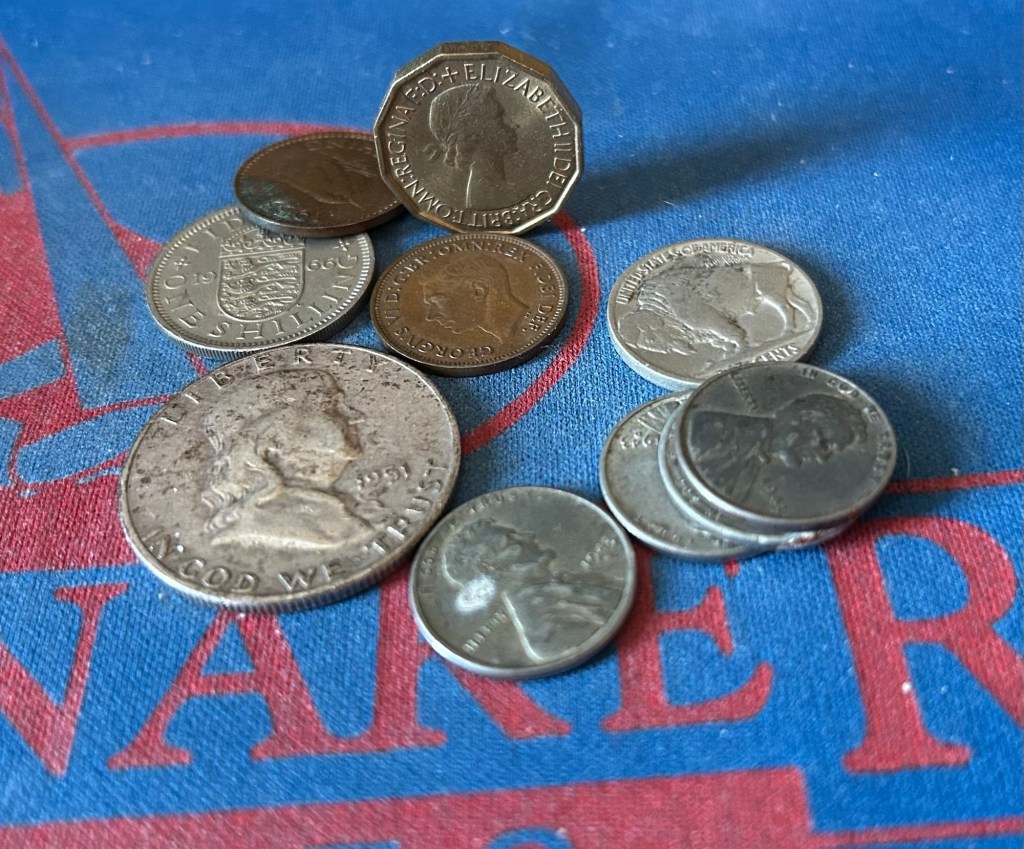
Clockwise from the top, a UK 3 penny piece or a thrupence, Buffalo Nickel (also known as an Indian Head Nickel), Steel Pennies from WW2, Franklin Half Dollar, UK Shilling and UK Brass Farthings (KGVI – worth 1/4 of a cent)
Today’s Haiku is based on some verse from the 1963 Musical, Half a Sixpence). According to Wikipedia, Half a Sixpence is a 1963 musical comedy based on the 1905 novel Kipps by H. G. Wells, with music and lyrics by David Heneker and a book by Beverley Cross. It was written as a vehicle for British pop star Tommy Steele.
I had no idea it was a based on a book by HG Wells.
The line in question goes:
Still, half a sixpence Is better than a half a penny Is better than a half a farthing Is better than none
I do remember it was selected as the High School Musical at Grand Rapids Creston High School when my little brother Steve was in the choir and he got the part of the evil brother who tries to steal the fortune of the hero.
Never thought much about the play until years later when I read the autobiography of John Cleese who wrote that in 1963 he and a bunch of his buddies from college took a comedy review to New York City and the shows producer saw him and offered him the role mostly due to his British accent. Cleese writes that was astounded to find himself, at age 24, in a Broadway Musical playing the evil brother.
And it clicked.
Hey, that was Steve’s part!
The idea that the United States Penny with Mr. Lincoln on it is no longer being made go me thinking about coins.
According to some sources, the visage of Mr. Lincoln on the penny is the single most viewed work of art in history.
At one time Branniff Airlines had Alexander Calder paint some of their planes and claimed that one of them, “The Flying Colors of the United States”, christened by First Lady Betty Ford and flown on its inaugural flight to Grand Rapids, Michigan was also a work of art and IT was seen by more people than any other single work of art in the history of the world. There is some question about that number as it would appear that when the plane flew over New York City, Braniff would claim that 8 million people looked up and saw it … as a tiny dot in the sky. As Mr. Frank Lloyd Wright would have said, “There you are.”
But I digress.
Thinking again about coins, I thought back to when I friend of mine was planning a trip to Great Britain and asked if I wanted anything.
I did.
I wanted some British coins.
Thinking of the line from My Fair Lady, whenever Alfred P. Doolittle comes on the scene, everyone prepares for him to ask for money and they cut him off saying, ‘NOT A BRASS FARTHING.”
I had to look it up.
Understand coins had some value based on what they were made of.
Golden Guineas.
Silver Shillings. (I always loved this bit of useless knowledge that Brits use £ and in each £ are 20 silver shillings. Back in the day and I mean Henry Vth days, 20 Silver Shillings weighed … one pound.)
Copper Pennies.
Farthings, worth 1/4 of cent or 4 to a penny were made of brass.
So I asked for some brass farthings.
And maybe a two penny or three penny or even a six penny piece, knowns as Tuppence, Thrupence and Sixpence coins.
My friend returned from her trip and came in my office and slammed the coins down on my desk.
“I had to go to three different antique stores,” she said.
As un aware as any of what happened in Great Britain, the coinage system of the revolutionary war, Dicken’s and Yeats, Forester and Orwell had disappeared in the late 1970’s though it took decades for people to forget about ‘New Money’.
I mean it was time.
As Alistair Cooke wrote about Thomas Jefferson on old money, “His objections to the laboriousness of pounds, shillings, and pence anticipated by two hundred years the wisdom of the British government: the ordinary man or woman “is used to be puzzled by adding the farthings, taking out the twenties and carrying them on; but when he came to pounds, where he had only tens to carry forward, it was easy and free from error.” He suggested that, since “everyone knows the facility of decimal arithmetic,” it should be adopted in the coinage “to the great ease of the community.”
Still hard to understand that we no longer need the penny.
Or that it costs more to make a penny that a penny is worth.
In other words, for every Penny that got minted, the US Government lost 2 cents.
Right there is the old Catch 22 of buying eggs for 5 cents and selling them for 3 cents.
Boy Howdy but it gets confusing.
What was the worth of a penny today?
And the old saying, at one point you reach the age where anything less than a Quarter isn’t worth picking up.
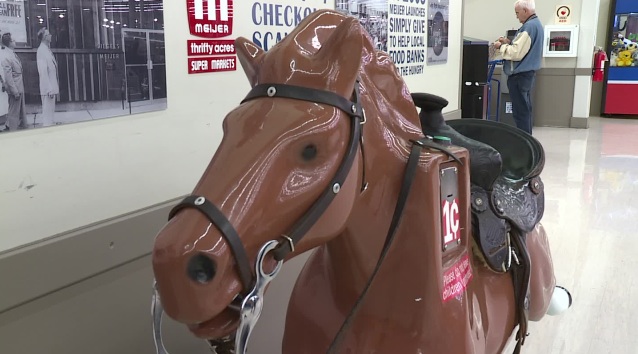
But it was good to hear that up north, Meijer Stores will continue its penny pony rides.
If you grew up in West Michigan, like I did, you rode one of those Penny ponies.
My wife would take our 2 year son, in full Cowboy Regalia, to ride that penny pony.
What’s the worth of that?
To many of us, priceless.
So shines a good deed in a weary world.
Still, half a sixpence Is better than a half a penny Is better than a half a farthing Is better than none.





 No Haiku For You