7.16.2023 – epiphany when

epiphany when
I met paint – didn’t know word
artist, what it meant

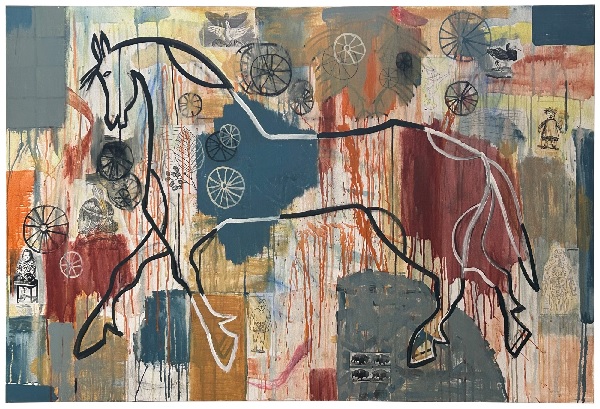
I caught an interview with Jaune Quick-to-See Smith on CBS Sunday Morning.

There is or there used to be a saying that they wrap fish in yesterday’s newspapers.

After 20 years in TV news, I marvel at these wonderful production pieces like Jaune Quick-to-See Smith: Raising Indigenous voices throughout her art that too few people watched and will ever see.

I remember the number of times people would reach out to the TV station I worked at in Grand Rapids Michigan and say, “I was on your Bozo the Clown show sometime in January, 1973. Is it possible to get a copy of that show from your archives?”

The point being here there are no or at least very limited video archives and you can’t wrap fish up in them anyway.

But I digress.

The words in today’s haiku are from a quote in the piece that I heard when I watched the it this morning and I was intrigued enough to watch the video to copy down the quote.

I will try to learn more about Jaune Quick-to-See Smith.

As is too easy to do online, I did find a quote of her’s that I am wrestling with.

She is quoted saying, Art should reveal the unknown, to those who lack the experience of seeing it.

Art should reveal the unknown is good.

But do I lack experience in seeing art or seeing the unknown.

And in seeing the unknown, if I see it, is it still unknown?

Take someone watching the tide come in for the first time.

They know what they see but the force bringing the water … is still unknown.

Thoughts to start a week and end the 62 year of my life with a new year starting tomorrow.

Arlee LedgerPony – 2015

7.15.2023 – distinction between

distinction between
the push of past versus the
pull of the future

Any historian worth his salt knows how to eschew monocausal explanations of human events — that is, the attribution of a single motive to any given decision.

And there is another necessary distinction, the one between motives and purposes (the first a push of the past, the second the pull of the future), for rare are also those instances when the purposes of a decision are singular or exclusive.

I was struck by this phrase written by by John Lukacs in his book, Five days in London, May 1940 (New Haven, ale University Press, 1999).

It brought to mind the old discussion (and forgive me for my use of pronouns) between the idea that men make their time (The important man theory of narrative history) against the idea that times make the men (The social view of history).

As I was taught, Hitler impacted his world or the world as it existed in the middle 1900’s created the vortex that vomited out a Hitler and had not Hitler existed, another person would have been created by the spirit of the time or Zeitgeist.

I guess I go both ways.

The boiling angst of post WWI Europe was going to lead to someone or something at sometime.

The fact is that Hitler DID show up in 1932 and his arrival on the stage had a great impact on the world at that time.

In the grand scope of things, 20 or 30 years either way in the history of the world may not mean much, but for those people alive and soon to be dead, that Hitler showed up in 1932, the man and his times had a great impact.

So I DO think that the former President could have been created by the times.

But the man and the moment, for better or for worse, met.

With consequences unforeseen, the man and the moment met.

The push of the past and the pull of the future called for someone and that someone turned out to be Mr. Trump.

Maybe not a single motive but I do feel that the term monocausal explanation kind fits as I think you can look at a lot, and I mean A LOT or what is impacting us today can be traced to this one person being in office.

It leads to easy speculation, on just one topic, how this country and this world would have reacted to COVID had the President of the United States and ‘Leader of the Free World” had provided leadership.

I think I will leave it there.

The push of the past, the pull of the future and the impact of one person.

Maybe this was best depicted in the life of George Bailey in the movie, “It’s a Wonderful Life” which was a box office failure and rarely watched until NBC discovered it as a cheap holiday on air filler but I digress.

I imagined a time where an Angel came down to me and asked had I ever thought about a world where I hadn’t been born.

He snaps his fingers and we visit a world where I had never been born and it turns out that everyone was better off and having a great time.

The Angel looks at me and shrugs and says sorry, sometimes these things don’t work out.

Then the Angel has me click my heals three times, I am wearing black loafers, and say there is no place home and bang, zoom here I am.

One of those rare those instances when the purposes of a decision was both singular and exclusive.

7.9.2023 – okeechobee mess

okeechobee mess
for decades, festered out of
public consciousness

I enjoyed reading It’s Toxic Slime Time on Florida’s Lake Okeechobee by Dan Egan (author of “The Devil’s Element: Phosphorus and a World Out of Balance” and a journalist in residence at the Center for Water Policy at the University of Wisconsin-Milwaukee’s School of Freshwater Sciences) in the New York Times on July 9, 2023.

Well written and informative, it was one short line that chilled my heart.

The Okeechobee mess, caused mainly by phosphorus-based agricultural fertilizers, festered out of the public consciousness for decades.

That last bit, festered out of the public consciousness for decades.

You cannot read this article and not come away with the standard, ‘yes, its a problem and something SHOULD be done.’

But it festered out of the public consciousness for decades.

Folks heard about the problem.

Folks were aware of the the problem.

Folks didn’t like the problem and the problems the problem brought with it.

Folks were all in agreement that something should be done about the problem.

But it festered out of the public consciousness for decades

Festered …

When I was a kid, I spent my summers on shore on Lake Michigan.

I remember one day when I was about 12, walking the beach, I ran my hand along a piece of driftwood and I managed to get a big sliver under the nail of my index finger.

It hurt.

It hurt a lot.

But I didn’t tell anybody.

I didn’t tell anybody as I knew that when I did, my Dad would want to look at it and then he would tell me the sliver would have to come out.

My Dad was a Dentist and his solution to most ailments was to yank them out.

When I was 9, I broke a top front tooth.

A few years later, he had me in the chair to cap the broken tooth.

It was years before we had a relationship again.

So I kept quiet.

It hurt but I kept quiet.

At least I kept quiet until my finger swelled up to the size of hot dog and turned purple.

My Dad caught sight of it and said, “Let me look at you finger.”

Then, “WHAT DID YOU DO?”

I explained I had picked up a sliver but I would handle it.

My Mom came over and looked at my finger.

The sliver had started to fester and ooze was oozing out under the nail.

It looked bad.

It looked scary.

“Should you take him to the Emergency Room?” Mom asked?

“We’ll go the office,” said my Dad, “I can get it out.”

Nobody asked me what I wanted to do.

We got to my Dad’s office and he turned on a few lights.

He went to an operating and turned on the big dental light and turned on the other dental equipment like the spit sink and such, out of habit I guess.

He gestured to the chair and told me climb up.

Then he raised the chair and swung a tray in front of me.

He covered the tray with a white towel and told me to lay my hand on the tray.

He then rummaged in his equipment cabinet.

The last time that happened, he came out with a hammer to hammer my new tooth into place.

This time he came out with a dental syringe and needle and a vial of Novocain and gave me pain killing shot in my wrist.

He kept pocking my finger and when he decided my finger was numb, my Dad dug into my swollen finger with one of those sharp little dental hooks.

I screamed and yanked my hand back.

My Dad says, “THAT DOESN’T HURT! I GAVE YOU A SHOT OF NOVOCAIN!”

I yelled back, “In wrist, not my jaw. Are you sure it was the right place?”

He looked at me for a second.

Picked up the syringe and gave my wrist another shot.

He waited a few more minutes then he pinched my finger and didn’t flinch.

Both of us were satisfied and he dug into my finger and in a short time, he pulled this chunk of wood the size of about a half inch piece of spaghetti out from under my finger nail.

A lot of ooze and pus and other ucky stuff dribbled out.

The relief was instant.

Relief that the sliver was out.

Relief that my finger felt better.

Relief that Dad was done.

He wrapped my finger in some gauze and he wrapped up the sliver to take home to show Mom.

I had a problem.

A problem that I wanted to be done with.

A problem that I wanted to forget about.

But the problem festered.

And it became a bigger problem.

I needed relief but festering out of consciousness was not going be any help in the short run or the long run.

But festering out of the public consciousness is too often the solution or at least the solution, de facto.

I think of other problems.

Weapon violence.

Climate change.

The angst against the Church.

The angst within the Church.

Folks are aware of the problems.

Folks don’t like the problems and the problems that the problems bring with them.

Folks are in agreement, not about the problems themselves, but that something needs to be done about the problems.

And, I know in my heart, they will all festered out of the public consciousness.

Truly, for evil to triumph, we just need to bored or maybe overwhelmed to the point that problems fester out of the public consciousness.

And some folks plan on that.

7.6.2023 – deep embarrassment

deep embarrassment
only after did I learn
of the monument

I recently read of a video that captured a tourist in Rome carving his initials into the bricks of the Colosseum.

The tourist in question has announced that, “It is with deep embarrassment that only after what regrettably happened did I learn of the antiquity of the monument.”

The feller made the effort to take a trip to Rome.

The feller made the effort to see the Colosseum.

But he couldn’t tell you why he made the effort or at least that the effort was not made due to the antiquity of the monuments that fill the City of Rome.

I am reminded of the short piece,

One of my favorites was “Demolition of the Cathedral at Chartres” in comedian Steve Martin’s book Cruel Shoes.

Mr. Rivers was raised in the city of New York, had become involved in construction and slowly advanced himself to the level of crane operator for a demolition company. The firm had grown enormously, and he was shipped off to France for a special job. He started work early on a Friday and, due to a poorly drawn map, at six-thirty one morning in February, began the demolition of the Cathedral at Chartres.

The first swing of the ball knifed an arc so deadly that it tore down nearly a third of a wall and the glass shattered almost in tones, and it seemed to scream over the noise of the engine as the fuel was pumped in the long neck of the crane that threw the ball through a window of the Cathedral of Chartres.

The aftermath was complex and chaotic, and Rivers was allowed to go home to New York, and he opened up books on the Cathedral and read about it and thought to himself how lucky he was to have seen it before it was destroyed.