‘Once, after I did a presentation, someone came up to me and said, ‘I don’t get eight hours of sleep a night. Am I going to die?’” says Prof Russell Foster, head of the Sleep and Circadian Neuroscience Institute at the University of Oxford. “And I said, ‘Well, yes, you’re going to die. But, you know, we all die eventually.’”
Which brought to mind Big Bill and the speech of Hamlet which I paraphrase here:
To die, to sleep, no more; and by a sleep to say we end The heart-ache and the thousand natural shocks That flesh is heir to.
To die, to sleep; to sleep, perchance to dream—ay, there’s the rub, for in that sleep of death what dreams may come, when we have shuffled off this mortal coil,
Must give us pause—there’s the respect that makes calamity of so long life but that the dread of something after death, makes us rather bear those ills we have than fly to others that we know not of?
Thus conscience doth make cowards of us all ...
I must be getting old though a recent location chnage has dropped me on an island where the median age is 62 I am middle aged again.
On that theme of getting older, let me talk about the best part of my day of late.
My after-supper nap.
I ask, why don’t I feel as refreshed as I do after my after-supper nap as when I wake up in the morning?
I read all these articles about sleeping.
We all have to sleep.
We all are going to die.
All I want is to feel refreshed, like I do when I nap, when I sleep all night.
Mr. Snape writes:
… the best advice is to prioritise sleep: recognise that it’s important, make sure you’re setting enough time aside to get as much as you need to feel well rested, and make the most adjustments you can to your current sleep environment.
“If I only did one thing, it would be invest in proper blackout curtains,” says Leschziner.
“And if you live in a noisy environment, then consider comfortable earplugs that are designed for sleeping in.”
happy restaurants still exist, don’t go often … like a local church
Adapted from the article, Applebee’s and Ihop unite – will new ‘dual’ restaurant tempt back US diners? by Adam Gabbatt where Mr. Gabbatt writes:
Perhaps the truth is that some Americans have been guilty of indulging in nostalgia over patronage when it comes to Applebee’s and Ihop: people are happy these restaurants still exist, in the same way they are about a local church, but they don’t actually go that often – also like a local church.
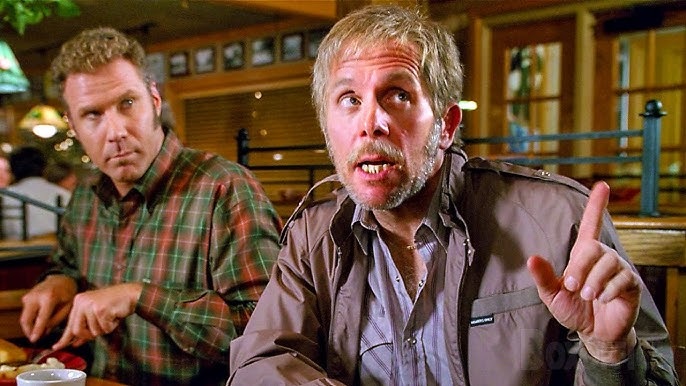
I am reminded of the last lines of the movie Talladega Nights: The Ballad of Ricky Bobby.
The family of Ricky Bobby included his estranged parents, girlfriend and children are standing out side the Talladega Superspeedway when Reese Bobby looks around.
The movie closes with this bit of dialogue.
Reese: I gotta say things are pretty much perfect right now. And it’s makin’ me kinda of itchy. Ricky: What’d you say we all get thrown out of an Applebee’s? Reese: Yeah that’d probably do the trick.
Maybe we all need to go get kicked out of Applebee’s again.
where the sweep of the harbor tide comes in, I rest dream, sit on the deck
Based on the poem, Waiting, by Carl Sandburg in Other Days as published in The Complete Poems of Carl Sandburg, by Carl Sandburg, Harcourt, Brace, New York, 1950.
Today I will let the old boat stand Where the sweep of the harbor tide comes in To the pulse of a far, deep-steady sway. And I will rest and dream and sit on the deck Watching the world go by And take my pay for many hard days gone I remember.
I will choose what clouds I like In the great white fleets that wander the blue As I lie on my back or loaf at the rail. And I will listen as the veering winds kiss me and fold me And put on my brow the touch of the world’s great will.
Daybreak will hear the heart of the boat beat, Engine throb and piston play In the quiver and leap at call of life. To-morrow we move in the gaps and heights On changing floors of unlevel seas And no man shall stop us and no man follow For ours is the quest of an unknown shore And we are husky and lusty and shouting-gay.
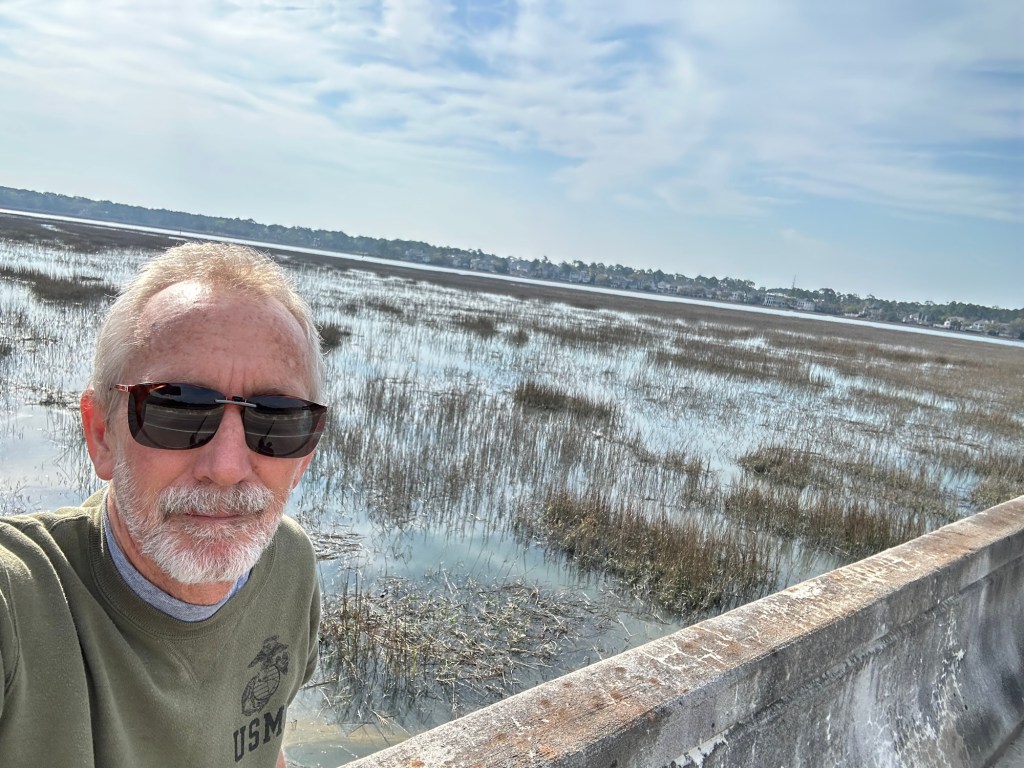
On my first morning bike ride as an Islander …
I pass this way each day that I drive to work.
I would take a photo with my phone held in one hand as I crossed the bridge in the middle of the island.
Now I ride my bike to the edge of the marsh.
I can sit and I will choose what clouds I like.
In the great white fleets that wander the blue.
As I lie on my back or loaf at the rail.
And I will listen as the veering winds kiss me and fold me.
And put on my brow the touch of the world’s great will.
Ides of March are come …. seer said softly, … they are come but they are not gone
Adapted from The Parallel Lives: The Life of Julius Caesar by Plutarch, as published in Vol. VII of the Loeb Classical Library edition, 1919 where the author rights.
The following story, too, is told by many. A certain seer warned Caesar to be on his guard against a great peril on the day of the month of March which the Romans call the Ides; and when the day had come and Caesar was on his way to the senate-house, he greeted the seer with a jest and said: “Well, the Ides of March are come,” and the seer said to him softly: “Ay, they are come, but they are not gone.” Moreover, on the day before, when Marcus Lepidus was entertaining him at supper, Caesar chanced to be signing letters, as his custom was, while reclining at table, and the discourse turned suddenly upon the question what sort of death was the best; before any one could answer Caesar cried out: “That which is unexpected.” After this, while he was sleeping as usual by the side of his wife, all the windows and doors of the chamber flew open at once, and Caesar, confounded by the noise and the light of the moon shining down upon him, noticed that Calpurnia was in a deep slumber, but was uttering indistinct words and inarticulate groans in her sleep; for she dreamed, as it proved, that she was holding her murdered husband in her arms and bewailing him.
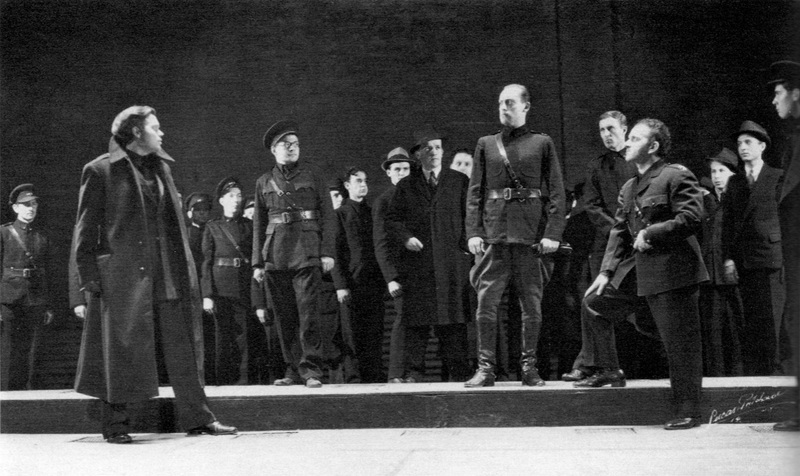
Julius Caesar, Act I, Scene II also comes to mind.
Cassius speaks to Brutus
Now, in the names of all the gods at once, Upon what meat doth this our Caesar feed That he is grown so great? Age, thou art shamed! Rome, thou hast lost the breed of noble bloods! When could they say, till now, that talked of Rome, That her wide walks encompassed but one man? Now is it Rome indeed, and room enough When there is in it but only one man.
As Kenneth Roth, a Guardian US columnist and visiting professor at Princeton’s School of Public and International Affairs, and former executive director of Human Rights Watch writes in his opinion piece, “Trump needs to reject Netanyahu’s quest for a forever war“:
As the world suffers the economic consequences of this disastrous war of choice, and people see yet another defenseless people being pummeled by the US-Israeli military alliance, public opinion is turning rapidly. American support for Israel has plummeted, first as it committed genocide in Gaza, and apartheid and ethnic cleansing in the West Bank, and now the crime of aggression in Iran.
Trump’s lawless belligerence and indifference to international standards have made the public in key democratic allies – Canada, Germany, France and the UK – favor a turn toward China, despite its own repressive indifference to international law. That’s quite an accomplishment.
Trump’s aggression is no more popular among allied governments. His pleas for help in defending tankers in the strait of Hormuz have so far come up empty. He has tried to up the ante, suggesting that his commitment to Nato, a defensive alliance built on pledges to support any member under attack, would depend on Nato members joining him in his offensive war of aggression. The response to that threat was decidedly cold.
Trump has an endless capacity to make fact-free pronouncements about the brilliant success of his policies. Iranians’ best hope may be that he declare victory and move on. Trump’s demand for Iran’s “unconditional surrender” complicates that face-saving strategy. Yet as the price of Trump’s folly mounts – new inflationary pressure, declining stock markets, worsening midterm prospects, even a disheartened Maga base – we must hope that Trump finds the wisdom to reject Netanyahu’s quest for a forever war and calls it quits.
Look again at the words …
Trump’s lawless belligerence and indifference …
Trump’s aggression …
Trump has an endless capacity to make fact-free pronouncements …
Trump’s folly mounts …
Upon what meat doth this our Caesar feed That he is grown so great? Age, thou art shamed!
… the seer said to him softly: “Ay, the Ides of March are come … but they are not gone.
Ms. Sauma quotes Salman Rushdie describing the movie, “as his “very first literary influence.”
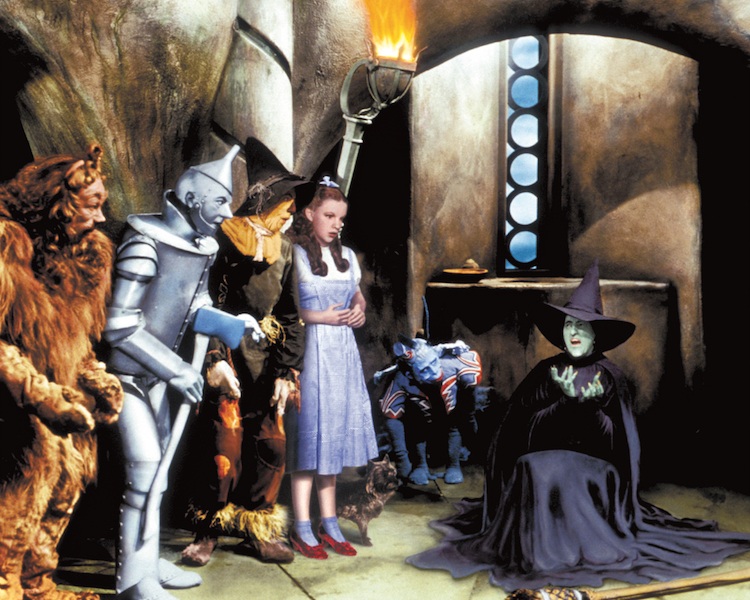
Ms. Sauma writes, “In all of western cinema, is there a more recognisable image than Dorothy in her blue gingham dress, arm in arm with the Scarecrow, the Lion and the Tin Man, skipping down the yellow brick road to the Emerald City, so that the Wizard can fulfil their dreams? It’s somehow cheering that this chaotic, surreal musical about a teenage girl, her dog and her three weird friends running away from a witch, searching for a wizard, and trying to become their best selves is so influential.”
I have long enjoyed thinking about this article since I first quoted from it back when it came out in 2019.
Everyone has seen the Wizard of Oz.
And, as Ms. Sauma writes, “This is the key to its influence: the fact that everyone watches it in childhood. It seeps into your unconscious and stays there.”
I had to wonder.
Was it true?
In all of western cinema, is there a more recognisable image than Dorothy?
Has everyone has seen the Wizard of Oz?
I happened to be in a Pat Conroy cycle.
Pat Conroy, the author of the Low Country.
His books (and movies of his books) include The Great Santini and Prince of Tides.
And the book about his year teaching on Dafuskie Island, about 5 miles from where I am sitting.
That book, The Water is Wide, written in the early 70’s, about how, instead of joining the Peace Corps, Conroy takes a job teaching in a two room school house where he would have the 4th through 8th graders.
These kids were Gullah kids.
Born and raised on a barrier island with little contact to the rest of the world.
Conroy writes of his first day:
At the end of the day I had compiled an impressive ledger of achievement.
Seven of my students could not recite the alphabet.
Three children could not spell their names.
Eighteen children thought Savannah, Georgia, was the largest city in the world.
Savannah was the only city any of the kids could name.
Eighteen children had never seen a hill—eighteen children had never heard the words integration and segregation.
Four children could not add two plus two.
Eighteen children did not know we were fighting a war in Southeast Asia.
Of course, eighteen children never had heard of Asia.
One child was positive that John Kennedy was the first President of the United States.
Seventeen children agreed with that child.
Eighteen children concurred with the pre-Copernican Theory that the earth was the center of the universe.
Two children did not know how old they were.
Five children did not know their birth dates.
Four children could not count to ten.
The four oldest thought the Civil War was fought between the Germans and the Japs.
Do you get they picture here?
The year was 1973 but it might have been 1773.
Conroy digs in a makes the effort to expose his class to the rest of the world and encourages discussion on topics on levels that would bring in his students.
One day had a discussion, by chance after watching an old movie of the TV Show You Are There with Walter Cronkite (Conroy had discovered a movie projector in a store room and took all the movies he could get from the County School System) about The Salem Witch Trials and that led to questions and statements from the students on witches.
From here, I will let Pat Conroy tell the story.
Big C screwed his face up into his question-mark look. “It true if you throw water on a witch, she disappear?”
Suddenly every eye in the room was riveted on me. Only the pigs grunting and rooting on the schoolyard disturbed the silence created by this single question. And there was something about the question itself, something ancient and primordial, something that disturbed the hidden and oft lost mythology of my own youth; I felt something stir as I thought about the wet witch, and knew that a feeling in my subconscious was rising like an air bubble to the surface. Then I had it.
“Big C, you’ve seen the Wizard of Oz.”
Eighteen voices shouted hosannas to the trembling faker of Oz. Cindy Lou broke off into an impromptu rendition of “Over the Rainbow.” Others pretended they were cowardly lions. Richard stood up and walked like a scarecrow suspended from his stake. Each member of the class had memorized the movie classic, had watched it religiously each time it appeared on television and had added personal interpretations to the bizarre forces rampant in the spirit-haunted land over the rainbow. And if the Yamacraw children knew about Oz, then I was convinced a hell of a lot of other children in America knew about it, too. My jeremiads against television since my first days on the island had continued undiminished, fed with the plentiful food of my students’ ignorance about people, events, and the world. Now, in a single moment, I had to retract my sweeping indictment of TV: it had not failed completely, only partially. Every child in the room knew the legend of Oz by heart, the importance of the yellow-brick road, the incarnate evil of the wicked Witch of the West, and the ultimate hypocrisy of the great wizard himself. Oz, it seemed, had entered into the consciousness of American children, and not just a selected few, but almost every child in every situation. I considered Yamacraw a touchstone: if the Yamacraw children knew about it, then the chances were excellent that the vast majority of American children had been reached. The Wizard of Oz, through the medium of television, had become part of American mythology as important and relevant to the children of America as the Homeric legends were to the children of Athens.
So Big C’s question was the catalyst for a great and memorable afternoon, one of those rare moments generated by chance, planned by no one, spontaneous and joyful, transcending the need for a teacher or a classroom, and making me once more think of education as something alive and helpful, instead of as a withered dream in need of formaldehyde. Oz took over the rest of the day. For a couple of minutes it was utter pandemonium. Fred introduced a moving argument in incomprehensible Fredese in favor of the proposition that water could evaporate witches. Prophet thought this was crap. He told Fred so. Fred told Prophet he would kick his butt if he continued to think it was crap. Mary mumbled something into her left hand about fire being better than water. Saul said that there ain’t no sure way to kill a witch.
Cindy Lou’s voice finally broke through the general upheaval of noise and offered to recite her King James Version of the story.
“O.K.,” said I.
“There was this little girl who got blown away in a rainstorm,” she started.
“That ain’t the way it was,” said Jimmy Sue.
“How was it then, you old ugly self?” Cindy Lou shot back.
“Ain’t no rainstorm, sister.”
“Damn right it was a rainstorm.”
“No, girl, it was a tor-nay-do.”
“Yeah,” the class agreed, “it was a tornado.”
“Same thing,” claimed Cindy Lou.
“No, girl. Tor-nay-do take your head clean off,” offered Mary.
“You tellin’ the story, girl?” Cindy inquired menacingly of Jimmy Sue.
“No.”
“Then you keep your mout’ out of it.”
“This girl got blown away by a wind and the house she was in hit a bad witch on the head and kill her dead. Then the girl and her little dog go marchin’ down this yellow-brick road ’til they meet this chicken lion who try to act tough.”
“No,” a chorus of voices shouted.
“No, what?” Cindy Lou asked.
“That girl don’t meet no lion,” said Samuel, in one of his first vocal contributions of the year.
“Sure she meets a lion.”
“No, girl, first she sees the scarecrow. Ain’t got no brains.”
“Yeah, scarecrow first,” the class agreed, acting out the chorus in this impromptu drama.
“You tell the story, cockeye.”
“Call me cockeye and I bust your head,” Samuel shouts, clenching his fists.
“Don’t call Samuel cockeye, Cindy Lou.”
“He is cockeye.”
“Yeah, he cockeye,” the chorus agrees.
“No,” I say.
“I bust your head,” Samuel warns the whole class.
“You cockeye,” the class chants.
“The scarecrow first,” says Richard. “Let me tell the story.”
“Oh boy, Richard, give it to us.”
So Richard rendered his version of Oz. Then Oscar, then Frank, then Mary, then Sidney, each adding their own peculiar interpretations, each emphasizing a different part of the story, and each feeling perfectly free to combine incidents from the Wizard of Oz with incidents that occurred in other television programs. Sidney got Oz confused with an episode from “Bonanza.” Hoss Cartwright battling the witches of the Purple Sage. According to Oscar, Oz and Disneyland were somehow related. Richard somehow got Captain Kangaroo confused with the wizard, and Mr. Greenjeans confused with the scarecrow.
Ethel, a purist in the group, strutted to the microphone and began a long, precise, but monotonous epic, which was technically unflawed and accurate except that everyone in the class believed she was making the stuff up. In the middle of her story, Top Cat got up and started singing a new song just released by swing-man James Brown. He hopped and swayed what he called a “new jive” while the kids clapped their hands and tapped their feet until the great head of Mrs. Brown appeared in the window, flashing a look the Romans must have worn on their faces when turning thumbs down on some prostrate Christian. But even though the kids quit responding and reverted back to their classical pose of scholars erect in their desks and lusting for knowledge, Top Cat gyrated on, a grin like a jack-o’-lantern carved on his face and eyes raised in adoration of some muse deep within him.
When Top Cat finally subsided and sank back into his desk, Prophet of the unknown tongue continued the interrupted marathon of Oz, an untranslatable potpourri of grunts and monosyllables, punctuated only by Prophet’s beautifully effusive smiles.
When the afternoon was over and the bus ambled into the schoolyard, and the kids had filed out of the room, I had on tape the story of Oz as it had never been told before—a new Oz, a land that Judy Garland had never entered, but one especially created on a December afternoon by children of an island ruled by a river, and possibly another wizard, with perhaps a greater claim to credibility.*
Ms. Sauma writes, “Everyone has their own Oz.”
You know what?
I think that’s true.
Ms. Sauma closes her 2019 article writing, “The Wizard of Oz doesn’t sugar-coat the truth: there are monsters out there, and the only things that matter are fellowship and home, wherever you find them – a message as relevant now as it was in 1939.”
I agree.
Got to end this now as it has gone on long enough and I want to check under the bed for flying monkeys.
*The Water is Wide by Pat Conroy (Boston : Houghton Mifflin Co., 1972).


 No Haiku For You