make managers bit less uptight – something silly but acceptable
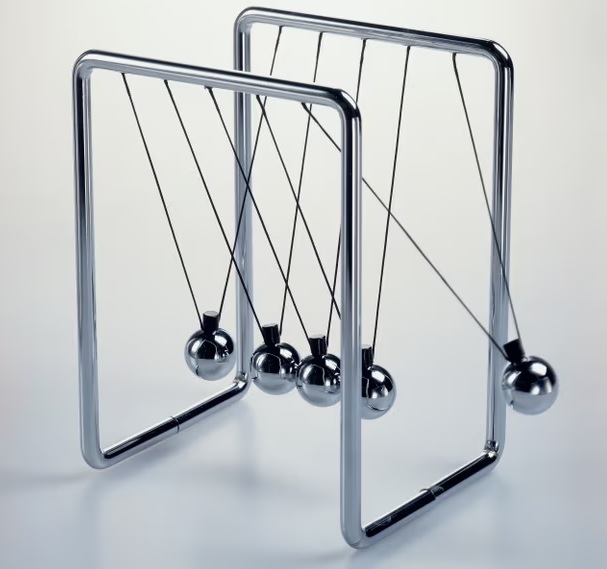
“I never thought anyone would want to do a book about the madness of the 1970s and 1980s. I had no idea people even remembered our Newton’s cradle,” said Loncraine, 78. “It was something to make bank managers a bit less uptight – something silly but acceptable to have on your desk.”
Growing up in the 70’s … the 1970’s, we had one of these at home.
Everyone did.
We knew it by another name though.
We called it ‘Newton’s Balls’ not Newton’s Cradle and it made a big difference.
Especially when you let the two hanging balls on the ends go at the same time and they slammed into the other three over an over again.
You felt it in … well …
One of my older brothers was studying to be a math teacher.
At one point in his life he had a pet cat named Newton.
He would explain how the action of the steel balls demonstrated conservation of momentum and conservation of energy in physics.
I had just read a book about Robert H Goddard and how he had studied Newton’s laws of physics.
As a kid (the book I had read was a young readers life of Robert H Goddard) the book said Goddard had sent away for multi volume sets of books that he read to learn all he could about Newton and this somehow led him to design rockets and rocket engines.
I thought about that.
I thought about what my brother told me.
And I watched Newton’s balls slowly slow down.
And I realized I was not destined for a career in mathematics.
Understand this was not in the family genes.
There were 11 of us and over time we all attended the same high school.
Every year, Grand Rapids Creston would recognize its top students and one of the awards was the math trophy.
My family brought that trophy home 4 times.
But not me.
Years later there was a family get together at my mom’s house.
I was running late and got there after dinner to find most of my brothers and sisters and a lot of my niece’s and nephews all sitting around the dining room table starring at pieces of paper with pencils in hand.
My brother the math teacher looked up and said, ‘Grab a pencil, we working on quadratic equations.”
I figured these were people who needed something silly but acceptable to have on their desk to help them seem bit less uptight.
Mr. Baan’s Bar and Mookata Noori Pocha Fikscue Azizam
Jenny Lawson, in her book, “Furiously Happy: A Funny Book About Horrible Things” , writes that sometimes she needs ‘a word that I just made up for words that you have to invent because they didn’t yet exist.’
With today’s haiku, you might think I am indulging myself with words I had to invent but they didn’t exist.
In the movie, The Natural, baseball player Roy Hobbs, played by Robert Redford, goes out to dinner with an old coach played by Richard Farnsworth who takes him to an Italian restaurant.
The coach starts eating as says something along the lines of, “… you can’t pronounce it, but it sure does eat good.”
I like that line and how it applies to Italian food (and I always have to ask what was Italian food like before Columbus brought tomatoes back from the new world – there was no saucy pizza before 1492 so maybe that is were Neapolitans got the idea … but I digress ) but I am not sure how it applies to restaurant names.
Noori Pocha?
Fikscue?
Azizam?
You can’t pronounce it but it sure does eat good?
Maybe – but I will know never know as I am pretty sure I will never eat in any of these places.
Growing up in a family with 11 kids and a Dad who liked to eat out, eating out was interesting.
Like my own family when we got to seven kids, we didn’t so much go to a restaurant as much as we invaded it.
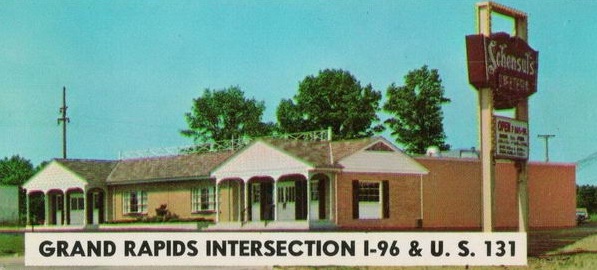
There was a cafeteria on the North End of Grand Rapids, Michigan were we lived that my Dad enjoyed named Schenshul’s and when Mom needed a break for Sunday Dinner we would all pile in the car and drive up there after church and pile out of the car.
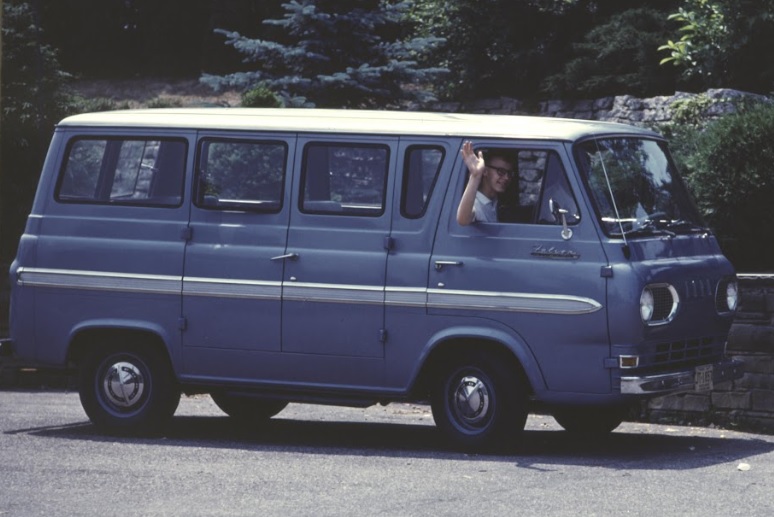
We drove around in what today is called a Van but we called it bus.
In front it had a drivers sear and a passenger seat with the engine … yes the engine … between the two seats.
It had double doors on the passenger side and the last one in sat on a four legged wooden stool that my Dad would place just behind the front seat.
That was with one kid seating on that engine.
In the summer time that engine block would get HOT so my Dad had a couple of wool army blankets that he would set on top of the engine and you would sit on that.
A little kid in summer, wearing shorts, sitting on itchy wool blankets on top of a motor.
No air conditioning back then either.
Don’t even ask me about seat belts.
That was just the transportation.
I am not sure what folks thought watching us all pile out.
I know what they thought of the bus though.
One time there was dent in a door and for reason known but to my Dad, he covered the dent with a stick-on fluorescent flower.
On a trip somewhere at a stop, me and my brothers were wondering around the parking lot waiting for the rest of the family and we heard these two old guys point out the bus and the flower and said, “Stupid Hippies.”
Oh did we laugh and laugh and couldn’t wait to tell Dad when we all got in the car.
No sure what he thought but he left the flower.
Back to Schenshul’s, one time I remember we came through the doors and someone on the restaurant crew looked up and saw us in the line and yelled out, “IT’S THE HOFFMANS! BREAK OUT THE WHITE MILK.”
There were several layers of ‘rites of passage’ when dining at Shenschul’s.
The age when you got your own tray.
The age when you got to push your own tray.
The age when you to order for yourself.
The age when you got to reach over the edge of the cafeteria line and help yourself to a dessert.
The age when you got to CARRY your own tray to the table. This was a biggie and one that my parents were reluctant to okay as there were many close calls.
I myself don’t remember that I or anyone in my family ever dropped or tipped a tray so everything slid off but we saw it often enough.
The final passage was where you got to sit.
Those folks at Schenshul’s would often pull together tables so we could sit in one long group but just as often my Dad would let us take a cluster of tables and we could sit away from our parents.
State more widely known through University than any other means
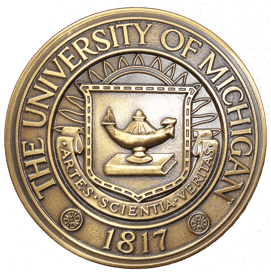
Among the very first laws enacted by the Legislature of Michigan after its organization as a State was one for the establishment of the State University, founded on the act of Congress of 1826, which appropriated two entire townships of wild land for the special purpose. That action on the part of its original legislators, suggested by a clause in the constitution pg 092enjoining upon the legislature the “encouragement of learning and the general diffusion of knowledge among the people,” was highly creditable to their intelligence, and was the key-note to the subsequent prosperity of the State. A prime mover in this enterprise was the Rev. John D. Pierce, the first superintendent of public instruction; and among the professors first chosen were Asa Gray and Douglass Houghton, the first as professor of botany and zoology, and the second of geology and mineralogy. By careful and judicious management the University has progressed so rapidly that it is now awarded a prominent place among American institutions, and in foreign countries the mother State is more widely known through the fame of her University than through any other means.
From the The Red Book of Michigan; a civil, military and biographical history by Charles Lanman, Detroit, EB Smith and Company, 1871.
1871.
By 1871, The University of Michigan was, more than any other means, the reason any knew there was a State of Michigan.
It would be another 20 years before football even showed up.
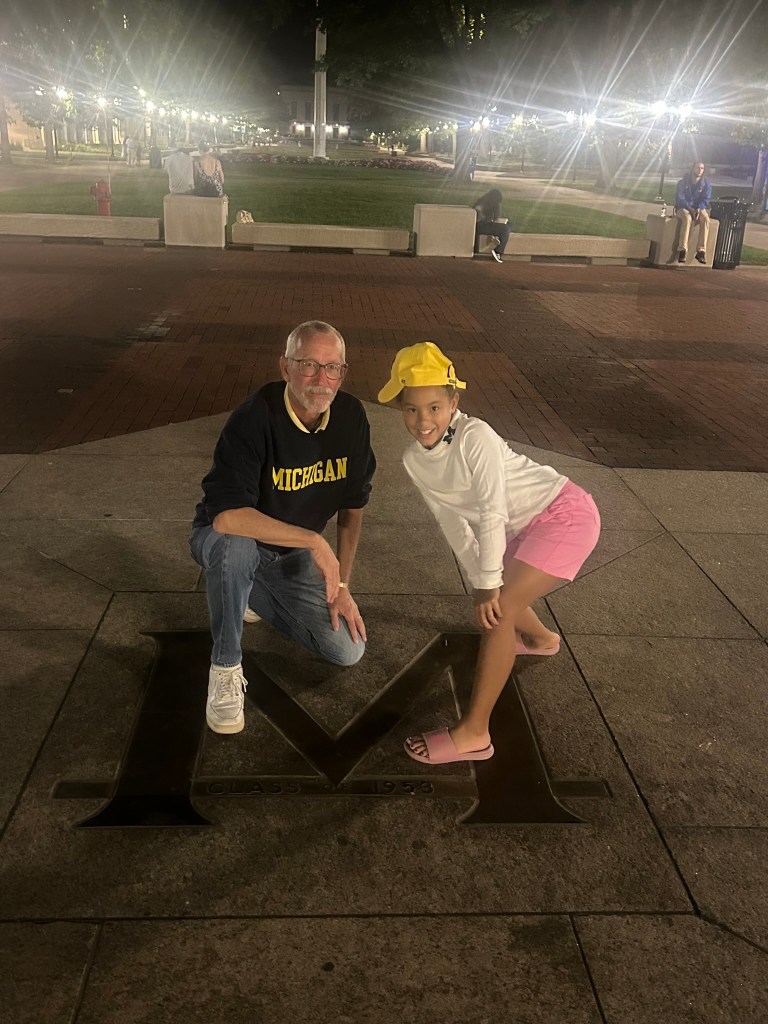
Last week I was on campus with one of my grand daughters.
Me and my grand daughter and her parents walked around central campus in the early dark.
It had been 40 years since I was a student and I could have stepped back in time and been right at home.
When I had been there as a student, it was a little more than 40 years that my Dad had been a student.
I am just now realizing that as he walked around the campus with me, he could have stepped back in time and been right at home.
My Dad was at Michigan 30 years after his Dad graduated.
I wonder if his Dad visited him in Ann Arbor and felt like he could have stepped back in time and been right at home.
His Dad, my Grand Father, was the first Hoffman born in the United States.
Now I was walking around that same campus with one of my grand daughters.
We walked up to the bronze M in the center of the Diag, the center of Central Campus.
I asked her if she wanted to go school in Ann Arbor and she said yes but then she is just seven.
I told the tale that if anyone stepped on the M, that person would fail their first test.
She looked at me and looked at the M.
Then she looked me right in the eye and stamped her foot on the M.
an absence of flags, it said on the sign … does not assure safe waters
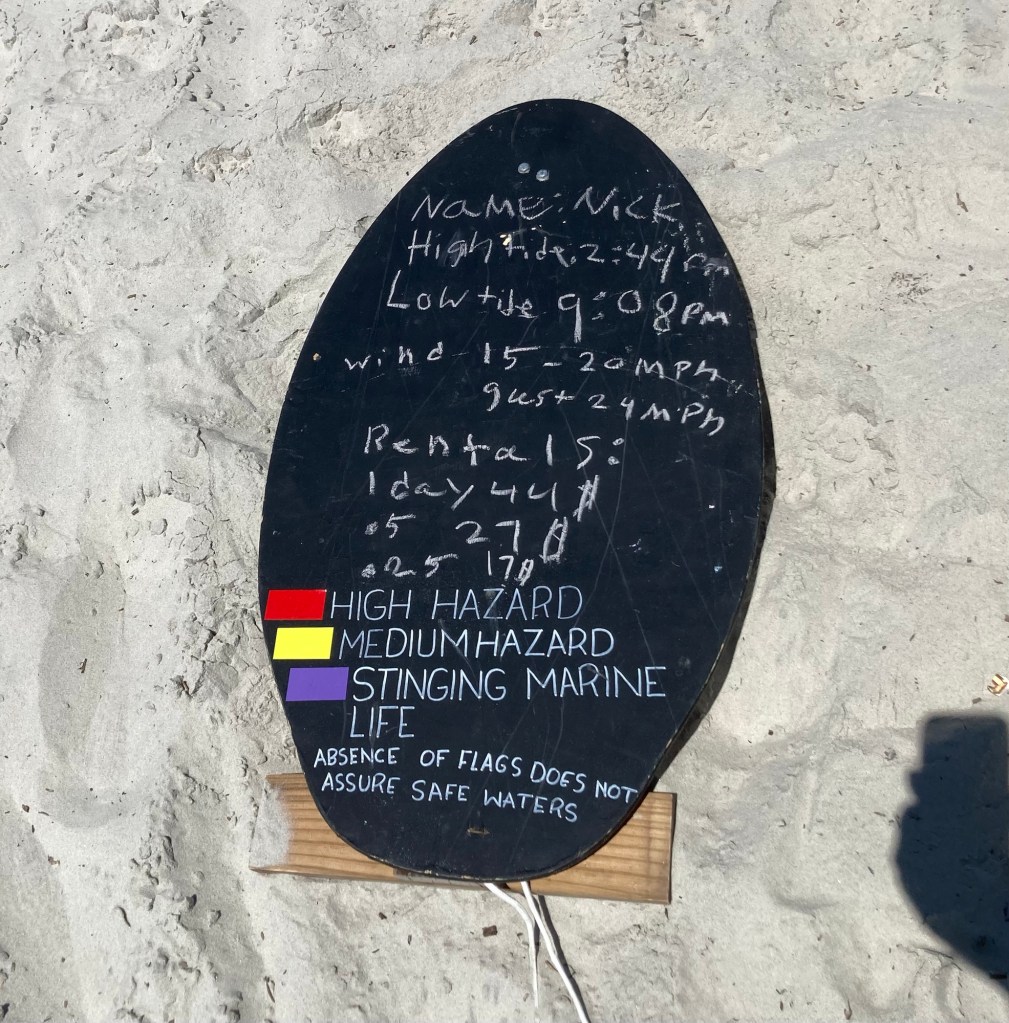
The lifeguards on Hilton Head Island fill out a message board with chalk at their lifeguard station listing current conditions.
Usually the board covers the basics, high tide, low tide, water temps and water conditions.
I grew up on the shore of Lake Michigan about seven miles south of the state park at Grand Haven.
On rough days, my Mom would have us call the state park and ask “What flag was out?”
The lifeguards at the state park had most of the same flags they fly down here in South Carolina.
Green flag meant safe to swim.
Yellow flag meant to swim with caution.
Red flag meant that that water was rough and swimming was not recommended.
We say thank you, hang up, yell “RED FLAG’ or what ever it was and then run off to go swimming.
When we were little kids, under the age of 10, my Mom made us wear life jackets.
Those old orange canvas ones with cloth ties that ate into your chin once the cloth got wet but when we got older we took our chances with the waves.
The temperature of the water in Lake Michigan was easy to find because The Grand Rapids Press displayed a horizontal thermometer in the lower right hand corner of the front page that showed the current water temp at Grand Haven.
We would get the paper about 4 o’clock in the afternoon and start screaming ‘the lake is at 72 the lake is at 72’ and we couldn’t wait to get to the beach.
We never stopped to think that that report was most likely 24 hours old and Lake Michigan water temps could drop 10 degrees in one hour if the wind shifted.
Nor did we ever think to get our own thermometer and put it in the water to see just how cold it was.
And it could get cold.
ACHING COLD my brothers called it.
Stick your feet in the water and in seconds they would be throbbing.
You just have to get used to it, we would say as we dared each to ‘duck under’.
We would wade out slowly, slowly as we eased our bodies into the water that was around 64 degrees.
It took a lot of effort to finally dive in and get it over with.
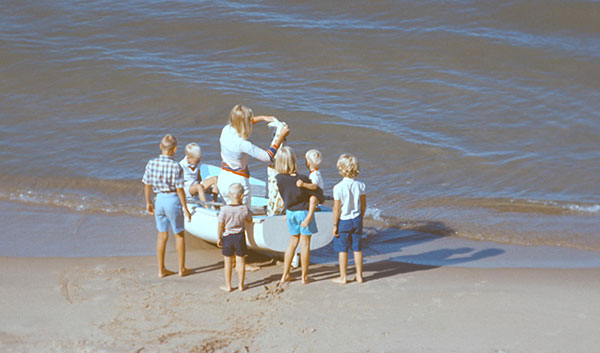
We had an old rowboat that we would paddle out into the lake where the water was over our heads and anchor it.
Lake Michigan was too rough to let a rowboat stay anchored off shore so we did this every day we went swimming.
Once the boat was anchored, we would flip it over and using it for a swimming platform.
When that boat flipped, anyone in the boat was going in the water and somedays, the water was so cold, that was the only way anybody was going to get wet.
I remember one day we flipped the boat over and the water was so cold, me and my brothers cambered over the side as it flipped and stayed out of the water and nobody was getting off into the water so we untied the anchor and drifted into shore.
It wasn’t until I started working in online news for WZZM13 in Grand Rapids that I really got into the mechanics of water temps.
The National Weather Service makes all of their data available to public for free, it is a service after all, if you can figure out what you need.
The file I needed was named something like metar/CONUS/MI_GL_watercond_temp.txt but once I got it, I was able to turn the data into a weather map with locations and temps and put it online.
This was back in the early days of the World Wide Web and nothing was ‘web ready’ and we created everything from scratch.
The file I found listed all the reported water temperatures at Michigan State parks on Lake Michigan from South Haven to Pentwater.
I was in the weather center chatting with meteorologist George Lessens and we got to wondering HOW the data was gathered and George picked up the phone and called the Grand Haven State Park.
He found out that at some point before 11 a.m. a park employee would take a thermometer tied to a rope and walk down to the water and toss the thermometer in and get a reading.
George asked, but no, there were no guidelines as to how long the thermometer should be left in the water or how deep it should be in the water or any instructions except to get a reading and call it in by 11 a.m.
It was, we decided, an inexact science.
Now I live a mile from the Atlantic Ocean.
The ocean is different from Lake Michigan.
It is warmer for one.
That’s just one, but it is a big one.
When I was a kid, we would get excited when the water in Lake Michigan was in the 70s.
Right now the ocean is in the low 80’s and it is wonderful.
The ocean also is saltier and I float so I swim better.
And there are … things in the water down here.
That is why where up north you have green, yellow and red flags, down here you have green, yellow, red, double red and purple flags.
A purple flag indicates that dangerous marine life, such as jellyfish, stingrays or man-of-wars are present in the water.
A purple flag can be flown with any other color.
I have yet to be bothered by any dangerous marine life since moving to the coast but I was bitten by dog in downtown Charleston.
The flag code comes down to this.
Safe to swim.
Use caution.
Swimming not recommend.
Do not swim.
Dangerous marine life.
You might think that this list should cover all the bases.
Yet today, Nick the lifeguard on duty, added a further note of caution.
On his notice board, Nick wrote, “Absence of flags does not assure safe waters.”
I like that.
Absence of flags does not assure safe waters.
I want that one a T Shirt.
That message would fit anywhere in the world not just the beach.
Just about the most right words for today I can imagine.
Always remember, an absence of flags does not assure safe waters.
imagination … reconcile raw emotive power of the past
In his book, Walk About (Published in America as Notes from a Sunburned Country), Bill Bryson writes about Australia:
One of the more cherishable peculiarities of Australians is that they like to build big things in the shape of other things. Give them a bale of chicken wire, some fibreglass and a couple of pots of paint and they will make you, say, an enormous pineapple or strawberry or, as here, a lobster. Then they put a café and a gift shop inside, erect a big sign beside the highway (for the benefit of people whose acuity evidently does not extend to spotting a fifty-foot-high piece of fruit standing beside an otherwise empty highway), then sit back and wait for the money to roll in.
Some sixty of these objects are scattered across the Australian landscape, like leftover props from a 1950s horror movie. You can, if you have sufficient petrol] money and nothing approaching a real life, visit a Big Prawn, a Big Koala, a Big Oyster (with searchlights for eyes, apparently), a Big Lawnmower, a Big Marlin, a Big Orange and a Big Merino Ram, among many others. The process, I am patriotically proud to tell you, was started by an American named Landy who built a Big Banana at Coff’s Harbour, on the New South Wales coast, which proved so magically attractive to passing vehicles that it made Mr Landy, as it were, the big banana of the business.
As an aside, I love that word cherishable or having the ability to be cherished and I am working on my own list but I digress.
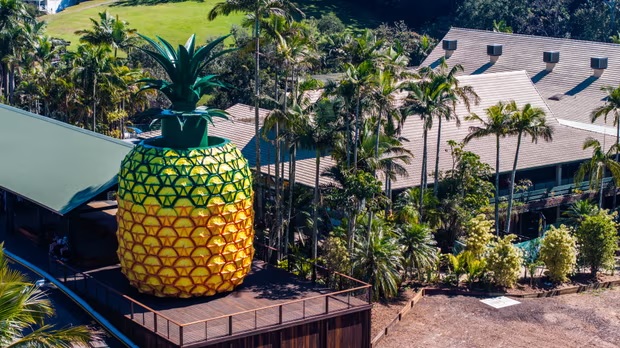
I am happy to report that according to story in the Guardian, one of these big things in on its way back.
After 14 years of big promises, legal battles and a Game of Thrones’ style ownership jostle, the Big Pineapple finally reopened in June. Patsy, too, has returned, at the age of 93, for another ride around the track.
But it is not just over its former workers that this roadside attraction maintains its peculiar hold. In 2006 the National Trust of Queensland unveiled a list of state icons – alongside the Great Barrier Reef and the Gabba was the Big Pineapple. The year after, it was one of five big things celebrated on Australia Post stamps. In 2009 it was heritage listed. Last year the Royal Australian Mint stamped its likeness on a $1 coin.
For generations of Australians the Big Pineapple conjures up memories of road trips to the sunshine state, of birthday parties and weddings, of train rides and ice-cream.
And it got me thinking about things growing up that I experienced like the Giant Pineapple.
What for me taps into that raw emotive power of the past?
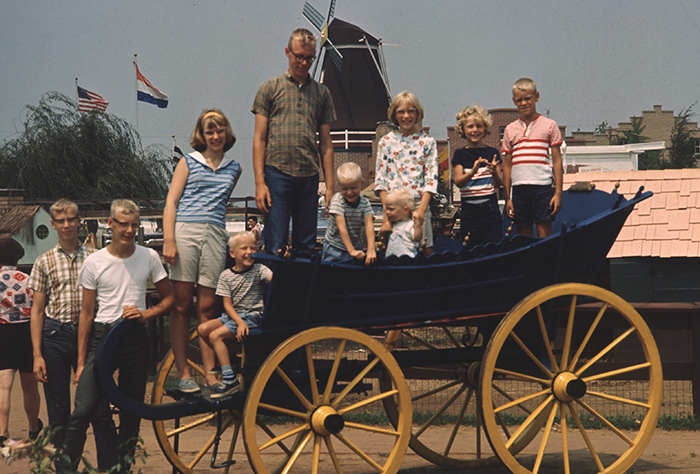
One such place for me and my family was the Dutch Village over in Holland, Michigan.
We would make the short trip when my Dad would take a week off.
My family had a cotttage on Lake Michigan where we would go in the summer and when my Dad took a week off, he would celebrate by not shaving.
But at some point during that week, Dad would shave.
There was a small bathroom off the kitchen.
My Dad would have showered and dressed for the day and would open the bathroom door to let out the shower steam.
In the morning the sun would flood through the back window in the bathroom and my Dad would stand in front of the small sink and look in the mirror and, very deliberately, shave.
Shaving cream spread over his face.
Firm use of the razor.
Down the sides of face.
Then up under has chin.
I can smell the scent of the shaving cream drifting in with the steam and sunshine.
I would be sitting at the kitchen table with my brothers and sisters eating breakfast and we would see Dad shaving and know that we would be going somewhere.
Maybe it would be the Coast Guard festival in Grand Haven.
Maybe it would be a longer day trip up to Sleeping Bear Dunes.
Most likely it was a trip to the Dutch Village.
It wasn’t much.
A glorified tourist trap.
But it was our tourist trap!
The then 10 Hoffman’s at Dutch Village – maybe 1966.
There were a few shops and some things to play one, a giant wooden shoe and a Dutch barn with barnyard animals to feed.
All operated by a staff in ‘traditional’ Dutch clothes.
We would first run to the candy store.
I remember one time when all of us Dutch blond kids ran in the sales lady said something like ‘you know they’re Dutch when the coming asking for bobbalars and chocolate Droste’s wooden shoes.’
Once when I worked at a local TV station in Grand Rapids, a team was sent out to cover the Holland Tulip Festival and I wrote a tease for one of news broadcasts along the line of … “The bobbalars are just as sweet …” and the anchor came over to ask what that meant. I then had to pronounce the word phonetically bah bah lars .. which she wrote down.
And there was the zweefmolen or swing carousel with swings that spun you high in the air in circle until you were ready to throw up all your chocolate wooden shoes.
This was a condition we called ‘zweefmolen disease’ and we loved to bring friends and new family members who had just married into the family to Dutch Village just to watch them get zweefmolen disease.
Seeing them stagger around was as much fun as just saying zweefmolen.
It was goofy but we loved it.
I loved taking my kids when we got kids to Dutch Village.
I loved watching them get zweefmolen disease.
My kids didn’t look like my brothers and sisters but I told them they were all Dutch anyway.
Nothing gets you odder looks than to live in the south and tell people that you are Dutch and it’s like they can’t imagine anything so exotic.
So for the folks in Australia, the big pineapple is back … ‘but is it a big deal?’, Mr. Hinchliffe asks.
Another case of the ‘You can’t go home again’ syndrome as nothing is like it was but then was anything like it ever was?
When my kids were growing up I watched a lot Nickelodeon and Nick Jr. and I remember that in that cartoon called ‘Rugrats’, the perspective was often drawn from about 1 foot about floor level, the perspective of a toddler.
In the movie Dead Poets Society, Robin Williams dares his students to stand on their desks to gain a new perspective.
I offer that to relive your childhood, sit on the floor, get your head down there and experience life as it used to be.
At the beach, with you head just above the sand, the beach stretches out forever.
At a park, the jungle gym is 5 stories high.
Mr. Hinchliffe closes his article with this:
“Today, the pineapple is a curious site next to a regional road with a serviceable cafe and a train ride. It takes a bit of imagination to reconcile what stands now with the raw emotive power of its past.”
It takes a bit of imagination to reconcile what stands now with the raw emotive power of its past.
I love that.
Embrace your imagination and get as low to the floor as you can go and tap in the raw emotive power of your past.
If nothing else, you will be looking up.
Also, make the trip to West Michigan and visit a little bit of old Holland at the Dutch Village.


 No Haiku For You