6.9.2023 – was all tenderness

was all tenderness
but lit, as if from within
with lively spirit

This has been the glory of the Met: the love, care, craft and experience that go into works as different as these two — starkly contrasting titles, both presented at the highest level.

In “Elisir,” the tenor Javier Camarena and the soprano Golda Schultz were all tenderness, but were lit, as if from within, with a lively spirit by the conductor Michele Gamba, making his company debut.

From the article,

Is It the End of an Era at the Metropolitan Opera? As the 2022-23 season ends, the country’s largest performing arts institution looks ahead to a future of fewer titles. by Zachary Woolfe

Zachary Woolfe, according to the blurb, became The Times’s classical music critic in 2022, after serving as classical music editor since 2015. Prior to joining The Times, he was the opera critic of the New York Observer.

I don’t do much opera though I grew up in house where opera played a loud role.

My Dad loved opera.

In his war letters from Europe he tells my future Mom that he was able to attend several opera performances while in London and on the continent.

Then he asked, “Do you like opera?”

Not sure that Mom ever liked it as much as Dad but she did appreciate it.

I can still hear her describing how she felt when she first heard Bizet’s Votre toast, je peux vous le rendreml, better known as the Toreador Song from Carmen.

She told how she got out the record and played it for her cousin who listened and then said, ‘meh’ and my mother couldn’t understand how she could not be thrilled.

I call also her my Mom describe who some awe on hearing the voice of Leontyne Price in person.

My Dad lived in the era before online music.

All I can say about that is had my Dad had access to music the may I have access to music, we may never have seen my Dad.

As it was, Saturday’s at my house were known by several sounds.

First was the sound of Bugs Bunny cartoons, which seemed to be on all morning.

Then, in the fall, there was the sound and voice of Tom Hemingway of radio station WUOM calling the play by play of Michigan football games on the radio.

My Dad had wired our house with speakers so the game was one in everyone room.

Then there was the sound of opera through the Metropolitan Opera radio broadcasts with Milton Cross, a regular series of weekly broadcasts on network radio of full-length opera performances, transmitted live from the stage of the Metropolitan Opera in New York.

I can close my eyes and hear the sound of Warner Brothers cartoons with the opening guitar chord.

I can close my eyes and hear the sound of the opening, “The Wolverines are on the air!”

I can close my eyes and hear the sound of Milton Cross welcoming listeners to other broadcast of the Metropolitan Opera.

My Dad had large closet called “The Sound Room” located off the living room.

In his sound room he had an assortment of radios, turntables and reel to reel tape records and lots and lots of cables.

If the opera was one of my Dad’s favorites, all he had to do was flip a switch or two and broadcast the show throughout the house AND record it at the same time.

There several shelves along the wall and they were filled with recordings of Michigan Football games and opera.

It was a library of sound built with love, care, craft and experience.

I have a distinct memory of needing something important from my Dad on Saturday.

Something like an air pump needle to blow up a football or something really important like that and I found him in his sound room.

No knocking or waiting or regard, I barged in to question my Dad.

He was cueing up a tape and turned and looked at me and said, “NOW JUST HOLD IT. I HAVE BEEN WAITING FOR 20 YEARS TO RECORD THIS!”

So I waited and we listened to the music together.

It was the overture to Richard Wagner’s Tannhäuser.

It wasn’t long but it was a short moment with my Dad that was tenderness, and lit, as if from within, with a lively spirit.

Every once in a while I will search out the Tannhäuser Overture on You Tube.

The search takes a split second.

It took my Dad 20 years.

I will listen to the annhäuser Overture on You Tube.

I will think of my Dad.

And Saturday afternoons at home.
3.10.2023 – still, how strangely still

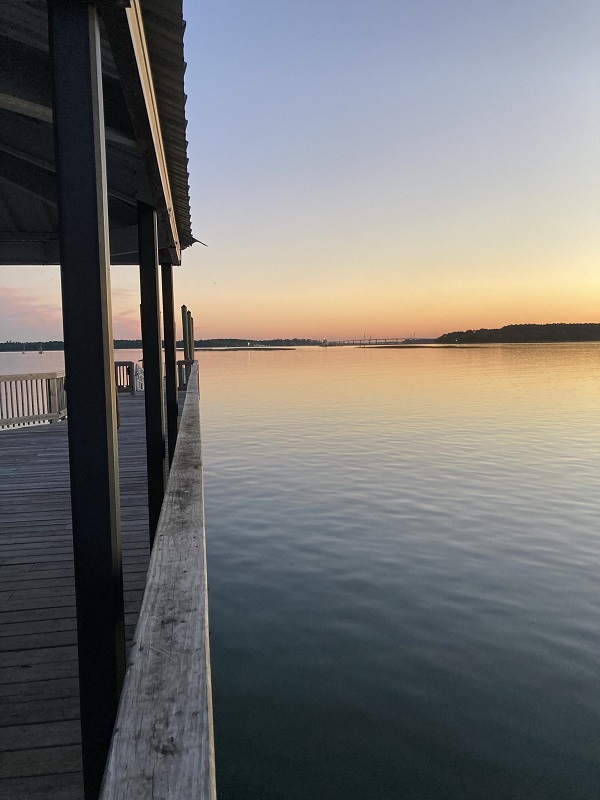
still, how strangely still
water is today, not good
to be still that way

Adapted from the poem, Sea Calm by Langston Hughes as it appeared in The Weary Blues (Alfred A. Knopf, 1926) .

How still,
How strangely still
The water is today.
It is not good
For water
To be so still that way

Langston Hughes was just twenty-four years old when his debut poetry collection The Weary Blues was published in 1926.

The first line of the introduction to The Weary Blues reads, “At the moment I cannot recall the name of any other person whatever who, at the age of twenty -three, has enjoyed so picturesque and rambling an existence as Langston Hughes.

Back in the day when I worked at WZZM13 TV in Grand Rapids, Michigan, I remember a newsroom discussion about travel and places to go and places gone to and plans to go to other places.

I looked up and said in what my wife calls ‘My Hoffman Voice’, you know, the voice you develop in a family of 11 kids if you ever want anyone to hear you – my kids say it cuts through concrete – my Mom said it was just like my brother Bobby’s (who was a baseball coach for 20 years), “I live in house 1 mile from where I grew up, 1 mile from the hospital where I was born and 1 mile from the cemetery where I will be buried.”

Then I said, “Oh am I depressed!”

At the time it was all true.

I lived near Kent Country Club on the North End of Grand Rapids.

It was less than a mile from my childhood home on Sligh Blvd.

It was about a mile to Butterworth Hospital where I was born.

And it was less than a mile from Fairplains Cemetery where my grand parents and parents are buried and where, most likely, I would end up one day.

I was about to turn 50.

Since then, I can say that I have enjoyed a picturesque and rambling existence.

Someone looked at my life and said it was still, too still.

And then that someone decided that it was not good for my life to be still that way.

I am reminded of a silly movie starring Steve Martin named Parenthood.

Mr. Martin watches his life come apart at the seams with the flu, bills, car accidents, kids fighting, job loss and everything else and is ready to lose it.

When his Grandma comes by and kind of in passing says:

You know, when I was 19, Grandpa took me on a roller coaster
Up, down, up, down. Oh, what a ride.
I always wanted to go again.
You know, it was just interesting to me that a ride could make me so frightened,
so scared,
so sick,
so excited
and so thrilled,
all together.
Some didn’t like it.
They went on the merry-go-round.
That just goes around … Nothing.
I like the roller coaster.
You get more out of it.

The movie was written by Lowell Ganz and Babaloo Mandel.

These two guys wrote a lot of movies.

One of those was, A League of Their Own where baseball manager Jimmy Dugan, played by Tom Hanks, says:

It’s supposed to be hard.

If it wasn’t hard, everyone would do it.

The hard… is what makes it great.

It is not good
For water
To be so still that way

3.9.2023 – fundamentally

fundamentally
flawed conception of our selves
language, knowledge

Adapted from:

Today our supposedly revolutionary advancements in artificial intelligence are indeed cause for both concern and optimism. Optimism because intelligence is the means by which we solve problems. Concern because we fear that the most popular and fashionable strain of A.I. — machine learning — will degrade our science and debase our ethics by incorporating into our technology a fundamentally flawed conception of language and knowledge.

It is at once comic and tragic, that so much money and attention should be concentrated on so little a thing — something so trivial when contrasted with the human mind, which by dint of language, in the words of Wilhelm von Humboldt, can make “infinite use of finite means,” creating ideas and theories with universal reach.

In the guest opinion essay, “The False Promise of ChatGPT” by Noam Chomsky (March 8, 2023, NYT).

Mr. Chomsky’s global standing as THE expert on language leaves me little room to argue, not that I would, as I was happy to read his opinions on the latest computer generated textual content craze that has a place in the current news cycle.

For me, the concept is as old as the Infinite Monkey Theory which states that if an infinite number of monkeys were left to bang on an infinite number of typewriters, sooner or later they would accidentally reproduce the complete works of William Shakespeare.

It goes back to 1913 and Félix Édouard Justin Émile Borel a French mathematician, who wrote:

.. Concevons qu’on ait dressé un million de singes à frapper au hasard sur les touches d’une machine à écrire et que, sous la surveillance de contremaîtres illettrés, ces singes dactylographes travaillent avec ardeur dix heures par jour avec un million de machines à écrire de types variés. Les contremaîtres illettrés rassembleraient les feuilles noircies et les relieraient en volumes. Et au bout d’un an, ces volumes se trouveraient renfermer la copie exacte des livres de toute nature et de toutes langues conservés dans les plus riches bibliothèques du monde. Telle est la probabilité pour qu’il se produise pendant un instant très court, dans un espace de quelque étendue, un écart notable de ce que la mécanique statistique considère comme la phénomène le plus probable…*

I remembered it more from Bob Newhart who told the joke about the typing monkey’s, “Hey, Harry! This one looks a little famous: ‘To be or not to be – that is the gggzornonplatt.”

To be sure of the date, I did the google and read the article on Wikipedia.

BOY HOWDY!

So much on so little that for some reason caught the attention of so many people including a ‘famous’ study by some fellers named, Hoffmann and Hofmann!

It seems that the image of an infinite number of typing monkeys is just the thing to get stuck in a lot of people’s brain.

And, for the record, my family name is Hofman, but my Grandpa thought it looked unbalanced and changed it to Hoffman.

I think to get four spellings of the same last name into 2 sentences is pretty good for a non monkey!

To return to Mr. Chomsky and his something so trivial when contrasted with the human mind.

I used to try to observe objectively my mind in action as it worked to process all the information coming into my brain as I drove into Atlanta.

I was pretty much left in awe everytime.

In his books, C.S. Forester has several scenes where the hero is in a situation surrounded by activity and is called on to make decision after decision.

In these scenes, one of the sources of activity is either a beeping clock or someone else calling off the time in 5 second intervals or some such thing that marks the time in the background and the hero begins to contemplate how in the world the brain can process all the data let alone arrive at a conclusion, let alone a successful conclusion, in the time allowed for the situation.

Infinite use of finite means, creating ideas and theories with universal reach.

It is, the mind, an incredible thing.

click on image to watch music and listen

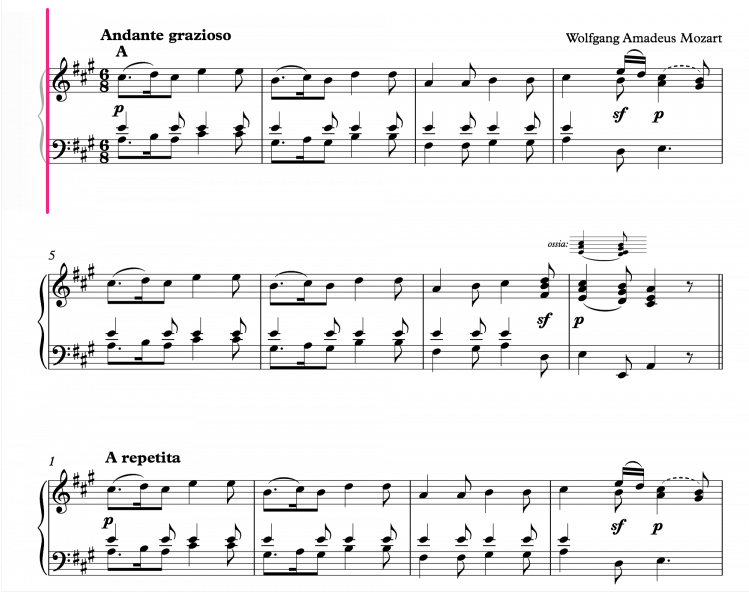
To shift from text to music, I have long said that I had been allowed to compose the first 8 bars or so of Mozart’s Piano Concerto #11, I could die a happy person.

When Artificial Intelligence can compose this music, then email me a note.

When Artificial Intelligence can compose this music and KNOW what it did, then text me.

When Artificial Intelligence can LISTEN to this and feel it and know it is special and also know that if the computer was unplugged today, that computer would be happy that it has composed such a piece, then call me.

*.. Let us imagine that a million monkeys have been trained to type at random on the keys of a typewriter and that, under the supervision of illiterate foremen, these typing monkeys work with ardor ten hours a day with a million machines to write of various types. Illiterate foremen would collect the blackened sheets and bind them into volumes. And at the end of a year, these volumes would be found to contain the exact copy of the books of all kinds and all languages ​​preserved in the richest libraries of the world. Such is the probability that there will occur for a very short instant, in a space of some extent, a notable deviation from what statistical mechanics considers to be the most probable phenomenon… (Yes I used a computer generated translation)

12.31.2022 – Ahhhh freudenfreude!

Ahhhh freudenfreude!
that bliss that you will feel when
someone else succeeds

I am not much on bucket lists or New Year’s resolutions.

I have to say there is nothing on my ‘list’ that I need to do or just would like to do before I die that would make my life complete.

I am a sinner saved by grace and while I know I need to work out my Salvation with fear and trembling, I also KNOW that when I do die, bold will I approach the throne, confident and wrapped in the gift of that grace.

Not much I can do or see here on earth to improve on that in my back pocket.

As for resolutions, I guess if its worth doing, it worth doing now rather than the an arbitrary state-by-date set by a calendar devised by people a long time ago.

That being said, I admit I enjoyed reading 6 Ways to Strengthen Your Relationships in 2023, By Catherine Pearson.

In the spirit of the New Year and looking ahead (maybe not forward) to the 2023, I pass along Ms. Pearson’s 6 Tips.

  1. Assume people like you.
  2. Don’t underestimate small acts of kindness.
  3. Embrace the power of the casual check-in.
  4. ‘Turn toward’ your partner throughout the day.
  5. Acknowledge the ‘normal marital hatred,’ too.
  6. Cultivate ‘freudenfreude.’

That’s it.

The article does give some background on each tip, but just by themselves, if read introspectively, has just enough words to make the point.

And it’s is that last that really caught my eye.

Cultivate ‘freudenfreude’.

Ms. Pearson writes;

Unlike schadenfreude, when we take pleasure in others’ misfortunes, “freudenfreude” describes the bliss we feel when someone else succeeds — even if it doesn’t involve us.

There are benefits to sharing in someone else’s joy.

It can foster resilience and improve life satisfaction.

Freudenfreude.

I was not aware of the word but maybe I was aware of the feeling.

My sister Mary once wrote of our Mother something like, that our Mom had the gift to enjoy and be proud of other people’s good fortune without being or appearing to be envious.

Freudenfreude.

I think of my Mom at Church.

I remember how people would seek out my Mom to tell her things.

They got a job.

They finished school.

Their child was getting married.

It didn’t matter what.

But what ever it was, my Mom was excited and happy for the news and excited and happy in such a way that whoever was talking to her was pleased that she was excited and happy for them.

I remember a Sunday sermon where the Pastor was preaching on spiritual gifts.

He mentioned the gifts in the Bible like the word of wisdom, the word of knowledge, faith, healing, miraculous powers, prophecy.

Then he mentioned everyday things.

The gifts of song.

Some people can just sing, he said.

The gifts of teaching.

Some people can just teach, he said.

Then he said some people being happy, so happy they can just make you feel good.

Some people, if you just sit next to them, make you feel good.

Then he paused.

Then the Pastor pointed over to the left at my Mom.

“Go sit next to Mrs. Hoffman.”

“FIND OUT HOW SHE DOES THAT!”

Freudenfreude.

At my Mom’s funeral, we all got a chance to say something about our Mom.

My brother Tim demonstrated calling my Mom with good news.

He took out a cell phone and showed how you would punch in her number and say hello when Mom answered and then tell her the good news.

He immediately took the phone from his ear and held it arms length.

And we all laughed.

Because, no matter the good news, Mom would SCREAM OHHHHHHHHHHHHHHHHHHHHHHHHHHHHHHHHH and if you didn’t hold the phone away from your ear, you stood a good chance of losing an ear drum.

My Mom felt bliss expressed when someone else succeeded.

Freudenfreude.

My Mom and my 4 youngest kids Lexi, Ellie Dasia and Jack

Seems like there hasn’t been a lot of freudenfreude going around lately.

A lot of schadenfreude in today’s world.

A lot of just plain meanness.

A lot of just plain ugliness.

A of lot of watching other people dealing with meanness and ugliness.

A little Freudenfreude …

The bliss we feel when someone else succeeds — even if it doesn’t involve us.

Ms. Pearson closes with this paragraph.

One easy way to experience more freudenfreude is to check in with your friends and loved ones about their small victories or the bright spots in their day.

Doing so turns you into a “joy spectator” — and gives you an opportunity to see the people around you at their best.

Going into 2023 I plan to engage freudenfreude.

Going into 2023 I want to take advantage of any opportunity to see the people around me at their best.

It can foster resilience and improve life satisfaction.

For both of us.

Ahhhhhhhhhhh freudenfreude!

Happy New Year.

11.4.2022 – to world’s end I went

to world’s end I went
in my torment and music
dawned above despair

Adapted from the poem, Secret Music, by Siegfried Sassoon as published in Collected Poems, Faber and Faber Limited, London, 1947.

I keep such music in my brain
No din this side of death can quell;
Glory exulting over pain,
And beauty, garlanded in hell.

My dreaming spirit will not heed
The roar of guns that would destroy
My life that on the gloom can read
Proud-surging melodies of joy.

To the world’s end I went, and found
Death in his carnival of glare;
But in my torment I was crowned,
And music dawned above despair.

Mr. Sassoon was a war poet.

A World War One poet.

A British World War One poet.

According to Wikipedia, one of those poets, whose work combined stark realism and bitter irony with a sense of tragic futility.

Stark realism.

Bitter irony.

Sense of tragic futility.

I recently came across of discussion of the World War One poets that included the observation that the sky had a very prominent role across the body of work of these poets.

The point was made that when you are in a trench 15 feet wide and 15 feet deep, the sky is the only thing you see.

It is easy to imagine how such a view, which combined with stark realism and bitter irony with a sense of tragic futility led to the dark poetry of the war.

The view though, did not create those feelings of stark realism and bitter irony with a sense of tragic futility.

I put it out there that neither did the war nor the war in the trenches, create the feelings of stark realism and bitter irony with a sense of tragic futility.

The war experience most likely put those feelings into bright contrast and made them stand out.

I hear though the words of Mr. Thoreau when he wrote that Most men lead lives of quiet desperation.

All those thoughts together, the quiet desperation, the stark realism, the bitter irony with a sense of tragic futility.

Those thoughts and feelings are there.

I have no answers.

And there are no words.

To the world’s end I went, and found
Death in his carnival of glare;
But in my torment I was crowned,
And music dawned above despair.

James Robert Hoffman 1978 – 2022

Please read my Nephews memorial – click here.