
driving with only
half a brain need to save the
other half for work
Due to road construction and the tourons*, my last couple of commutes have been a little rough.
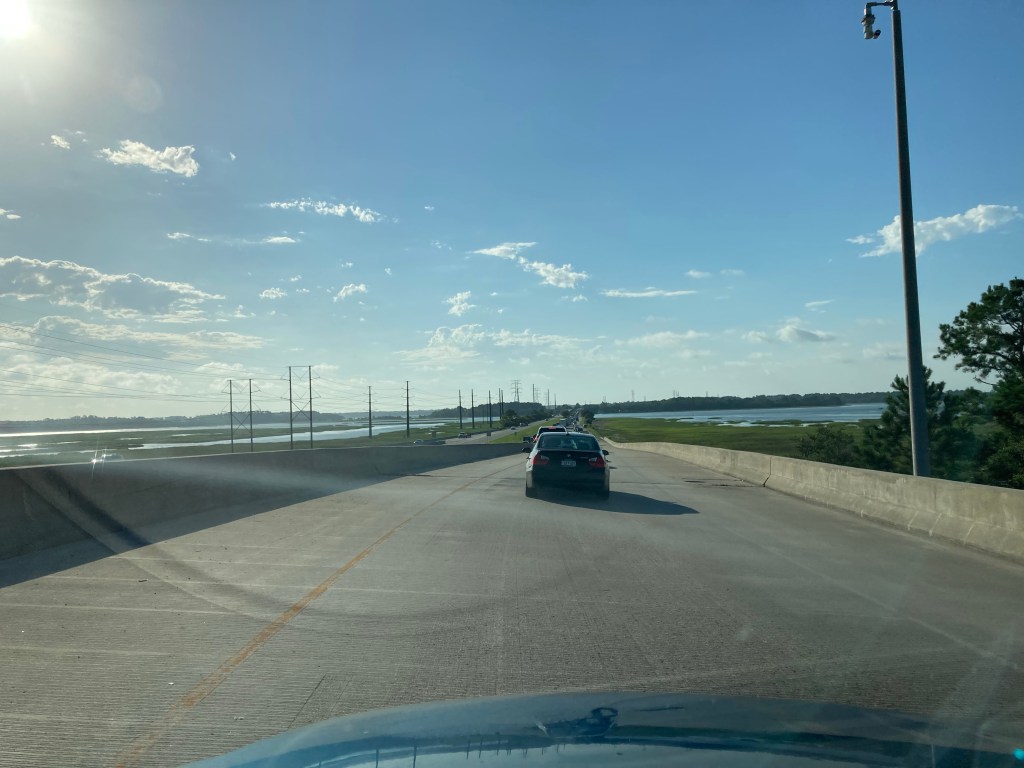
The bridge to the island where my office is was built in 1984 and while there have been no improvements to the bridge, the number of cars using the bridge has doubled.
They are putting more sand in the hourglass but not making the neck that connects the two halves of the hour glass any bigger so travel time gets higher and higher.
Seems like someone could realize that if you double the amount of sand in an hour glass, you would need to double the width of the neck to make sure it was still an hour glass.
I think it was Bill Bryson who said traffic engineers cannot fix traffic but they can spread the problem out over a larger area.
But I digress.
The problem for me is that I am getting so agitated with other drivers.
I get so agitated that it takes a lot of time getting my mind back in line to work.
I thought about how I used to commute.
I thought about how I used to commute when I worked in Atlanta and started writing these haiku.
In many ways my old ATL commute was much much worse.
The saying was what would you get if you took the cars in the world and put them end to end?
The answer was ATLANTA!
Atlanta traffic was always doing its best to kill me.
Low Country traffic just was to annoy me as much as humanly possible.
Over those ATL years, I was able to develop a commuting mind set where I used my half my brain, so to speak, to drive to work, and saved or reserved or protected the other half of my brain so that I could work once I got to work.
If I did it before, I can do it again.
I got up this morning a little earlier planning to get a head start on my drive.
I thought about my drive and the music I would listen to and the views I would enjoy driving towards the sun rising out from the Atlantic Ocean.
I made a big travel cup of coffee.
It was magical.
Did I worry when I had to go through that first traffic circle with a bunch of South Carolinians who understand neither the concept of yielding or know their right hand from their left?
No I did not and I successfully navigated that first road hazard on the my commute.
My mood was threatened when the feller in front of me who had successfully fended off my efforts to pass him stopped for a yellow light.
I just went with the flow.
Did I worry when I entered the merge lanes for the Bluffton Flyover where half the cars are trucks pulling trailers of tools twice as long as the truck that make blind side merging such an adventure?
Same for the merge of the Bluffton Flyover with 278 where you meet up with all the auslanders who slow down when they see the water of Mackay Creek and they point fingers at the water and yell, SEE THE WATER and slow down to see the water.
No I did not and I successfully navigated that second and third road hazards on the my commute.
It didn’t bother me when there was the usual fender bender on Pinckney Island where you finish the first bridge (the one not yet condemned but not deemed safe to use) and start the second bridge.
I used the slow down to have a big sip of coffee.
The taste of hot coffee in a well worn plastic travel cup took me back, BOY HOWDY.
On to the island and through the first 2 traffic lights and then over the Cross Island Parkway and the next 2 traffic lights and bang, zoom, I was at work.
Stoplights in the low country are always an adventure as, for some reason, South Carolinians are always surprised that the colors change and that the change in color requires a reaction beyond saying, GOSH THAT COLOR JUST CHANGED, LETS WATCH AND SEE IF IT CHANGES AGAIN.
But I made it.
I got out of the car and grabbed my backpack and walked up to the doors with a light heart.
I used my entrance code, which I take as a sign that I still have a job and entered the building.
I walked into the office and greeted my coworkers with a smile.
I made my commute and saved half my brain for work.
I wasn’t agitated or angry or spouting off at the mouth with all the things I wanted to yell at drivers that I didn’t yell because I knew they couldn’t hear me. (Okay I DO YELL even though I know they can’t hear me – you can ask my wife)
Nope.
I was fresh and happy and ready for work.
I started my day with a focus on the drive and left half my mind for the job.
Yessir.
I zipped open my backpack and saw that I had forgot to pack my laptop.
*Tourons (according to Wikipedia) Touron is a derogatory term combining the words “Tourist” with “Moron” to describe any person who, while on vacation, commits an act of pure stupidity. The term is considered park ranger slang that describes how some tourists act when entering a national park. The phrase indicates an act of ignorance and is known to be used in different subcultures. It is also used to describe tourists in general when they are outside their normal “comfort zone”.
Tourists acting as Tourons can drive erratically. A common occurrence is to see vehicles stopped in the middle of the road at the first sighting of deer. Drivers and occupants leave the vehicle to take pictures, backing traffic up for miles. The term is used as humor to defend against the usual aggravation of continued exposure to tourists by even local residents of tourist areas.

 No Haiku For You