May 7 – Hum of the Highway

Hum of the Highway
Sound of America singing
Not Walt Whitman’s song

All day long, like white noise (by itself a terrible nuance of this age) or the low drone of of a far off bagpipe, I hear the hum of thousand’s of engines. The low whoosh of cars and trucks forcing their way through air.

It’s background music for this techno era of auto tuned electronics.

Not the same music Walt Whitman wrote about.

I Hear America Singing

BY WALT WHITMAN

I hear America singing, the varied carols I hear,
Those of mechanics, each one singing his as it should be blithe and strong,
The carpenter singing his as he measures his plank or beam,
The mason singing his as he makes ready for work, or leaves off work,
The boatman singing what belongs to him in his boat, the deckhand singing on the steamboat deck,
The shoemaker singing as he sits on his bench, the hatter singing as he stands,
The wood-cutter’s song, the ploughboy’s on his way in the morning, or at noon intermission or at sundown,
The delicious singing of the mother, or of the young wife at work, or of the girl sewing or washing,
Each singing what belongs to him or her and to none else,
The day what belongs to the day—at night the party of young fellows, robust, friendly,
Singing with open mouths their strong melodious songs.

May 6 – Wake up Eddie!

NOOOOOO, MA-MA, Come ON,
Keep Moving! Wake up Eddie!
Driving? Words to yell

My wife has noticed that one the rare occasions when I am driving with her in the car, I talk to the other drivers. She is quick to point out that they can’t hear me.

Actually, when I am driving by myself, on my daily commute into and out of Atlanta, I am not talking to other drivers so much as I am yelling at them.

I know they can’t hear me, but it does help me feel a little better.

Today’s Haiku is a lexicon of my most used phrases.

Here is what they mean.

NOOOOOOOO: (Long and slow, starting high to low) – For drivers who try to cut in, in front of me.

MA-MA: (prayerfully as in ‘ma-ma yo tengo hambre” which is about 33% of the Spanish I retained from a single term in college) – When I see drivers ahead me somehow avoid getting themselves into an accident (two cars merging into the same place, 1 car merging and speeding up as the car already in the lane starts to break).

COME ON: (said in two very distinct words with a corresponding pause between)- For drivers in front of me who allow a gap for other drivers to cut in, in front of them, which pushes me another car length away from my destination. This has become more a problem lately as I notice drivers leaving a ‘handheld gap’ in front of themselves so they have more space between cars to stop as they are playing with their phones and not watching the road.

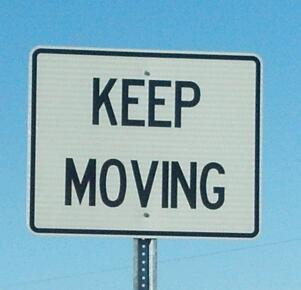
Keep Moving: (like a command in the way A TEN TION is yelled in army movies)- For cars that slow down for no apparent reason. Gawking, Cop on the opposite side of the freeway, right turns with a right turn lane for traffic through the turn, RAIN. This is big in Georgia and there are actually ROAD SIGNS that have been produced and placed by the State of Georgia that say, KEEP MOVING. I love this sign and want these words carved on my tombstone if I have one.

Wake up Eddie: (with desperation in your voice) – For those moments when all the sights and sounds of traffic leave you in no doubt that an accident is just about to happen. Based on this old joke:

George and his brother Eddie, were interviewing for truck driving jobs.

The guy says to George, “You and your brother are driving a big rig across country. Eddie is asleep next to you in the cab. It’s raining and you are going down a steep hill. Without a warning, at the bottom of the hill, another big truck coming the way other hits the brakes and jackknifes into your lane. Other trucks in front of you break and stop all over the road. At the same time, the railroad signs start to flash and the crossing guards come down and a trains crosses the road in the middle of all the trucks. What do you do?

George looks at the man and thinks for a moment and says, “I wake up Eddie.”

“Wake up Eddie?, says the guy, “Why would you do that?”

“Well,” says George, “Eddie has never seen such a big accident.”

April 23 – cars and commuting

cars and commuting
perfect match, improved means to
an unimproved end

I have no doubt that Mr. Thoreau would take one look at a freeway system and throw up.

WALDEN and ON HE DUTY OF CIVIL DISOBEDIENCE
by Henry David Thoreau

As with our colleges, so with a hundred “modern improvements”; there is an illusion about them; there is not always a positive advance. The devil goes on exacting compound interest to the last for his early share and numerous succeeding investments in them. Our inventions are wont to be pretty toys, which distract our attention from serious things. They are but improved means to an unimproved end, an end which it was already but too easy to arrive at; as railroads lead to Boston or New York. We are in great haste to construct a magnetic telegraph from Maine to Texas; but Maine and Texas, it may be, have nothing important to communicate. Either is in such a predicament as the man who was earnest to be introduced to a distinguished deaf woman, but when he was presented, and one end of her ear trumpet was put into his hand, had nothing to say. As if the main object were to talk fast and not to talk sensibly. We are eager to tunnel under the Atlantic and bring the old world some weeks nearer to the new; but perchance the first news that will leak through into the broad, flapping American ear will be that the Princess Adelaide has the whooping cough. After all, the man whose horse trots a mile in a minute does not carry the most important messages; he is not an evangelist, nor does he come round eating locusts and wild honey. I doubt if Flying Childers ever carried a peck of corn to mill.

April 10 – stories unfinished

each drive, cars, more cars
bookmarks left in unread books
stories unfinished

I marvel each morning at the number of people and cars that are brought together by a need to get to work.

I will, I hope, never meet these people. But for about one hour, I share a close proximity with all these people, a common goal, a common desire to avoid getting killed while getting to work.

I wonder, when I can, who are all these people? Where are all these people going? What are they like? What was their morning like so far?

The back end of their cars often read like a table of contents to their life.

Places they have been, people they have voted for, personal accomplishments as well as family accomplishments and schools they have attended.

What is the rest of their story?

March 29 – Quo Vadis?

Augusta? Macon?
Chattanooga? Birmingham?
Bypass? Quo Vadis?

A Latin phrase meaning “Where are you marching?” It is also commonly translated as “Where are you going?” or, poetically, “Whither goest thou?” (Wikipedia)

Inspired by the road signs and directions at the I85 and I285 interchange in North Georgia AND the EB White story, Quo vadimus?, about two men who meet each other on the street. One asks the other Quo vadis? and after a bit of hesitation, tells him a very complex tale of where he is going, and what he is going to do. (New Yorker, May 24, 1930 Issue)

White writes, “Did it ever occur to you that there’s no limit to how complicated things can get, on account of one thing always leading to another?”

As a post script, a little known piece of family trivia is that son Ellington’s full name is Ellington Bernard Hoffman.

He is named after Duke Ellington, Bernard Berg (Grand Father) AND EB White.