1.11.2022 – miss me a little

miss me a little
but not for long and not with
your head bowed low

Adapted from the poem, “Let Me Go” –

by Christina Rossetti (5 December 1830 – 29 December 1894).

Here is an excerpt.

When I come to the end of the road
And the sun has set for me
I want no rites in a gloom filled room
Why cry for a soul set free?

Miss me a little, but not for long
And not with your head bowed low
Remember the love that once we shared
Miss me, but let me go.

For this is a journey we all must take
And each must go alone.
It’s all part of the master plan
A step on the road to home.

When you are lonely and sick at heart
Go to the friends we know.
Laugh at all the things we used to do
Miss me, but let me go.

Lots of things, on this anniversary of my Dad’s death back in 1988, come to mind from this poem.

I think my Dad would have wanted to be missed, for little while, but not with a head bowed low.

There was too much fun in our lives to hang my head.
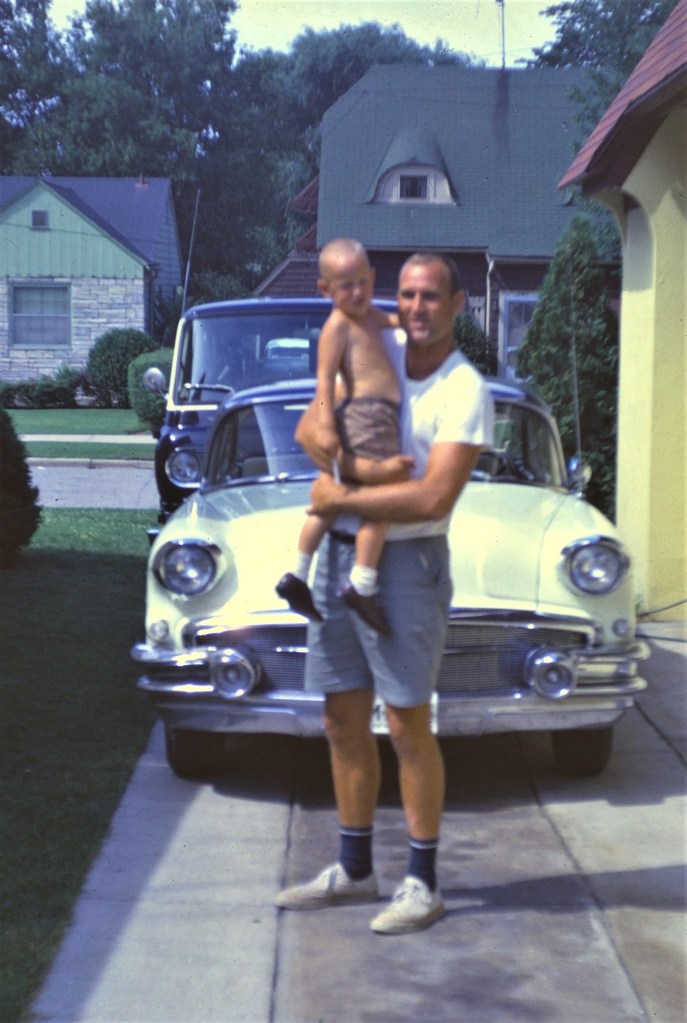
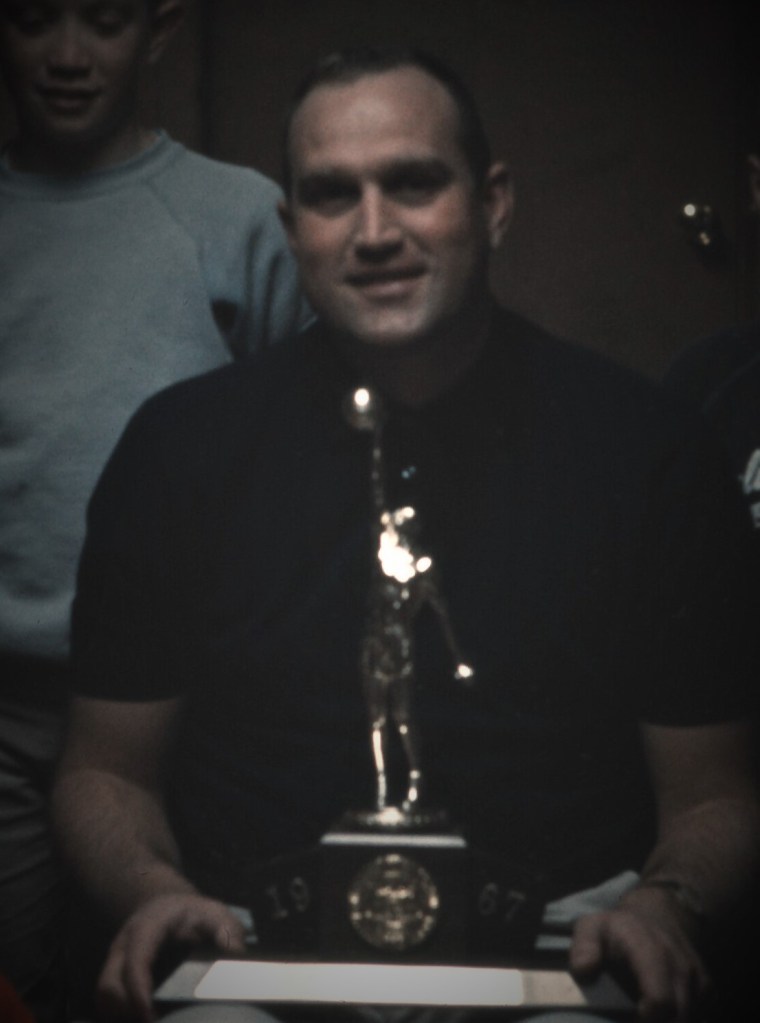
1967? Me and my Dad on VACATION – well, that is how he dressed on vacation

We had a place out on Lake Michigan and every spring we would go out to repair any winter storm caused damage.

Usually this involved the whole crew of my brothers and brothers-in-law and a lot of building and digging.

One spring when I was back from college, my Dad took me and drove off to the lake with a plan to pick up a load of lumber that we would need later when everyone else could get out there.

We got the lumber at Lappo’s in Spring Lake, Michigan and drove to our place where I unloaded it.

I had a little more muscle I guess in those days.

As I unloaded my Dad looked over the deck we had built on the edge of the sand dune overlooking the lake.

It leaned back in one corner and had a couple of loose boards but otherwise was in good shape.

With the lumber unloaded Dad told me to “go get a bucket.”

Which meant one of the buckets we used at the beach for a tool box.

I knew he wanted a bucket with hammers, nails and a level.

We always used a level when working on decks or steps more so we could always say, “We used a level” no matter how the project turned out.

We also always used Grip-Tite nails, that ones that made noise when you hammered them in, ping ping ping, rising in pitch with each hammer blow.

I set the bucket down and took my jacket off and laid it on the deck.

It was warm in the sun.

When I brought out the hammers and nails, Dad positioned himself against the low corner of the deck with the level on the deck and he lifted the corner of the deck until he could see that he had it level.

“Put a nail in here,” he said, indicating a place where the deck brace lined up with the deck post.

And I did.

Never did something I had learned in 7th grade shop class or any class feel so good.

Dad pointed about 4 inches away from the first spot and said, “And here.”

And I did.

It went right in, straight.

ping – Ping – PING.

“Put another one in,” he said.

After about 5 nails, he got up on the deck and bounced a few times.

“Good,” he said.

Then he pointed to the loose deck boards.

“Pound some nails in there.” he pointed.

And I did.

“Good!” he said.

He walked back and forth on the deck, testing it, trying to make it sway.

Satisfied, Dad sat down on the bench that was built into the back of the deck.

I picked up my jacket and pulled two cigars out the inner pocket along with a small cigar cutter and some matches.

Dad looked at me and before I could ask, he held out his hand for a cigar.

He stripped off the wrapper and held out his hand for my cigar cutter and when the cigar was ready, he turned towards me.

He leaned over and I held a match out cupped in my hands.

Once Dad had his cigar properly lit he sat back on the bench.

I sat next to him in the spring sunshine, warmed by the sun, but cooled by the breeze off the lake.

Two guys and two cigars with troubles, like the cigar smoke, drifting away.

Dad took a few puffs, then gestured at the repaired deck with his cigar.

“We do good work!” he said.

And we sat and smoked.

It was kind of solemn, sitting by the big still lake.

We did not feel like talking loud.

And it seemed like nothing happened to us at all.

Yes, I stole that from Huckleberry Finn.

So what?

I will miss my Dad a little.

I will miss my Dad a lot.

But with my head bowed?

Nope.

Never.

No way.

That wouldn’t be right.

We had too much fun.

We had too much.
1.1.2022 – opportunities

opportunities
move on, never wanted to
was living MY dream

Robert Wayne Hendrickson (1933 – 2021)

Some years back when I worked at WZZM13 TV in Grand Rapids, Michigan, it was announced that the old Ottawa Hills High School Building, a building that currently was home to Iroquois Middle School, would be demolished.

At the morning news meeting, possible story lines about Ottawa Hills were brought up and I said that someone had to interview my Uncle Wayne.

The story was assigned to a very young Steve Patterson, now a national reporter with NBC News.

I got with Steve and called my Mom to get Uncle Wayne’s phone number and Uncle Wayne agreed to meet Steve at the old building for a walk through and interview.

My Uncle Wayne was known to the world as Robert Wayne Hendrickson.

(For some reason, my Mom’s family used that Southern tradition of family members using middle names within the family.)

Robert Wayne Hendrickson or Bob Hendrickson or Coach Hendrickson was Ottawa Hills High School.

While my Mom went to South High School in Grand Rapids, by the time her brothers started the 7th grade in school, the districts had changed and they went to Ottawa Hills.

While at Ottawa Hills, Uncle Wayne was an athletic wonder.

According to the stories my brothers told me, in basketball, he could lay up with either the left or right hand and was pretty much unstoppable.

The story was that Michigan wanted him but in those days there weren’t athletic scholarships and beside, he wanted to get married, so he went to Hope College in Holland, Michigan.

After college, he got a job teaching and coaching at Ottawa Hills.

He would stay there until he was retired at age 60.

Uncle Wayne was quoted in the Grand Rapids Press, “Ottawa Hills was my life from age 13 to age 60, with the exception of my four years at Hope College. When I returned as a teacher, my old teachers helped me so much. They wanted me to start calling them by their first names but I was never able to do it. Before I was old enough to start school there in the seventh grade, I would watch the high school teams on the practice fields and want to be a part of that. What a great break for me to spend so much of my life at Ottawa Hills. I had opportunities to move on, but I never wanted to go. I was living my dream.”

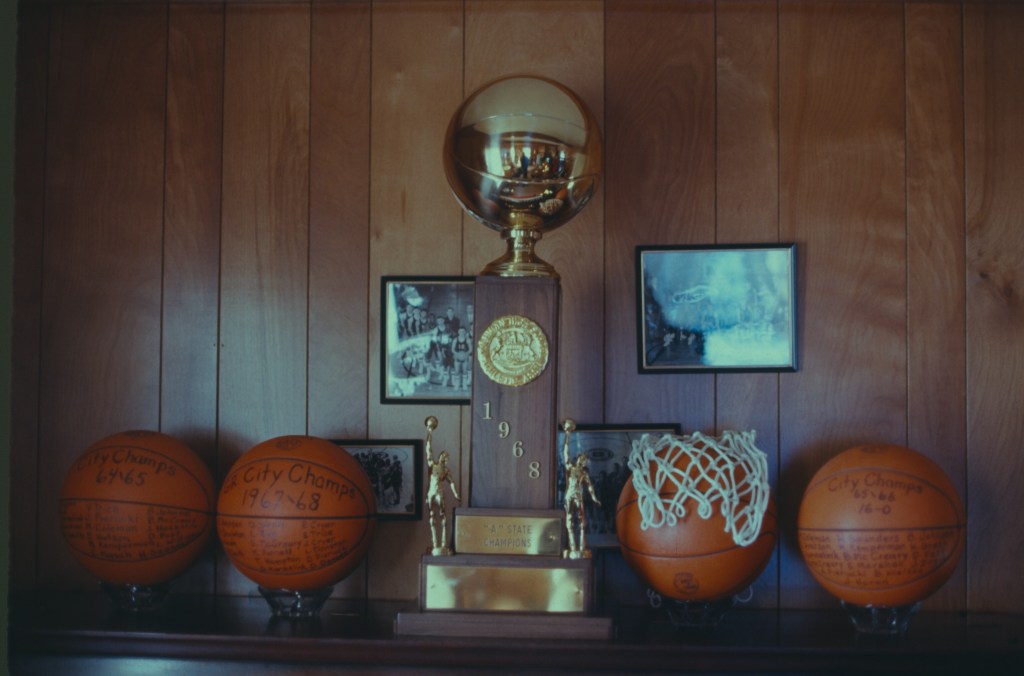
The dream included winning two Michigan Class A State Championships in 67-68 and 68-69. 

Each year, there was parade and celebration on the south end of Grand Rapids.

As the Coach was my Mom’s little brother, we went to see the parades from the vantage point of the front porch of the Coach’s house.

I was only 8 years old and after the 2nd parade, I figured these things happened every year.

We got to see the trophy’s up close.

I have never won a trophy in my life but that’s okay as any other trophy that I could have won PALED TO INSIGNFICANCE when compared to those trophies.

Also there with the trophies were the nets.

I have watched countless teams cut down basketball nets after big games.

Maybe of all sports traditions this one is the most special to me because of seeing those nets laying there.

Silent objects speaking volumes.

There were all sorts of stories of my Uncle as a Coach.

Those championship teams in the late 60’s were integrated teams.

I think that was unusual for the time, maybe inevitable but new.

Back in those days, BEFORE THE DUNK was made illegal, the story was that my Uncle Wayne’s team had a dunk DRILL in warm up.

His team would line and one by one they would dribble in and BA BOOM, BA BOOM, BA BOOM, they would dunk dunk dunk.

I was told that the backboards would be swaying and the crowd screaming.

And the other team watched.

Watched in disbelief.

Those games were over before they started.

My brother tells a story about a game against our high school on the North End, Creston (Ottawa was on the South End) and Uncle Wayne came off the bench, yelling at the refs.

My brother says, and as I remember it, this was in the OLD Creston High School Gym, where the basketball court was kinda wedged into a space surrounded by bleachers, my brother said the crowd just went crazy yelling at Uncle Wayne.

Uncle Wayne spins around and GLARES at the crowd.

And the crowd shut up.

Years later, Uncle Wayne happened to be at our house when we were watching a Piston’s game.

He stood there watching the end of the game and started coaching.

Never took his eyes off the screen but kept saying out loud how much time was left as the seconds ticked off on some click inside, he called all the plays, so it seems to me, and narrated how the Piston’s would win the game before it happened.

Uncle Wayne, to me, was bigger than life.

He was one of those guys who filled a room with his personality and physical presence.

I remember that I when I went to Creston, the Creston Basketball Coach, Jim Haskins, was my biology teacher.

Mr. Haskins told me once how the first time his team played Ottawa he watched that team run out on the floor and then their Coach came out and HE LOOKED SEVEN FEET TALL.

Mr. Haskins just stood there shaking his head.

Uncle Wayne knew it too.

He once said to me that, “Uncle Paul is the only one I know who makes me feel smaller.”

Uncle Paul, who also played basketball in the City League and at Hope, was 6′ 11″.

So Steve Patterson goes out on assignment to interview Bob Hendrickson.

Later that afternoon, Steve got back to the building and he sought me out.

“HOFFMAN,” says Steve.

“Your Uncle! …”

“Is a LEGEND!”

“Yes,” I said, “I know.”

Late on New Years Eve, 2021, I got email that, back in Grand Rapids, my Uncle Wayne has died.

I seem to say this often, but I say it because it is true, that in a era when experts mourn the lack of role models, I got more than my fair share.

My Father, my Grand Father, my Uncles; Wayne, Carol, Paul, Bud and Jim, my brothers; Paul, Jack, Bob, Tim, Pete, Steve and Al and even all my brothers in law.

I don’t know, maybe God knew something and made sure I had lots of help.

Love them all and proud of them all.

Proud to be a part of their family.

Proud of my Uncle Wayne.

Very very said to hear that my Uncle Wayne has died.

He was part of my life and part of what made my life.

Like Alistair Cooke when Duke Ellington died, “I don’t have to believe it if I don’t want to.”

1.9.2021 – old voices, concerns

old voices, concerns
getting a grip on today
what will history say

I saw today that Helen Viola Jackson has died.

She was thought to be the last living widow of a Civil War verteran.

The reports state she married her much-older neighbor, 93-year-old James Bolin, in September 1936 during the depression with the idea she might inherit his pension.

My Great Great Grand Father was a Civil War veteran.

Wound in action and married after he returned home, I like to tell folks I came THIS close to not being here.

Grandpa also got a pension of 8 dollars a month after surviving being shot through the lungs in 1862.

I was going to cite to Helen Viola Jackson as an example of living history but since she just died, well, you know what I mean.

A voice from the past.

There was another voice from the past this week and like many surprise voices from the past, some surprise was connected to the fact that the person in question was still alive.

Browsing through the World Wide Web this past week I can across an opinon piece by none other than Danial Ellsberg.

Danial Ellsberg.

If there is a name that evokes more memories and little understanding of the Vietnam War era, I do not know whose name it would be.

Ellsberg has a big role in the anti Vietnam War effort during the Johnson era and while what he did had nothing to do with Watergate and the Nixon era, it had everything to do with Watergate and the Nixon era.

Ellsberg was a Pentagon staffer who had growing misgivings about US involvement in Vietnam,

The Secretary of Defense, Robert McNamara (one time President of Ford Motor Company – another story for another time) asked that a report be compiled.

The report was to be titled “Report of the Office of the Secretary of Defense Vietnam Task Force, is a United States Department of Defense history of the United States’ political and military involvement in Vietnam from 1945 to 1967.”

Daniel Ellsberg got the assignement and produced an 11 volume report.

ELEVEN VOLUMES!

Mr. Ellsberg’s report came down heavily on the side that said Vietnam was the wrong war in the wrong place at the wrong time with the wrong enemy.

Okay so Chief of Staff General Omar Bradley said that about Korea, but it fits here for this narrative.

Mr. Ellsberg was dismayed at the lack of attention his report received.

Mr. Ellsberg famously related that the only way you could really get something across to Secretary McNamara was to find out when he was flying to Vietnam and then somehow get yourself on the plane and you had 18 hours to talk to the Secretary and he couldn’t get away.

The report was kept under wraps during the Johnson years.

But the Vietnam War stayed on the front pages.

The Nixon Era began and the Vietnam War stayed on the front pages with every indication that the war would get bigger.

Mr. Ellsberg felt he had to act.

Mr. Ellsberg gave the report to the New York Times.

The New York Times published part of the report with the promise that the entire report was coming.

Even though the report was an indictment of the Johnson Administration, the Nixon Government took steps in court to stop publication.

The Nixonians cited National Security.

The Nixon reasoning was that the report said the war was both stupid and wrong and since they had the report when they took over, the were even more stupid and more wrong than Johnson to continue the war.

A Court set a restraining order in place and told the New York Times to stop printing the report.

The Washington Post got a copy of the report (strange how this things get around even then) and started printing.

The case quickly and I mean quickly got to the Supreme Court and the Supremes decided 6-3 in favor of the New York Times and the long and inglorious history of the United States’ political and military involvement in Vietnam from 1945 to 1967 was out there for all to read.

So what could the Nixonians do?

The could discredit Mr. Ellsberg.

The Nixonans knew that Mr. Ellsberg had been driven to seek psychiatric help.

The Nixonians broke into the office of Mr. Ellsberg’s Psychiatrist to get their hands on his case notes to prove that Mr. Ellsberg was crazy.

This did not work out too well for the Nixonians.

Not that they learned any lessons from this.

The Nixonians, if nothing else, felt they now knew what to do if they needed information.

When the Nixonians decided they wanted to know what the Democratic National Committee was doing they resurected the Ellsberg plan and broke in to the DNC Headquarters at the Watergate Hotel in Washington, DC.

This also did not work out to well for the Nixonians.

That is how a very minor, low level Pentagon staffer entered the history books.

For a couple of years there its seems to me that you could not watch or listen to the news without hearing the words Ellsberg, Ellsberg Breakin or Pentagon Papers.

I haven’t heard the name in years however.

And here he was writing about his concerns about possible war plans for an attack on the middle east.

To be sure, he said, such PLANS are being considered.

Mr. Ellsberg even wondered out loud if the people working on these plans might be using his old desk.

Mr. Ellsberg wrote that he hoped if this was happening that who ever was working at his old desk would have his old feelings but have more courage and be a whistle blower for peace and release this information so these plans could be stopped.

Mr. Ellsberg said he was a whistle blower.

But that he waited too long.

Mr. Ellsberg wrote “I will always regret that I did not copy and convey those memos – along with many other files in the top-secret safe in my office at that time, all giving the lie to the president’s false campaign promises that same fall that “we seek no wider war” – to Senator Fulbright’s foreign relations committee in September 1964 rather than five years later in 1969, or to the press in 1971. A war’s worth of lives might have been saved.

A war’s worth of lives might have been saved.

Old voices voicing old concerns.

History has been kind to Mr. Ellsberg.

Kind of an anti-hero hero.

I am often asked my opinion on how history might treat our current man in the oval office.

And I consider Mr. Ellsberg.

Mr. Ellsberg wishes he could have done more to prevent the Vietnam War.

A war that lasted 20 years and in the end resulted in American casualties of 58,318 dead (47,434 from combat) and 303,644 wounded.

In his words, Mr. Ellsberg thinks that had he acted sooner, a war’s worth of lives might have been saved.

Right now in a pandemic lasting less than a year over 350,000 Americans have died.

I don’t have to ponder much as to how history will judge this feller currently in office.

6.19.2020 – days I hope will come

days I hope will come
rendezvous with Life I keep
fear I deeply, too

From the poem I Have A Rendezvous With Life by Countee Cullen

I have a rendezvous with Life,
In days I hope will come,
Ere youth has sped, and strength of mind,
Ere voices sweet grow dumb.
I have a rendezvous with Life,
When Spring’s first heralds hum.
Sure some would cry it’s better far
To crown their days with sleep
Than face the road, the wind and rain,
To heed the calling deep.
Though wet nor blow nor space I fear,
Yet fear I deeply, too,
Lest Death should meet and claim me ere
I keep Life’s rendezvous.

Born in 1903 in New York City, Countee Cullen was raised in a Methodist parsonage.

He attended De Witt Clinton High School in New York and began writing poetry at the age of fourteen.

An imaginative lyric poet, he wrote in the tradition of Keats and Shelley according to the website, https://allpoetry.com/.

It was another one of Cullen’s poems that may have been the first real poem I ever read.

Back in the 1960’s at Crestview Elementary School in Grand Rapids, Michigan, the school took part in the Scholastic Book Program.

We would get a 4 page newsprint catalogs of cut rate paper back books and we would be encouraged to order a book or two.

We still had to pay of course but the prices of these books were pretty cheap.

The day the orders were due, most kids in class would show up with a white envelope with a dollar in it along with an order for 1 or 2 books.

Then I would go up with order for 5 or 10 or 20 books.

I have to admit that when it came to books and me, my parents were very generous.

Maybe they figured if I was reading I wasn’t in trouble and that alone was priceless.

After a week or two, we would come in from recess and on the teachers desk would be a big box.

In this day and age of Amazon, it is hard to explain how exciting a big brown box could be.

The teacher, most likely Miss Critchell as I had her for 2 and a half years of grade school, but that is a different story, would open the box and we would see that it was filled with books and a bunch of orders.

Once we settled down, the teacher would pick up an order form, rummage for a book and call out Diane, Ruby, Richard or Cindy and those kids would go forward and the teacher would hand them their book and their order.

And I would wait and wait and wait.

Then the teacher would count the last books and look at the last order and say, “Mike, these are yours,” amd had me the box.

And that was it for me for the rest the day, maybe that week.

Teachers were as happy as I was.

Call It Courage, The Mystery of the Blue Cat, Up Periscope.

I can still remember the titles.

The smell.

The feel of a new book.

I can say I have spent all my life in information services, with the last 20 years creating an online environment for news.

But before that I worked for, going backwards, a publisher, the public library and for almost 10 years, a bookstore.

That all got started back in grade school.

I would order almost anything off of those Scholastic Catalogs.

My Mom would look over the list and ask, “Are you really going to read that?”

Of course I would say.

Though I admit sometimes I just wanted the book.

Out would come the checkbook and the next day I would give my teacher a white evenlope with the order and my Mom’s check.

I feel like I read them all the books I ordered.

I know I read a most of them.

Most of them in a matter of days.

I know I got lifted eyebrows over, “A Students book of Verse” or something like that, but I know I got the book.

I remember looking at it when it came and wondering why I ordered it, but there it was.

I remember that it was 4th or 5th grade.

Crestview had been integrated by them.

I was sitting at my desk.

I would read at my desk when we were supposed to working on other subjects.

I would open a book in my lap to hide it and read.

I always thought my teacher didn’t notice.

She might not have noticed the book but she had to notice I was being quiet.

And if I was being quiet, the teacher wasn’t going to do anything to get me to stop being quiet.

I had the Students Book of Verse open.

I was thumbing through it, never having read much poetry aside from anything I might have had to learn as a ‘Memory Selection.”

Somehow, someway, in 1970, the editors of that book managed to include the poem “Incident” by Countee Cullen.

Never heard of it,

Never heard of Cullen.

But I read his poem.

I slapped the book shut and put it in my desk and slammed the lid.

I was shaking inside.

Had anyone seen me reading that poem.

Had anyone known that that poem was in my new book.

How has THAT poem got into this book?

To this day I wonder that.

I like to think that some young editor at scholastic snuck the poem in there with the hope that one kid, like me, might learn from it .

It was the 60’s..

About the same time we had a school concert with lots of Bob Dylan songs.

I might have got looks when I slammed my desk but no one, including the teacher, said anything.

I hid the book back in the box and later that day took all the books home.

When I had a chance to be alone, I got the book out the box and read the poem again.

For a little kid there were just too many emotions.

One was WRONG WRONG WRONG WRONG WRONG.

Another was awe.

Awe because, while I couldn’t verbalize it and today I still can’t, how could all this emotion and feeling and meaning be contained in the words of poem.

A short short poem and it said so much.

I looked around at my classmates and could not understand.

You could say that’s when I discovered the power of poetry.

Makes me laugh to think that I am now writing these daily haikus.

Dandelions in a forest of redwood trees with poems like Incident.

Maybe besides poetry there were other things that I understood that day.

Things that were WRONG WRONG WRONG.

Not much I could to make it right.

But I could try.

It wasn’t the wrong I wanted to concentrate on but the right.

A rendezvous with life

Even though I have fear, I have hope.

And I give thanks for the parents who wrote those checks for those books.

And I give thanks for a wife who understands and we always try to give books as gifts to the kids.

And wait for those days I hope for.

For those who have never read it, here is Countee Cullen’s Incident or Incident in Baltimore, written in 1925

Once riding in old Baltimore,
    Heart-filled, head-filled with glee,
I saw a Baltimorean
    Keep looking straight at me.

Now I was eight and very small,
    And he was no whit bigger,
And so I smiled, but he poked out
    His tongue, and called me, “Nigger.”

I saw the whole of Baltimore
    From May until December;
Of all the things that happened there
    That’s all that I remember.