poignant misery dawn begins clouds sag stormy but nothing happens …
Start a new day and every part screams that it is NOT SUPPOSDED TO BE THIS WAY.
Start a new day and hope for a new beginning.
Start a new day and all that is wanted is to have what WAS before today to be what IS before today.
The poignant misery when the new day starts and dawn begins and clouds sag stormy.
The new day arrives and is a new day.
But nothing happens.
The haiku is adapted from the World War One, or the Great War as it is called elsewhere, poem, Exposure, by Wilfred Owen.
From the third stanza that goes:
The poignant misery of dawn begins to grow . . . We only know war lasts, rain soaks, and clouds sag stormy. Dawn massing in the east her melancholy army Attacks once more in ranks on shivering ranks of grey, But nothing happens.
Appropriate for Veteran’s Day, or Armistice Day as it is called elsewhere, and for many other reasons.
to world’s end I went in my torment and music dawned above despair
Adapted from the poem, Secret Music, by Siegfried Sassoon as published in Collected Poems, Faber and Faber Limited, London, 1947.
I keep such music in my brain No din this side of death can quell; Glory exulting over pain, And beauty, garlanded in hell.
My dreaming spirit will not heed The roar of guns that would destroy My life that on the gloom can read Proud-surging melodies of joy.
To the world’s end I went, and found Death in his carnival of glare; But in my torment I was crowned, And music dawned above despair.
Mr. Sassoon was a war poet.
A World War One poet.
A British World War One poet.
According to Wikipedia, one of those poets, whose work combined stark realism and bitter irony with a sense of tragic futility.
Stark realism.
Bitter irony.
Sense of tragic futility.
I recently came across of discussion of the World War One poets that included the observation that the sky had a very prominent role across the body of work of these poets.
The point was made that when you are in a trench 15 feet wide and 15 feet deep, the sky is the only thing you see.
It is easy to imagine how such a view, which combined with stark realism and bitter irony with a sense of tragic futility led to the dark poetry of the war.
The view though, did not create those feelings of stark realism and bitter irony with a sense of tragic futility.
I put it out there that neither did the war nor the war in the trenches, create the feelings of stark realism and bitter irony with a sense of tragic futility.
The war experience most likely put those feelings into bright contrast and made them stand out.
I hear though the words of Mr. Thoreau when he wrote that Most men lead lives of quiet desperation.
All those thoughts together, the quiet desperation, the stark realism, the bitter irony with a sense of tragic futility.
Those thoughts and feelings are there.
I have no answers.
And there are no words.
To the world’s end I went, and found Death in his carnival of glare; But in my torment I was crowned, And music dawned above despair.
ask smoking or non but wait, where does that seat us after forty years
I was thinking about my Mom this past week.
Hard to believe that it was 9 years ago at the end of August, 2013, that she died.
It is almost more difficult to believe that she had lived the last 25 years of her life without my Dad.
Difficult to believe because in my mind, my Mom and my Dad were a couple, a couple together in my memory.
My family was lucky enough to have had a summer place on Lake Michigan.
This place played a large part in our family.
Yet when my Dad died, my Mom was ready to sell it.
To her, she told me, that was her place to be with Dad and without Dad …
This place on Lake Michigan was a cottage, or so we called it, that had to be winterized as well and prepped for summer early in the springtime.
I started going along with my Dad to close it as well as open it up so I could take over these chores.
I learned where the well was and how to turn off the pump and drain the pipes in the fall as well as prime the pump and fill the water tank in the spring.
At some point, I started taking a week off in the spring and I would stay out at the lake by myself and get the water turned on, the furnace going and do any painting or other small repairs that might be needed.
What I really did was make a pot of coffee in the morning and sat either by the water or if too cold (this would have been Michigan in May), next to the big picture windows looking out over the water and read all day.
One year in the middle of week, my Mom and Dad drove out from Grand Rapids, Michigan, where we lived to drop in on me.
There were also happy to have a cup of coffee and sit and look out over the water as we chatted about eveything and nothing.
Then my Dad suggested lunch.
I knew what that meant.
He wanted to go to local hamburg joint named Russ’.
It was bad English, but everyone called it ‘Russes’.
It had started in Holland, Michigan and we stopped there often when we were out that way and back in the 1980’s it was starting to expand and open locations in Grand Haven and Grand Rapids.
I knew my Dad wanted to order a hamburger they offered called the Big Dutchman.
Somewhere in Grand Haven there was a street sign near a school that said STOP – ALLOW CHILDREN TO CROSS.
Someone had taken a Russ’ bumper sticker and stuck it on the sign so that it read, STOP – ALLOW BIG DUTCHMAN TO CROSS.
My Dad would drive out of his way just to pass that sign and laugh and laugh.
It helps if you grew up Dutch and in West Michigan.
So off I went to Russes with my Mom and Dad.
And so the moment began.
Back in the 1980s, people smoked in public but it was popular if not required by law, that restaurants offer no smoking sections.
It didn’t matter if it was one big room, restaurants would say this side people can smoke and this side people can’t.
They all breathed the same air but there it was.
Russes tried to accommodate non smokers by building on new additions to their restaurants that would at least put smokers and non smokers in separated rooms.
My Mom liked non smoking.
My Dad liked service.
As we pulled into the parking lot of the restaurant, my Mom mentioned that she would prefer to sit in the non smoking section.
My Dad said that he had no problem with non smokers but that the location of the no smoking section at this location was down, back and around the corner from the kitchen.
“I will not sit back there.” my Dad said.
“Might as well as sit in Death Valley. No waitress goes back there.”
My Mom said that maybe things had changed and the non smoking section might have been moved to the front.
My Dad turned off the car and got out and said, “I am not sitting in Death Valley.”
Russes was the place to have lunch in Grand Haven and it was packed.
We had to wait for a bit and then the hostess called our name.
“HOFFMAN?”
From the name we were in the Dutch Club.
We walked up and the hostess asks, “Smoking or non?”
“Non smoking, please” my Mom answered.
The hostess grabbed three menus and asked to follow her.
My Mom and I walked off but my Dad held back and watched.
We walked down a long aisle between tables to the back of the dining room and turned right to go around the kitchen back to the no smoking section.
“Lorraine!”
“Lorraine!” my Dad YELLED.
We stopped and the hostess looked back.
My Dad was now running up the aisle and waving.
“Lorraine,” he said, at one of those moments where the entire restaurant went silent.
“I am 65 years old and I do not have to sit where I don’t want to sit. I will not sit back there.”
My Mom looked at him and then asked, “Where do you want to sit then?”
My Dad pointed at the first empty booth, still with some dirty dishes, and said, “Right there.”
My Mom looked at the hostess who was quick to say sure we could sit and sat my Dad did.
My Mom and I slid in the other side of the booth and the hostess removed the dirty dishes and handed out the menus.
My Dad picked up the menu and held it up high so he could read it through his bifocals.
I heard he say something about Death Valley then he said, “I think I’ll order a Big Dutchman.”
I bit my tongue to keep from saying something about stopping to allow Big Dutchman to sit where they want.
My Mom looked at me and I looked at my Mom.
She caught my glance shrugged with her eyes and held back a laugh as well.
My Mom was known for her hospitality.
My Mom was known for her laugh.
My Mom was known for her smile.
Once in Church when the Pastor was preaching about spiritual gifts and the fact that some folks had certain gifts and said something along the lines of the gift to always be smiling and happy in the way that if you SAT next to that person, you began to smile and feel happy.
Then the Pastor paused and said if you want to know HOW to do this .. go sit next to Mrs. Hoffman … and FIND OUT HOW SHES DOES IT!
My Mom sat across from Dad at Russes.
“Oh Bob,” she said.
They had been married 40 years.
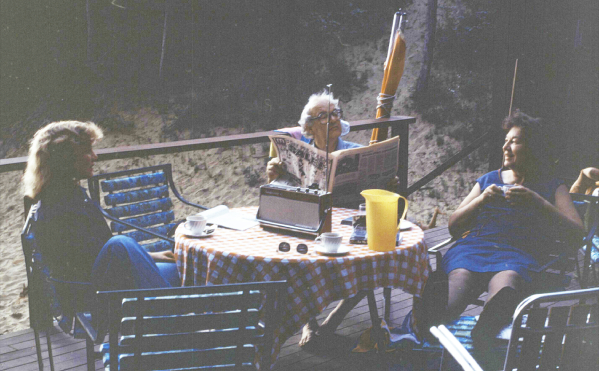
My parents and sister Lisa at the lake with a cup of tea
not surprised nor leap in imagination from sunlight to shadow
Then welcome death and be by death benignly welcomed.
Or so says Conrad Aiken in his poem, When You Are Not Surprised.
I am surprised by an election where my home town lined up with the former president.
The voters in my home town tossed out this one feller who did everything right except to say the former president should have followed almost 250 years of American Democratic precedence and quietly left office.
And I am surprised.
Guess I am not ready to welcome death.
Mr. Aiken, a one time Poet Laurate of the United States is buried near here in Savanah.
His grave is marked by a marble bench.
Carved in the bench is perhaps a fitting epitaph for this country.
It says:
Cosmic Adventurer – Destination Unknown.
Here is the complete poem, When You Are Not Surprised.
When you are not surprised, not surprised, nor leap in imagination from sunlight into shadow or from shadow into sunlight suiting the color of fright or delight to the bewildering circumstance when you are no longer surprised by the quiet or fury of daybreak the stormy uprush of the sun’s rage over the edges of torn trees torrents of living and dying flung upward and outward inward and downward to space or else peace peace peace peace the wood-thrush speaking his holy holy far hidden in the forest of the mind while slowly the limbs of light unwind and the world’s surface dreams again of night as the center dreams of light when you are not surprised by breath and breath and breath the first unconscious morning breath the tap of the bird’s beak on the pane and do not cry out come again blest blest that you are come again o light o sound o voice of bird o light and memory too o memory blest and curst with the debts of yesterday that would not stay, or stay
when you are not surprised by death and death and death death of the bee in the daffodil death of color in the child’s cheek on the young mother’s breast death of sense of touch of sight death of delight and the inward death the inward turning night when the heart hardens itself with hate and indifference for hated self and beloved not-self when you are not surprised by wheel’s turn or turn of season the winged and orbed chariot tilt of time the halcyon pause, the blue caesura of spring and solar rhyme woven into the divinely remembered nest by the dark-eyed love in the oriole’s breast and the tides of space that ring the heart while still, while still, the wave of the invisible world breaks into consciousness in the mind of god then welcome death and be by death benignly welcomed and join again in the ceaseless know-nothing from which you awoke to the first surprise.
caring deeply and passionately, really, has gone out of our lives
Roger Angell has died.
Born in 1920 and the son of Katherine Angell White (which made him the step son of EB White), Roger Angell wrote about baseball for the New Yorker Magazine for as long as I can remember.
To say, though, that Roger Angell wrote about baseball is much like saying Michelangelo painted ceilings.
There was so much more than that to what Mr. Angell wrote.
The focus, the reason for the writing was baseball, but the words were brought together in ways that were magical and poetry.
It was after the 1975 World Series, the famous game six that was won by the Red Sox on a home run in the bottom of the 12th inning, late, late at night in Fenway Park, that Mr. Angell wrote:
What I do know is that this belonging and caring is what our games are all about: this is what we come for.
It is foolish and childish, on the face of it, to affiliate ourselves with anything so insignificant and patently contrived and commercially exploitative as a professional sports team, and the amused superiority and icy scorn that the non-fan directs at the sports nut (I know this look — I know it by heart) is understandable and almost unanswerable.
Almost.
What is left out of this calculation, it seems to me, is the business of caring — caring deeply and passionately, really caring — which is a capacity or an emotion that has almost gone out of our lives.
And so it seems possible that we have come to a time when it no longer matters so much what the caring is about, how frail or foolish is the object of that concern, as long as the feeling itself can be saved.
Naïveté — the infantile and ignoble joy that sends a grown man or woman to dancing and shouting with joy in the middle of the night over the haphazardous flight of a distant ball — seems a small price to pay for such a gift.
Mr. Angell was a not so much a sports reporter but a baseball commentator.
Each year, it seems to me now, he would write an essay that previewed the upcoming season, then an essay or too on the season so far and then an essay recapping the season just finished.
These 4 or 5 essays over the course of a year all appeared in the New Yorker Magazine.
Written a leisure with thoughtfulness beyond anything but appreciation, Mr. Angell could bring each and every game he covered to life though it had been over for some time.
I was 8 years old when the Detroit Tigers won the World Series in 1968.
It wasn’t until years later that I was able to understand and appreciate what when on in that World Series, the dual between Denny McCain and Bob Gibson and the slow turtle-and-the-hare story Mickey Lolich pitching his way to 3 World Series wins, and I got those stories from reading Roger Angell’s account in an essay titled, “A LITTLE NOISE AT TWILIGHT.”
But like the Persian Rug with the missing knot so it wouldn’t be perfect, Mr. Angell did make mistakes.
I always felt somehow privileged that I caught one.
But to this day, I am not sure if the error was Mr. White’s or his editor.
Here is the passage in question?
Can you find the mistake?
The scene is late in Game 7 of the ’68 Series between the Cardinals and Tigers.
The game is in St. Louis and the series is tied 3-3.
Mr. White wrote: Still no score. Summer and the Series were running out. Gibson had permitted only one base-runner in the game, and here were the Tigers down to their last seventh inning of the year. Gibson fanned Stanley, for his thirty-fourth strikeout of the Series, and Kaline grounded out. At three and two, Cash singled to right. Horton hit to the left side, and the ball went through for a single. Northrup lined the first pitch high and deep, but straight to center, where Curt Flood started in, reversed abruptly, and then stumbled, kicking up a divot of grass. He recovered in an instant and raced toward the fence, but the ball bounced beyond him, a good four hundred feet out; Northrup had a triple, and two runs were in. Freehan doubled past Brock in left, for the third.
It is right there in plain sight.
For me, it made Mr. Angell more human and that much more great.
Roger Angell has died.
This is when I quote John O`Hara on the death of George Gershwin.

 No Haiku For You