10.22.2025 -La mer est tout, son

La mer est tout, son
souffle est pur et sain que
mouvement et amour 

Based on the passage: La mer est tout ! Elle couvre les sept dixièmes du globe terrestre. Son souffle est pur et sain. C’est l’immense désert où l’homme n’est jamais seul, car il sent frémir la vie à ses côtés. La mer n’est que le véhicule d’une surnaturelle et prodigieuse existence ; elle n’est que mouvement et amour ; c’est l’infini vivant, comme l’a dit un de vos poètes. Et en effet, monsieur le professeur, la nature s’y manifeste par ses trois règnes, minéral, végétal, animal.”

From Vingt mille lieues sous les mers : Tour du monde sous‑marin by Jules Verne( Paris : Éditions J. Hetzel & Cie, 1870).
Or … The sea is everything!

It covers seven-tenths of the earth’s surface. Its breath is pure and healthy.

It is the vast desert where man is never alone, for he feels life stirring on all sides.

The sea is only the vehicle for a supernatural and prodigious existence;

it is nothing but movement and love;

it is living infinity, as one of your poets said.

And indeed, Professor, nature manifests itself there in all three of its kingdoms: mineral, vegetable, and animal.”

From Twenty Thousand Leagues Under the Seas: A Tour of the Underwater World by Jules Verne (Paris: J. Hetzel & Co., 1870).

What?

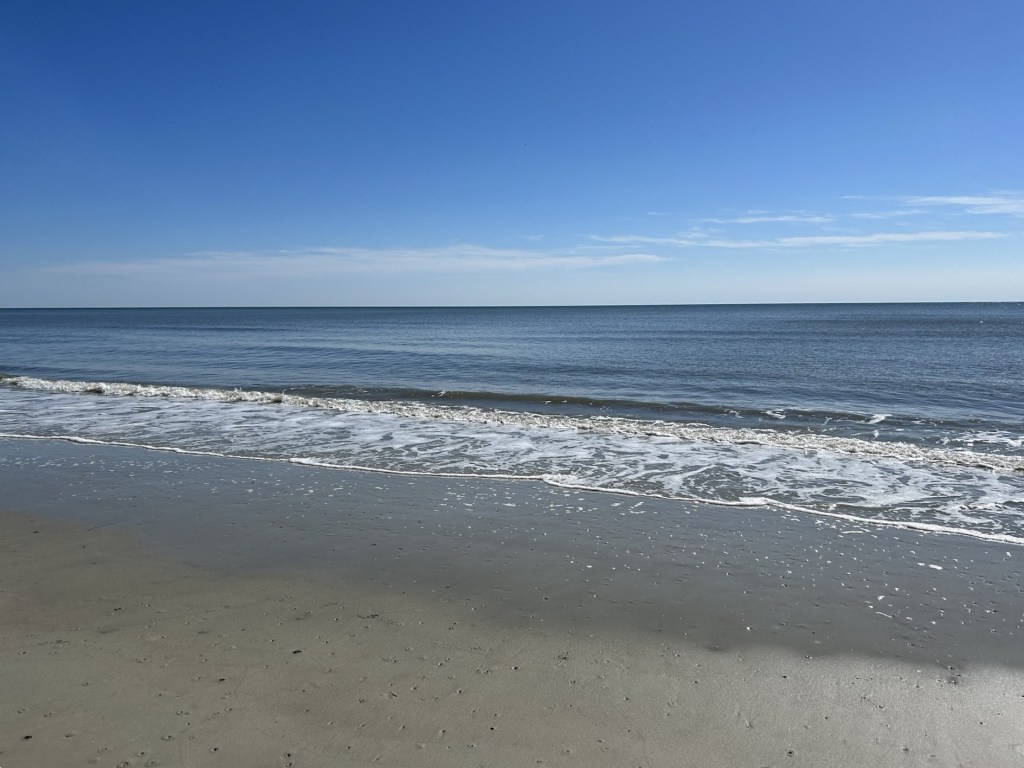
Another excuse to show off that this is where I take my lunch time?

La mer est tout!

The sea is everything!

Elle n’est que mouvement et amour!

It is nothing but movement and love!

And … another excuse to show off that this is where I take my lunch time.
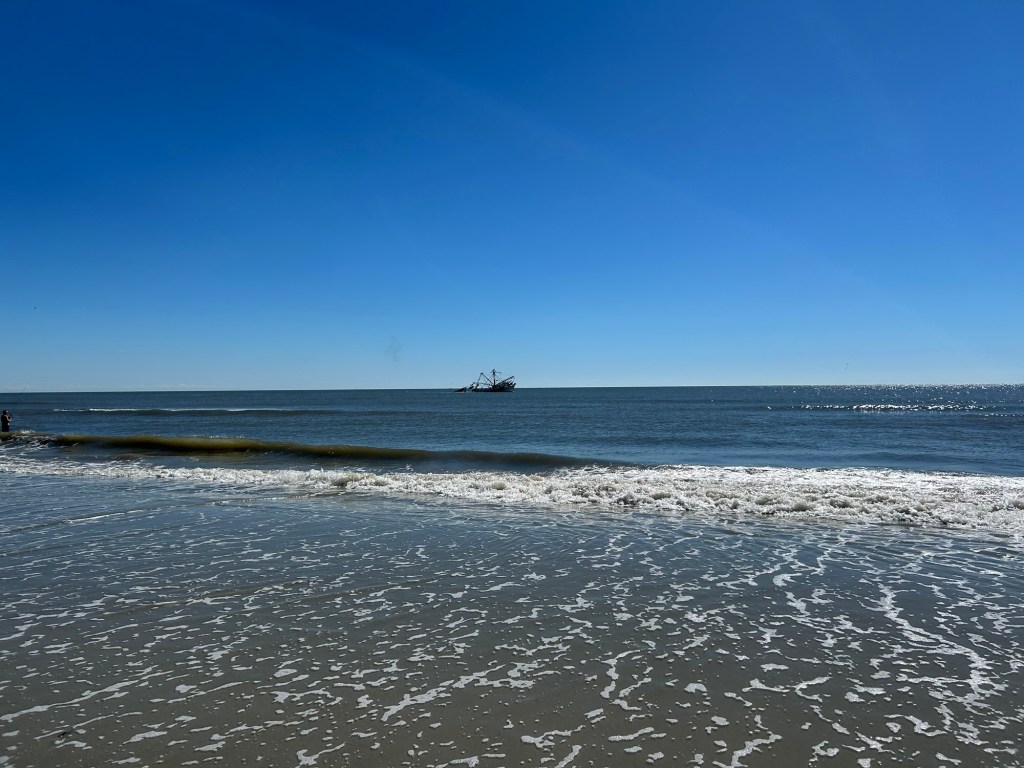
10.16.2025 – shrimping boats are late today

shrimping boats are late today
swift mischief or stubborn sea
lost beneath the tide

The shrimping boats are late today;
The dusk has caught them cold.
Swift darkness gathers up the sun,
And all the beckoning gold
That guides them safely into port
Is lost beneath the tide.
Now the lean moon swings overhead,
And Venus, salty-eyed.

They will be late an hour or more,
The fishermen, blaming dark’s
Swift mischief or the stubborn sea,
But as their lanterns’ sparks
Ride shoreward at the foam’s white rim,
Until they reach the pier
I cannot say if their catch is shrimp,
Or fireflies burning clear.

Nocturne: Georgia Coast by Daniel Whitehead Hicky as published in Poems of Daniel Whitehead Hicky by Daniel Whitehead Hicky (Atlanta : Cherokee Pub. Co.: Atlanta, 1975).

10.15.2025 – sea-born Venus, when

sea-born Venus, when
rose from out her cradle shell
wind out-blows, ’tis blue

Venus in the Morning Sky over the Atlantic Coast – You will have to take it on faith that its there, but it is

That, when I think thereon, my spirit clings
And plays about its fancy, till the stings
Of human neighbourhood envenom all.
Unto what awful power shall I call?
To what high fane? — Ah! see her hovering feet,
More bluely vein’d, more soft, more whitely sweet
Than those of sea-born Venus, when she rose
From out her cradle shell. The wind out-blows
Her scarf into a fluttering pavilion;
’Tis blue, and over-spangled with a million
Of little eyes, as though thou wert to shed,
Over the darkest, lushest blue-bell bed,

Except from Endymion: a poetic romance by John Keats, John, 1795-1821 (Taylor and Hessey, 93, Fleet Street: London, 1918).

I cannot drive to work without looking to my left and see Venus bright in the pre dawn sky and not relax.

Since the moment of Creation, Venus has been there as the morning or evening Star.

No one in history, whether they made the history books or not, has not, at some point in their lives, seen Venus in the sky.

Maybe they didn’t know it was Venus but there it was.

My Dad had a way of pointing out Venus whenever he saw it.

Or if we pointed out that bright star, he would correct us and say, “That’s Venus … It’s a planet”.

I do the same thing with my kids and now, my many grand kids.

And when I do, I think of my Dad and I think of the how long people Dads and Grandfathers have been doing this.

A quick look at history shows that not only has Venus been around a long time, the name Venus for Venus goes back a ways in recorded history.

The Greeks had two names for Venus:

Phosphoros (Φωσφόρος, “Light-Bringer”) when seen as the Morning Star.

Hesperos (Ἓσπερος, “Evening”) when seen as the Evening Star.

Eventually, Greek astronomers (like Pythagoras) realized they were the same object.

Later Greek writers used the name Aphrodite for the planet in line with mythology.

The Babylonians called Venus Ishtar, their goddess of love and war—very similar to Aphrodite/Venus.

Venus was extremely important in Babylonian astronomy and astrology.

For Egyptians, Venus was associated with goddess Isis and also sometimes Hathor.

Egyptians noted its dual role in the sky and had separate names for its morning/evening appearances.

In Chinese cosmology, Venus is called “Taibai” (太白), meaning the “Great White” star, it is associated with metal in the Five Elements (Wuxing).

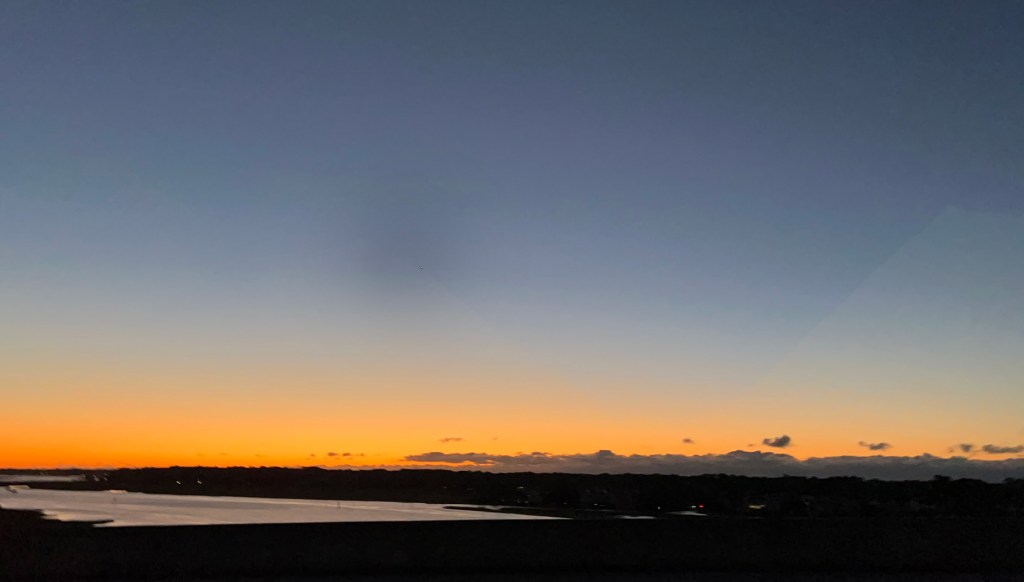
Hard to see in the photo I snapped as I drove over the Cross Island Bridge this morning, but there was Venus.

As C. S. Forester writes in Hornblower and the Hotspur, ” Over there was Venus, shining out in the evening sky. This sea air was stimulating, refreshing, delightful. Surely this was a better world than his drained nervous condition allowed him to believe.”

I see Venus.

I think of my Dad.

I think of my kids and grandkids.

And I think, surely this is a better world than my drained nervous condition allows me to believe.

10.14.2025 – the autumn always

the autumn always
gets me badly – go south where
the cold doesn’t crouch

Beach Colors

To J. M. Murry, from Del Monte Ranch, Questa, 3 October 1924

The country here is very lovely at the moment.

Aspens high on the mountains like a fleece of gold.

Ubi est ille Jason?

The scrub oak is dark red, and the wild birds are coming down to the desert.

It is time to go south, – Did I tell you my father died on Sept. 10th, the day before my birthday? –

The autumn always gets me badly, as it breaks into colours.

I want to go south, where there is no autumn, where the cold doesn’t crouch over one like a snow-leopard waiting to pounce.

The heart of the North is dead, and the fingers of cold are corpse fingers.

There is no more hope northwards, and the salt of its inspiration is the tingling of the viaticum on the tongue.

The Letters of D. H. Lawrence. Vol. 2, Edited by James T. Boulton. )Cambridge: Cambridge University Press, 1962).

10.7.2025 – it begins to rain

it begins to rain
first harsh, sparse, swift drops across
ground in a long sigh

“It begins to rain. The first harsh, sparse, swift drops rush through the leaves and across the ground in a long sigh, as though of relief from intolerable suspense. They are big as buckshot, warm as though fired from a gun; they sweep across the lantern in a vicious hissing.”

As I Lay Dying by William Faulkner (New York: Jonathan Cape and Harrison Smith, 1930).

In the original screen for the movie, Talladega Nights: The Ballad of Ricky Bobby, Ricky Bobby’s two boys are named Hank and Williams, Jr. which gets changed to Walker and Texas Ranger in the movie.

There is a scene that is only on the DVD in the extended cuts where Grandma Lucy is reading to Hank and Williams Jr. They are asking her questions. We see she is reading them Faulkner’s The Bear.

Williams, Jr. asks, “But doesn’t the bear symbolize the old south and the new dog, the encroaching North?”

Hank responds, “Duh! But the question is, should the reader feel relief or sadness at the passing of the old south?”

Grandma asks, “How about both?

To which Hank gets it and says, “Ahh!… I get it, moral ambiguity! The hallmark of all early twentieth century American fiction!”

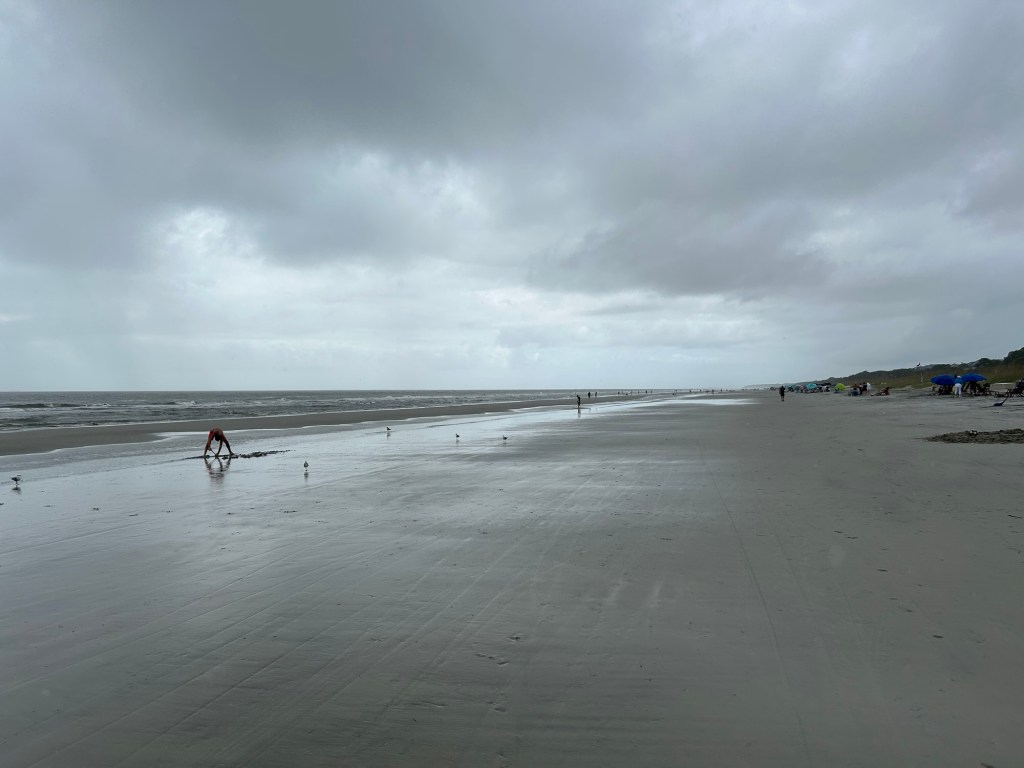
I went for a walk on the beach today and it started to rain and I got soaked.

I was there for a short time on my lunch break.

There were lots of families there who had spent a lot of time and effort and money to be on that same beach for just a few days.

Did I feel relief or sadness at being caught in the rain with all those poor folks, struggling to say, “I don’t think the hard stuff is going to come down for some time yet.”

Or …

Did I feel both.

Moral ambiguity! The hallmark of all early twentieth century American fiction!