4.18.2021 – but came the tide, and

but came the tide, and
made my pains his prey vain man
dost in vain assay

Adapted from the sonnet, Amoretti LXXV, by Edmund Spenser.

This is one of several haiku I got from this sonnet.

Edmund Spenser (1553-1559), according to wikipedia, was an English poet best known for The Faerie Queene, an epic poem and fantastical allegory celebrating the Tudor dynasty and Elizabeth I. He is recognized as one of the premier craftsmen of nascent Modern English verse and is often considered one of the greatest poets in the English language.

In 1595, Spenser published Amoretti and Epithalamion. This volume contains eighty-eight sonnets commemorating his courtship of Elizabeth Boyle. In Amoretti, Spenser uses subtle humour and parody while praising his beloved, reworking Petrarchism in his treatment of longing for a woman.

Spenser used a distinctive verse form, called the Spenserian stanza. The stanza’s main meter is iambic pentameter with a final line in iambic hexameter (having six feet or stresses, known as an Alexandrine), and the rhyme scheme is ababbcbcc. He also used his own rhyme scheme for the sonnet. In a Spenserian sonnet, the last line of every quatrain is linked with the first line of the next one, yielding the rhyme scheme ababbcbccdcdee.

But you knew that.

Here is the full sonnet.

One day I wrote her name upon the strand,
But came the waves and washed it away:
Again I wrote it with a second hand,
But came the tide, and made my pains his prey.
‘Vain man,’ said she, ‘that dost in vain assay,
A mortal thing so to immortalize;
For I myself shall like to this decay,
And eke my name be wiped out likewise.’
‘Not so,’ (quod I); ‘let baser things devise
To die in dust, but you shall live by fame:
My verse your vertues rare shall eternize,
And in the heavens write your glorious name:
Where whenas death shall all the world subdue,
Our love shall live, and later life renew.
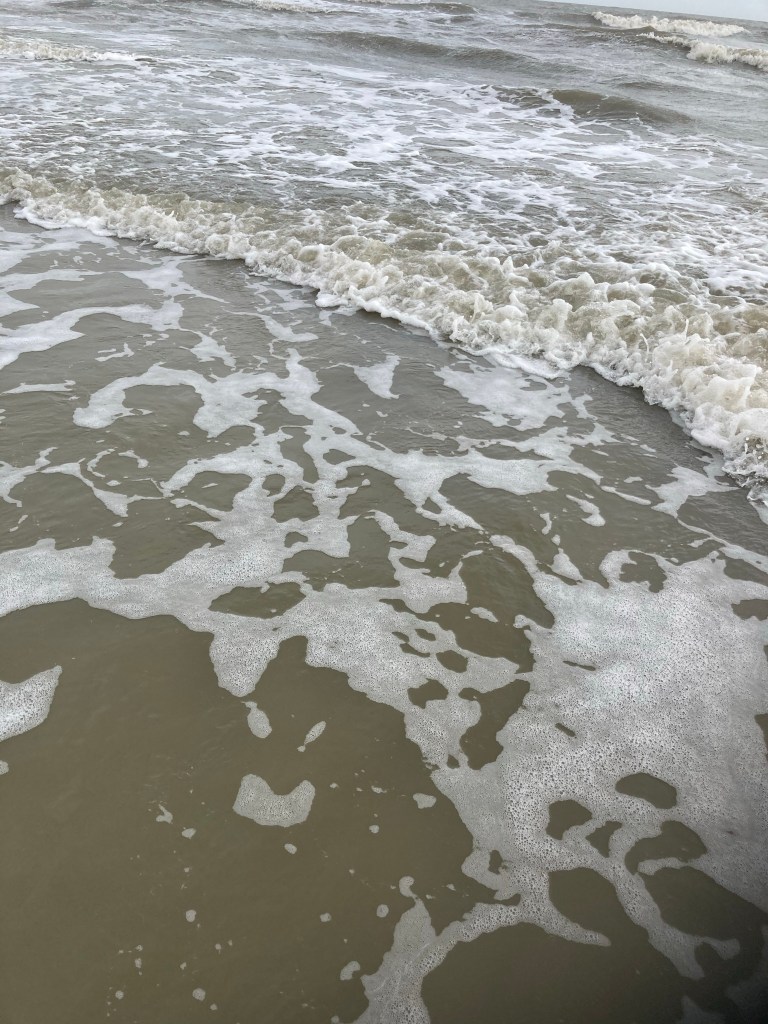
4.16.2021 – white water bubbles

white water bubbles
surf crashes foams flows flat clear
waves tide rolls up beach

Part of a series based on an afternoon spent at the beach on Hilton Head Island.

I wanted to see if I would be ‘inspired’ by what I saw, by what I heard, by what I smelled, by what I tasted, what I felt emotionally and what I felt tactilely.

Some turned out okay.

Some were too forced.

Some were just bad.

Some did involve some or all of those feelings.

As far as it goes, I guess I was inspired by by what I saw, by what I heard, by what I smelled, by what I tasted, what I felt emotionally and what I felt tactilely.

Click here for more Haiku in the BEACH category —

4.13.2021 – sunny sun shinning

sunny sun shinning
out from the clouds warming down
rolling over my skin

Part of a series based on afternoons spent at the beach on Hilton Head Island.

I wanted to see if I would be ‘inspired’ by what I saw, by what I heard, by what I smelled, by what I tasted, what I felt emotionally and what I felt tactilely.

Some turned out okay.

Some were too forced.

Some were just bad.

Some did involve some or all of those feelings.

As far as it goes, I guess I was inspired by by what I saw, by what I heard, by what I smelled, by what I tasted, what I felt emotionally and what I felt tactilely.

Click here for more Haiku from the BEACH

4.4.2021 – death shall all the world

death shall all the world
subdue, Our love shall live, and
later life renew

Adapted from the sonnet, Amoretti LXXV, by Edmund Spenser.

This is one of several haiku I got from this sonnet.

Edmund Spenser (1553-1559), according to wikipedia, was an English poet best known for The Faerie Queene, an epic poem and fantastical allegory celebrating the Tudor dynasty and Elizabeth I. He is recognized as one of the premier craftsmen of nascent Modern English verse and is often considered one of the greatest poets in the English language.

In 1595, Spenser published Amoretti and Epithalamion. This volume contains eighty-eight sonnets commemorating his courtship of Elizabeth Boyle. In Amoretti, Spenser uses subtle humour and parody while praising his beloved, reworking Petrarchism in his treatment of longing for a woman.

Spenser used a distinctive verse form, called the Spenserian stanza. The stanza’s main meter is iambic pentameter with a final line in iambic hexameter (having six feet or stresses, known as an Alexandrine), and the rhyme scheme is ababbcbcc. He also used his own rhyme scheme for the sonnet. In a Spenserian sonnet, the last line of every quatrain is linked with the first line of the next one, yielding the rhyme scheme ababbcbccdcdee.

But you knew that.

Here is the full sonnet.

One day I wrote her name upon the strand,
But came the waves and washed it away:
Again I wrote it with a second hand,
But came the tide, and made my pains his prey.
‘Vain man,’ said she, ‘that dost in vain assay,
A mortal thing so to immortalize;
For I myself shall like to this decay,
And eke my name be wiped out likewise.’
‘Not so,’ (quod I); ‘let baser things devise
To die in dust, but you shall live by fame:
My verse your vertues rare shall eternize,
And in the heavens write your glorious name:
Where whenas death shall all the world subdue,
Our love shall live, and later life renew.

3.30.2021 – place never return

place never return
resulting from rare conjunctions
season, light, weather

Adapted from the book, The Art of Travel (2002, Vintage Books) by Alain de Botton, and the passage:

A dominant impulse on encountering beauty is to wish to hold on to it, to possess it and give it weight in one’s life. There is an urge to say, ‘I was here, I saw this and it mattered to me.’

But beauty is fugitive, being frequently found in places to which we may never return or else resulting from rare conjunctions of season, light and weather.

How then to possess it, how to hold on to the floating train, the halvalike bricks or the English valley?

The camera provides one option. Taking photographs can assuage the itch for possession sparked by the beauty of a place; our anxiety over losing a precious scene can decline with every click of the shutter.

According to the website, GOOD READS, Any Baedeker will tell us where we ought to travel, but only Alain de Botton will tell us how and why.

As I said in the section on Architecture , what I find irresistible in reading Mr. de Botton is his use of language.

I get the feeling that if you made a spread sheet of all the words, adverbs and adjectives used by Mr. de Botton, you just might find that he used each word just once.

Neat trick in writing a book.

If I knew how to do that, hey, I would.

** More from the category TRAVEL — click here