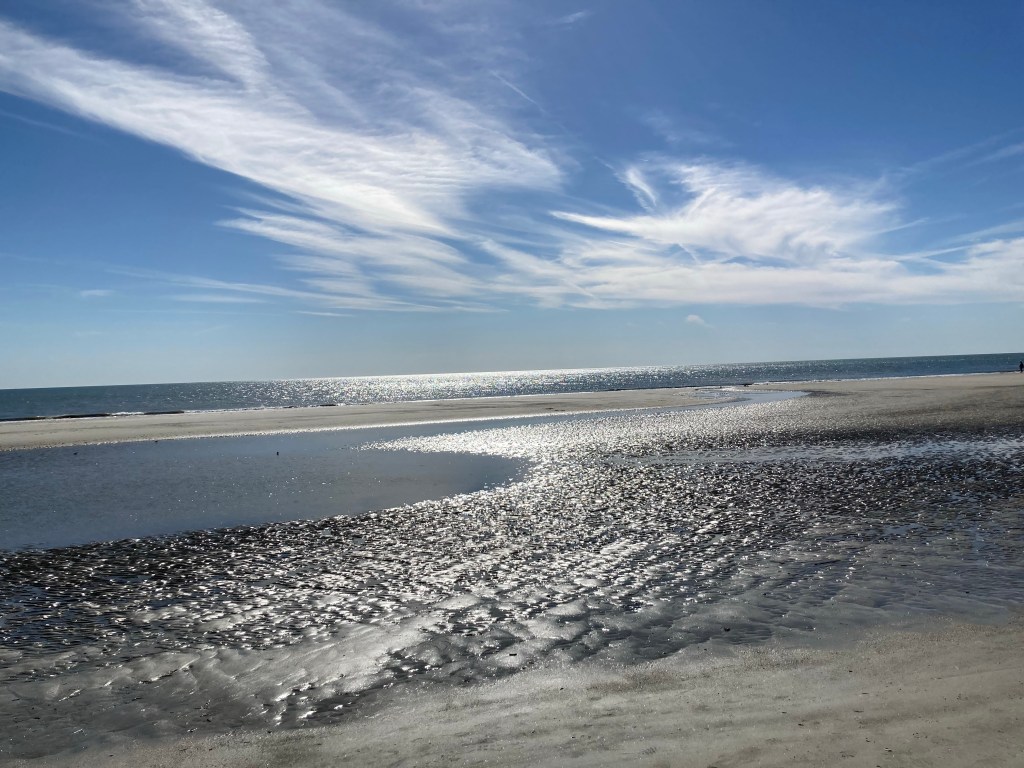
1.14.2024 – whorls, curves, and shiny

whorls, curves, and shiny
iridescent insides are
the remains, the shell

One of the most striking features of our beaches is seashells. Their whorls, curves, and shiny iridescent insides are the remains of animals. Most shells come from soft-bodied mollusks. Snails, clams, oysters, and others need the hard protection of their shells. This tough outer covering protects the tasty body hiding inside. Other animals, such as crabs and lobsters, also make a tough outer covering, but here we focus on mollusk shells.

Where do shells come from? The animals make them. Mollusks have an outermost layer of tissue on their bodies. Called the mantle, this layer connects the animal to its shell. The mantle also creates that shell.

Specialized cells in the mantle build the shell using proteins and minerals. These are secreted—released into the space outside the cells. There, the proteins create a framework that provides support for the growing shell. The proteins in the framework also determine which minerals are used in specific parts of the shell.

Calcium carbonate, the main mineral found in shells (including eggshells), binds to the protein. If you have ever seen construction workers build with concrete, this is similar. The protein is like the steel rebar that gives shape and support. Calcium carbonate is like the cement that fills in all the gaps.

Calcium carbonate can form two different types of crystals. One is called calcite. This incredibly common crystal can be found all over the world. Calcite makes up chalk, marble, coral, limestone—and seashells. The other form is aragonite. This crystal has a different arrangement of calcium carbonate. Both calcite and aragonite are found in seashells.

A mollusk’s shell has three layers. Each is made up of similar materials. But how those materials are arranged gives them each a different look and feel. The outermost layer is mostly protein. It’s often rough and may have bumps or spikes. Proteins in the middle layer cause calcium carbonate to form calcite crystals. These fill in the spaces, making the shell tough to break.

The innermost layer is the one in contact with the mantle. It’s a smooth, iridescent layer called nacre or mother-of-pearl. Nacre is made up of protein and calcium carbonate. But it looks and feels completely different from other parts of the shell. That’s because the mantle secretes different proteins for different layers. Different proteins cause calcium carbonate to crystallize in different ways. Those used in the middle layer create calcite. Those used in the innermost layer create aragonite.

As the animal grows, its shell must grow along with it. This happens along the outer edges. A snail adds to its shell around the opening, where it pokes its head out. For a clam or mussel, it’s the outer edges where the two shells separate. The result is growth rings, like those in a tree, that allow us to measure a mollusk’s age.

When the animal inside dies, its shell is gradually pounded against the rocks and sand. Over time, shells break down. They become part of the sand. White beaches have sand made almost entirely of tiny bits of shells.

From How are seashells made? by the staff at the Woods Hole Oceanographic Institution.
I did not grow up near an ocean beach.

I grew up on a great lakes beach in Michigan.

On the great lakes you don’t have tides.

On the great lakes you don’t have sea water.

One of the favorite sayings of the folks up North is, “Lake Michigan – No Salt Added.”

But you also don’t have sea shells.

And I have fallen in love with them.

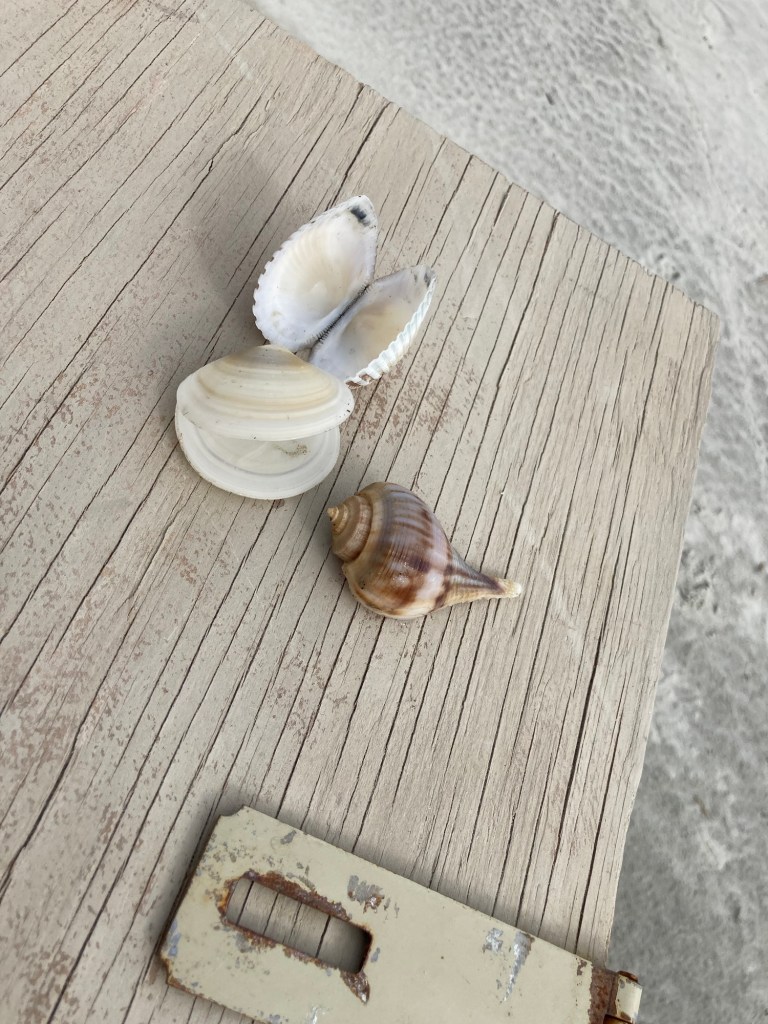
The shells in the picture I found on my lunch time break beach walk last week.

Being January, the number of the people on the beach is close to like … none (though there are always crazies from Wisconsin running around in swimsuits yelling its so warm) and the chances on finding sea shells on the beaches on the southern part of Hilton Head Island are pretty good.

I am learning about sea shells.

Any one should be able to tell you that you can cut down a tree and count the rings to get an age for the tree.

One new ring for each growth cycle in one year of freezing and thawing.

But what about shells.

Clam shells will add a new ring as it grows and these are not always one year apart.

According to the folks at Cornell:

• As they grow, clams add to the edge of their shell to protect
their squishy body inside.
• Each time the clam grows, you see a ring. Clams grow in
seasons when the water is warm (April-October).
• You can count the growth rings like you would age a tree.
• Count the darkest rings, each ring represents 1 year.
• The wider the band, the more the clam grew that year! More
growth suggests warm water and a lot of food that year!

I will never look at sea shells the same.
1.13.2024 – wave-sculpted ripples

wave-sculpted ripples
oscillating flows pick up
sand grains, set them down

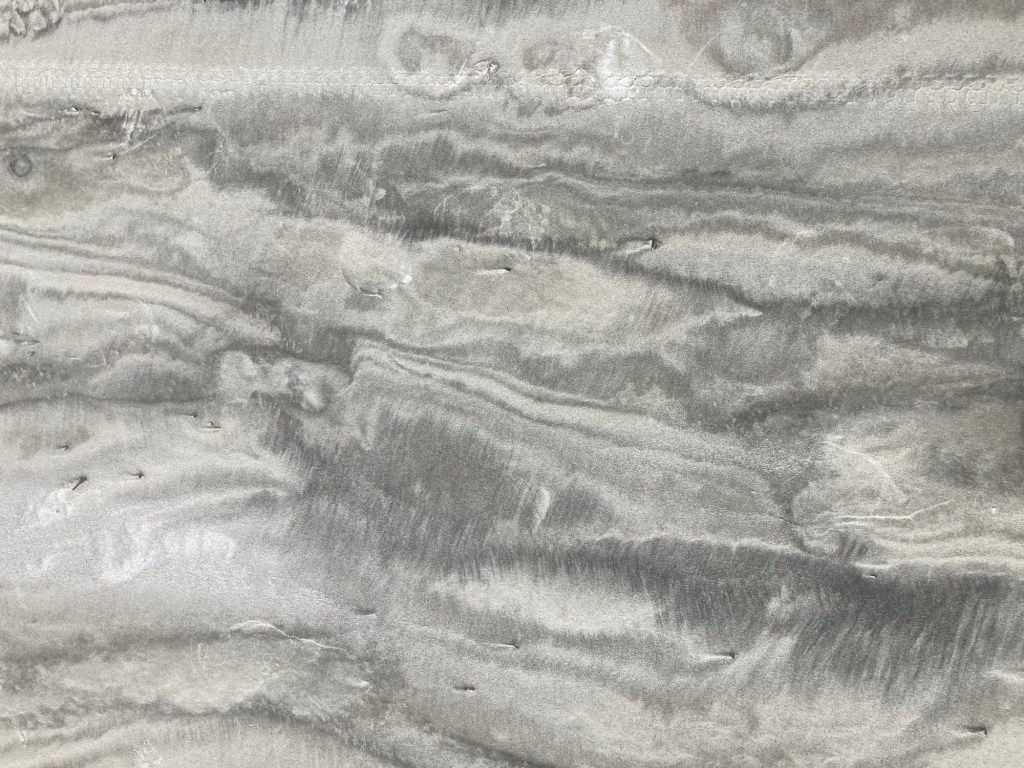
When a coastal tide rolls out, it can reveal beautiful ripples in the temporarily exposed sand. These same undulating patterns can also be seen in ancient, petrified seabeds that have been exposed in various parts of the world and preserved for millions or even billions of years.

Wave-sculpted ripples form as waves travel across the surface of a body of liquid. These waves cause water beneath the surface to circle around and around, generating oscillating flows that pick up sand grains and set them down in a process that eventually carves out troughs and grooves throughout the sandbed.

From Beach sand ripples can be fingerprints for ancient weather conditions by Jennifer Chu in the MIT News.

1.6.2023 – cotidal lines that

cotidal lines that
circulate counterclockwise
amphidromic points

In the North Atlantic, because the cotidal lines circulate counterclockwise around the amphidromic point, the high tide passes New York Harbor approximately an hour ahead of Norfolk Harbor. South of Cape Hatteras the tidal forces are more complex, and cannot be predicted reliably based on the North Atlantic cotidal lines.

From ancient times, tidal observation and discussion has increased in sophistication, first marking the daily recurrence, then tides’ relationship to the Sun and moon. Pytheas travelled to the British Isles about 325 BC and seems to be the first to have related spring tides to the phase of the moon.

Isaac Newton’s theory of gravitation first enabled an explanation of why there were generally two tides a day, not one, and offered hope for a detailed understanding of tidal forces and behavior. Although it may seem that tides could be predicted via a sufficiently detailed knowledge of instantaneous astronomical forcings, the actual tide at a given location is determined by astronomical forces accumulated by the body of water over many days. In addition, accurate results would require detailed knowledge of the shape of all the ocean basins—their bathymetry, and coastline shape.

(Wikipedia)

Time and tide wait for no man but when you move to an area with an average 8 foot tide you learn to check the tide tables early and often.

I am not sure why it didn’t sink in but an 8 foot tide is not horizontal.

The water does not move back and forth.

An 8 foot tide is veritical.

It moves up and down.

In doing so, the water moves back and forth across the beach but it is the depth that is changing.

I am just at six feet tall.

If I stood at low tide along the ocean’s age and didn’t move, but the time high tide was at its peak, my head would be 2 feet under water.

Those cotidal lines that circulate counterclockwise around the amphidromic points can really mess up your day and use some really wonderful words to do it.

12.22.2023 – every person’s

every person’s
heart on Earth burns the spark of
luminous goodness

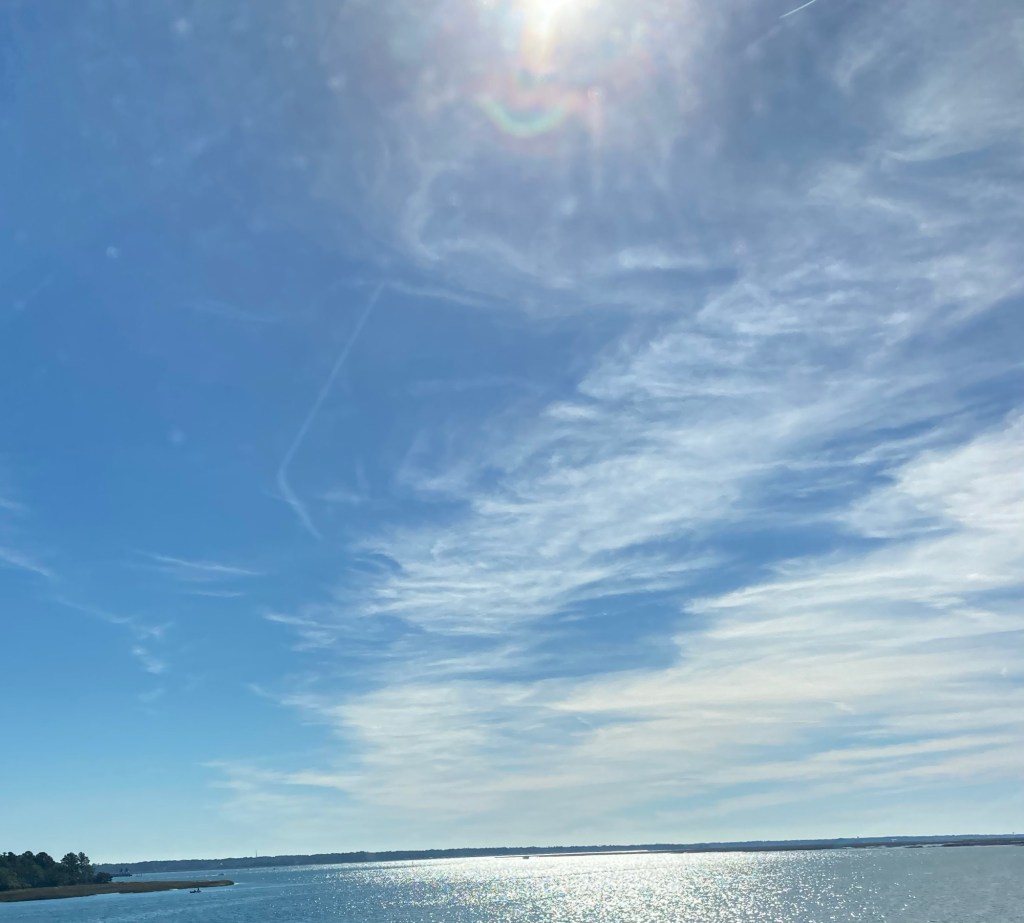
Calibogue Sound looking towards Hilton Head Island, Noonish on the Winter Solstice – 2023

The dark shadow of space leans over us. . . . .
We are mindful that the darkness of greed, exploitation, and hatred
also lengthens its shadow over our small planet Earth.
As our ancestors feared death and evil and all the dark powers of winter,
we fear that the darkness of war, discrimination, and selfishness
may doom us and our planet to an eternal winter.

May we find hope in the lights we have kindled on this sacred night,
hope in one another and in all who form the web-work of peace and justice
that spans the world.

In the heart of every person on this Earth
burns the spark of luminous goodness;
in no heart is there total darkness.
May we who have celebrated this winter solstice,
by our lives and service, by our prayers and love,
call forth from one another the light and the love
that is hidden in every heart.

A Winter Solstice Prayer by Edward Hayes

I feel bad as I took the photograph of the sun on the water at the right place at the right time and I needed the google to find an appropriate poem.

So I hammered the two things together.

I am not sure who Edward Hayes is?

Maybe he has a blog and writes poems all day and publishes them to world to be read … or not.

I can see it happening.

This line isn’t bad.

May we find hope in the lights we have kindled on this sacred night,
hope in one another

and in all who form the web-work of peace and justice
that spans the world.

As I work in web work I kind of like it.

Not bad.

Ever see the movie Reuben, Reuben?

I watched as Julius Epstein gave an interview once and said it was his favorite movie of his.

Mr. Epstein and his brother Mr. Epstein are two of the people credited with the achievement otherwise known as the screen play for the movie, Casablanca.

There was also the feller who wrote the book, “Everybody Comes to Ricks“.

Aside from that one line from the title, nothing else has anything to do with the movie.

The Epstein Brothers worked with a feller named Howard Koch who apparently was never in the same room with the Epstein Brothers.

Then there was the producer, Hal Wallis.

And the Director, Michael “Next time I send a son-of-a-bitch, I go myself’ Curitz.

I think all of them claim to have come up with the line, “Louie this looks the beginning of a …”


But I digress.

In Rueben, Rueben a down and out Irish poet, full of despair, (all his teeth have been damaged by a Dentist whose wife he compromised) is about to hang himself when he recites of bit of verse and realizes he still has poems yet to write.

Then a dog bursts into the room and jumps up on the poet, knocking him off the ladder he was standing on and, well, you can work out the rest.

What kind of Christmas Haiku is this?

That’s the problem I guess when writing at work in a few stolen moments with the sun shinning outside and me not outside even though its a freezing 50 degrees out there.

Right, the poem.

The poem wasn’t bad.

Free association is free but what of association?

Thank goodness that was the shortest day of the year.

12.12.2023 – more wonderful than

more wonderful than
way sun floats toward horizon?
relaxed, easy …

Have you ever seen
anything
in your life
more wonderful

than the way the sun,
every evening,
relaxed and easy,
floats toward the horizon

and into the clouds or the hills,
or the rumpled sea,
and is gone–
and how it slides again

out of the blackness,
every morning,
on the other side of the world,
like a red flower

streaming upward on its heavenly oils,
say, on a morning in early summer,
at its perfect imperial distance–
and have you ever felt for anything
such wild love–
do you think there is anywhere, in any language,
a word billowing enough
for the pleasure

that fills you,
as the sun
reaches out,
as it warms you

as you stand there,
empty-handed–
or have you too
turned from this world–

or have you too
gone crazy
for power,
for things?

The Sun by Mary Oliver

I can sit and watch the sun all day long as the show never changes but is never the same.

Sometimes it isn’t the fun I get in walking the beach on my lunch hour as much as it is that I have to go back to work.

I do have to go back but I did get to walk on the beach.

How DO you work the definition of fair and being fair and what is fair, into this thought?