10.24.2025 – whole world was watching

whole world was watching
and other nations could not …
help but be impressed

I’ve never been a Nixon-hater, and I felt no pleasure when he resigned.

But if it had to be, I’m glad it happened the way it did.

A president fell and a new president took over, and yet there was no scuffling, no guns, no harsh bickering, no crowds in the streets— not so much as a fistfight.

The whole world was watching, and other nations couldn’t help but be impressed.

After all, when leaders fall, their governments usually collapse as well.

But our transition was orderly and by the book, and this period, as much as anything in our history, showed the strength of our great democracy.

Man of the House : the life and political memoirs of Speaker Tip O’Neill by Tip O’Neill (New York: Random House, 1987).

I have to ask, what has the recent effort to make America great again achieved over this?

About the last 10 years there is little to contribute to writing that this period, as much as anything in our history, showed the strength of our great democracy.

Mr. O’Neill concluded his book with an epilogue titled, What I Believe.

He wrote:

I BEGAN my political career in 1936, on a slogan of “work and wages.” Today, more than half a century later, I’m still a bread-and-butter liberal who believes that, every family deserves the opportunity to earn an income, own a home, educate their children, and afford medical care.

That is the American dream, and it’s still worth fighting for. In my view, the federal government has an obligation to help you along the line until you achieve that dream. And when you do, you have an obligation to help out the next group that comes along.

What a dreamer and what a dream.

Let’s repeat those last two sentences.

The federal government has an obligation to help you along the line until you achieve that dream.

And when you do, you have an obligation to help out the next group that comes along.

Just boil it down to the simple statements that the federal government has an obligation to help you and you have an obligation to help the next group.

Those two statement as much as anything in our history, show the strength of our great democracy.

That is where the focus should be if anyone wants to make America great again.

Speaker Tip O’Neill was Speaker of the House from Gerald Ford to Ronald Reagan and most likely that last of Speaker of House to hold real power in politics.

When he died, President Bill Clinton paid tribute to him, saying, “Tip O’Neill was the nation’s most prominent, powerful and loyal champion of working people… He loved politics and government because he saw that politics and government could make a difference in people’s lives. And he loved people most of all.

AS KIND OF A POSTSCRIPT, Mr. O’Neill also wrote:

God has been good to America, especially during difficult times.

At the time of the Civil War, he gave us Abraham Lincoln.

And at the time of Watergate, he gave us Gerald Ford—the right man at the right time who was able to put our nation back together again.

Nothing like Watergate had ever happened before in our history, but we came out of it strong and free, and the transition from Nixon’s administration to Ford’s was a thing of awe and dignity.

Making an assessment based on the folks now in Government, I think God doesn’t like us much right now.

10.21.2025 – implements of war

implements of war,
subjugation – arguments
to which kings resort

Based on these excepts from the speech known as, Give Me Liberty or Give Me Death by Patrick Henry as published in American Oratory, 1760–1900: Critical Studies and Sources, edited by Gregory Schneider, 18–23 (New York: Oxford University Press, 2000).

Are fleets and armies necessary to a work of love and reconciliation?
Have we shown ourselves so unwilling to be reconciled that force must be called in to win back our love?
Let us not deceive ourselves, sir.
These are the implements of war and subjugation—the last arguments to which kings resort.

It is in vain, sir, to extenuate the matter. Gentlemen may cry, Peace, Peace—but there is no peace. The war is actually begun!
The next gale that sweeps from the north will bring to our ears the clash of resounding arms!
Our brethren are already in the field!
Why stand we here idle?
What is it that gentlemen wish?
What would they have?
Is life so dear, or peace so sweet, as to be purchased at the price of chains and slavery?
Forbid it, Almighty God!
I know not what course others may take; but as for me, give me liberty or give me death!

According to Wikipedia, Mr. Henry made the speech to the Second Virginia Convention on March 23, 1775, at St. John’s Church in Richmond, Virginia. Henry is credited with having swung the balance in convincing the convention to pass a resolution delivering Virginian troops for the Revolutionary War. Among the delegates to the convention were future United States presidents Thomas Jefferson and George Washington.

According to Edmund Randolph, the convention sat in profound silence for several minutes after Henry’s speech ended.

10.19.2025 – little value in

little value in
survival if traditions
do not survive

The very word “secrecy” is repugnant in a free and open society; and we are as a people inherently and historically opposed to secret societies, to secret oaths and to secret proceedings.

We decided long ago that the dangers of excessive and unwarranted concealment of pertinent facts far outweighed the dangers which are cited to justify it.

Even today, there is little value in opposing the threat of a closed society by imitating its arbitrary restrictions.

Even today, there is little value in insuring the survival of our nation if our traditions do not survive with it.

And there is very grave danger that an announced need for increased security will be seized upon by those anxious to expand its meaning to the very limits of official censorship and concealment.

That I do not intend to permit to the extent that it is in my control.

And no official of my Administration, whether his rank is high or low, civilian or military, should interpret my words here tonight as an excuse to censor the news, to stifle dissent, to cover up our mistakes or to withhold from the press and the public the facts they deserve to know.

President John F. Kennedy speaking on The President and the Press, before The American Newspaper Publishers Association at the Waldorf-Astoria Hotel, New York City on April 27, 1961. (Listen to the full speech on You Tube – from an era when Presidents spoke in complete sentences).

10.17.2025 – looking where program

looking where program
was, is, where we want to be
was no other course

“Anything this significant just doesn’t come on a whim,” Kraft said. “You have to have scenarios, and we do. How is this going to go? What if this happened? But looking at where the program was and where it is and where we want to be as a program, I just felt there was no other course.”

Penn State athletic director Patrick Kraft on the firing on the Head Football Coach, James Franklin. (Quoted in the article At Penn State, James Franklin was standing on the edge of a cliff for years. Here’s why by Bruce Feldman and Ralph D. Russo, NYT 10/17/2025)

While the statement is about football, I can find application of that last bit in so many areas of todays life in America.

As voters, if we could only say, you have to have scenarios, and we do.

How is this going to go?

What if this happened?

But looking at where the Country was and where it is and where we want to be as a County, We just felt there was no other course.

Hmmmmmmmmmmmmmmmmmmmmmm

HEY WE CAN SAY THAT!

Last time I checked, The Constitution of the United States still starts: WE the PEOPLE.

Admitted I haven’t checked today and you never know what those folks might try.

Does anyone else remember the scene from Star Trek, The Omega Glory” (Star Trek: The Original Series, Season 2, Episode 23 – and when I say Star Trek, for myself, I am referring only to the Original Canon of 79 shows, broadcast September 8, 1966 – June 3, 1969) where Kirk explains the Constitution.

The society Kirk and the Crew of the Enterprise come across in outerspace is based on the US Constitution but some how the document was buried in that society’s history and the words were only allowed to be spoken by a very few revered leaders.

In a long speech Kirk grabs their copy of the Constitution and says:

“Hear me! Hear this! Among my people, we carry many such words as this from many lands, many worlds. Many are equally good and are as well respected, but wherever we have gone, no words have said this thing of importance in quite this way.
Look at these three words written larger than the rest, with a special pride never written before or since, tall words proudly saying ‘We the People’.
That which you call Ee’d Plebnista was not written for the chiefs of kings, or the warriors or the rich or the powerful, but for all the people!
Down the centuries, you have slurred the meaning of the words, ‘We the People of the United States, in order to form a more perfect union, establish justice, insure domestic tranquility, provide for the common defence, promote the general welfare, and secure the blessings of liberty to ourselves and our posterity, do ordain and establish this Constitution’.
These words and the words that follow were not written only for the Yangs, but for the Kohms as well!
They must apply to everyone, or they mean nothing! Do you understand?”

But looking at where the Country was and where it is and where we want to be as a County, We just felt there was no other course.

They must apply to everyone, or they mean nothing!

Do you understand?

There is no other course.

10.12.2025 – courts have to pretend

courts have to pretend
anything normal about
these criminal charges

When asked about things that surprise me here in the 21st Century, I hold out my iPhone.

I make the point that in the Science Fiction writing about the future worlds either as projections of our future or dystopian what-might-have beens, no one, not HP Lovecraft, Issac Asimov or even Stephen King predicted a world where almost everyone carried some kind of computer with more computing power of all of NASA when the USA went to the moon in their hands and that almost everyone would be able to be contacted anywhere in the world.

No one saw the iPhone or handheld device.

It was “inconceivable!” (To quote Vizzini from the movie Princess Bride (who was played by Wallace Shawn, SON OF William Shawn, longtime editor of the New Yorker Magazine).

I mention all that to set the mood for my next point.

Remember that word, inconceivable.

There is this line in an opinion piece in the New York Times I read on Sunday, October 12, 2025.

The line reads:

In other words, do courts have to pretend that there’s anything normal about these criminal charges?

The piece is titled, How a Trump Judge Exposed the Trump Con By David French.

I am not here today to debate the points made by the Mr. French.

I am not here today to debate the actions of anyone on either side in the piece written by Mr. French.

All I want to say is that on this day, someone writing in the New York Times about Criminal Charges brought by the current administration against Americans asked the question, “, … do courts have to pretend that there’s anything normal about these criminal charges?

I am not sure that such a question, in history or in fiction, has ever been asked in such a way about the United States Judicial system.

In fact, I would use the word, inconceivable!

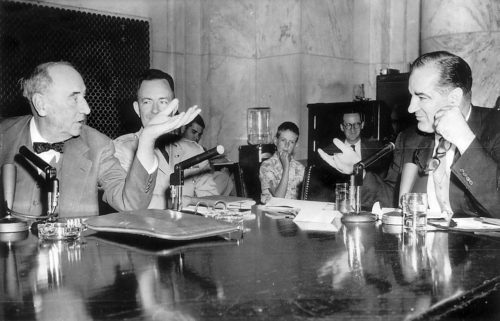
Maybe during the McCarthy era?

Not in any way do I want to be boxed into the corner of DEFENDING the McCarthy Era but at least he made charges that Americans were turning to side with our biggest enemy.

False as it might have been, it was a charge you could understand.

MY GOSH I AM DEFENDING JOE MCCARTHY!

OH my offense is rank.

BOOOY Howdy!

Lets say that one more time.

In other words, do courts have to pretend that there’s anything normal about these criminal charges?

Where does that put us?

In the movie Casablanca, Victor and Ilsa want to meet with Señor Ugarte but Ugarte was arrested the night before.

Meeting in the police station, they are told by Major Strasser that if they met with Ugarte, they “… would find the conversation a trifle one-sided. Señor Ugarte is dead.

Oh?” says Ilsa.

Captain Renault looks up form his report and says, “I am making out the report now. We haven’t quite decided yet whether he committed suicide or died trying to escape.”

In the Casablanca of that day, the courts had to pretend that there WAS everything normal about those criminal charges.

Inconceivable!

But here we are.