new meritocracy perhaps Britain could regain some of these nations
In the article, Farage adviser said UK would be better off if it had not fought in WW2 by Guardian Senior political correspondent Peter Walker, Mr. Walker quotes Jack Anderton, who ran Nick Farage’s hugely successful TikTok account as posting on his personal blog that:
“Trillions of pounds of British taxes have been spent in foreign lands in the pursuit of ‘democracy’, ‘human rights’ and ‘doing what is right’,” the post said. “More than a million British lives have been lost since WW1 in wars and battles that have never once been fought by British men, on this island.”
Fighting in both the world wars ensured the UK was no longer a great power, he wrote: “We impoverished ourselves for decades, we didn’t finish paying the loans off to America until 2006. Our economy stagnated, we lost an empire, and we are pushed around by America. And Germany, a country we beat, has been richer than us since the 1970s.
“Alternative history is interesting; if Britain had not fought in WW1 and WW2, it would not have had to rely on America for economic support, and it would have had the independence to act accordingly. Britain could have developed India, Cyprus, Fiji, Malta, Saint Lucia, Seychelles, the Bahamas, Australia, Canada, South Africa, Ireland and New Zealand. In the coming meritocracy, perhaps Britain could regain some of these nations.”
Admittedly, Nixon Speech Writer, Pat Buchannan made much the same point in his book, Churchill, Hitler, and “The Unnecessary War but it is still odd to see this argument a new.
That neither writer explained out a victorious Third Reich, beating the USSR and cleansing Europe of all its unwanted and unnecessary human life forms would have allowed the British Empire to thrive and survive does bring a huge question mark to their argument.
Then again, maybe the Third Reich and its aims were not unattractive to either Gentleman.
Not that it should matter, but Mr. Anderton is 23 years old.
intellectual integrity and thoughtful design is presented
Adapted from the article, “The Smithsonian Changes Its Description of Trump’s Role on Jan. 6” by By Graham Bowley who quoted an official response from The Smithsonian when the National Museum of American History removed some details of the charges President Trump faced when it replaced a display about his two impeachment stating:
“Adhering to principles foundational to our role as the nation’s museum, we take great care to ensure that what we present to the public reflects both intellectual integrity and thoughtful design,” the Smithsonian said.
According to the article:
The new text removed previous references to Mr. Trump’s incitement charge being based on “repeated ‘false statements’ challenging the 2020 election results” and giving a speech that “encouraged — and foreseeably resulted in — imminent lawless action at the Capitol.”
The new label reads: “On Jan. 13, 2021, Donald Trump became the first president to be impeached twice. The charge was incitement of insurrection based on his challenge of the 2020 election results and on his speech on Jan. 6. Because Trump’s term ended on Jan. 20, he became the first former president tried by the Senate. He was acquitted on Feb. 13, 2021.”
The new labeling that went up on Friday also changed the description of President Trump’s first impeachment, in 2019, adding the word “alleged” to a line that now reads: “The charges focused on the president’s alleged solicitation of foreign interference in the 2020 presidential election and defiance of Congressional subpoenas.”
I guess it is lucky for the Smithsonian that the text was printed on just a cardboard placard.
Plaques at the Baseball Hall of Fame are cast in bronze and is a notice outside the hall that information on the plaques WAS CORRECT at the time the plaque was created.
Me and my family has had a long association with the Smithsonian.
When my brother lived just outside Washington, DC, we made twice yearly trips to visit his family and those trips always included the Smithsonian.
When you walked into National Museum of American History the first thing you saw was a giant pendulum demonstrating the rotation of the earth.
Then you saw the original Star Spangled Banner.
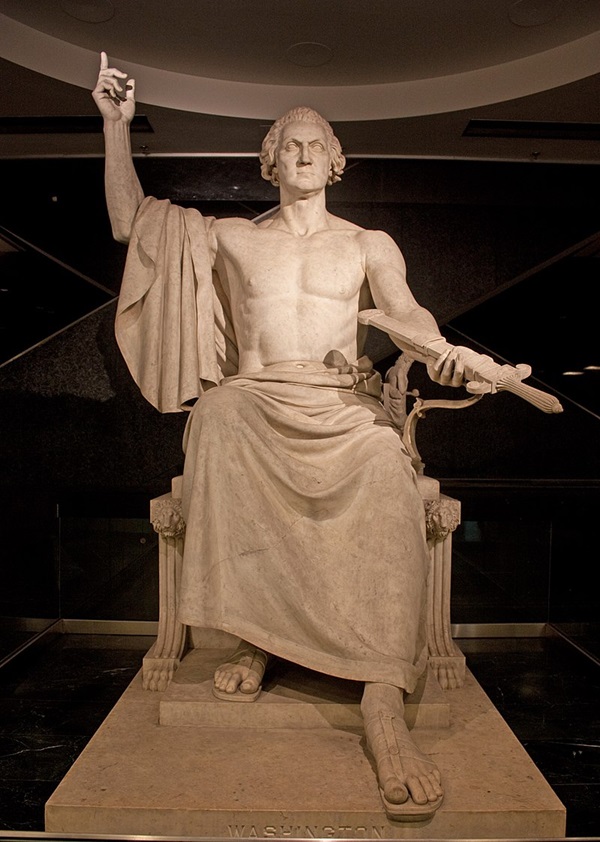
Then you turned left and you saw the statue George Washington, also known as Enthroned Washington, a large marble sculpture by Horatio Greenough commissioned by the United States Congress on July 14, 1832 for the centennial of U.S. President George Washington’s birth on February 22, 1732. Completed in 1840, the statue was soon exhibited in the Rotunda of the United States Capitol and then moved to the Capitol’s east lawn in 1843. Since 1964, it has been in the National Museum of American History. (WIKIPEDIA)
Us little kids just had to laugh at this statue of the half naked George Washington.
That wasn’t unusual.
According again to Wikipedia, “When the marble statue arrived in Washington, D.C. from Italy on July 31, 1841 it immediately generated controversy and criticism on its installation in the rotunda in December 1841. Many found the sight of a half-naked Washington offensive, even comical.”
Official Washington didn’t quite know what to do with this statue so it’s entirely appropriate that it ended up in what some call “The Nation’s Attic.”
At least it has done better that Mr. Greenough statue, The Rescue, that at one time was the steps of the East Front of the United States Capitol that depicted a Native America attacking a settler woman while a Daniel Boone type is about to axe the Native American.
Congress in 1939, in a joint resolution, condemned The Rescue and recommended that it should be “ground into dust.” In 1941, another resolution said it was “an atrocious distortion of the facts of American history and a gratuitous insult” to Native Americans.
The Rescue was removed in 1958 during some renovations and put in the real attic of the Smithsonian out in Silver Springs, Maryland where during a move in 1976, it got dropped by accident and broke into several pieces.
But it isn’t so much the statue I am thinking of today.
It is the inscription on the statue of Washington.
Written by Mr. Greenough, it says in latin,
SIMULACRUM ISTUD AD MAGNUM LIBERTATIS EXEMPLUM NEC SINE IPSA DURATURUM HORATIUS GREENOUGH FACIEBAT
Which translates to:
Horatio Greenough made this image as a great example of freedom, which will not survive without freedom itself.
An appropriate warning for the Smithsonian if I say so myself.
lady stands waiting decent person trying to survive a tough life
On my commute to work I pass a lady, standing on the side of the road.
I am sure she is waiting for a ride to work.
She is dressed in the uniform of a hotel housekeeper which isn’t unusual since my commute takes me out to resort island on the coast of the South Carolina low country.
Some mornings she is standing with a young boy about 10 years old.
Both wear backpacks.
I want to stop and offer her a ride but I don’t.
This morning I happened to be listening to an audio book (The Guardians by John Grisham) and just as I pass the lady standing and waiting, I hear the words, “… a decent guy trying to survive a tough life.”
Mr. Grisham was describing someone in the book.
But the words hit me, looking at the lady as I passed.
She is there everyday.
She shows up for work and if the traffic works, she shows up on time.
Probably not working for much beyond minimum wage.
Working.
Working hard.
Working hard to make things nice for people who are on the island for a vacation.
Decent person trying to survive a tough life.
Type of person this country was built on.
So why?
Why aren’t we trying to help this lady?
Why do so many people seem to hate this lady?
Decent person trying to survive a tough life.
Isn’t that a description that any one of us would want?
my heart has become as hard as a city street, it sings like iron
My heart has become as hard as a city street, The horses trample upon it, it sings like iron, All day long and all night long they beat, They ring like the hooves of time. My heart has become as drab as a city park, The grass is worn with the feet of shameless lovers, A match is struck, there is kissing in the dark, The moon comes, pale with sleep. My heart is torn with the sound of raucous voices, they shout from the slums, from the streets, from the crowded places, And tunes from a hurdy-gurdy that coldly rejoices Shoot arrows into my heart. O my belovèd, sleeping so far from me, Walking alone in sunlight, or in blue moonlight, Are you alive there, far across that sea, Or were you only a dream?
Discordants II as published in Turns and movies, and other tales in verse by Conrad Aiken (New York, Houghton Mifflin company, 1916).
I get up and have my coffee.
I get up and have my coffee and look at the news on my tablet.
I swipe and swipe and look for news that might be news.
I swipe and swipe.
Is it any wonder that my heart has become as hard as a city street.
who denies freedom to others, deserves it not … cannot retain it
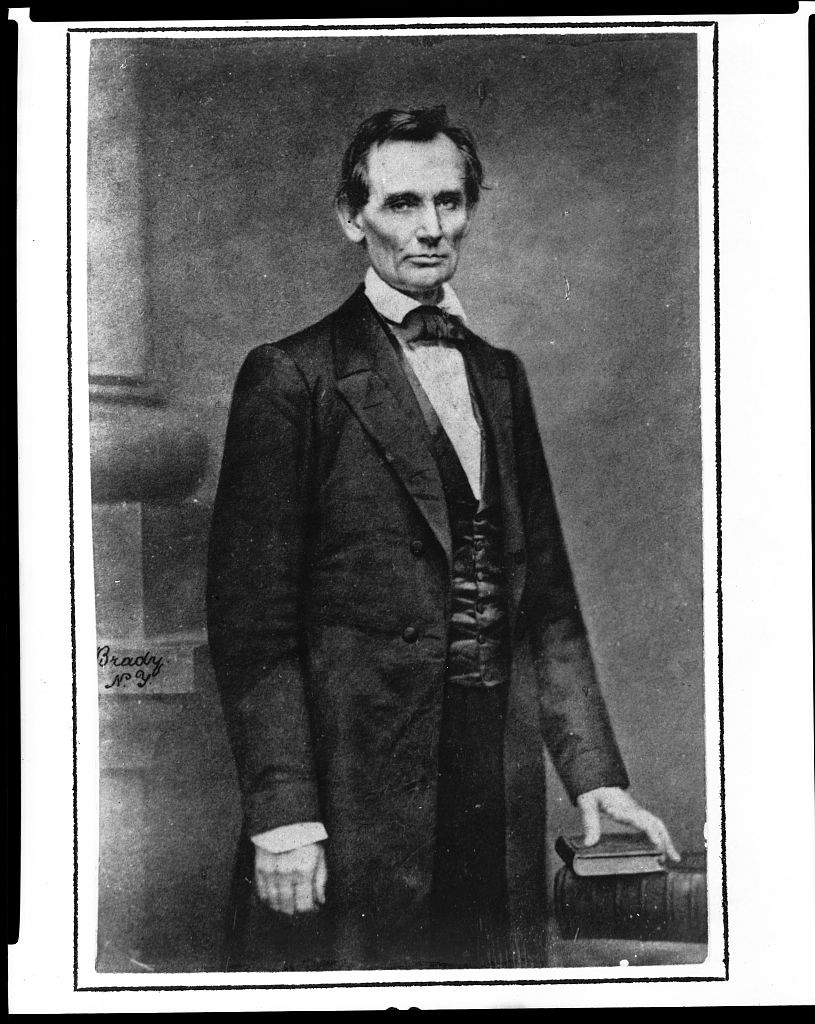
Today’s haiku is based on the following letter written in 1859.
Springfield, Ills, April 6, 1859
Messrs. Henry L. Pierce, & others.
Gentlemen
Your kind note inviting me to attend a Festival in Boston, on the 13th. Inst. in honor of the birth-day of Thomas Jefferson, was duly received. My engagements are such that I can not attend.
Bearing in mind that about seventy years ago, two great political parties were first formed in this country, that Thomas Jefferson was the head of one of them, and Boston the head-quarters of the other, it is both curious and interesting that those supposed to descend politically from the party opposed to Jefferson should now be celebrating his birthday in their own original seat of empire, while those claiming political descent from him have nearly ceased to breathe his name everywhere.
Remembering too, that the Jefferson party were formed upon its supposed superior devotion to the personal rights of men, holding the rights of property to be secondary only, and greatly inferior, and then assuming that the so-called democracy of to-day, are the Jefferson, and their opponents, the anti-Jefferson parties, it will be equally interesting to note how completely the two have changed hands as to the principle upon which they were originally supposed to be divided.
The democracy of to-day hold the liberty of one man to be absolutely nothing, when in conflict with another man’s right of property. Republicans, on the contrary, are for both the man and the dollar; but in cases of conflict, the man before the dollar.
I remember once being much amused at seeing two partially intoxicated men engage in a fight with their great-coats on, which fight, after a long, and rather harmless contest, ended in each having fought himself out of his own coat, and into that of the other. If the two leading parties of this day are really identical with the two in the days of Jefferson and Adams, they have perfomed the same feat as the two drunken men.
But soberly, it is now no child’s play to save the principles of Jefferson from total overthrow in this nation.
One would start with great confidence that he could convince any sane child that the simpler propositions of Euclid are true; but, nevertheless, he would fail, utterly, with one who should deny the definitions and axioms. The principles of Jefferson are the definitions and axioms of free society.
And yet they are denied and evaded, with no small show of success.
One dashingly calls them “glittering generalities”; another bluntly calls them “self evident lies”; and still others insidiously argue that they apply only to “superior races.”
These expressions, differing in form, are identical in object and effect–the supplanting the principles of free government, and restoring those of classification, caste, and legitimacy. They would delight a convocation of crowned heads, plotting against the people. They are the van-guard–the miners, and sappers–of returning despotism.
We must repulse them, or they will subjugate us.
This is a world of compensations; and he who would be no slave, must consent to have no slave. Those who deny freedom to others, deserve it not for themselves; and, under a just God, can not long retain it.
All honor to Jefferson–to the man who, in the concrete pressure of a struggle for national independence by a single people, had the coolness, forecast, and capacity to introduce into a merely revolutionary document, an abstract truth, applicable to all men and all times, and so to embalm it there, that to-day, and in all coming days, it shall be a rebuke and a stumbling-block to the very harbingers of re-appearing tyranny and oppression.
Your obedient Servant A. Lincoln
This is a world of compensations; and he who would be no slave, must consent to have no slave.
Those who deny freedom to others, deserve it not for themselves; and, under a just God, can not long retain it.
Can we choose up sides based on that last?
Those who deny freedom to others, deserve it not for themselves?

 No Haiku For You