looking back on it
marvel it hadn’t happened
long before it did …
The Greatest Man in the World
by James Thurber
Looking back on it now, from the vantage point of 1950, one can only marvel that it hadn’t happened long before it did. The United States of America had been, ever since Kitty Hawk, blindly constructing the elaborate petard by which, sooner or later, it must be hoist. It was inevitable that some day there would come roaring out of the skies a national hero of insufficient intelligence, background, and character successfully to endure the mounting orgies of glory prepared for aviators who stayed up a long time or flew a great distance. Both Lindbergh and Byrd, fortunately for national decorum and international amity, had been gentlemen; so had our other famous aviators. They wore their laurels gracefully, withstood the awful weather of publicity, married excellent women, usually of fine family, and quietly retired to private life and the enjoyment of their varying fortunes. No untoward incidents, on a worldwide scale, marred the perfection of their conduct on the perilous heights of fame. The exception to the rule was, however, bound to occur and it did, in July, 1937, when Jack (“Pal”) Smurch, erstwhile mechanic’s helper in a small garage in Westfield, Iowa, flew a second-hand, single-motored Bresthaven Dragon-Fly III monoplane all the way around the world, without stopping.
Never before in the history of aviation had such a flight as Smurch’s ever been dreamed of. No one had even taken seriously the weird floating auxiliary gas tanks, invention of the mad New Hampshire professor of astronomy, Dr. Charles Lewis Gresham, upon which Smurch placed full reliance. When the garage worker, a slightly built, surly, unprepossessing young man of twenty-two, appeared at Roosevelt Field in early July, 1937, slowly chewing a great quid of scrap tobacco, and announced, “Nobody ain’t seen no flyin’ yet,” the newspapers touched briefly and satirically upon his projected twenty-five-thousand-mile flight. Aëronautical and automotive experts dismissed the idea curtly, implying that it was a hoax, a publicity stunt. The rusty, battered, second-hand plane wouldn’t go. The Gresham auxiliary tanks wouldn’t work. It was simply a cheap joke.
Smurch, however, after calling on a girl in Brooklyn who worked in the flap-folding department of a large paper-box factory, a girl whom he later described as his “sweet patootie,” climbed nonchalantly into his ridiculous plane at dawn of the memorable seventh of July, 1937, spit a curve of tobacco juice into the still air, and took off, carrying with him only a gallon of bootleg gin and six pounds of salami.
When the garage boy thundered out over the ocean the papers were forced to record, in all seriousness, that a mad, unknown young man–his name was variously misspelled–had actually set out upon a preposterous attempt to span the world in a rickety, one-engined contraption, trusting to the long-distance refuelling device of a crazy schoolmaster. When, nine days later, without having stopped once, the tiny plane appeared above San Francisco Bay, headed for New York, spluttering and choking, to be sure, but still magnificently and miraculously aloft, the headlines, which long since had crowded everything else off the front page–even the shooting of the Governor of Illinois by the Vileti gang–swelled to unprecedented size, and the news stories began to run to twenty-five and thirty columns. It was noticeable, however, that the accounts of the epoch-making flight touched rather lightly upon the aviator himself. This was not because facts about the hero as a man were too meagre, but because they were too complete.
Reporters, who had been rushed out to Iowa when Smurch’s plane was first sighted over the little French coast town of Serly-le-Mer, to dig up the story of the great man’s life, had promptly discovered that the story of his life could not be printed. His mother, a sullen short-order cook in a shack restaurant on the edge of a tourists’ camping ground near Westfield, met all inquiries as to her son with an angry “Ah, the hell with him; I hope he drowns.” His father appeared to be in jail somewhere for stealing spotlights and laprobes from tourists’ automobiles; his young brother, a weak-minded lad, had but recently escaped from the Preston, Iowa, Reformatory and was already wanted in several Western towns for the theft of money-order blanks from post offices. These alarming discoveries were still piling up at the very time that Pal Smurch, the greatest hero of the twentieth century, blear-eyed, dead for sleep, half-starved, was piloting his crazy junk-heap high above the region in which the lamentable story of his private life was being unearthed, headed for New York and a greater glory than any man of his time had ever known.
The necessity for printing some account in the papers of the young man’s career and personality had led to a remarkable predicament. It was of course impossible to reveal the facts, for a tremendous popular feeling in favor of the young hero had sprung up, like a grass fire, when he was halfway across Europe on his flight around the globe. He was, therefore, described as a modest chap, taciturn, blond, popular with his friends, popular with girls. The only available snapshot of Smurch, taken at the wheel of a phony automobile in a cheap photo studio at an amusement park, was touched up so that the little vulgarian looked quite handsome. His twisted leer was smoothed into a pleasant smile. The truth was, in this way, kept from the youth’s ecstatic compatriots; they did not dream that the Smurch family was despised and feared by its neighbors in the obscure Iowa town, nor that the hero himself, because of numerous unsavory exploits, had come to be regarded in Westfield as a nuisance and a menace. He had, the reporters discovered, once knifed the principal of his high school–not mortally, to be sure, but he had knifed him; and on another occasion, surprised in the act of stealing an altar-cloth from a church, he had bashed the sacristan over the head with a pot of Easter lilies; for each of these offences he had served a sentence in the reformatory.
Inwardly, the authorities, both in New York and in Washington, prayed that an understanding Providence might, however awful such a thing seemed, bring disaster to the rusty, battered plane and its illustrious pilot, whose unheard-of flight had aroused the civilized world to hosannas of hysterical praise. The authorities were convinced that the character of the renowned aviator was such that the limelight of adulation was bound to reveal him to all the world as a congenital hooligan mentally and morally unequipped to cope with his own prodigious fame. “I trust,” said the Secretary of State, at one of many secret Cabinet meetings called to consider the national dilemma, “I trust that his mother’s prayer will be answered,” by which he referred to Mrs. Emma Smurch’s wish that her son might be drowned. It was, however, too late for that–Smurch had leaped the Atlantic and then the Pacific as if they were millponds. At three minutes after two o’clock on the afternoon of July 17, 1937, the garage boy brought his idiotic plane into Roosevelt Field for a perfect three-point landing.
It had, of course, been out of the question to arrange a modest little reception for the greatest flier in the history of the world. He was received at Roosevelt Field with such elaborate and pretentious ceremonies as rocked the world. Fortunately, however, the worn and spent hero promptly swooned, had to be removed bodily from his plane, and was spirited from the field without having opened his mouth once. Thus he did not jeopardize the dignity of this first reception, a reception illumined by the presence of the Secretaries of War and the Navy, Mayor Michael J. Moriarity of New York, the Premier of Canada, Governors Fanniman, Groves, McFeely, and Critchfield, and a brilliant array of European diplomats. Smurch did not, in fact, come to in time to take part in the gigantic hullabaloo arranged at City Hall for the next day. He was rushed to a secluded nursing home and confined to bed. It was nine days before he was able to get up, or to be more exact, before he was permitted to get up. Meanwhile the greatest minds in the country, in solemn assembly, had arranged a secret conference of city, state, and government officials, which Smurch was to attend for the purpose of being instructed in the ethics and behavior of heroism.
On the day that the little mechanic was finally allowed to get up and dress and, for the first time in two weeks, took a great chew of tobacco, he was permitted to receive the newspapermen–this by way of testing him out. Smurch did not wait for questions. “Youse guys,” he said–and the Times man winced–“youse guys can tell the cock-eyed world dat I put it over on Lindbergh, see? Yeh–an’ made an ass o’ them two frogs.” The “two frogs” was a reference to a pair of gallant French fliers who, in attempting a flight only halfway round the world, had, two weeks before, unhappily been lost at sea. The Times man was bold enough, at this point, to sketch out for Smurch the accepted formula for interviews in cases of this kind; he explained that there should be no arrogant statements belittling the achievements of other heroes, particularly heroes of foreign nations. “Ah, the hell with that,” said Smurch. “I did it, see? I did it, an’ I’m talkin’ about it.” And he did talk about it.
None of this extraordinary interview was, of course, printed. On the contrary, the newspapers, already under the disciplined direction of a secret directorate created for the occasion and composed of statesmen and editors, gave out to a panting and restless world that “Jacky,” as he had been arbitrarily nicknamed, would consent to say only that he was very happy and that anyone could have done what he did. “My achievement has been, I fear, slightly exaggerated,” the Times man’s article had him protest, with a modest smile. These newspaper stories were kept from the hero, a restriction which did not serve to abate the rising malevolence of his temper. The situation was, indeed, extremely grave, for Pal Smurch was, as he kept insisting, “rarin’ to go.” He could not much longer be kept from a nation clamorous to lionize him. It was the most desperate crisis the United States of America had faced since the sinking of the Lusitania.
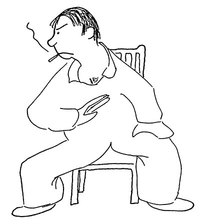
On the afternoon of the twenty-seventh of July, Smurch was spirited away to a conference-room in which were gathered mayors, governors, government officials, behaviorist psychologists, and editors. He gave them each a limp, moist paw and a brief unlovely grin. “Hah ya?” he said. When Smurch was seated, the Mayor of New York arose and, with obvious pessimism, attempted to explain what he must say and how he must act when presented to the world, ending his talk with a high tribute to the hero’s courage and integrity. The Mayor was followed by Governor Fanniman of New York, who, after a touching declaration of faith, introduced Cameron Spottiswood, Second Secretary of the American Embassy in Paris, the gentleman selected to coach Smurch in the amenities of public ceremonies. Sitting in a chair, with a soiled yellow tie in his hand and his shirt open at the throat, unshaved, smoking a rolled cigarette, Jack Smurch listened with a leer on his lips. “I get ya, I get ya,” he cut in, nastily. “Ya want me to ack like a softy, huh? Ya want me to ack like that —- —- baby-faced Lindbergh, huh? Well, nuts to that, see?” Everyone took in his breath sharply; it was a sigh and a hiss. “Mr. Lindbergh,” began a United States Senator, purple with rage, “and Mr. Byrd–” Smurch, who was paring his nails with a jackknife, cut in again. “Byrd!” he exclaimed. “Aw fa God’s sake, dat big–” Somebody shut off his blasphemies with a sharp word. A newcomer had entered the room. Everyone stood up, except Smurch, who, still busy with his nails, did not even glance up. “Mr. Smurch,” said someone sternly, “the President of the United States!” It had been thought that the presence of the Chief Executive might have a chastening effect upon the young hero, and the former had been, thanks to the remarkable cooperation of the press, secretly brought to the obscure conference-room.
A great, painful silence fell. Smurch looked up, waved a hand at the President. “How ya comin’?” he asked, and began rolling a fresh cigarette. The silence deepened. Someone coughed in a strained way. “Geez, it’s hot, ain’t it?” said Smurch. He loosened two more shirt buttons, revealing a hairy chest and the tattooed word “Sadie” enclosed in a stencilled heart. The great and important men in the room, faced by the most serious crisis in recent American history, exchanged worried frowns. Nobody seemed to know how to proceed. “Come awn, come awn,” said Smurch. “Let’s get the hell out of here! When do I start cuttin’ in on de parties, huh? And what’s they goin’ to be in it?” He rubbed a thumb and forefinger together meaningly. “Money!” exclaimed a state senator, shocked, pale. “Yeh, money,” said Pal, flipping his cigarette out of a window. “An’ big money.” He began rolling a fresh cigarette. “Big money,” he repeated, frowning over the rice paper. He tilted back in his chair, and leered at each gentleman, separately, the leer of an animal that knows its power, the leer of a leopard loose in a bird-and-dog shop. “Aw fa God’s sake, let’s get some place where it’s cooler,” he said. “I been cooped up plenty for three weeks!”
Smurch stood up and walked over to an open window, where he stood staring down into the street, nine floors below. The faint shouting of newsboys floated up to him. He made out his name. “Hot dog!” he cried, grinning, ecstatic. He leaned out over the sill. “You tell ’em, babies!” he shouted down. “Hot diggity dog!” In the tense little knot of men standing behind him, a quick, mad impulse flared up. An unspoken word of appeal, of command, seemed to ring through the room. Yet it was deadly silent. Charles K. L. Brand, secretary to the Mayor of New York City, happened to be standing nearest Smurch; he looked inquiringly at the President of the United States. The President, pale, grim, nodded shortly. Brand, a tall, powerfully built man, once a tackle at Rutgers, stepped forward, seized the greatest man in the world by his left shoulder and the seat of his pants, and pushed him out the window.
“My God, he’s fallen out the window!” cried a quick-witted editor.
“Get me out of here!” cried the President. Several men sprang to his side and he was hurriedly escorted out of a door toward a side-entrance of the building. The editor of the Associated Press took charge, being used to such things. Crisply he ordered certain men to leave, others to stay; quickly he outlined a story which all the papers were to agree on, sent two men to the street to handle that end of the tragedy, commanded a Senator to sob and two Congressmen to go to pieces nervously. In a word, he skillfully set the stage for the gigantic task that was to follow, the task of breaking to a grief-stricken world the sad story of the untimely, accidental death of its most illustrious and spectacular figure.
The funeral was, as you know, the most elaborate, the finest, the solemnest, and the saddest ever held in the United States of America. The monument in Arlington Cemetery, with its clean white shaft of marble and the simple device of a tiny plane carved on its base, is a place for pilgrims, in deep reverence, to visit. The nations of the world paid lofty tributes to little Jacky Smurch, America’s greatest hero. At a given hour there were two minutes of silence throughout the nation. Even the inhabitants of the small, bewildered town of Westfield, Iowa, observed this touching ceremony; agents of the Department of Justice saw to that. One of them was especially assigned to stand grimly in the doorway of a little shack restaurant on the edge of the tourists’ camping ground just outside the town. There, under his stern scrutiny, Mrs. Emma Smurch bowed her head above two hamburger steaks sizzling on her grill–bowed her head and turned away, so that the Secret Service man could not see the twisted, strangely familiar, leer on her lips.
The Greatest Man in the World as published in The Thurber Carnival by James Thurber, (The Modern Library: New York, 1957).
Hey folks.
Don’t look at me if you find anything here.
I am just holding up a mirror.
You see what you bring with you.
That being said, Well, nuts to that, see?



 No Haiku For You