8.6.2025 – night sunrise daylight

night sunrise daylight
sunset nautical twilight
astronomical!

There are a lot things that someone who spent the first 50 years of their life in the Great Lakes state of Michigan has to adjust if they move south.

A lot of things, LET ME TELL YOU!

You do adjust.

I once went to a company breakfast, got a bowl, broke a biscuit in half and put it in the bowl, put some sausage patties on the biscuits, covered the sausage with scrambled eggs, added some grits on top of the eggs and covered it all with sausage gravy … and never thought nothing about it.

But I digress.

Something no one ever mentioned to me is what happens to twilight when you move south.

I now live in Bluffton, SC which is almost 1,000 miles south or 10 degrees of latitude (32°14′14″N to 42°57′48″N) south of Grand Rapids, where I grew up.

Look out the window and you see the orange sky of sunset.

Put on your shoes and go outside and by the time your get outside, its dark.

Using the wonderful calculator at https://suncalc.net/, I learned that in Grand Rapids, the difference between official SUNSET and NIGHT is 110 minutes while in Bluffton, due to curvature and angle of the earth, it is only 86 minutes.

This is defined using the wonderful delimiters of sunrise, sunset, daylight, night along with civil twilight, nautical twilight, astronomical twilight.

24 minutes may not seem like a lot but when it gets dark down here, someone hits a switch and it’s dark!

There is none of the lingering twilight that I remember as a kid growing up when the twilight went on forever.

Garrison Keillor once wrote (or said) that … “kids didn’t need a watch; they could tell time by the sun. Noon was when your shadow was shortest.”

I know what Mr. Keillor means.

Growing up I never wore a watch but always seemed to know what time it was.

Seems to me that the rule was to be inside “when the street lights came on” and with the lingering twilight of Western Michigan, we could be outside for a long time.

The City of Grand Rapids had a moment of wisdom somewhere in its history and the city officially adhered to what was the called the CITY SCHOOL/CITY PARK PLAN.

This plan called for large public parks to be built up around public schools so that neighborhoods got fields and playgrounds that the kids used for recess during the school year.

Schools weren’t surrounded by businesses or factories, but by a ball field and a black top and playground equipment and some woods if possible.

In our neighbor, the school was Crestview Elementary.

It was built during the baby boom expansion of the North End of Grand Rapids.

It was U shaped with the main entrance, which kids never used, at the outside top of the U and a blacktop connecting the two arms of the U.

The black top had a basketball court painted in thick yellow lines along with more yellow lines for hopscotch and four square.

Across the black top was our playground.

It was a square, surrounded by a chain link fence with gates at the bottom and on the right, if you had your back to the school.

It had a merry go round of heavy, thick rusted metal that screamed “get a cut, get tetanus” and it was on some sort of spindle that groaned and moaned as it spun over a concrete base with space just wide enough to stick your arm under and get it sliced off with no trouble if you weren’t careful.

Every once in a while, the mechanism got lubricated or something and with a couple of kids pushing, you could reach g forces that rivaled a NASA centrifuge and if you weren’t careful, you could let go and fly across the playground.

A few rides on the merry go ground and you were also ready to lose your lunch if you didn’t sit down for a while.

Across from the merry Go round were the blocks and barrels.

The blocks were big concrete blocks with letters about 3 feet wide on each side and must have weighed a ton each.

The were piled up for us to climb on and crawl over.

The barrels where sections of giant water pipe at least 4 feet in diameter as when we were in the lower grades, we could walk through them standing up.

Little kids walked through them.

Bigger kids ran and jumped to sit on top which was no easy feat as there was nothing to grab on top so you could go up and right over and right over and down head first.

The biggest kids and the dare devils would stand on the barrels and run and jump from barrel to barrel.

As I remember, there where five barrels in a line that was slightly curved and they were spaced further and further apart so you had to get your speed up to make that last jump as well as keep your footing on the very top of the barrel and since they weren’t lined up the chances of landing off center and losing your footing was very real.

Did I mention these barrels were also made of concrete?

Thank goodness for sneakers!

In the corner of the playground, opposite the merry go round was the monkey bars.

This was a scaffolding type arrangement of polished slippery pipe, in the circular shape of rocket and must have been about 20 feet high OR almost two stories!

You could climb and jump off or climb and hang down from the top INSIDE the monkey bars and drop.

Or you could climb and be pushed.

There was also a set of three sliders.

Two were about 10 feet high and then there was THE BIG SLIDER.

It also must have been about 20 feet high.

For a little kid, it was a vertical climb up a steel ladder to a 2 foot square platform with low rails.

It was better than any Cedar Point thrill ride and the threat of death was real!

There were teeter totters, horse swings and little kid swings.

All made made with heavy duty lumber and rusted metals with lots of sharp edges and splinters.

Across from this playground were the BIG SWINGS which were in there own chain link space and were supposed to be just for the upper elementary kids.

As I remember there was also an argument of morning recess vs afternoon recess and if the swings where reserved as BOY SWINGS or GIRL SWINGS.

Seems like no one ever knew, but you called if for your gender if you wanted to swing but for the most part swings were not much noticed but the big kids.

Past the playground was our field.

It had a pretty sad baseball diamond but it was huge expanse that went on forever.

It also had some steep hills were we would go sledding in Winter time but we couldn’t bring our sleds to school so me made slides on the hill that we slide in on in our snow boots.

Also in winter, the field was were we would have snow ball fights, usually the 6th grade boys against everyone else.

This was against the rules and every once in awhile participants would be marched off for a talk with the Principal but the snowball fights were always part winter recess.

It was as if the school and the Board of Education provided all this equipment and parkland to enougrage us to go out and get killed or at least maimed for life.

And here’s the thing.

I don’t remember one time when anyone was badly hurt or that an ambulance had to be called.

Today, schools would have an ambulance parked at the playground entrance.

Oh sure, the rumor flew around once that Timmy Sugiyama slipped jumping barrels and ‘CRACKED HIS HEAD OPEN’ and we came running to see.

I expected to see Timmy lying there with his skull cracked like an egg with his brain all over like a broke yolk but he was gone by the time I got there and Timmy later showed up with a big bandaid on his forehead and that was that.

This was during school mind you.

During the school day.

When school was out of it was summer time, this was out neighborhood park and often you would find your way to the park and just as often, friends from school would be there.

Back then kids didn’t need a watch; they could tell time by the sun. Noon was when your shadow was shortest.

And twilight was when you met your friends at the park.

Because in Michigan, twilight went on forever.
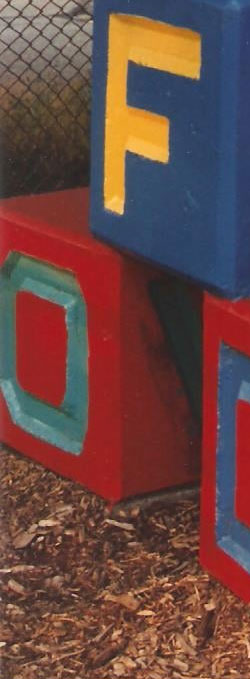
the blocks of Crestview Elementary – How a red and gray O was allowed I do not know

10.26.2024 – high school I went to

high school I went to
does not exist any more …
but it is still there

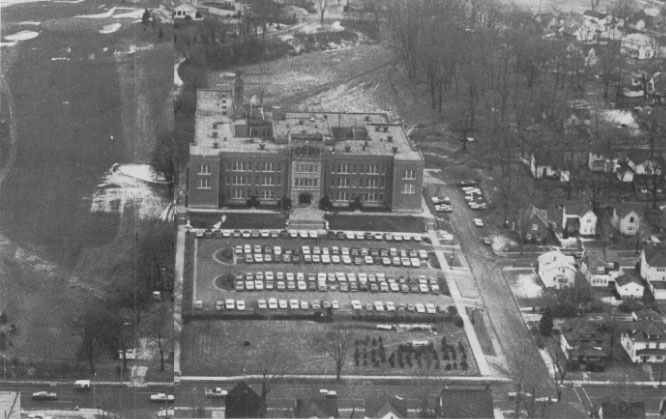
Grand Rapids Creston – 1968? (note the Christmas Tree Lot)

Came across this old photo and as I remember it, Grand Rapids Creston High School was built in 1927 as the City of Grand Rapids, Michigan, spread north and started to wrap around the far away from downtown, Kent Country Club.

Enough families now lived north of Leonard Street a new high school was needed.

A community effort was made to choose a suitable mascot for the new high school and as it was on the North End of the city, the community picked out Polar Bears and the Creston Polar Bears joined the Grand Rapids City League Athletic Conference.

When opened, there were classes from 7th to 12th grade in the new high school.

My Dad grew up on the North End and graduated from Creston in 1936.

He had been bumped up two grades along the way at Plainfield Elementary and was only 16 years old and had been moved up into the same class has his sister, Marion.

For the rest of his life, my Dad was against any kid being bumped up a grade or two.

For sure, it guaranteed he was the smallest kid in class, which was something most of us Hoffmans did not need any help understanding.

But it also meant that he graduated from Dental School in Ann Arbor in the Spring of 1942 (he was on a fast track of two years at Grand Rapids Junior College and then three years in Dental School without needing an undergraduate degree).

Which made him available for service in the Army of the United States.

He always thought that had he not been bumped ahead in elementary school, he might have been allowed a deferent to finish Dental school and entered the army later or maybe have missed all of WW2 which would have suited him just fine.

My Dad had a pretty good WW2, being the Dental Officer in a headquarters unit in Europe for 3 years but for the rest of his life, camping or spending time in a tent held no attraction for him.

After the war, my Dad returned to the North End, moved his practice from Leonard Street, to Plainfield Ave. and set up housekeeping with my Mom just east of Riverside Park.

They had 11 kids and all of us went to Creston.

By the time I started at Creston, it was a HIGH school of 10th to 12th grade and there were four city high schools, Central, Creston, Ottawa and Union, in Grand Rapids.

My Dad’s office was just down the street so we had a ride to school but a long walk home.

I remember once being in the car with my sister, Lisa, with my Dad driving and he says all of sudden to my sister, “Is it your birthday?”

Lisa said yes it was.

Dad then said, “The sun was in my eyes just like this that day when I drove Mom to the hospital when you were born.

As little kids we would go to events at Creston starring our big brothers and sisters in plays and choir concerts, so we were familiar with the building.

Most of my brothers and sisters where in the Creston Choir or Madrigals and back then, the thing to do was make a record that they could sell to raise money for who knows what.

I remember this as we at least two of each album in our stacks of records because we usually had at least two kids in the choir at any time so my Mom had to buy two albums.

Every Christmas, a forest appeared in front of the high school for the Athletic Club Christmas Tree Sale fund raiser.

We got our Christmas trees there for years and as a little kid, I thought they grew there.

Creston was a building built like they built buildings in 1927.

Designed to be bright inside, there were lots of windows in the classrooms and hallways.

Tall, tall ceilings in the hall ways.

Tall, tall wood framed windows that magically slid in and up and over so that the top and bottom of the windows were open for air flow.

The floors were hardwood and each room had a built in closet for the teacher.

Some rooms had little platforms for the teachers desks.

By the time I got there I knew my way around pretty good but I learned more.

In my junior year I was on the school paper but due to scheduling conflict, Mr. Eikenhout, the teacher in charge, let me work by myself during 1st hour, in the newspaper office while the rest of the class met during 4th hour.

I would often have to seek him out before class and find him in the teachers lounge and he would throw me his keys and I would let myself in.

So there I was with keys and all by myself.

I took it upon myself to really search out Creston High School.

I found my way into the 4th floor attic.

I found my way into the storage rooms behind the auditorium stage that could only be reached by a ladder bolted to the wall that went past interior windows on the air shaft so I could look down in the metal shop.

I found my way into the old coal bins under the gym and back parking lot from the days when Creston had a coal fired furnace.

I ran around so much that a security guard grabbed me one day and asked, “Just who are you anyway?”

I even got an A in Newspaper.

I was smart enough to not do anything stupid.

Well, too stupid anyway.

I admit dumping the bucket of water out the third floor window when the band was marching up the driveway was stupid.

Especially 5 minutes later when the Band teacher kicked the door of the Newspaper room open and demanded to know who did that … and I was the only one in there.

The gym was small and cramped and had to be shared between boys and girls.

The gym was so small that league basketball games were played at North East Jr. High.

The locker rooms were small and cramped (about 7 feet of brick vaulted clearance as I remember.

And there was no swimming pool for athletics.

Back then, the folks of the North End had some clout and the decision was to modernize and enlarge Creston.

A new gym and pool complex was planned and the old neighborhood next door was bought out and demolished.

One of my odder assignments came when I was called into the Principals office along with Mr. Eikenhout and I was told to go through the old neighbor and take photographs to show what it looked like.

With the Principals assignment in my pocket, I walked through the now abandoned neighborhood and went in and out of all those homes and took several rolls of film of streets and rooms and views out windows.

I gave the film to the Principal and never saw them again.

Years later, married with children, I moved back to the North End.

My oldest two boys went to Creston.

There were a little bit surprised how well I knew my way around.

But it wasn’t the same.

Sure there was the huge gym and pool but there were other changes.

Due to risk of fire, the big stairwells were all enclosed with fire doors.

The ceilings in the hallways had been lowered and most of the light from the interior air shafts was cut off making the hallways gloomy.

The floors were all carpeted and you couldn’t run and slide in your socks any more.

Instead of smelling of floor wax, the rooms and halls smelled of carpet disinfectant.

The rooms had modern tables and teachers had been supplied with new cabinets that, sadly, were made of particle board and most were chipped with doors hanging at odd angles.

The windows were sealed as a modern HVAC system had been installed.

They had modernized all the charm, for what it was, out of the place.

Just a few years later, as online education came into play and more and more people moved out the North End and the City overall, Grand Rapids no longer needed 4 high schools and the decision was made to close Creston High School.

The building and grounds had somewhat of a re-birth as Grand Rapids City High and Middle School but Polar Bears no longer.

But the name lives on.

A few years ago I was locked out of my online banking and I called customer service to restore access.

“No problem”, she said, “just let me ask you a few security questions.”

What was your high school mascot?”

POLAR BEARS,” I answered proudly.

There was a long pause.

“I don’t think I ever heard that one before,” she said.

And most likely, never will again.

4.29.2024 – that’s just an excuse

that’s just an excuse
to cover up history
not to share the truth

“That’s just an excuse not to share the truth, to cover up history. But I believe that history is sacred – that none of us should have the right to change or alter history in any way.”

So said Ruby Bridges in an interview with Kirsten Welker of NBC News for Meet the Press – Meet the Moment segment, 4.28.2024 (as reported in the article, Ruby Bridges: civil rights pioneer rejects claim book makes white children uncomfortable)

Ms. Bridges was talking about how books and movies about her experience in school, growing up in the 1960’s in New Orleans were being added to the ‘Banned List’ by parents who were concerned that the story might make their children feel bad about themselves.

And what did Ms. Bridges experience in school, growing up in the 1960’s in New Orleans you might ask?

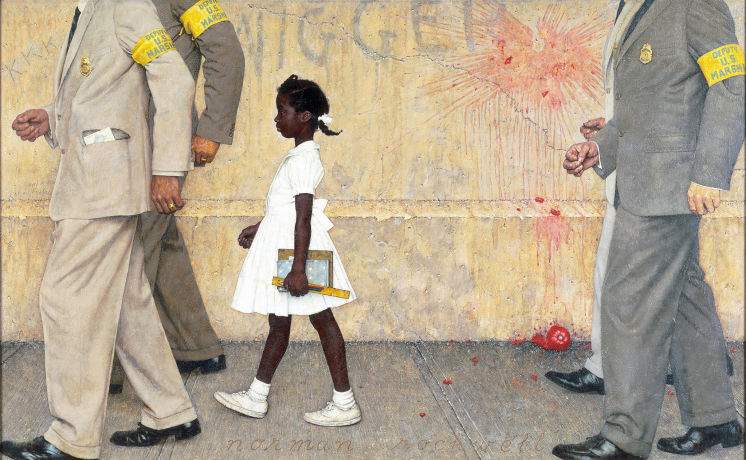
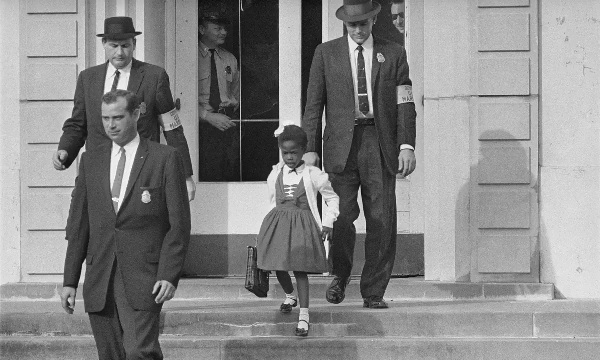
You might not remember the name, but I hope you remember the picture.

Nothing special, says Ms. Bridges, for a six year old.

Ms. Bridges relates that she was told she would be going to new school and they might be some commotion.

Ms. Bridges says that she had grown up in New Orleans and went to Madri Gras celebrations so the idea of a ‘commotion’ didn’t make much of impression.

But at some point, that this wasn’t normal, had to sink in.

Maybe when a package of new school clothes arrived (paid for by the family of a psychiatrist who volunteered to be available when Ms. Bridges started school).

Maybe when she arrived at her first day of school and there was an angry mob on hand to voice their opinion that Ms. Bridges should not be allowed to go to that school.

Maybe when Ms. Bridges was escorted into the building that day and for many days afterward, by US Marshall’s that looked more like the starting offensive line for the Chicago Bears.

Maybe when Ms. Bridges got to her room and found that her teacher was the ONLY teacher on the school faculty who would take the her class.

Maybe when Ms. Bridges got to her room and found she was the only student in her class and would be the ONLY student in her class the rest of the year.

Maybe when she left that day and her hulking guards and the angry mob was still there.

At some point, it had to sink in.

Still, Ms. Bridges came back the next day.

And the next and the next and the next.

Her parents lost their jobs over the publicity.

And she came back the next day.

Some Mom stood outside that school each morning and each afternoon holding up a small coffin and doll that was black.

And she came back the next day.

Ruby Bridges was 6 years old.

Growing up on the North End of Grand Rapids, Michigan, I did not know many black people.

Being ignorant, I accepted that ‘White Kids” and “Black Kids” were compound nouns.

When I was in 3rd grade, my elementary school, Grand Rapids Crestview, was integrated.

So far as I know, and I was 7, it wasn’t ‘busing’ as ‘busing’ is understood but I may be wrong.

What it was was that the population of the North End of Grand Rapids exploded after WW2 and several new elementary schools, Riverside, Crestview and Wellerwood, had to be built to handle all the kids.

But the folks who moved into these neighborhoods, all stayed put in these neighborhoods and the families aged out and there weren’t enough students to keep all these elementary schools open.

At the same time, elementary schools on the South End, like Sigsbee, were overcrowded.

The solution that the Grand Rapids Board of Education came up with was to send a bus load of kids to Crestview.

It was 1967 and all at once Crestview, that had been nothing but white kids, was integrated.

I can guess that there was some ‘concerns’ but I do not recall anything happening those first days.

What happened to me is that I realized that ‘Kids’ was the noun all by itself and words like ‘white’ and ‘black’ were nothing but adjectives.

We were all kids.

And about all we thought being was being kids.

I think about that as I think about Ruby Bridges.

I never thought about what the kids, who happened to be black, felt when they were told they would be going to Crestview.

I never thought about what the kids, who happened to be black, experienced when they got to Crestview.

I lived at the bottom of the hill from school and could hear the first bell and run out the door still eating a pop tart and make it to school by the time the doors opened.

I didn’t have to make it to a bus stop and ride for an hour on a bus before and after school.

I went home for lunch.

I didn’t eat lunch in the Art Room because Crestview had no lunch room because when it was built, there were no plans for students eating lunch at school.

Life went on for all us I guess.

For myself, I appreciate what I learned and I appreciate that I had time to learn it.

Did it have a lasting impact?

For me it did.

I knew forever after, that kids were kids.

I knew forever after, that people were people.

Any other words added to those nouns were just adjectives.

Years later when my wife and I started the adoption process we had to have one-on-one interviews with the social worker.

She looks at me and asks, “What kid of child are you hoping to adopt?”

I looks her in the eye and I say, “What’cha got?

She smiled and made a note on her pad and I said, “Hey wait, what are you writing down? What do other people answer to that question?

In your case“, she said, I would have expected, “Blond hair, blue eyes, someone who looks like me …”

“What happens to those people?”

“Well, that’s why they wait 2 or 3 or more years.”

Seven kids later, I would still answer the same thing.

My Mom and our 4 younger kids in the house where I grew up when I went to Crestview

BUT I DIGRESS.

The question I have is why would kids feel guilty reading the Ruby Bridges story?

Is there a story of anyone, let alone a six year old, filled with more courage, more grit, more heart, more hope or more of the eternal struggle of right over wrong then the Ruby Bridges story?

But the parents worry their kids feel guilty?

On that, Ms. Bridges said in the NBC interview, “All of the letters, all of the mail, I have little girls from all walks of life, different nationalities that dress up like Ruby Bridges, I found through … traveling that they resonate with the loneliness, probably the pain that I felt. There’s all sorts of reasons that they are drawn to my story. So I would have to disagree.

Maybe it’s not the kids.

Maybe its the parents who worry, not about their kids, but that THEY feel guilty.

I did just say that this was a story of the eternal struggle of right over wrong.

Maybe if someone somehow lined up on the wrong side of the story, you might feel guilty.

But who wants to line up against Atticus Finch?*

But who wants to line with the Major Strassers,** the Mr. Potters of this world?***

As Huck Finn said, “… right is right, and wrong is wrong, and a body ain’t got no business doing wrong when he ain’t ignorant and knows better.”

If you know better and persist in doing wrong, I bet you end up, I hope you end up, feeling guilty.

And what to do if the Ruby Bridges story makes you feel guilty?

Well, stop telling the Ruby Bridges story of course.

And force the book and the story out of libraries.

Yep that will do it, Boy Howdy!!!!

That’s just an excuse not to share the truth, to cover up history,” Ms. Bridges said. “But I believe that history is sacred – that none of us should have the right to change or alter history in any way.

I embrace the story of Ruby Bridges.

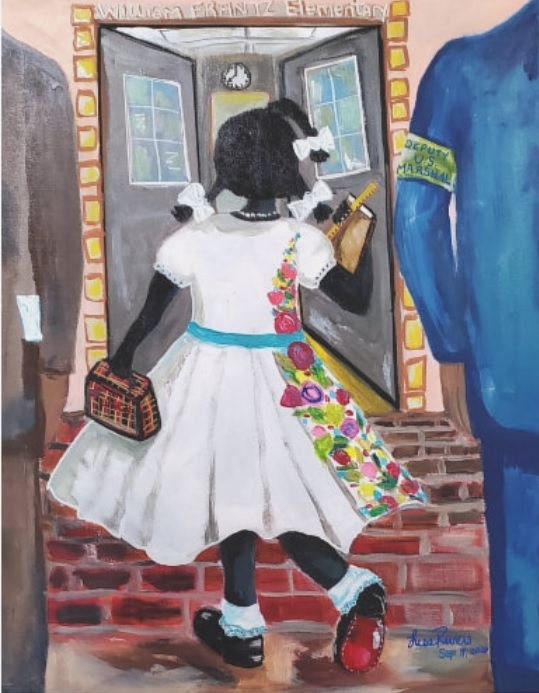
The story was captured by local low country artist Lisa Rivers.

You can tell a Lisa Rivers painting by her visible signature, she always paints the soles of shoes red.

It’s a story of courage, grit, heart, hope in the eternal struggle of right over wrong.

I think Ruby Bridges is a hero.

Mr. Shakespeare writes in his play, Henry V, “This story shall the good man teach his son.”

We have a print of this painting by Lisa Rivers and we have it hanging on our wall in our home.

In my book, those kids who came to Crestview are part of the same story.

To paraphrase that line from the end of the HBO series, ‘Band of Brothers’, if my Grandkids ask me if I was a hero in grade school, I can say, “No, I wasn’t a hero, but I went to school with some.

Crestview Elementary 5th grade – 1970 – me in the lower right between Steve and Cal … and sneaking a peace sign into the picture

*Atticus Finch: The Father in the movie To Kill a Mockingbird, played by Gregory Peck

** Major Strasser: Evil bad guy played by Conrad Veidt opposite Richard Blaine played by Humphrey Bogart in the movie Casablanca

*** All around bad crabby old man played by Lionel Barrymore opposite George Bailey played by James Stewart in the movie, It’s a Wonderful Life

3.17.2024 – complications of

complications of
envenomization from …
a gila monster

I joke that I grew up in a family where I was told that Woody Hayes, the evil football coach at Ohio State, was under my bed and if I got up in the middle of the night, Woody would grab me and take me to Columbus.

That isn’t exactly true.

I was never told anything was under my bed when I was a kid.

I knew.

Gila Monsters were under my bed.

I knew Gila Monsters were under my bed and if I got out, they would get me.

For some reason, when I was growing up, the scariest thing for me in all of nature (after that thing on the wing in the Twilight Zone) were Gila Monsters.

And I have no idea why.

But I have an theory, an idea.

The reason I was scared of Gila Monsters was the TV show, The Wonderful World of Color from Walt Disney Studios.

It was on TV every Sunday night back in the day when 1) church started at 7PM and us little kids got to stay home (there was much politicking amongst my older brothers and sisters to ‘babysit’ and get of going to church) and 2) there were only three TV channels so we always, always watched The Wonderful World of Color.

“Color is on” or “It’s time for color!” we would yell and for the next hour, Mr. Disney would take us all over the world with shows about the Vienna Boys Choir or back in time with Davy Crockett.

One the regular stops would be the Natural World as amateur filmmakers around the world, the people who had the patience to film a prairie dog farm or make stop action films of flowers blooming, would send their film clips to Disney and Disney would crop all these clips together, add music and captivating narration and The Living Desert came to life on our TVs.

A Gila Monster from the actual Living Desert Preview by Disney Studios

One Living Desert episode had a short segment on the Gila Monster and the video was so scary it was burned in my brain.

The even paced, deep narration emphasized the awfulness of the Gila Monster and the terribleness of being bit by one.

I doubt I slept that night as somehow I knew, there were Gila Monsters under my bed.

The were probably every where.

The next day at Crestview Elementary in Grand Rapids, where I went school, what was the major topic of conversation?

Monday morning in the hallways at school, at recess and in class we all talked about Gila Monsters.

Because there were only three channels, everyone in my class watched the same show.

Out on the play ground, We all looked for likely places Gila Monsters could be hiding.

I wouldn’t go in the concrete barrels on the playground for weeks and never ever felt comfortable playing in the sandbox.

Those of us who could talk with authority on the subject (anyone who might have been to the Southwest United States or someone whose Dad might have been the desert) would assert that there was no more terrible way to die than to die from a Gila Monster bite.

These shows would get repeated and the conversations would be repeated and over the years it was Gila Monster dread that kept me from walks in the woods or from turning over rocks.

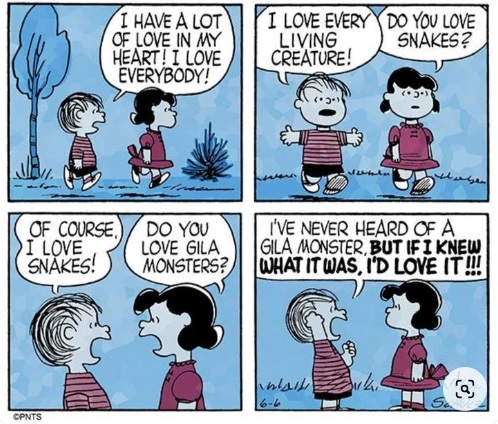
The funny part is that I don’t know that it was unique to me or my school but, much like Davy Crockett, it may have a national phenomena as Gila Monsters even got featured in a Charlie Brown comic strip in 1966.

Gila Monster Phobia doesn’t turn up in the google but …

Today in the New York Times was the article, “Colorado Man Died From Venomous Gila Monster Bite, Autopsy Confirms” By Aimee Ortiz.

Ms. Ortiz writes that: Mr. Ward endured a four-minute-long bite by the lizard to his right hand on the night of Feb. 12, the report said. He lapsed in and out of consciousness for about two hours before seeking medical attention, the report said.

Paramedics found Mr. Ward in a bed, minimally responsive and “in apparent severe distress,” the report said. He was taken to a hospital, where he was put on life support and “continued to decline throughout his hospitalization.”

Minimally responsive and “in apparent severe distress” sounds pretty bad to me.

Continued to decline throughout his hospitalization.” sounds even worse.

It was all my nightmares come true.

Then I read:

Kevin Torregrosa, the curator of herpetology at the Bronx Zoo, said that it’s rare to be bitten by a Gila monster and that “it’s also incredibly rare to die from one.”

“This is certainly the first one that I have firsthand knowledge of in my career,” he said on Saturday.

The Associated Press reported that it was believed to be the first death from a Gila monster bite in the United States in almost a century.

It was believed to be the first death from a Gila monster bite in the United States in almost a century.

Oh.

Well, that’s because I stayed in bed.

12.26.2022 – brilliant sunny day

brilliant sunny day
cloudless December blue skies
but can’t see the cold

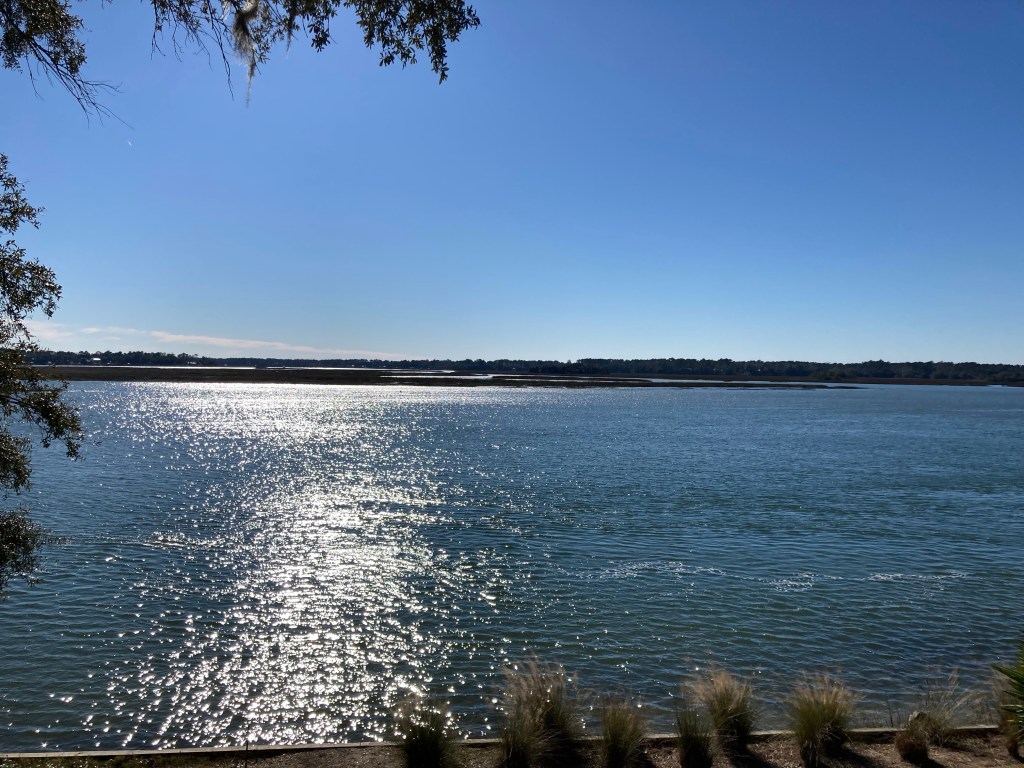
We were out and about on Christmas Day in the Low Country of South Carolina, it was a brilliant sunny day.

The December sky was a deep blue.

And it was COLD!

I was standing on the bluff overlooking the May River, thinking of the hot hot hot days in the past that I have stood there.

I stood there in the Bluffton Breeze that is always blowing across the river to the Bluff.

It was for the Bluffton Breeze that people moved to Bluffton South Carolina in the first place with many of the area families building summer homes here to catch the refreshing breeze off the river.

Standing there on this brilliant sunny Christmas Day, I felt frozen.

I felt frozen and it came to me that, you can’t see cold.

Or can you?

I was reminded of the Weatherball of Grand Rapids, Michigan, where I grew up.

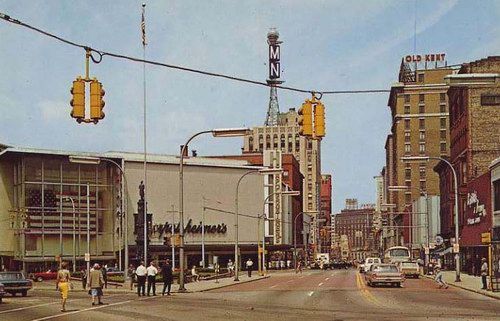
The Weatherball was this giant stainless steel ball on top of a bank building in downtown Grand Rapids.

It changed color with the weather.

And you could see it from all over the city.

There was a little rhyme that everyone in Grand Rapids could recite.

Weatherball red – warm weather ahead

Weatherball blue – cold weather in view

Weatherball green – no change foreseen

And it worked, though maybe not in the way the designers designed it.

I what I mean is, take for example, August in Grand Rapids, a soupy humid month.

80 degree days with 90% humidity is the norm.

When I was kid and my family would drive into Grand Rapids from the west on Lake Michigan Drive and get on the freeway that came across John Ball Park, the entire downtown would open up in front of us like a panorama.

The city would be hidden in a thick, humid haze.

And shining in this swampy morass was the Weatherball.

Glowing a smoky red in the haze, somehow the Weatherball made it seem warmer, stickier and more humid.

In the winter time, we would go sledding on a hill at Crestview School.

Nighttime the sky would be crystal clear and Orion would stretch over and all around us, from the top of the hill, we could see the lights of the city.

And shining above on the lights was the Weatherball.

Glowing a bright light blue, somehow the Weatherball made it seem colder, crisper and more freezing.

Perception drove reality and you could see warm and you could see cold.

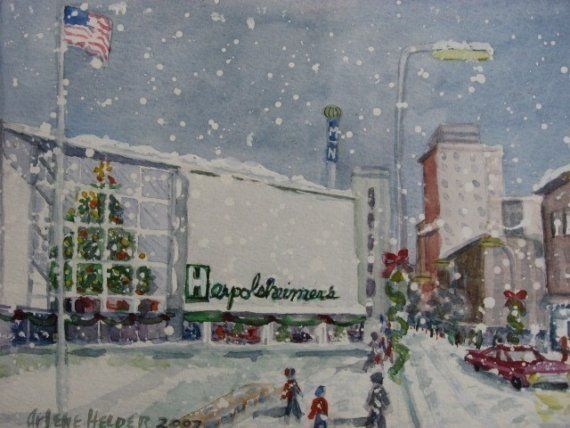
At some point, the Michigan National Bank that owned the building where the Weatherball was located (the letter M N B blinked just below the Weatherball) made the decision that the Weatherball had to come down.

Somewhere along the line, I met someone who told me that it was their Dad, as a brand new-in-town Michigan National Bank Vice President, made the decision.

This person told me that their Dad was told that the giant tower on top of the building was starting to sway and when it rocked in high winds, the roof of the building was showing signs wear and tear and there was good chance the Weatherball could come crashing down.

This person said that their Dad made the decision to take down the Weatherball and spent the rest of his career with Bank being known as the ‘Man who wrecked the Weatherball.’

He may have been one of the most, well, I was going to say hated but that is a too strong term, yet anyone who heard the story did hate the guy so I will say, one of the most hated men who figured in the List of Great Things Grand Rapids Lost.

Other things on this list include the Grand Rapids City Hall which is almost more famous for an incident during its demolition when a young lady hand cuffed herself to a wrecking ball.

A lesser know incident that took place during the demolition was that two guys took sledgehammers and made their way up to the old bell town of City Hall and with the sledges, range the City Hall Bell one last time.

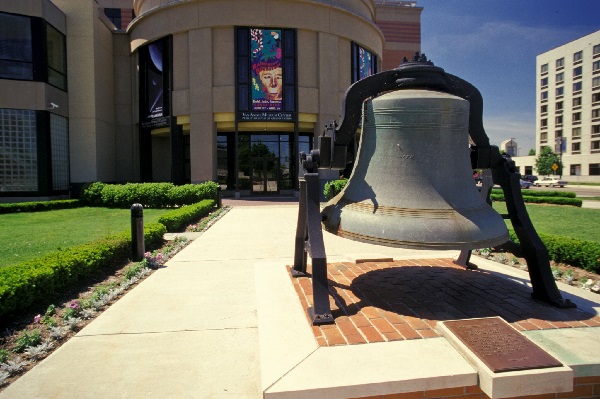
You can see this bell to this day outside the entrance to the Grand Rapids Public Museum and if you look closely you will the surface dotted with circles the size of 50 cent pieces where the sledge hammers made contact.

I had done some research on that bell when I worked for the Local History Collections of the Grand Rapids Public Library and I remember talking about to Bob, one of the security guards at the Library who was retired from the Grand Rapids Police Department.

I told Bob the story of the guys with the sledgehammers and he responded, “Do I remember that I night! I was the first cop on the scene and I had to make my way through the half demolished building and up the bell tower stair way with no railing using a flash light! It was crazy! I thought I was going to fall of the stairs or that the place was going to come down.”

I told my boss, then City Historian, L. Gordon Olson, that we had to make a oral history interview with Bob but nothing came of it.

And speaking of Gordon Olson, he WAS the most hated man who figured in the List of Great Things Grand Rapids Lost.

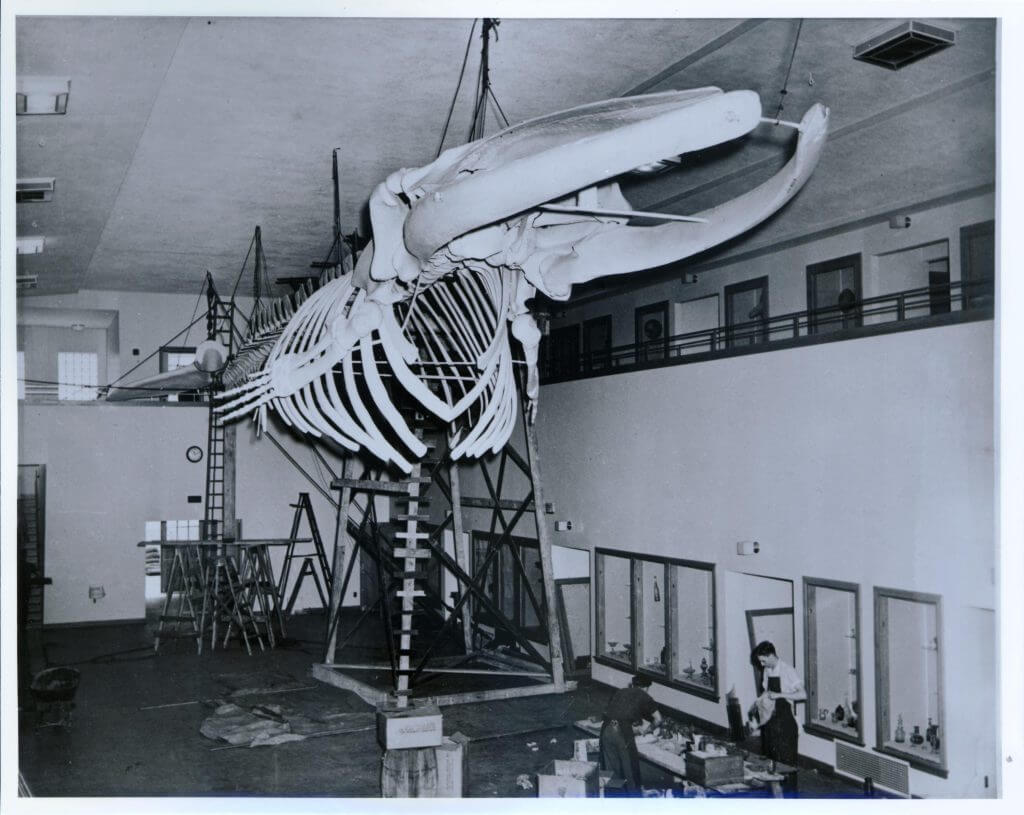
It was Gordon, you see, as Assistant Director of the Grand Rapids Public Museum, who had the whale removed from the original Museum building on Washington St.

Around 1900, the Public Museum acquired a complete whale skeleton (the origin of which is a little murky but chances are it was purchased from the State of Florida when Florida shut down their pavilion at the Great Columbian Exposition in Chicago).

The whale bones were on separate stands and the Museum would pack the whole thing off the Kent County Fair in Comstock Park and wrap the bones in canvas so you could take the Jonah experience and walk through the whale.

When a new building was built during the depression, the whale was proudly hung in the main gallery of the museum until the late 1970’s when Gordon had it taken down.

Gordon told me that if ever he spoke anywhere at any city function or gathering, and that fact that he was the guy who removed the whale was mentioned, he would get booed.

The boos might have toned down once the new museum was built and the whale skeleton was restored but for anyone who grew up with the old museum and pitching pennies on the whale’s tail from the 2nd floor gallery, Gordon was not well liked.

Gordon told me that he was caught in a bad spot and that the whale bones had started disintegrating and falling to the floor and it was only a matter of time before some one got hurt.

The funny part of the story is that Gordon told me how a giant scaffold had to be built at some expense to remove the skeleton.

Gordon said that about a month after the whale came down and the scaffold removed, he noticed a guy walking around the gallery, looking up at the ceiling.

Gordon knew what he was looking for but went up to him and asked anyway.

The man did indeed ask if there had been a whale hanging there at one time.

Gordon told him yes and that it had just recently been removed.

The man nodded and then asked how did they take it down?

It turned out the man was the guy who had hung the whale in the first place.

He pointed out some ring bolts still in the ceiling and showed Gordon how the skeleton had been suspended in such a way that had ropes been tied up through those bolts and PULLED UP, the entire frame was designed to then unlock and be lowered to the floor.

As I said, the whale was saved and can seen to this day at the new Grand Rapids Public Museum.

I am also happy to say that when I worked at WZZM, a co-worker did some research and found that the original Weatherball was sitting in a scrap metal yard and the station was able to buy the Weatherball, have the neon fixed and the restored Weatherball returned to the Grand Rapids skyline from a cell tower next to the WZZM station.

Maybe on brilliant sunny days in December in South Carolina you can’t see cold.

But I know what cold looks like.

It’s light blue and glows in a clear colder, crisper and more freezing way than you could have imagined it.

And because of that blue light, the coldness is clear and colder, crisper and more freezing way than you could have imagined it.

And if you are in Grand Rapids, Michigan in December, at night and you look west, you can see it too.