Down and out semi poet who is down and out in the Low Country of South Carolina after living in Atlanta which is not to be confused with the south, the old south or the new south. Atlanta was a global metropolis with all the pluses and minuses that comes with that. The low country, low because it is low, 8 feet above sea level, is not Podunk but once you get to Podunk, turn left. I try to chronicle a small part of all that through my daily haiku for you.
being walkers with the sun and morning not afraid days of gloom, darkness
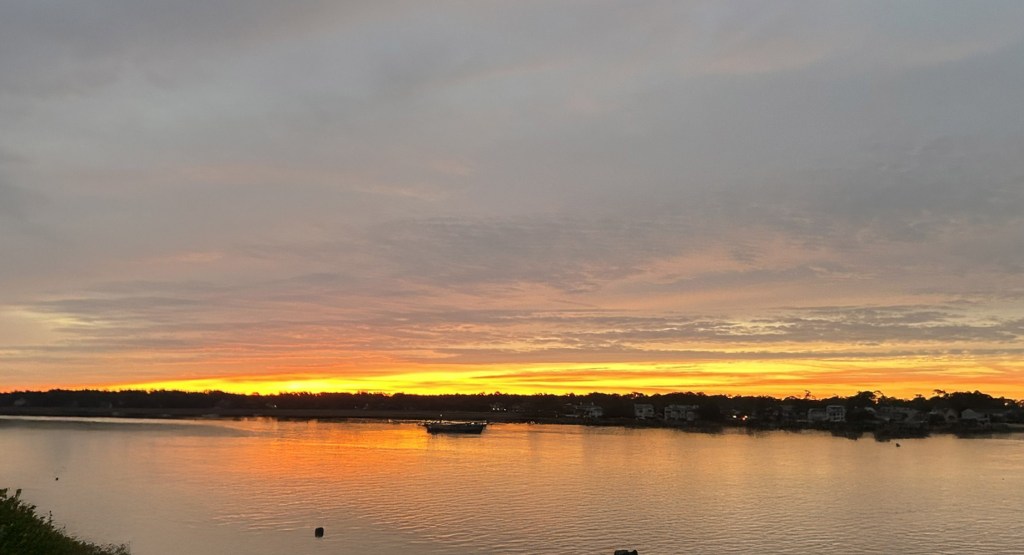
Broad Creek with the Sun about to come out of the Atlantic Ocean just on the other side of those trees – Hilton Head Island, SC 2-4-2026
Being walkers with the dawn and morning, Walkers with the sun and morning, We are not afraid of night, Nor days of gloom, Nor darkness— Being walkers with the sun and morning.
Walkers With The Dawn By Langston Hughes as printed in The collected poems of Langston Hughes by Langston Hughes (Knopf: New York, 1994).
When I was kid going to Grand Rapids Crestview Elementary School, every classroom had a model of the solar system sitting on the shelves that ran along the inside wall of every classroom.
The outside wall was all windows covered in venetian blinds.
The front wall was all chalkboards.
The back wall was all bulletin boards.
Seems like every room at Crestview had the same layout except that the lower elementary rooms had a restroom in the classroom.
The kindergarten room had a restroom in the classroom and for reason unknown, the light switch was on the outside. The switch had a red light under it and if the door was closed and the red light was on you knew someone was inside with the light on. Which proved too much temptation for some kids and by some kids I mean me. Sure we got in trouble but to hear someone yell when all you had to do was hit that switch … well, like I said too much temptation and I, early on started down the path of class cut up. The cost of a talking-to and maybe even a trip to hall was small price for the moment of notoriety I could achieve with that simple act. But I digress.
As I said, each room had this model of the solar system.
It wasn’t much.
It had a large yellow sun in the center and a small earth that went around the sun and on an extended arm, it had another model of the earth with a little moon that went around the earth.
There was a knob on the arm and you grabbed the knob and spun the arm around the sun and the earth went around the sun and the moon went around the earth.
It took about 25 seconds to get the gist of it and that nothing else was going to happen.
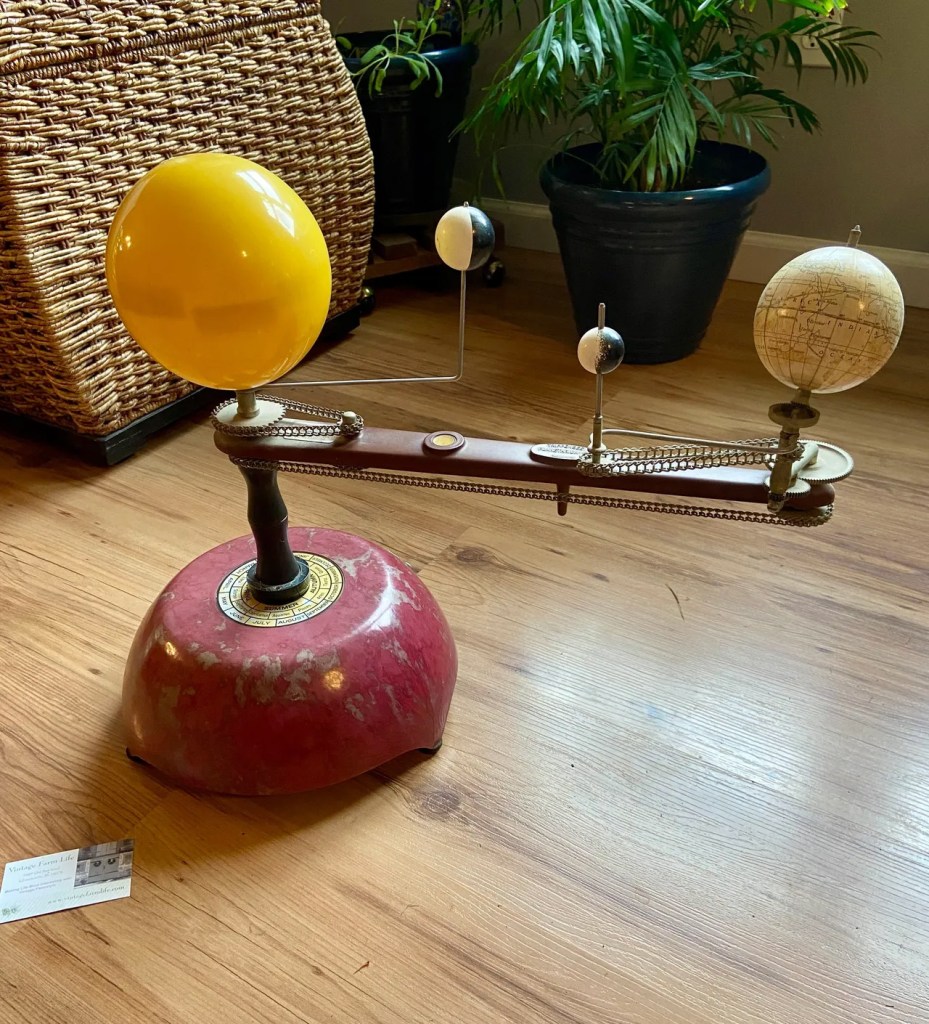
I found this photo of something that looks a lot like what we had, but the one pictured is a little more elaborate that what we had in school and I am pretty sure that the chain drive and gears where all enclosed but this gives you the idea.
But there was this one time.
I want to say it was in 5th grade with Miss Critchell that she really tried to use the model and explain the solar system.
This would have been at the height of the Apollo space program and there was a lot of interest in space and the solar system.
When there was a space launch, Miss Critchell would bring in her personal portable black and white TV and we would have a quiet day to work at our desks while she left the TV on.
I remember sitting at my desk with the lights off so we could see the fuzzy TV picture waiting through one of those ‘MISSION IS ON HOLD’ moments while NASA worked out some problem and I was so bored I asked Miss Critchell if I could go to the library.
“But this IS history,” said Miss Critchell, shaking her head, but she let me go anyway.
Before this space launch, Miss Critchell did her best to explain the solar system and the moon missions.
She had done her home work so that when she got out the model of the solar system and made the earth go around the sun and moon go around the earth she said something that fell through the cracks in my brain and stayed there forever.
“This is just a model,” she said.
“In real life,” she said, “if the Sun was this big, (pointing at the grapefruit sized yellow model of the sun), the earth would really be … somewhere out on the playground.”
I don’t know if the rest of the class heard like I did but it hit me that in the grand scheme of things, earth was pretty insignificant.
Maybe Horton Hears a Who came to mind and I realized that we, the people on earth, could be the that dust speck of boil that dust speck fame.
And what came to me was that, boy howdy, but we were lucky God was in charge of the whole thing as it was all too much for pure chance for me.
As everyone knows who reads these, as I drive to work, I drive out onto a barrier island on the east coast.
Each day that crank is turning and the earth is spinning and everything is going around the Sun.
It did this yesterday.
It will do this today.
It will do this tomorrow.
I still think, BOY HOWDY, but we were lucky God was in charge of the whole thing as it was all too much for pure chance for me.
And I think of the verse from the Bible, Romans 8:31: What shall we then say to these things? If God be for us, who can be against us?
Being walkers with the dawn and morning, Walkers with the sun and morning, We are not afraid of night, Nor days of gloom, Nor darkness— Being walkers with the sun and morning.
ethical demand must resonate in our hearts revealed in our lives
These issues are fundamental to the disciple of Jesus Christ.
“What we do to the least among us, we do to Him” is an ethical demand that must resonate in our hearts and be revealed in our lives.
I ask the faithful to join with people of good will everywhere and to stand with those who are afraid to leave their homes, afraid to go to the hospital, afraid to take their children to school, afraid to buy groceries — those who are forced to live in fear every moment of every day.
These are the ways we stand with Jesus Christ.
And between our voices and our always respectful, nonviolent witness, we might just reveal that the soul of our great nation is alive and well in us.
Read that line again, “What we do to the least among us, we do to Him” is an ethical demand that must resonate in our hearts and be revealed in our lives.
How can any Christian any where read that and not feel called upon to act, to do something.
Anything but support what is happening and if not openly support, say nothing.
Again, “What we do to the least among us, we do to Him” is an ethical demand that must resonate in our hearts and be revealed in our lives.
It might also be good to remember the warning.
What warning?
I point you back to Bible to the Book of Matthew, Chapter 7.
I’ll quote the verse in the King James English as it seems to resonate in my heart.
Chapter 7, verse 21 says, “Wherefore by their fruits ye shall know them.”
And in verse 23 …
Verse 23 reads, “And then will I profess unto them, I never knew you.”
These issues are fundamental to the disciple of Jesus Christ.
Who willingly runs that risk?
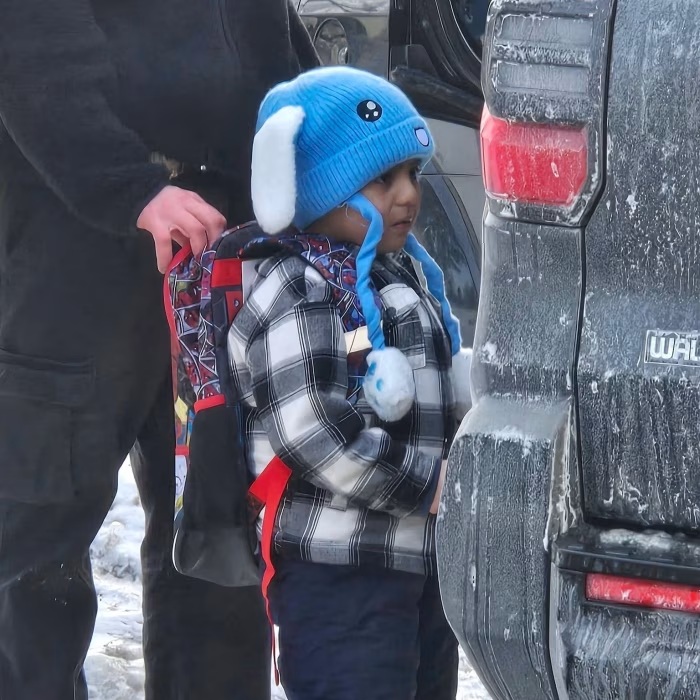
Read the complete essay below the photo.
In the light of recent and tragic immigration enforcement incidents, a great many individuals have asked my opinion of our nation’s immigration procedures.
Actually, they are among the issues that keep me awake at night.
Before I address the question, please allow me to recount a portion of my personal history which — along with the Gospel and Catholic teachings — has profoundly affected my understanding of the situation.
‘What you do to the least among you, you do to me’
When I served as the Bishop of Tucson, Arizona, my diocese contained the entire Arizona-Mexico border. Working with government entities, Tucson’s Catholic Charities coordinated the reception of thousands of immigrants during my tenure.
While it was usually a far lesser number, at its peak our Catholic Charities processed 1,400 asylum-seekers and immigrants per day. While Catholic theology makes no distinction between assisting immigrations with or without documents, I would note that every person we assisted was brought to us by the U.S. Border Patrol or other federal agents, and each was in possession of valid immigration documents.
In my own interactions with these immigrants, I knew I was on holy ground as I would hear their stories. I would also witness the traumatic wounds of those who had seen relatives killed or did all they could to find food for starving children. I am forever changed by that experience, and when I couple it with Our Lord’s teaching, “What you do to the least among you, you do to me,” I am compelled to speak on their behalf.
Fatal and toxic
In the last few weeks, we have witnessed a 5-year-old child, Liam Conejo Ramos, separated from his mother and quickly sent with his father from Minnesota to a detention center in Texas. This fast relocation of detainees seems to be a policy that seeks to separate the detained from family, community or any local legal assistance.
As this family entered the U.S. as legal asylum-seekers and committed no crimes, many are left to wonder, why focus on them? Having largely failed to detain and deport the large numbers of violent criminals as promised, is Immigrations and Customs Enforcement now rounding up legal asylum seekers for the sake of an optic of success?
We then witnessed the killing of Renee Good, whose death at the hands of ICE agents was ruled a homicide by the local medical examiner’s office. Rather than allowing for a transparent and independent investigation of the death, our federal government is uncooperative, and insisting on doing only the equivalent of an internal investigation.
More recently, we have the tragic death of Alex Pretti, a Veterans Affairs Hospital nurse. A common concern in both deaths is that they appear to have been fatal over-uses of violent force on the part of federal agents. The matter is made further toxic by leadership vilifying Good and Pretti within hours of their killings, despite having no substantial knowledge of the facts at that time.
America’s soul is at risk
I must admit that when I look at the totality of this situation, I am dumbfounded and deeply disturbed.
As a proud American, I have always lived by the belief that we are a nation of guiding values, a nation of noble virtues, a nation established on the rule of law and respectful of human rights. Increasingly, I find myself asking if our nation is losing its very soul.
For this reason, I join my voice to the growing number of those who have expressed grave concern for what is happening in our midst.
I also reject any notion of an internal investigation of these incidents, and instead call for an independent and transparent review of these actions.
Lastly, I call for a restoration of entirely innocent small children who have been separated from their mothers. Are we not better than that?
We must acknowledge that a substantial degree of responsibility for this catastrophe flows from the failure of our federal government to craft reasonable immigration reform.
Missing that federal leadership, we should not be surprised at the humanitarian and moral crisis that has resulted.
It seems that Americans can only envision two options: Either open borders with no restraint, or closed borders with no immigration of any kind.
That dichotomy is a lie. It is quite possible to acknowledge, respect and defend our borders, while also creating a path for the same kind of immigration that brought many of our ancestors to this nation.
I believe that our elected legislators are intelligent and capable. What is lacking is unified resolve to create this critical immigration reform. While admitting that it is a daunting task, I nevertheless urge our legislators to address what is truly a life-or-death issue, even if it entails braving the onslaught of criticism from those entrenched on one side or the other of this crisis.
Christ’s ethical demand
Without substantial immigration reform that balances legitimately maintained borders with the mercy that has always been at the root of our nation, I fear we will continue to see 5-year-olds separated from mothers, American citizens killed while protesting or exercising their right to free speech and documented immigrants who arrived in this nation via the correct channels rounded up for deportation.
Again, these issues are fundamental to the disciple of Jesus Christ. “What we do to the least among us, we do to Him” is an ethical demand that must resonate in our hearts and be revealed in our lives.
I ask the faithful to join with people of good will everywhere and to stand with those who are afraid to leave their homes, afraid to go to the hospital, afraid to take their children to school, afraid to buy groceries — those who are forced to live in fear every moment of every day.
These are the ways we stand with Jesus Christ. And between our voices and our always respectful, nonviolent witness, we might just reveal that the soul of our great nation is alive and well in us.
May God bless you, may God bless those at risk and may God bless our great nation.
Edward J. Weisenburger is the Archbishop of Detroit.
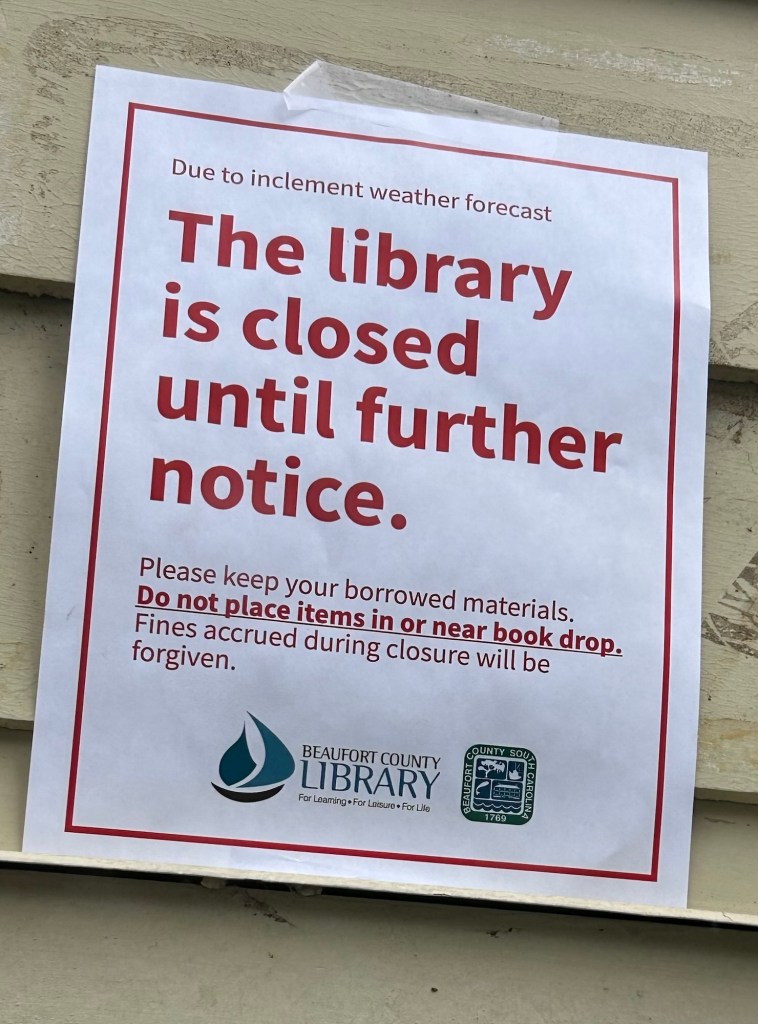
library closed fines accrued during closure will be forgiven
Watching the weekend weather, all the maps showed the cold and wet and snow swoop down out of the north … and come up short of our little corner of South Carolina.
That was close enough for most Government offices and businesses down here.
I got a number of emails and texts
And on Saturday afternoon some sort of visible precipitation started to fall, emergency emails and text messages poured into my phone.
As temperatures fall below freezing tonight, melt water may freeze and create icy spots on paved surfaces such as bridges and overpasses, primary and secondary roads, parking lots, sidewalks and driveways. Black ice is difficult to see and distinguish from dry surfaces. The deceptive nature of black ice can catch you unaware while you are driving or walking, causing you to lose control of your motor vehicle or to slip and fall.
And
Motorists are urged to use extreme caution, especially on roads that are less traveled, shaded areas, bridges, and overpasses, where ice may not be visible.
They talk an awful lot about ‘black ice’ down south and most locals will say that from birth they are told to stay away from the dread ‘black ice’.
I am convinced that the locals are convinced that if they drive on black ice, the car blows up.
But we got out.
The coffee shop we drove to … was closed.
Roads we wanted to use … were blocked.
We got to the library to see the building all dark and a sandwich board outside the front door saying that due to the weather, the library was closed.
We drove around back to use the drive-thru book return to see that THE BOOK RETURN was closed due to weather.
Now that was something new.
Never had I seen weather so bad that library books couldn’t be returned.
Not to worry though, as the sign said, fines accrued during closure will be forgiven.
WOW.
I was shocked.
And reminded of the time I was working with a sweet little lady name Rose at the Cascade Branch of the Kent District library.
A patron came in with an unusual hard cover red bound book and engaged Rose in a long conservation about overdue books, damaged books and late fees.
I listened but stayed out of the conversation and let Rose handle the whole thing.
The patron explained and they talked and the patron explained and Rose listened.
The patron smiled and explained and Rose listened.
I kept to myself and just stayed out of it.
The conversation wound down as did the Patron and Rose took the red bound book, walked over to the cash register and rang up an amount and the patron paid up and left.
At the end of the library day, we would close the doors and do some clean up, straighten chairs and wait for whoever was in charge to finish closing up.
We would all end up in the back room by the door and we would chat for a few minutes.
With everyone else in a group standing there, including Diane, the wonderful Library Director, I asked, “Rose, what was the deal with that lady’s book?”
“OH,” said Rose, “Her kids got a bird guide and then left it out on their back deck in the rain.”
“What did she say she did?” I asked (all so innocent).
“OH,” said Rose, “She said the binding fell apart so she took it to a rare book dealer to be rebound.”
Hence the bright red hardbound cover of this ordinally paper bound bird book.
“Gosh,” says I, “what did she say that cost?”
By now everyone on the staff knew I was up to something and were waiting to hear this through.
“OH,” said Rose, “She said it cost $30 to be rebound and it took a while, so it was late.”
“Wow,” I said, letting that sink in.
Then I said …
“Rose … how much of a fine did you charge her?”
“Oh,” said Rose, “$4.00.”
Rose, that poor sweet lady, looked all confused as everyone broke out laughing and Diane looked at me, shaking her head with one hand over her mouth.
“Well,” said Rose, “she maxed out. $4.00 was the most I could get.”
we should have a land of love joy wine song, not this … land where joy is wrong
Adapted from the poem, Our Land by Langston Hughes as printed in The collected poems of Langston Hughes by Langston Hughes (Knopf: New York, 1994).
(On the 125th Birthday of Langston Hughes.)
We should have a land of sun, Of gorgeous sun, And a land of fragrant water Where the twilight is a soft bandanna handkerchief Of rose and gold, And not this land Where life is cold.
We should have a land of trees, Of tall thick trees, Bowed down with chattering parrots Brilliant as the day, And not this land where birds are gray.
Ah, we should have a land of joy, Of love and joy and wine and song, And not this land where joy is wrong.
There is a call today to make America great … again.
Funny thing, I always thought it was great.
Feet of clay to be sure.
Lots of dirt swept under both now and in the past.
But something about it, still great.
Great maybe, for the reason that there was a way things happened.
A process for the way things happened.
A process that was due to all people to be followed.
Due process.
Rules.
Simple rules.
But that isn’t how the MAGA people see it.
They see themselves as victims and as being victimized.
They tell me that the guy in office will fight for them.
Fight for them regardless of the process that was due.
I my gut feeling is that they see themselves as the Undertaker in the Godfather movie.
The undertaker who starts out the movie with the lines, “I believe in America. America has made my fortune.”
The Godfather responds, “I understand. You found paradise in America. You had a good trade, made a good living. The police protected you and there were courts of law.”
The Godfather continues, “Had you come to me in friendship … and that by chance if an honest man such as yourself should make enemies, then they would become my enemies. And then they would fear you”
And then they would fear you.
Is that not the perfect line?
And then they would fear you.
They would fear you.
Fear you.
Fear.
The thinking goes that the guy in the oval office fights for me and then they will fear me.
Make America great again by making people fear America.
As so many people are saying.
That’s not who we are.
Or at least, who we were.
For me?
I trust in God.
Let people think about that one.
For this country?
We should have a land of sun, Of gorgeous sun, And a land of fragrant water Where the twilight is a soft bandanna handkerchief Of rose and gold, And not this land Where life is cold.
We should have a land of trees, Of tall thick trees, Bowed down with chattering parrots Brilliant as the day, And not this land where birds are gray.
Ah, we should have a land of joy, Of love and joy and wine and song, And not this land where joy is wrong.


 No Haiku For You