Down and out semi poet who is down and out in the Low Country of South Carolina after living in Atlanta which is not to be confused with the south, the old south or the new south. Atlanta was a global metropolis with all the pluses and minuses that comes with that. The low country, low because it is low, 8 feet above sea level, is not Podunk but once you get to Podunk, turn left. I try to chronicle a small part of all that through my daily haiku for you.
wrong, nonsensical entrenched ideas among accepted beliefs
Scientific truth is very difficult to discover.
There are two reasons for this.
The first is that nature is, with all its complexity, very obscure.
Secondly, there is the number of wrong, nonsensical yet deeply entrenched ideas that exist among currently accepted beliefs.
For example, even after the centuries long belief in the usefulness of drawing blood as a therapeutic measure had been found to be groundless, belief of almost as long duration sprang up in the healing virtues of castor oil.
When I was a boy, almost every complaint from fever to gastroenteritis was treated with castor oil. Measles, scarlet fever, mumps and the flu — all were treated indiscriminately with the same specific.
Two short generations have passed and today castor oil is hardly ever seen and the health of children and adults alike is not a whit the worse.
From the book, Butter side up!, or, The delights of science by Magnus Pyke, J. Murray, London, 1976.
1976!!
According to Wikipedia … Magnus Alfred Pyke OBE FRSE FRIC (29 December 1908 – 19 October 1992) was an English nutritional scientist, governmental scientific adviser, writer and presenter. He worked for the UK Ministry of Food, the post-war Allied Commission for Austria, and different food manufacturers. He wrote prolifically and became famous as a TV and radio personality, and was featured on Thomas Dolby’s 1982 synth-pop hit, “She Blinded Me with Science”.
due to the rising theme over sustained chords that begins the quartet
No. 4 (“Sunrise”) The Quartet No. 63 in B♭ major, Op. 76, No. 4, is nicknamed Sunrise due to the rising theme over sustained chords that begins the quartet.
The opening of the movement begins in a way that seemingly contradicts the allegro con spirito marking. Violin II, viola, and cello sustain a tonic chord while the first violin plays the melody (the “sunrise” motif) on top. In measure 7, the same instruments sustain a dominant seventh chord while the first violin again plays a rising solo on top. In measure 22, all instruments reach forte, and allegro con spirito character is apparent through the sixteenth-note movement and lively staccato eighth notes trading off between the parts. In measure 37, the opening sunrise theme returns, this time with the solo in the cello and the sustained chords in the violins and viola. The lively sixteenth-note section returns in measure 50, beginning with sixteenth notes in the cello which move to the viola, and finally, the violins. In measure 60, all instruments drop to piano for a six-measure staccato eighth-note section before jumping to an all sixteenth-note fortissimo in measure 66 to finish off the exposition.
people with song mouths connecting song hearts; people who must sing or die
For Labor Day, 2025.
Adapted from Work Gangs by Carl Sandburg as published in The Complete Poems of Carl Sandburg, by Carl Sandburg, Harcourt, Brace, New York, 1950.
Work Gangs
Box cars run by a mile long. And I wonder what they say to each other When they stop a mile long on a sidetrack. Maybe their chatter goes: I came from Fargo with a load of wheat up to the danger line. I came from Omaha with a load of shorthorns and they splintered my boards. I came from Detroit heavy with a load of flivvers. I carried apples from the Hood river last year and this year bunches of bananas from Florida; they look for me with watermelons from Mississippi next year.
Hammers and shovels of work gangs sleep in shop corners when the dark stars come on the sky and the night watchmen walk and look.
Then the hammer heads talk to the handles, then the scoops of the shovels talk, how the day’s work nicked and trimmed them, how they swung and lifted all day, how the hands of the work gangs smelled of hope. In the night of the dark stars when the curve of the sky is a work gang handle, in the night on the mile long sidetracks, in the night where the hammers and shovels sleep in corners, the night watchmen stuff their pipes with dreams— and sometimes they doze and don’t care for nothin’, and sometimes they search their heads for meanings, stories, stars. The stuff of it runs like this: A long way we come; a long way to go; long rests and long deep sniffs for our lungs on the way. Sleep is a belonging of all; even if all songs are old songs and the singing heart is snuffed out like a switchman’s lantern with the oil gone, even if we forget our names and houses in the finish, the secret of sleep is left us, sleep belongs to all, sleep is the first and last and best of all.
People singing; people with song mouths connecting with song hearts; people who must sing or die; people whose song hearts break if there is no song mouth; these are my people.
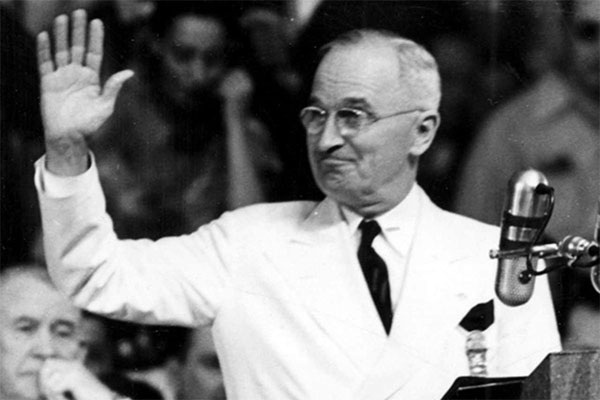
I went looking for a quote about Labor in the back of my mind that memory said was in Harry Truman’s address in Philadelphia accepting the nomination of the Democratic National Convention. I found ” … labor never had but one friend in politics, and that is the Democratic Party and Franklin D. Roosevelt.”
But what I also came across was this:
The United States has to accept its full responsibility for leadership in international affairs.
We have been the backers and the people who organized and started the United Nations, first started under that great Democratic President, Woodrow Wilson, as the League of Nations. The League was sabotaged by the Republicans in 1920.
And we must see that the United Nations continues a strong and growing body, so we can have everlasting peace in the world.
We removed trade barriers in the world, which is the best asset we can have for peace.
Those trade barriers must not be put back into operation again.
Harry had some wild ideas back then.
Raise minimum wage.
Universal Health Care.
This was the famous Give’em Hell Harry speech.
Mr. Truman later said all he did was tell the truth … which made the Republican’s feel like they were in hell.
mark against your name marks not that won or lost, but how you played the game
Adapted from the poem “Alumnus Football” by Grantland Rice as it printed in the book, The Sportlight, (New York: D. Appleton and Company, 1917).
The final stanza goes:
Then came the final whistle, And the end of all the strife, And Bill Jones, the brave half-back, Was carried from the game of life. But when the Great Scorer comes To write against your name, He marks — not that you won or lost — But how you played the Game.
And it’s that last line, how you played the Game, that comes to mind this morning.
It’s not yet fall, it’s not even Labor Day, but College Football has started and it starts with finding the T shirts and the hats and the memories of past games and past rituals.
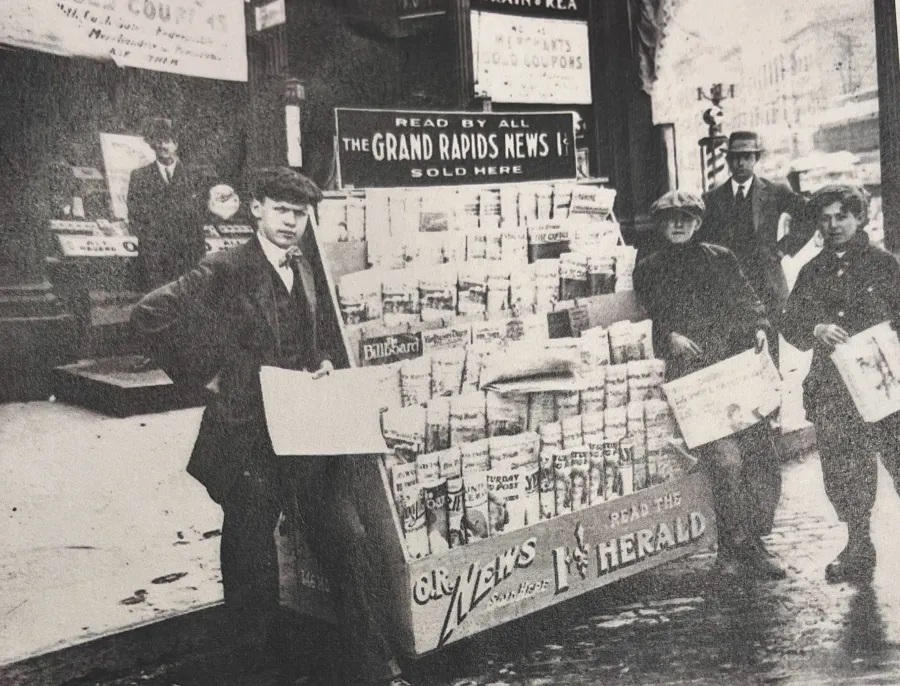
Back in the day, a favorite fall ritual on a Sunday morning after my team won it’s game on Saturday was to drive downtown to Elliott’s News Stand in Grand Rapids, Michigan, where I grew up, and get newspapers from out of town.
Not sure how back then, but you could get newspapers from almost every major American city east of the Mississippi River.
I wanted a New York Times and maybe a Chicago Tribune and if possible, the local paper from whatever town where the team my school had beat on Saturday was located.
My favorite time was when I needed to find editions of the Columbus Post Dispatch or the Lansing State Journal.
I loved reading the viewpoints of my team as written by the other side.
I wanted to read how they played the Game.
I wanted the who, what, where, why and how they played the Game.
In 1995, I had got a Macintosh Performa Computer and a modem and got a free internet access account from something called iserve.net and learned how to access information on the recently created World Wide Web.
I had to use something called a LYNX browser and you only had text and the early websites often had issues not display a lot of coded gobblygok but with a little patience, I found I could get to the few newspapers then online.
The Detroit News was one of them and I could read all their stories about my team at detnews.com.
From such little acorns, giant Oak trees grow.
By the year 2000, I was working in the online world and ALL newspapers were online and I was no longer driving downtown to buy print newspapers.
No one knew it, but the tide had shifted and was going out on print media.
By chance, I started working for a TV station with corporate ties to the Detroit News and I found myself in meetings with the online staff on how we could improve the product.
Occasionally the revenue model would be discussed and how this would all work out but no one saw anything but a bright future.
Readers started using the web and abandoning the print editions because the web version was free.
No worries said the papers, much like someone on the Titanic thinking the big ship couldn’t sink, we can make up the revenue from ads.
After being in online news for 20 years, let me tell you, the only people who made money from online advertising where the people who managed the online advertising.
By 2009, the rug was being pulled out from Newspapers and I watched as more and more of the people I worked with the newspaper side were let go or ‘repurposed’ or made redundant.
This cycle kept going until it caught up with me and I found myself being called into a Tuesday online meeting with an HR rep and told my last would be Friday.
It’s a long story but this was the 2nd time I had this meeting with that company but the 1st time it happened I was offered a way out if I accepted another position in Atlanta, but I digress.
Still, my Sunday Morning ritual continued.
Newspapers continued to wrestle with the revenue models of pay-windows or limited access to free atricles.
I had become accustomed to going to the websites for the Detroit News and the Detroit Free Press and clicking on what articles I could and ignoring those marked SUBSCRIBER ACCESS ONLY.
This morning those links were gone.
This morning almost every article I clicked gave the 1st paragraph and then required me to login as a subscriber.
And I am resistant.
I would pay for those newspapers at Elliott’s.
Why wouldn’t I pay for subscriber access?
If I could answer that question for myself, I would think the Newspapers would be glad to know the answer.
Earlier this week The Atlanta Journal Constitution announced they would no longer print a newspaper.
Their reported numbers are dismal.
According to a New York Times story:
About 40,000 subscribers receive the print newspaper, down from 94,000 in 2020. At its height, in 2004, the paper’s Sunday edition had a circulation of about 630,000. The paper is printed at a facility in Gainesville, Ga., that The Journal-Constitution does not own. About 30 staff members, half of them part-time workers, would lose their jobs as a result of the change, a company spokeswoman said.
…. an ambitious goal of reaching 500,000 paid digital subscribers by the end of 2026, a figure that would make the business sustainably profitable.
The paper is not on a pace to hit that goal. It has about 115,000 total paid subscribers, with 75,000 of those digital-only subscribers, a figure that’s up from about 55,000 at the end of 2023, according to a company spokeswoman.
“The bottom has fallen out of the entire industry,” Mr. Morse said. “Our organic traffic from Google has dropped 40 percent in the last year. Never could have predicted that.”
The folks at the AJC hold to the importance of news saying:
“Everything we’re doing is designed to protect the journalism, to build the best products we can and to get it in front of the most people,” Mr. Morse said.
Now, searching for a description of the yesterday’s game, I came across a handful of stories.
Just about all of them were pre game stories on how to BET THE GAME.
Or they were post game stories about how BETTING ON THE GAME turned out.
If they weren’t on betting, most of the stories were the current puff pieces of the athletes thoughts on Cracker Barrel or Taylor Swift of their favorite online reels.
I don’t have a lot of answers and maybe I am not even sure what the questions might be.
As Andrew Morse, The Atlanta Journal-Constitution President and Publisher, was quoted, “Unless news organizations have the courage to disrupt themselves faster than the marketplace is disrupting the industry, really important institutions that have existed for generations will cease to exist.”
In no small way, I fill a part of the reason this is happening.
But all I wanted to know is how they played the game.



 No Haiku For You