10.9.2025 – language created word

language created word
loneliness to express pain
of being alone

it created the word
solitude to express glory
of being alone

“Language has created the word “loneliness” to express the pain of being alone. And it has created the word “solitude” to express the glory of being alone.”

Paul Tillich in The Eternal Now (New York: Scribner, 1963).

Not wanting to get into any discussion on Mr. Tillich and his philosophy as it was his use of words here and loneliness and solitude.

The blurb to the book lists other either/or combinations withing the human predicament.:

Loneliness and solitude;

Forgetting and being forgotten;

The riddle of inequality;

The good that I will, I do not;

Heal the sick, cast out the demons;

Man and earth —

The divine reality.

Spiritual presence; The divine name;

God’s pursuit of man; Salvation;

The eternal now —

The challenge to man.

Do not be conformed ; Be strong ;

In thinking be mature ;

On wisdom ;

In everything given thanks.

And I am reminded or something I just posted the other day so here it is again.

In the original screen for the movie, Talladega Nights: The Ballad of Ricky Bobby, Ricky Bobby’s two boys are named Hank and Williams, Jr. which gets changed to Walker and Texas Ranger in the movie.

There is a scene that is only on the DVD in the extended cuts where Grandma Lucy is reading to Hank and Williams Jr. They are asking her questions. We see she is reading them Faulkner’s The Bear.

Williams, Jr. asks, “But doesn’t the bear symbolize the old south and the new dog, the encroaching North?”

Hank responds, “Duh! But the question is, should the reader feel relief or sadness at the passing of the old south?”

Grandma asks, “How about both?

To which Hank gets it and says, “Ahh!… I get it, moral ambiguity! The hallmark of all early twentieth century American fiction!”

Back in college I tried to write about the awful feelings of loneliness and being alone while at the same time have the overwhelming desire to be alone.

Moral ambiguity! The hallmark of all early twentieth century American fiction!
10.8.2025 – hang it on the wall

hang it on the wall
the last thing before she sleeps
first when you waken

Chair, Pocket Knife, Guitar

The slatted folding chair you sat upon,
The scantlings and ad hoc stuff of that playroom
You screened out as you just rocked on and on
In perfect time before the television,
To-day let all that tick-tock bric-a-brac
Come like a drumstick stick-man rolling home.

The one-blade pocket knife you coveted
In a shop window that first evening in France
And I bought then on the spot in thanksgiving
For us just being there: although it’s lost
I stand like a glad Macbeth faced with its ghost
Handle towards my hand, saying, ‘Thank, thank God’.

The guitar you got the day you started school
And were photographed with, up on the picnic table,
Play it again to-day, fierce Andalucian
Serenades and country wedding songs,
Then hang it on the wall, your true love’s token,
Last thing before she sleeps, first when you waken.

Unpublished poem by Seamus Heaney to be released on October 9th.

The reviewer in the Guardian writes:

Unlike other unpublished poems, some of which had tens of pages of drafts, there seems to be just one version of Chair, Pocket Knife, Guitar in existence. Heaney may have had more focus writing the poem because it was for an occasion, said Hollis. “It seems to have arrived with confidence, with force, and with purity of heart.”

From the article: Seamus Heaney’s unpublished poems to be released — read one exclusively here by Ella Creamer.

The slatted folding chair you sat upon

The one-blade pocket knife you coveted

The guitar you got the day you started school

Your true love’s token

Then hang it on the wall

Last thing before she sleeps

First when you waken

It seems to have arrived with confidence, with force, and with purity of heart.

I still like to wear a wristwatch.

I like to wear it on the inside of my wrist instead of the outside.

A longtime ago somewhere I read that wristwatches were designed during World War 1 so officers in the trenches didn’t have to pull out a pocket watch to check the time.

It was learned to wear the watch on the inside to protect the crystal.

Years later I read that Ronald Reagan also wore his wristwatch on the inside.

When asked, he said the had worn his watch that way since the days he had been an announcer on Radio and wearing the watch on the inside allowed him to check the time while holding a script.

Standard practice for folks onair back in the day.

The one I wear now was a gift from my wife on the occasion of our 25th Wedding anniversary.

It’s one of those self winding watches that winds itself as I swing my arm.

I like to say if my watch isn’t running, I must be dead.

Of late it hasn’t been running so well.

Admittedly, working at a computer all day, I don’t get much opportunity to swing my arms.

But last Christmas my wife bought me a self winding watch winder.

It’s a little box with a spinner in it.

I set my watch in there overnight and the spinner spins every once in a while to keep it wound.

My wife also suggested it’s time for a new watch.

Something I resist vehemently.

Just needs a good cleaning, I say.

See, it was a gift from my wife on out 25th anniversary.

For me, it’s my true love’s token.

I hang it on my wrist.

Last thing before she sleeps.

First when I waken.

It seems to have arrived with confidence, with force, and with purity of heart.

10.7.2025 – it begins to rain

it begins to rain
first harsh, sparse, swift drops across
ground in a long sigh

“It begins to rain. The first harsh, sparse, swift drops rush through the leaves and across the ground in a long sigh, as though of relief from intolerable suspense. They are big as buckshot, warm as though fired from a gun; they sweep across the lantern in a vicious hissing.”

As I Lay Dying by William Faulkner (New York: Jonathan Cape and Harrison Smith, 1930).

In the original screen for the movie, Talladega Nights: The Ballad of Ricky Bobby, Ricky Bobby’s two boys are named Hank and Williams, Jr. which gets changed to Walker and Texas Ranger in the movie.

There is a scene that is only on the DVD in the extended cuts where Grandma Lucy is reading to Hank and Williams Jr. They are asking her questions. We see she is reading them Faulkner’s The Bear.

Williams, Jr. asks, “But doesn’t the bear symbolize the old south and the new dog, the encroaching North?”

Hank responds, “Duh! But the question is, should the reader feel relief or sadness at the passing of the old south?”

Grandma asks, “How about both?

To which Hank gets it and says, “Ahh!… I get it, moral ambiguity! The hallmark of all early twentieth century American fiction!”

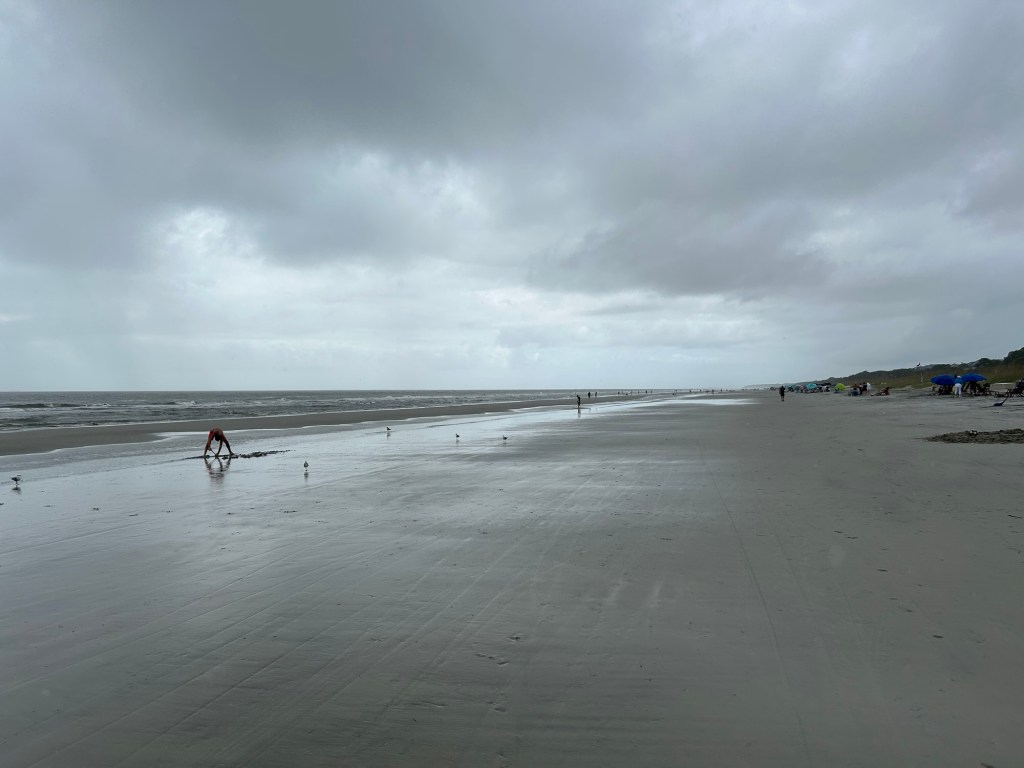
I went for a walk on the beach today and it started to rain and I got soaked.

I was there for a short time on my lunch break.

There were lots of families there who had spent a lot of time and effort and money to be on that same beach for just a few days.

Did I feel relief or sadness at being caught in the rain with all those poor folks, struggling to say, “I don’t think the hard stuff is going to come down for some time yet.”

Or …

Did I feel both.

Moral ambiguity! The hallmark of all early twentieth century American fiction!
10.6.2025 – one hurricane I

one hurricane I
lived through, other was different
and lasted longer

It didn’t behave
like anything you had
ever imagined. The wind
tore at the trees, the rain
fell for days slant and hard.
The back of the hand
to everything. I watched
the trees bow and their leaves fall
and crawl back into the earth.
As though, that was that.
This was one hurricane
I lived through, the other one
was of a different sort, and
lasted longer. Then
I felt my own leaves giving up and
falling. The back of the hand to
everything. But listen now to what happened
to the actual trees;
toward the end of that summer they
pushed new leaves from their stubbed limbs.
It was the wrong season, yes,
but they couldn’t stop. They
looked like telephone poles and didn’t
care. And after the leaves came
blossoms. For some things
there are no wrong seasons.
Which is what I dream of for me.

Hurricane By Mary Oliver as published in A Thousand Mornings: Poems. (New York: Penguin Books, 2013).

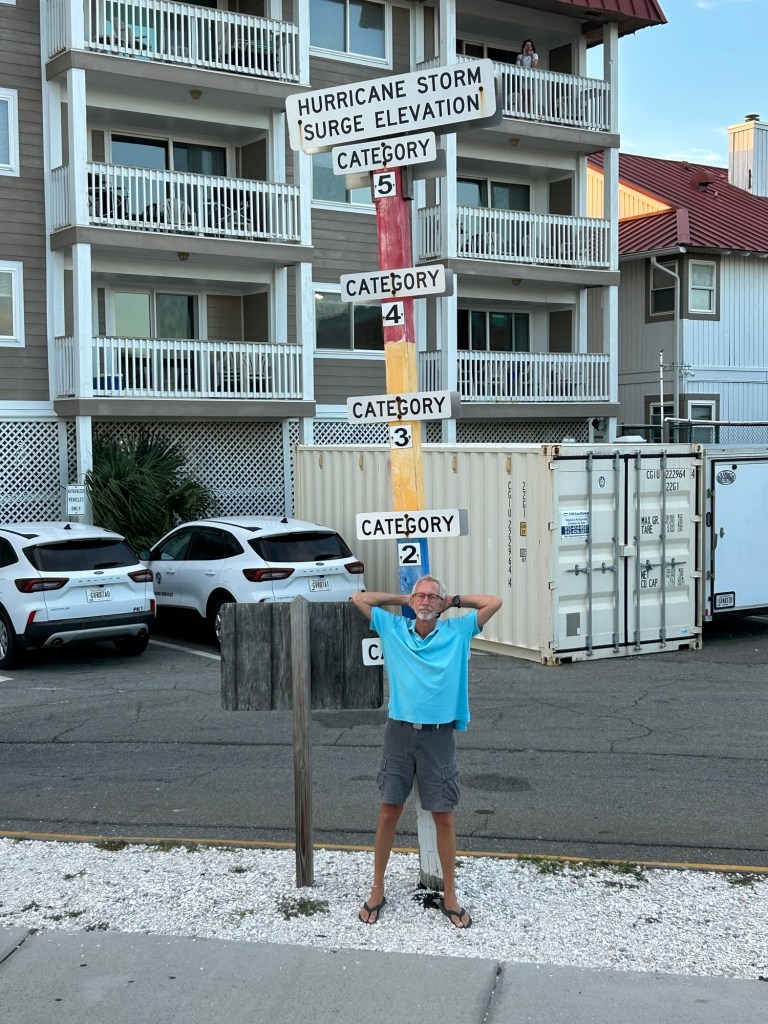
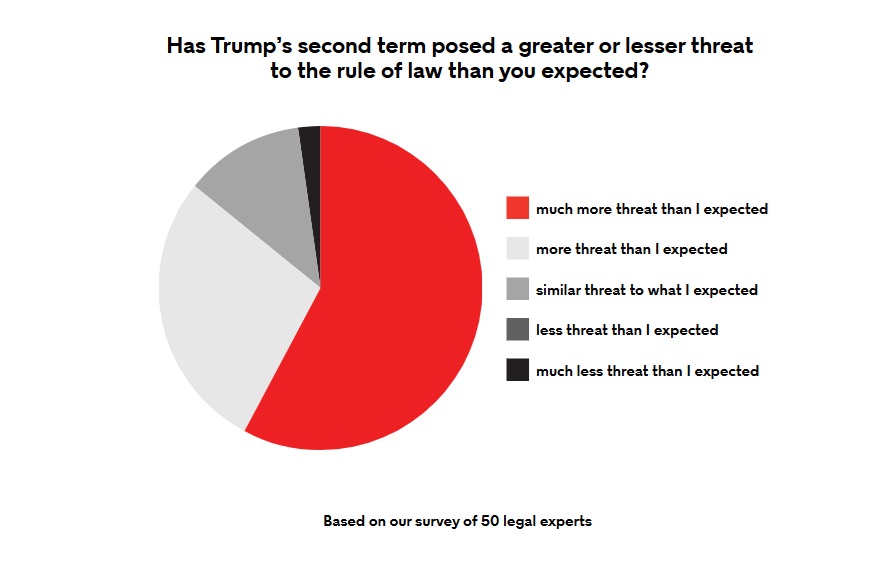
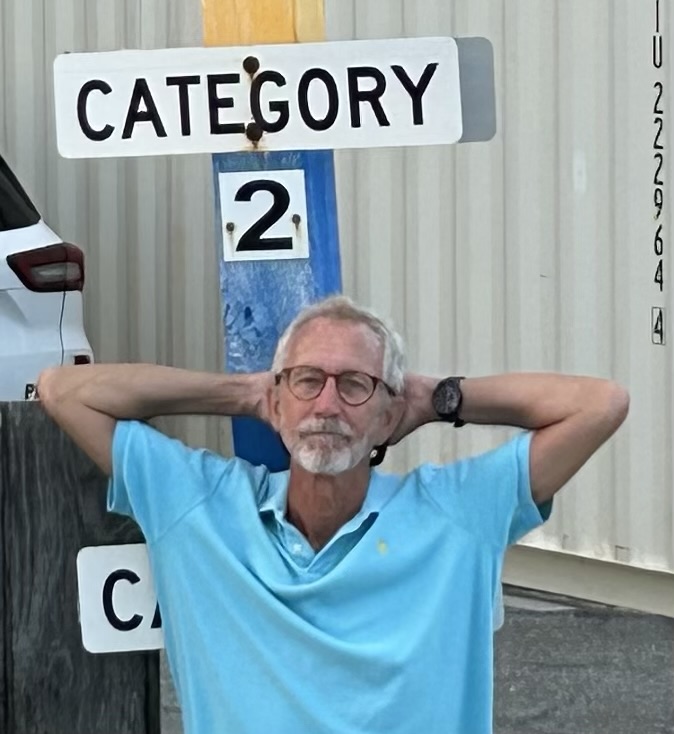
Standing by the storm surge pole on Tybee Island I got to thinking about how nice it would to have something like this to indicate the depth of political despair in the country right now.

This comes close from this mornings NYT article: We Asked 50 Legal Experts About the Trump Presidency Before the election, we surveyed the legal establishment about what a second Trump term could mean for the rule of law. A year later, they’re very, very worried.

For some things …

there are no wrong seasons.

Which is what I dream of for me

10.5.2025 – she predicts either

she predicts either
a war or the end of the
world in October

I know how she feels.

So I had to add another “a” to make it work.

Thurber, depending on the time of day, might have forgiven me.

More Thurber here at formuggsandrex.com.

Reading some odd stuff online I came across in review of the book of Thurber Letters titled The Thurber Letters: The Wit, Wisdom and Surprising Life of James Thurber , edited by Harrison Kinney,

In a reviewer states, Thurber never warmed to William Shawn.

Shawn took over as Editor of the New Yorker when Harold Ross died.

I also recently came across the fact that after three years, Shawn dropped out of the University of Michigan and went to New York to find his fortune.

Thurber never graduated from Ohio State after being a student there for five years.

Both institutions wrestled with how to handle these famous but non-degree holding alums.

But did it also sprout the roots of a non-working relationship?

Some one’s PhD dissertation is waiting to be written.