Down and out semi poet who is down and out in the Low Country of South Carolina after living in Atlanta which is not to be confused with the south, the old south or the new south. Atlanta was a global metropolis with all the pluses and minuses that comes with that. The low country, low because it is low, 8 feet above sea level, is not Podunk but once you get to Podunk, turn left. I try to chronicle a small part of all that through my daily haiku for you.
indifferent to suffering makes the human being inhuman
Based on the passage:
In a way, to be indifferent to that suffering is what makes the human being inhuman. Indifference, after all, is more dangerous than anger and hatred. Anger can at times be creative. One writes a great poem, a great symphony. One does something special for the sake of humanity because one is angry at the injustice that one witnesses. But indifference is never creative. Even hatred at times may elicit a response. You fight it. You denounce it. You disarm it.
Indifference elicits no response. Indifference is not a response. Indifference is not a beginning; it is an end. And, therefore, indifference is always the friend of the enemy, for it benefits the aggressor — never his victim, whose pain is magnified when he or she feels forgotten. The political prisoner in his cell, the hungry children, the homeless refugees — not to respond to their plight, not to relieve their solitude by offering them a spark of hope is to exile them from human memory. And in denying their humanity, we betray our own.
Indifference, then, is not only a sin, it is a punishment.
From the address, The Perils of Indifference delivered 12 April 1999, White House, Washington, D.C. by Elie Wiesel.
escape the nightmare, to rescue democracy, the tyrant must fall
For the sake of their friends, for the sake of global order, for their own sanity, the US’s silenced majority must now move with speed, determination, unity – and, if required, an unaccustomed degree of constitutional flexibility – to curtail his despotic reign before matters deteriorate further.
Citizens of the Republic! Impeach Trump. Declare him unfit. Rise up, rebel and overthrow him as, 250 years ago, George III was overthrown. Do whatever you must to peacefully rid the world of this gaudy, gormless usurper and dethrone this would-be king – but do it fast. Spike his guns. Shut him down. Lock him up. Exorcise the monster.
Since 1945, Americans have assumed the role of global freedom’s standard-bearer. Now they must liberate themselves. The US in 2026 requires a second revolution. To escape the nightmare, to rescue democracy, to rebuild the city on the hill, the tyrant must fall.
So writes Simon Tisdall, the Guardian foreign affairs commentator. He is a former Guardian foreign editor, US editor, White House correspondent, foreign leader writer and Observer foreign affairs commentator.
then I say, let your life be a counter-friction to stop the machine
Adapted from the passage:
If the injustice has a spring, or a pulley, or a rope, or a crank, exclusively for itself, then perhaps you may consider whether the remedy will not be worse than the evil;
but if it is of such a nature that it requires you to be the agent of injustice to another, then, I say, break the law. Let your life be a counter-friction to stop the machine.
From the essay, Civil Disobedience By Henry David Thoreau as printed in The works of Thoreau by Henry David Thoreau (Houghton Mifflin Company: Boston, 1937).
better to have large millstone around neck and be drowned in depths of sea
I grew up in the Baptist Evangelical Church.
Church on Sunday at 9:30 am for Sunday School, Morning service at 10:45 am and Evening church at 7 p.m.
Youth group / Awana on Monday.
Tuesday After School Bible Club on Tuesday after school.
Children’s Choir and Prayer Meeting on Wednesday.
If there was one thing stressed for kids at my Church is was the love of Christ, not just for everyone, but for children, the little children in particular.
It was comforting to know that Jesus liked kids.
When I was 9, I was called in front of the assembled Church body and awarded a Bible for a year of perfect Sunday Scholl attendance.
You got a Bible your first year and a pin to wear for the 2nd year.
The little round pin had an opening to display the 2 and after that you got little gold disks to swap in the 3 and so on.
We had a drawer full of pins at home.
It seems to me that my sister Lisa was the only person anyone knew who got into double digits for years of perfect attendance. That didn’t take into account my Uncle Bud whose had perfect his attendance starting in around 1920 until something called World War 2 came along.
I still have my Bible.
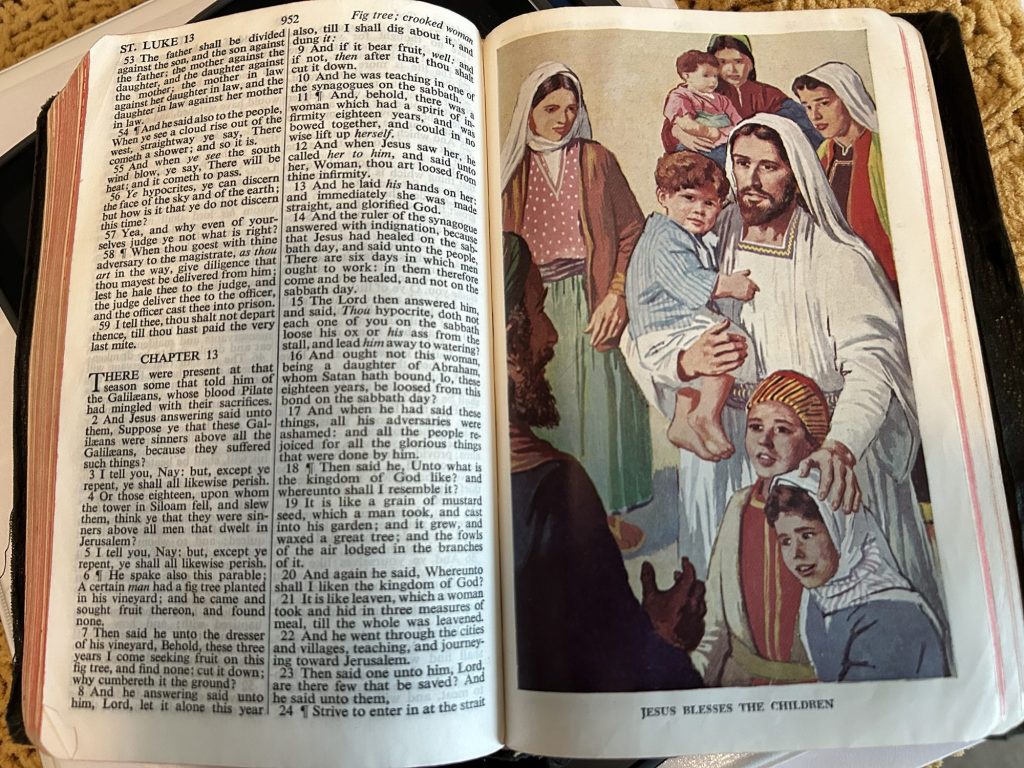
It was King James English of course and it had a few illustrations scattered through its pages.
One of those illustrations was captioned Jesus Blesses the Children.
That scene in the Bible where Jesus blesses the children appears in the New Testament right after another important passage about Jesus and children.
That passage in Matthew, Chapter 18 is an analogy, a promise and … a warning.
He called a little child to him, and placed the child among them.
And he said: “Truly I tell you, unless you change and become like little children, you will never enter the kingdom of heaven.
Therefore, whoever takes the lowly position of this child is the greatest in the kingdom of heaven.
And whoever welcomes one such child in my name welcomes me.
“If anyone causes one of these little ones — those who believe in me — to stumble, it would be better for them to have a large millstone hung around their neck and to be drowned in the depths of the sea.
The analogy is “Truly I tell you, unless you change and become like little children, you will never enter the kingdom of heaven.”
The promise is “… whoever takes the lowly position of this child is the greatest in the kingdom of heaven.“
And the warning is “If anyone causes one of these little ones — those who believe in me — to stumble, it would be better for them to have a large millstone hung around their neck and to be drowned in the depths of the sea.“
With little effort I can bring up in my mind the way my Sunday School Teachers, my Tuesday Bible Club leader and others stressed it would be better to have a millstone … a millstone … A MILLSTONE … around your neck then to have harmed little children.
The point they were making was that Jesus loved children and that meant God loved children.
We were children and we were loved.
And BEWARE anyone who harmed any child.
Now there are those who will say I am misapplying the meaning of the verse but let me tell you something, that with a millstone around my neck being on the line, I will err on the side of caution rather than the idea that I can explain my way out of a millstone around my neck by citing chapter, verse and my notes on biblical application.
A point of view is one thing.
A millstone around my neck is another.
I had no problem visualizing a millstone.
Back in the day on lazy Sunday Afternoons, we would pester my Dad to take to downtown to the old Grand Rapids Public Museum.
The one on Jefferson Street that is now the Grand Rapids City Archives.
When we went, Dad would always park on Washington Street and we would go in by the back entrance.
Along Washington Street were these large round planters … or what I took to be planters as they were giant round stones with a hole in the middle and plants growing out of the hole.
But these planters had a plaque mounted on the side.
It read something like First Millstones brought to Grand Rapids by Louis Campau in 1845.
That isn’t the exact wording but they were the first millstones ever used in the City and the Museum just parked them outside.
I mean, who was going to steal them?
The must have weighed a ton.
I remember one time Dad explained how the millstones were used, powered by a water wheel and they ground wheat into flour.
We looked at them for a bit and Dad said, “Imagine having one of those around your neck.“
He said it a tone of wonderment.
He needed no further explanation.
He had also grown up in the Baptist Church.
And when we heard those stories about millstones, we knew just what Jesus had in mind.
So that leads me to today.
For myself, the warning is pretty clear.
“If anyone causes one of these little ones — those who believe in me — to stumble, it would be better for them to have a large millstone hung around their neck and to be drowned in the depths of the sea.“
Seems pretty cut and dried here.
So I have to ask?
Who would sign up for this?
When you are looking at a situation where it is better to have a millstone around your neck is offered and directions to the nearest boat is pointed out, who says, ME FIRST!
They are looking at a choice for themselves where the millstone IS the good choice.
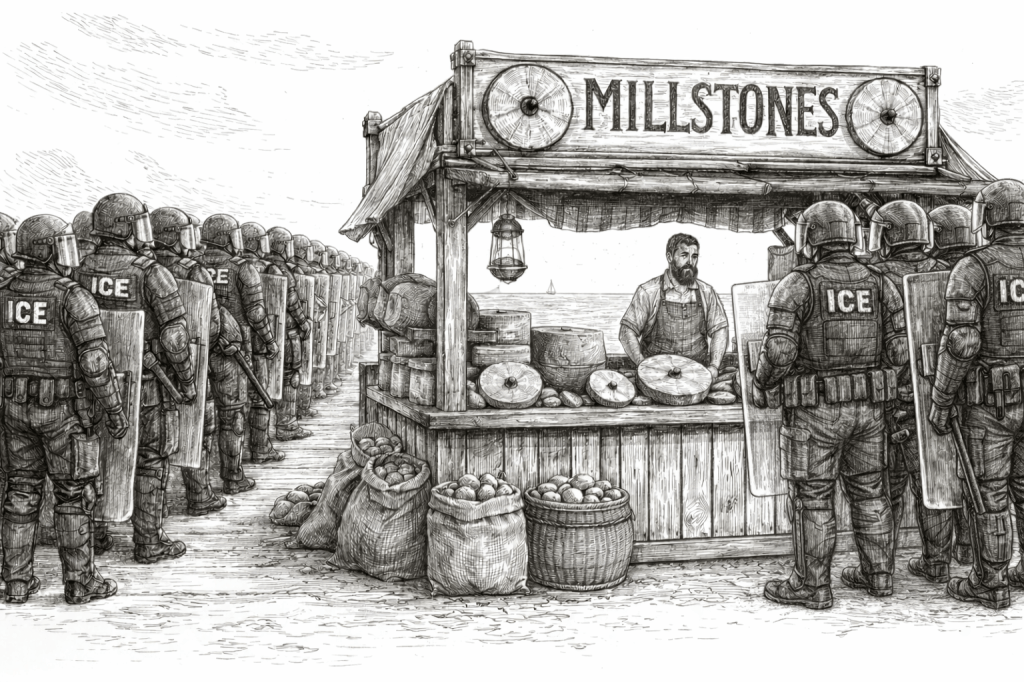
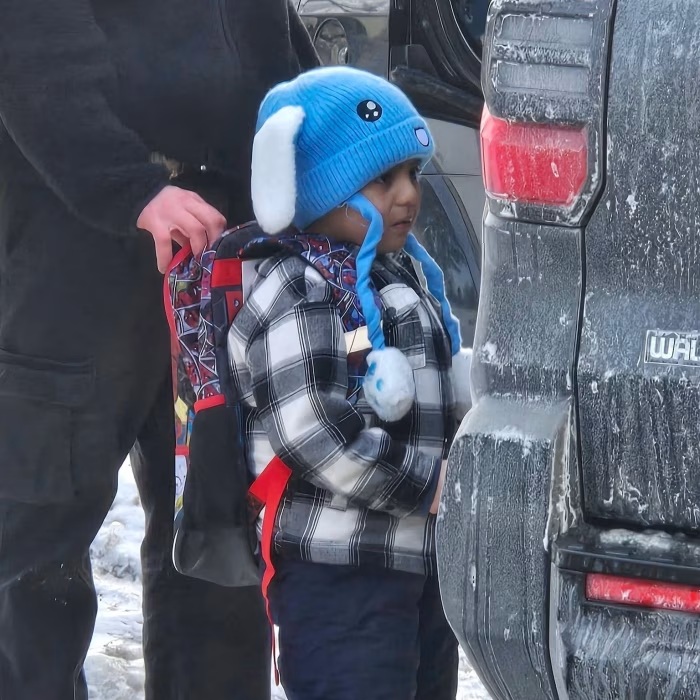
I look at the picture above and I can see millstones around the necks of all those officers.
How can they not see it?
How can they participate in a scene like that and sleep at night?
I cannot understand that for the life or me or for the life of those officers as well.
Where do they find these people?
I will also point out that there is further warning in the next verse.
Woe to the world because of the things that cause people to stumble!
A warning for all people, including me for letting such a world exist.
crises happening contemporaneously their effects pile up
Reading the Guardian this morning, I came across this headline, “We are living in a time of polycrisis. If you feel trapped – you’re not alone” and the article written by Theresa MacPhail, a science writer, medical anthropologist and associate professor of Science, Technology & Society at Stevens Institute of Technology.
The article had the sub headline, “I hadn’t fully grasped how the idea of a better future sustained me – now I, like many others, find it difficult to be productive”
Ms. MacPhail quotes a Dr Hal Hershfield, a psychologist and professor of marketing and behavioral decision-making at UCLA.
“What feels very different in the present moment,” Hershfield said, “is that it feels like it’s coming from multiple fronts. It’s everything from political uncertainty in the US and elsewhere, health insecurity from the very fresh memory of a global pandemic, job insecurity from AI, geopolitical insecurity, to environmental insecurity.”
And Ms. MacPhail writes:
All these crises are happening contemporaneously, and because they interact with each other, their effects pile up. Social scientists refer to these stacked crises as a polycrisis. During a polycrisis, radical uncertainty becomes rife.
The lack of predictability creates more doubt about the future, which blocks our ability to imagine ourselves in it. In a recent study, participants were asked to write down as many future possible events for themselves as they could. Those who were reminded that the future is uncertain produced 25% fewer possible events than control subjects and took much longer on the task. They also rated their thoughts as less reliable. Just thinking about uncertainty made it more difficult for them to remember all their hopes and plans.
Just thinking about uncertainty made it more difficult for them to remember all their hopes and plans.
All these crises are happening contemporaneously, and because they interact with each other, their effects pile up.
Social scientists refer to these stacked crises as a polycrisis.
During a polycrisis, radical uncertainty becomes rife.
Radical uncertainty.
Created by leadership based on buffoonery.
NO KIDDING.
For me, the good news is that I AM NOT ALONE.
Even for those who somehow find it in themselves to support this administration the radical uncertainty is no less real.
For all of us, all these crises are happening contemporaneously, and because they interact with each other, their effects pile up.
To hold out a ray of hope, Ms. MacPhail closes with:
As a new year begins, it’s good to remember that we are more resilient than we think.
“People are not the fragile flowers that a century of psychologists have made us out to be,” Gilbert said. “People who suffer real tragedy and trauma typically recover more quickly than they expect to and often return to their original level of happiness, or something close to it. That’s the good news – we are a hardy species, even though we don’t know this about ourselves.
For myself …
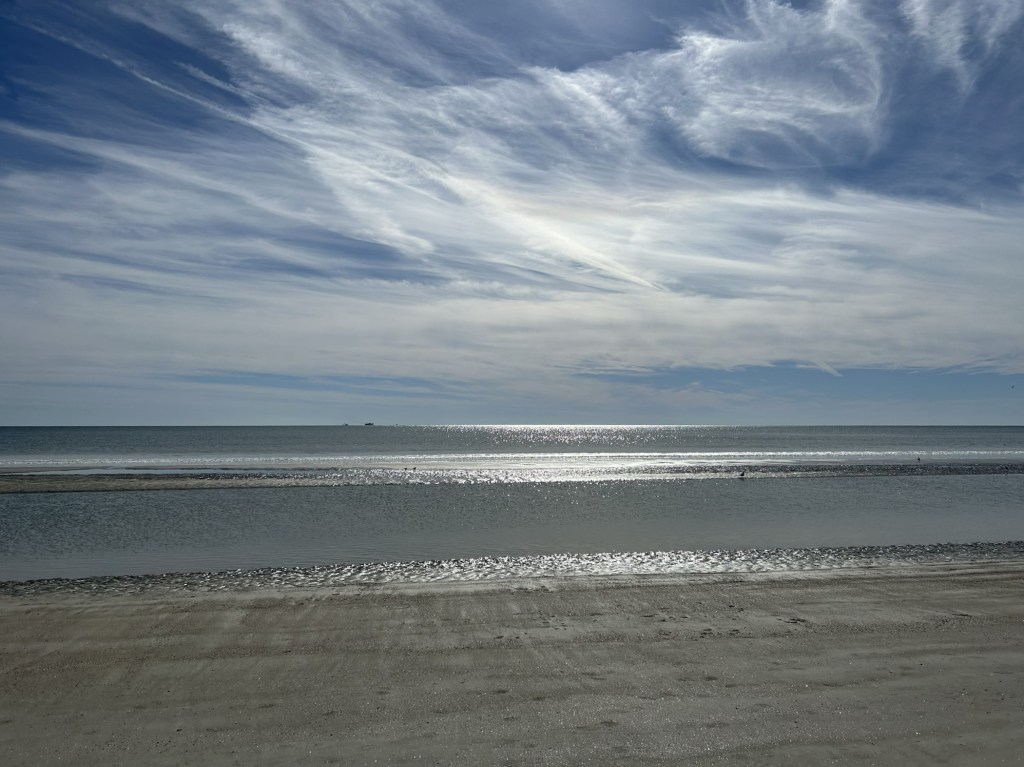
I stand on the beach and I am remined of Mr. Thoreau when the essay Cape Cod, he wrote:
The sea-shore is a sort of neutral ground, a most advantageous point from which to contemplate this world.
Thinking of that, watching the tide come in, all the polycrises in the world cannot stop it.
Twice a day that tide is coming and anything in its path will be wiped away.
It happened the day after creation, twice a day.
It will happen twice today.
And it will happen on the last day when ever that is.



 No Haiku For You