
freedom, basic things
speech, worship, from want, from fear
any, everywhere
For there is nothing mysterious about the foundations of a healthy and strong democracy. The basic things expected by our people of their political and economic systems are simple. They are:
Equality of opportunity for youth and for others.
Jobs for those who can work.
Security for those who need it.
The ending of special privilege for the few.
The preservation of civil liberties for all.
The enjoyment of the fruits of scientific progress in a wider and constantly rising standard of living.
These are the simple, basic things that must never be lost sight of in the turmoil and unbelievable complexity of our modern world. The inner and abiding strength of our economic and political systems is dependent upon the degree to which they fulfill these expectations.
In the future days, which we seek to make secure, we look forward to a world founded upon four essential human freedoms.
The first is freedom of speech and expression – everywhere in the world.
The second is freedom of every person to worship God in his own way – everywhere in the world.
The third is freedom from want – which, translated into world terms, means economic understandings which will secure to every nation a healthy peacetime life for its inhabitants – everywhere in the world.
The fourth is freedom from fear – which, translated into world terms, means a world-wide reduction of armaments to such a point and in such a thorough fashion that no nation will be in a position to commit an act of physical aggression against any neighbor – anywhere in the world.
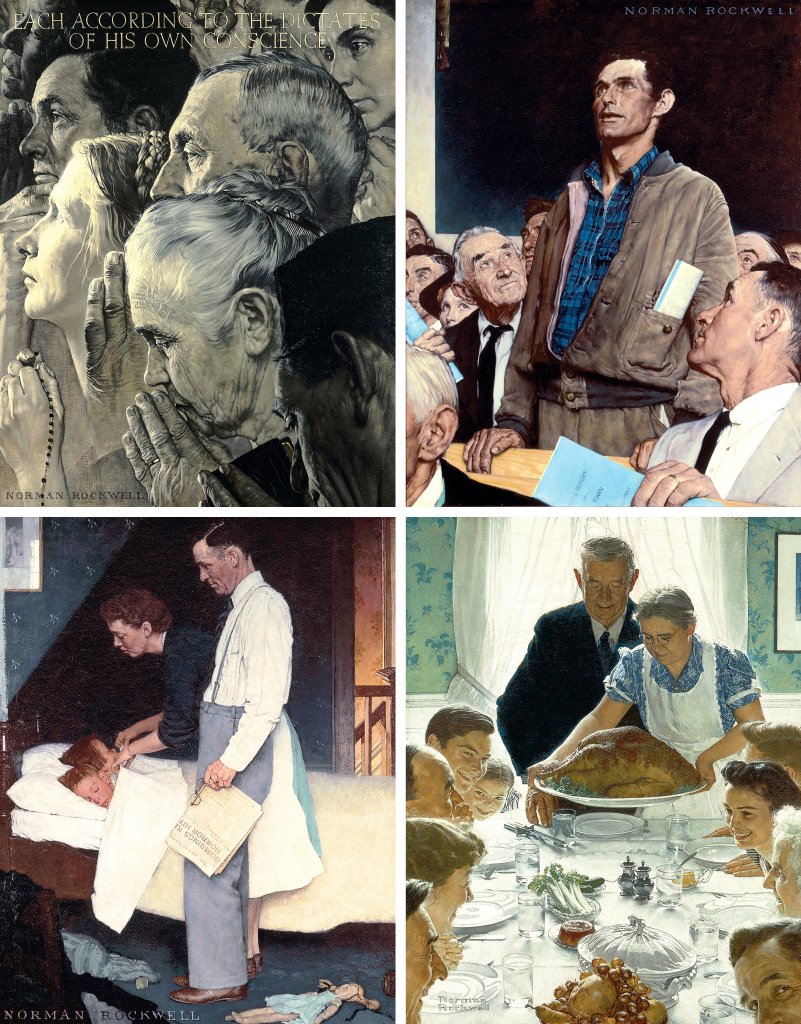
According to Wikipedia:
The Four Freedoms is a series of four oil paintings made in 1943 by the American artist Norman Rockwell. The paintings—Freedom of Speech, Freedom of Worship, Freedom from Want, and Freedom from Fear and are now in the Norman Rockwell Museum in Stockbridge, Massachusetts. The four freedoms refer to President Franklin D. Roosevelt’s January 1941 Four Freedoms State of the Union address, in which he identified essential human rights that should be universally protected. The theme was incorporated into the Atlantic Charter, and became part of the Charter of the United Nations. The paintings were reproduced in The Saturday Evening Post over four consecutive weeks in 1943, alongside essays by prominent thinkers of the day. They became the highlight of a touring exhibition sponsored by The Post and the U.S. Department of the Treasury. The exhibition and accompanying sales drives of war bonds raised over $132 million.
These are among his best-known works, and by some accounts became his most widely distributed paintings. At one time they were commonly displayed in post offices, schools, clubs, railroad stations, and a variety of public and semi-public buildings.
These are the simple, basic things that must never be lost sight of in the turmoil and unbelievable complexity of our modern world.
The inner and abiding strength of our economic and political systems is dependent upon the degree to which they fulfill these expectations.
They are simple, basic things.
In the future days, which we seek to make secure, we look forward to a country and a world founded upon these four essential human freedoms.
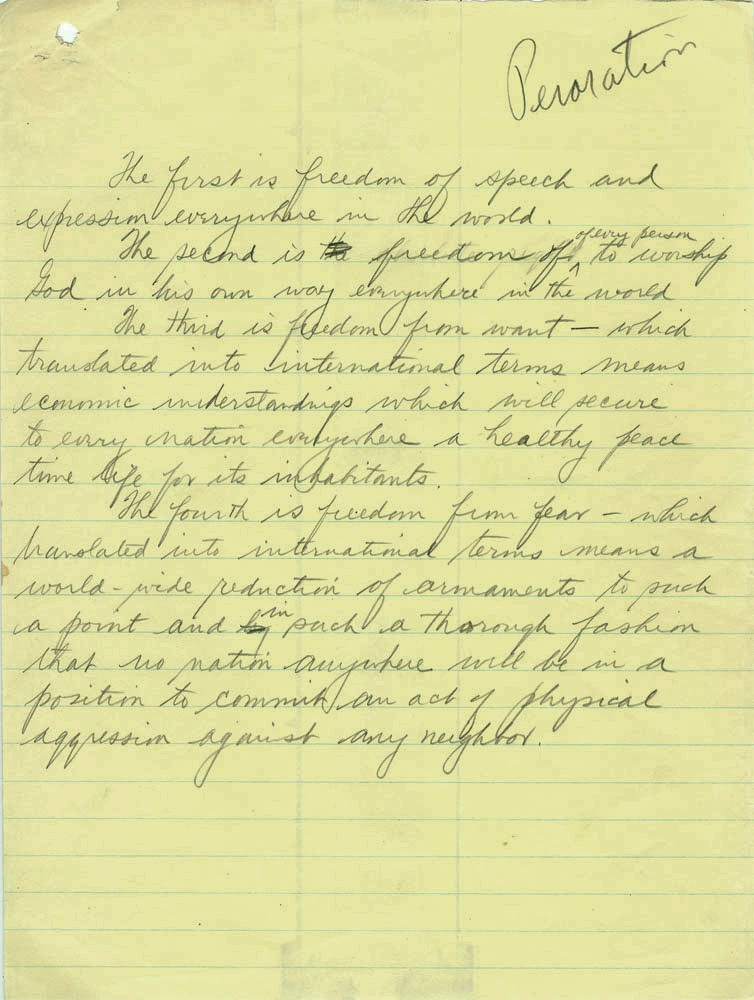
This a page of the draft of the speech as written by FDR speech writer, Judge Samuel I. Rosenman.
According to reports, FDR listened to a speech by Mr. Churchill and remarked that it was a great speech and he told his team something along the lines of, “Find out who writes his stuff.”
 No Haiku For You