
crises happening
contemporaneously
their effects pile up
Reading the Guardian this morning, I came across this headline, “We are living in a time of polycrisis. If you feel trapped – you’re not alone” and the article written by Theresa MacPhail, a science writer, medical anthropologist and associate professor of Science, Technology & Society at Stevens Institute of Technology.
The article had the sub headline, “I hadn’t fully grasped how the idea of a better future sustained me – now I, like many others, find it difficult to be productive”
Ms. MacPhail quotes a Dr Hal Hershfield, a psychologist and professor of marketing and behavioral decision-making at UCLA.
“What feels very different in the present moment,” Hershfield said, “is that it feels like it’s coming from multiple fronts. It’s everything from political uncertainty in the US and elsewhere, health insecurity from the very fresh memory of a global pandemic, job insecurity from AI, geopolitical insecurity, to environmental insecurity.”
And Ms. MacPhail writes:
All these crises are happening contemporaneously, and because they interact with each other, their effects pile up. Social scientists refer to these stacked crises as a polycrisis. During a polycrisis, radical uncertainty becomes rife.
The lack of predictability creates more doubt about the future, which blocks our ability to imagine ourselves in it. In a recent study, participants were asked to write down as many future possible events for themselves as they could. Those who were reminded that the future is uncertain produced 25% fewer possible events than control subjects and took much longer on the task. They also rated their thoughts as less reliable. Just thinking about uncertainty made it more difficult for them to remember all their hopes and plans.
Just thinking about uncertainty made it more difficult for them to remember all their hopes and plans.
All these crises are happening contemporaneously, and because they interact with each other, their effects pile up.
Social scientists refer to these stacked crises as a polycrisis.
During a polycrisis, radical uncertainty becomes rife.
Radical uncertainty.
Created by leadership based on buffoonery.
NO KIDDING.
For me, the good news is that I AM NOT ALONE.
Even for those who somehow find it in themselves to support this administration the radical uncertainty is no less real.
For all of us, all these crises are happening contemporaneously, and because they interact with each other, their effects pile up.
To hold out a ray of hope, Ms. MacPhail closes with:
As a new year begins, it’s good to remember that we are more resilient than we think.
“People are not the fragile flowers that a century of psychologists have made us out to be,” Gilbert said. “People who suffer real tragedy and trauma typically recover more quickly than they expect to and often return to their original level of happiness, or something close to it. That’s the good news – we are a hardy species, even though we don’t know this about ourselves.
For myself …
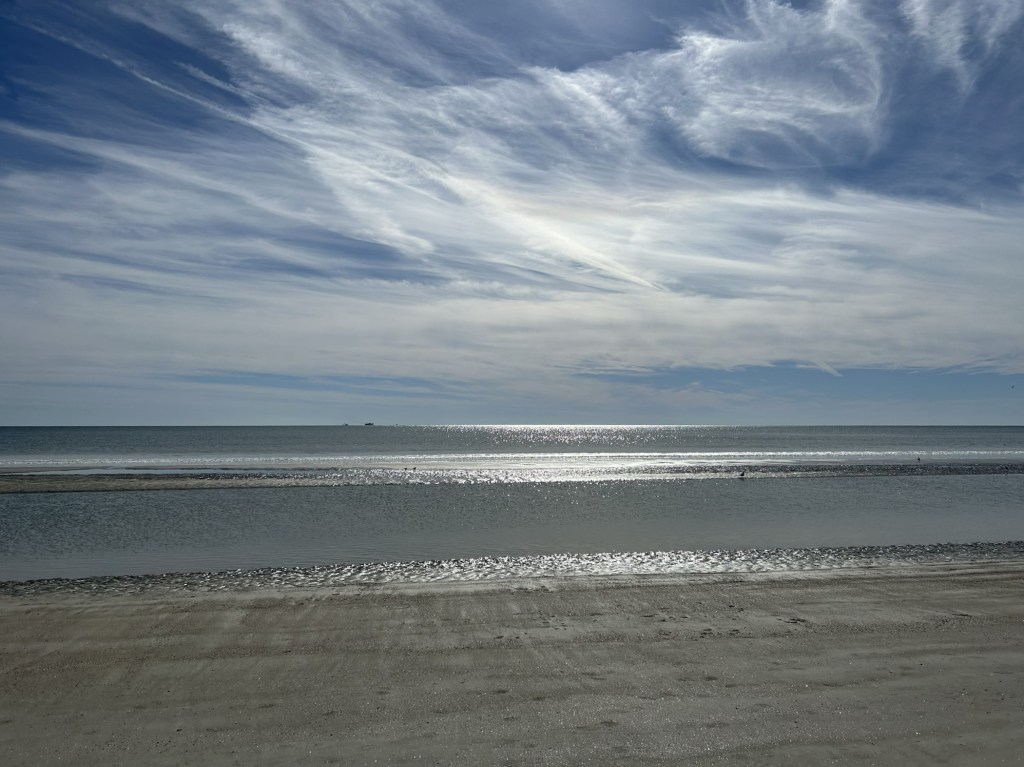
I stand on the beach and I am remined of Mr. Thoreau when the essay Cape Cod, he wrote:
The sea-shore is a sort of neutral ground, a most advantageous point from which to contemplate this world.
Thinking of that, watching the tide come in, all the polycrises in the world cannot stop it.
Twice a day that tide is coming and anything in its path will be wiped away.
It happened the day after creation, twice a day.
It will happen twice today.
And it will happen on the last day when ever that is.
 No Haiku For You