unique and complex don’t know that you can prepare for something like this
“Unique and complex, obviously,” Poggi responded. “Multiple levels of complexity that our young people are dealing with and our university is dealing with, our athletic director, Warde Manuel, is dealing with. And our team, our coaches and our kids. I don’t know that you can prepare for something like this.”
was without Christmas spirit – the world that used to nurse us keeps shouting
I was without Christmas spirit so I made three cow dogs, Lola and Blacky and Pinto, cheeseburgers with ground chuck and French St. André cheese so that we’d all feel better. I delivered them to Hard Luck Ranch and said, “Chew each bite 32 times.” They ignored me and gobbled. The world that used to nurse us now keeps shouting inane instructions. That’s why I ran to the woods.
Xmas Cheeseburgers by Jim Harrison in Songs of Unreason as published in the Complete Poems of Jim Harrison (Copper Canyon Press: Port Townsend, WA 2021).
The world that used to nurse us now keeps shouting inane instructions. That’s why I ran to the woods.
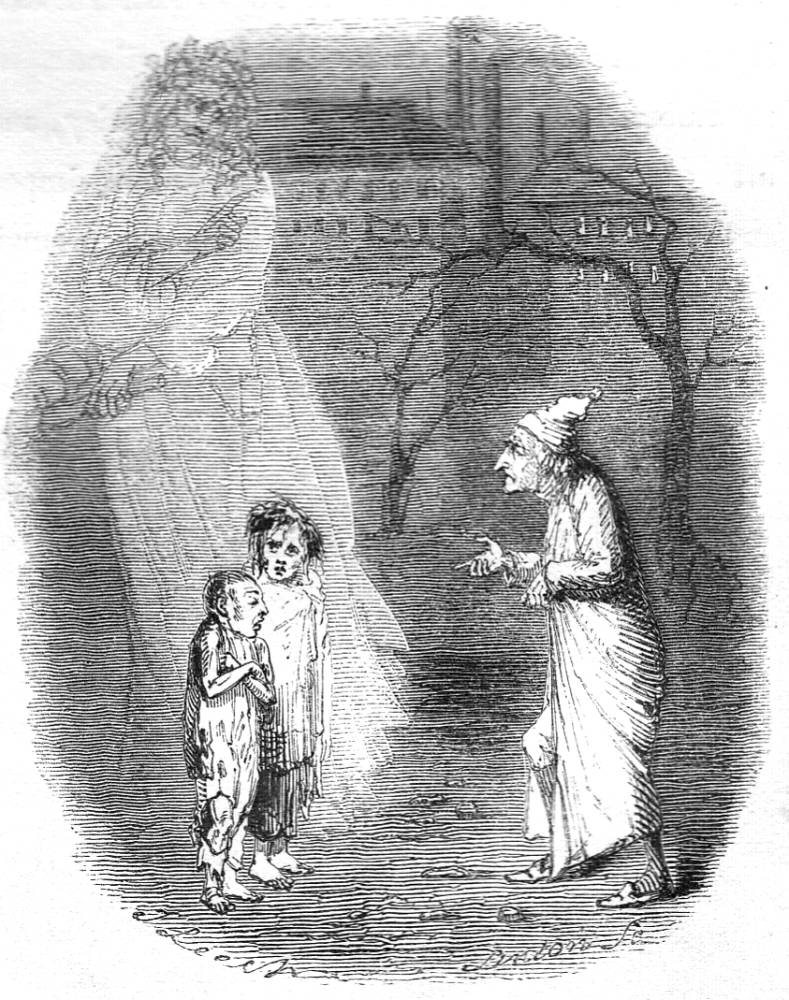
From the foldings of its robe, it brought two children; wretched, abject, frightful, hideous, miserable. They knelt down at its feet, and clung upon the outside of its garment.
“Oh, Man! look here. Look, look, down here!” exclaimed the Ghost.
They were a boy and girl. Yellow, meagre, ragged, scowling, wolfish; but prostrate, too, in their humility. Where graceful youth should have filled their features out, and touched them with its freshest tints, a stale and shrivelled hand, like that of age, had pinched, and twisted them, and pulled them into shreds. Where angels might have sat enthroned, devils lurked, and glared out menacing. No change, no degradation, no perversion of humanity, in any grade, through all the mysteries of wonderful creation, has monsters half so horrible and dread.
Scrooge started back, appalled. Having them shown to him in this way, he tried to say they were fine children, but the words choked themselves, rather than be parties to a lie of such enormous magnitude.
“Spirit! are they yours?” Scrooge could say no more.
“They are Man’s,” said the Spirit, looking down upon them. “And they cling to me, appealing from their fathers. This boy is Ignorance. This girl is Want. Beware them both, and all of their degree, but most of all beware this boy, for on his brow I see that written which is Doom, unless the writing be erased. Deny it!” cried the Spirit, stretching out its hand towards the city. “Slander those who tell it ye! Admit it for your factious purposes, and make it worse. And bide the end!”
“Have they no refuge or resource?” cried Scrooge.
“Are there no prisons?” said the Spirit, turning on him for the last time with his own words. “Are there no workhouses?”
The bell struck twelve.
A Christmas Carol by Charles Dickens (Chapman and Hall: London, 1843).
hope everlasting peace bliss except inventor of the telephone
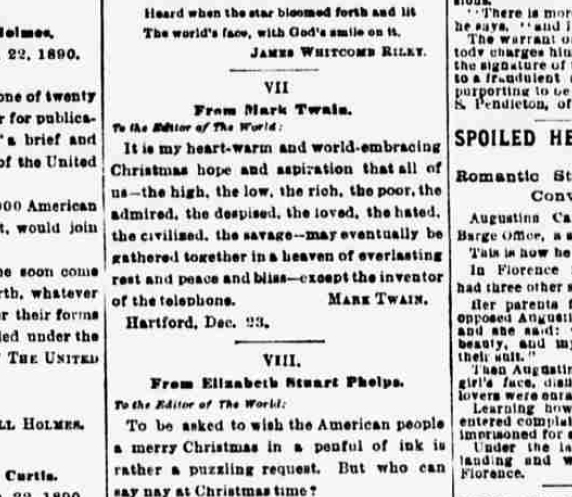
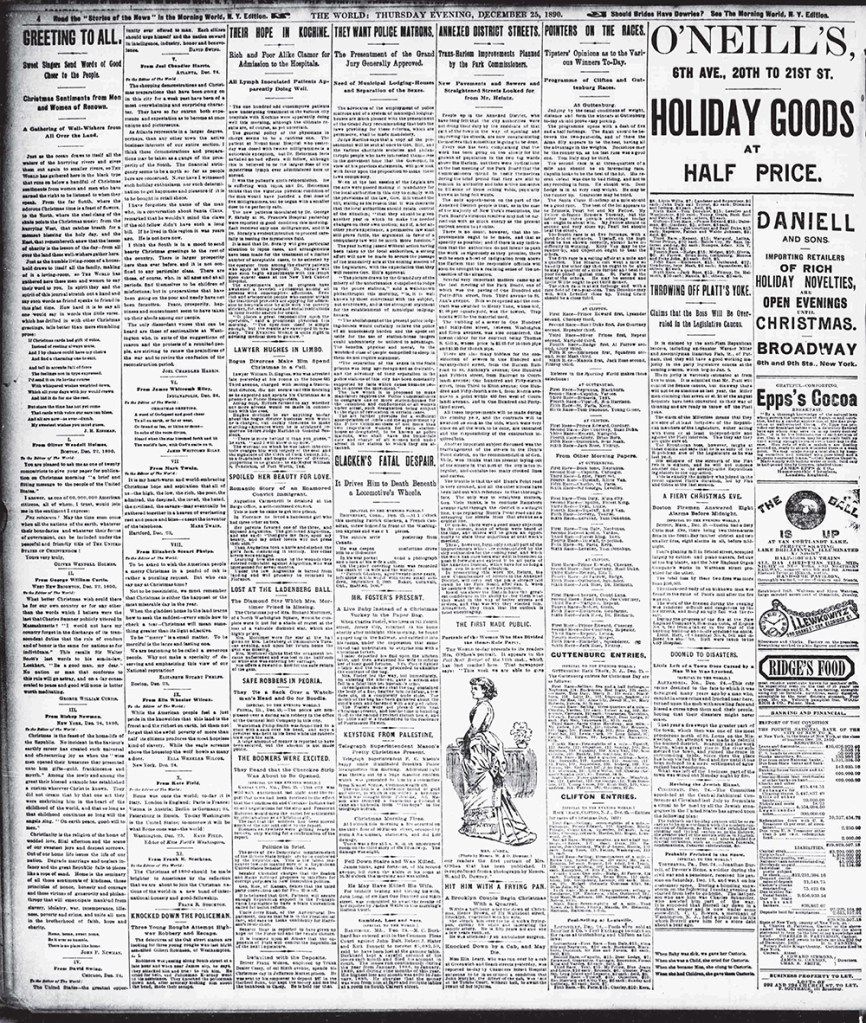
In 1890, the Editors or somebody at the New York Evening World, reached out to some of the literary notables of the time, Oliver Wendall Holmes, James Whitcomb Riley and others, requesting a thought or two about Christmas.
The responses were printed in the Newspaper on Christmas Day, 1890 under the slug lines:
GREETING TO ALL
Sweet Singers Send Words of Cheer to the People
Christmas Sentiments from Men and Women of Renown
Gathering of Well-Wishers from All Over the Land.
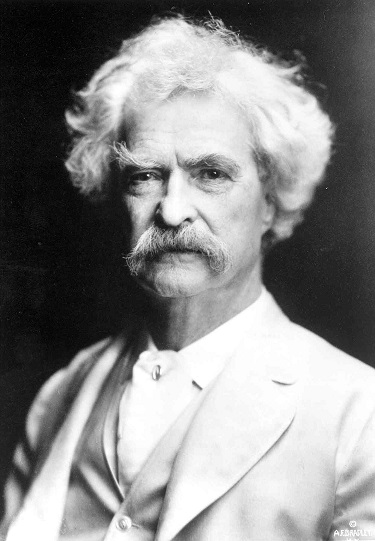
Mark Twain sent in this response.
“It is my heart-warm and world-embracing Christmas hope and aspiration that all of us –
the high,
the low,
the rich,
the poor,
the admired,
the despised,
the loved,
the hated,
the civilized,
the savage –
may-eventually be gathered together in heaven of everlasting rest and peace and bliss-
more importantly what do you believe? and what … what will you become
“To be able to tap into that source, that part of who you are that transcends thinking — that’s what I’m talking about. We’ve all done it; we’ve all seen it. Faith is belief without proof. Something deeper than your own thoughts. Giving your all, win, lose, or draw—that takes some version of faith, whatever that means to you. And sometimes that faith is the only way you’re going to win that game, or the only way you’re going to get that contract. It’s the only way to reach a new level of excellence. So I ask you: What is your big dream? More importantly, what do you believe? And what will you become?”
Excerpt From Stay Sane in an Insane World: How to Control the Controllables and Thrive by Greg Harden.
Greg Harden was known as Michigan’s Secret Weapon.
According to Wikipeda, Assoc Athletic Director Harden was best known for his work with 7-time Super Bowl champion quarterback Tom Brady. He also worked with Heisman Trophy winner and Super Bowl MVP Desmond Howard, and 23-time Olympic gold medalist Michael Phelps. Brady, Howard, and other athletes credit Harden with inspiring them to overcome obstacles and achieve success in their professional and personal lives.
Harden began work as a student-athlete counselor in 1986 when Michigan football coach Bo Schembechler brought him in after hearing of the work Harden was doing in Ypsilanti, helping people deal with the challenges of everyday life and work. In the years since, Harden has been named associate Athletic Director and Director of Athletic Counseling for the University of Michigan Athletic Department.
Sorry to say that Dr. Harden died a year ago.
Seems like his role and importance in that athletic program, was somehow, greatly underestimated.
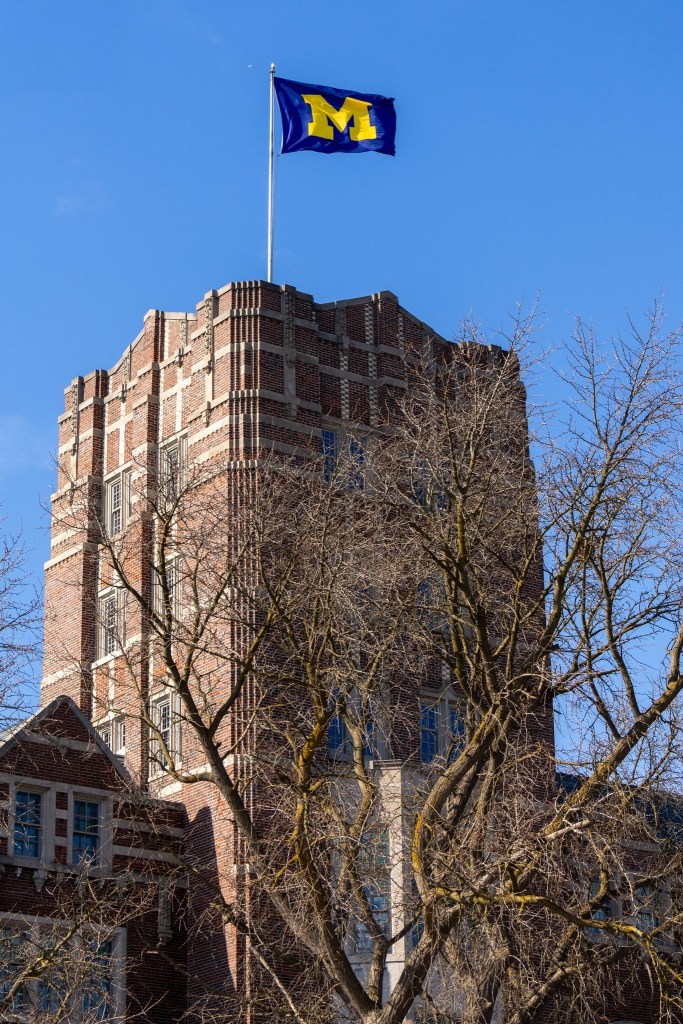
When I was a student, I had one Art History Professor who could not resist a Monday morning comment about that weekends game.
One week he approached the lectern and popped open a can of Coke and took a big swig, then said in a VERY HOARSE voice … “I mean really … 72 points.”
Then Michigan lost to that team down south.
This Professor stood at his lectern that next Monday and stared out at us a while then said, “It is good to remember there are all just kids like you.”
So I ask you: What is your big dream?
More importantly, what do you believe? And what will you become?”
And always remember, Whom the gods would destroy, they first make mad.
If lucky we may witness a spectacle vast elemental things
The shore means many things to many people. Of its varied moods the one usually considered typical is not so at all. The true spirit of the sea does not reside in the gentle surf that laps a sun-drenched bathing beach on a summer day. Instead, it is on a lonely shore at dawn or twilight, or in storm or midnight darkness that we sense a mysterious something we recognize as the reality of the sea. For the ocean has nothing to do with humanity. It is supremely unaware of man, and when we carry too many of the trappings of human existence with us to the threshold of the sea world our ears are dulled and we do not hear the accents of sublimity in which it speaks.
Sometimes the shore speaks of the earth and its own creation; sometimes it speaks of life. If we are lucky in choosing our time and place., we may witness a spectacle that echoes vast and elemental things. On a summer night when the moon is full., the sea and the swelling tide and creatures of the ancient shore conspire to work primeval magic on many of the beaches from Maine to Florida. On such a night the horseshoe crabs move in., just as they did under a Paleozoic moon — just as they have been doing through all the hundreds of millions of years since then — coming out of the sea to dig their nests in the wet sand and deposit their spawn.
From the article, Our Ever Changing Shore by Rachel Carson, in Holiday Magazine, July 1958 Volume 24 No. 1 as reprinted in Lost woods : the discovered writing of Rachel Carson, Edited by Linda J. Lear (Thorndike Press, Thorndike, Maine, 1999).



 No Haiku For You