telling myself, I was impressed, had to be some impression in it
Impressions of Sunrise over Hilton Head, 11/20/2205
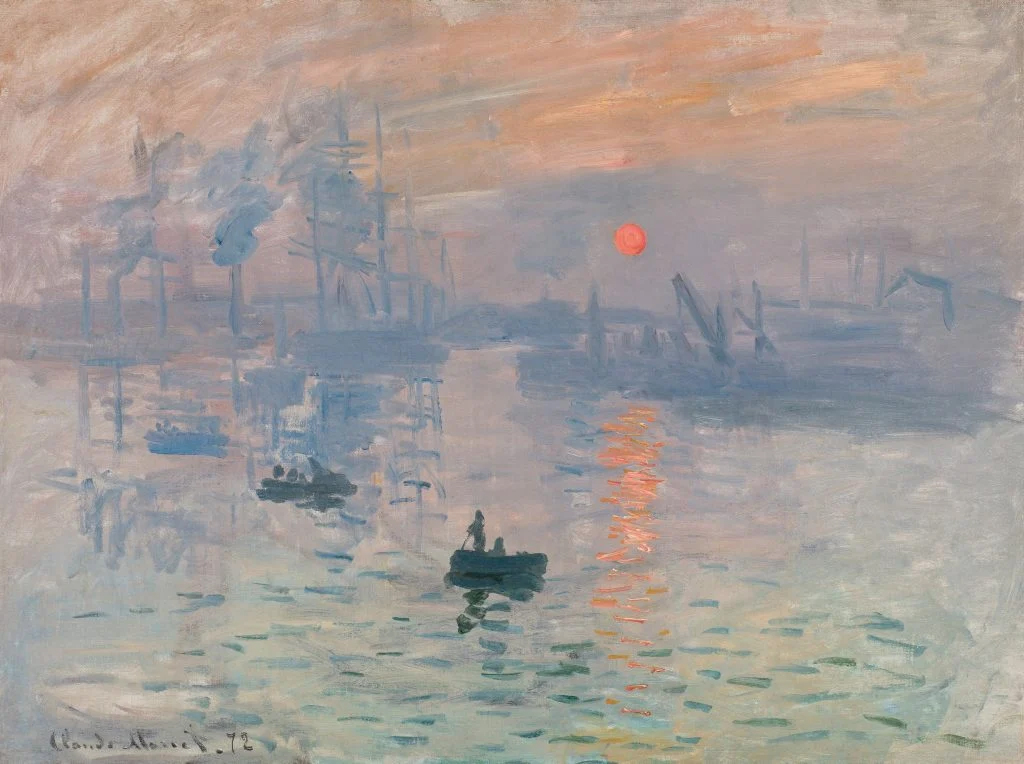
Impression I was certain of it. I was just telling myself that, since I was impressed, there had to be some impression in it — and what freedom, what ease of workmanship! A preliminary drawing for a wallpaper pattern is more finished than this seascape.
Louis Leroy’s review of the painting, Impression, Sunrise, was printed in Le Charivari on 25 April 1874.
Claude Monet, Impression, Sunrise (1872)
According to Wikipedia, While the movement and the painting initially garnered controversy, Monet’s Impression, Sunrise gave rise to the name and recognition of the Impressionist movement, arguably exemplifying more than any other work or artist the Impressionist movement as a whole in style, subject, and influence.
Driving to work this morning I could see the sunrise.
I was just telling myself that, since I was impressed, there had to be some impression in it.
dolphins had always believed far more intelligent for the same reasons
Sunrise over Skull Creek with dolphins mucking about unseen – but I know they’re there.
Adapted from the passage:
“For instance, on the planet Earth, man had always assumed that he was more intelligent than dolphins because he had achieved so much—the wheel, New York, wars and so on—whilst all the dolphins had ever done was muck about in the water having a good time. But conversely, the dolphins had always believed that they were far more intelligent than man—for precisely the same reasons.”
From The hitchhiker’s guide to the galaxy by Douglas Adams (New York : Pocket Books, 1985).
I had a ride to work this morning so instead of defending myself from drivers who are intent on killing me, I was able to look out the window.
When you ride to work in the Low Country of South Carolina you get to look out the window at water.
You get to look out the window at water and look for dolphins.
Sometimes you spot one or two or more as they muck about in the water having a good time.
They have such a good time that just to see them makes you feel better.
And sometimes, when I get a ride to work I can look out the window and see dolphins.
There are worse places to ride to work.
I got to thinking about dolphins.
They do not labor or spin.
They spend the lives not knowing about borders, taxes, politicians, jobs or NFL Referees.
You know what?
I do believe that they ARE far more intelligent than man.
democracy most fragile thing on earth, it rests upon you and me
Democracy is the most fragile thing on earth, for what does it rest upon?
You and me, and the fact that we agree to maintain it.
The moment either of us says we will not, that’s the end of it.
It doesn’t rest on anything but us; it doesn’t rest on armed force, the moment it does it isn’t democracy.
It isn’t something to kick around or experiment with.
From the preface page to the 2017 Edition of the book, Advise and Consent by Allan Drury (WordFire Press: Colorado Springs, Colorado , 2017).
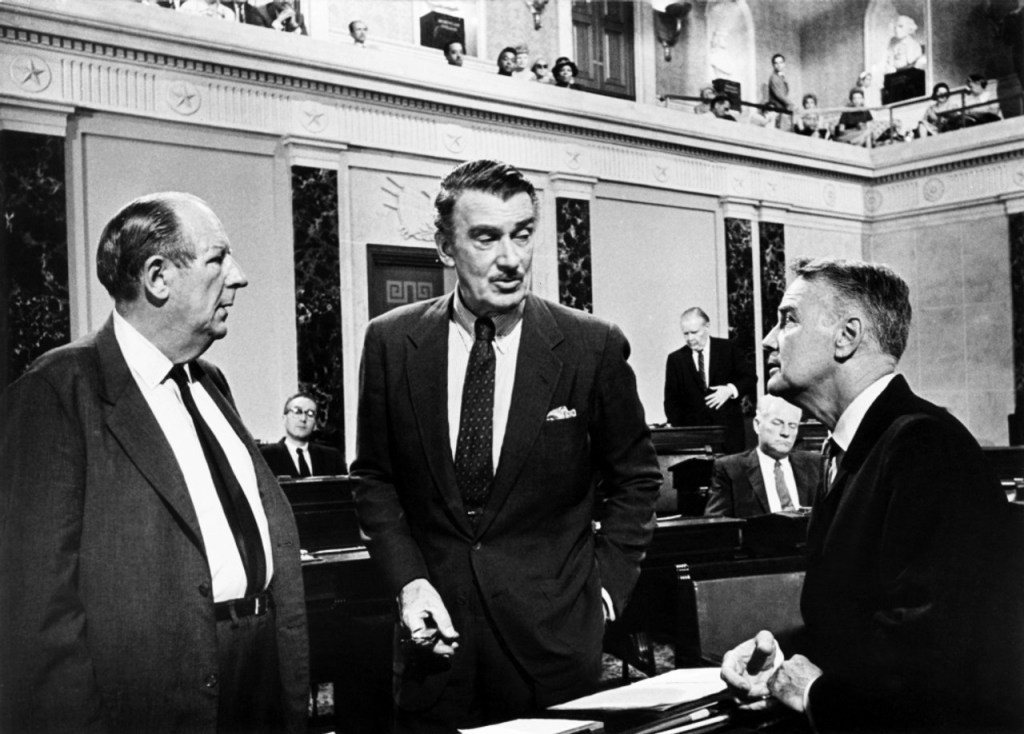
Advise and Consent is one of those books AND film adaptations that I can read or watch again and again.
Watching the movie today I have to laugh the Minority Whip of the Senate arrives a the Capitol Building in a cab, walks to a news stand and buys and paper and only then learns what the President did overnight.
In today’s instant news coverage, I marvel that anything got done back in 1959.
I mean the poor guy woke up, got dressed, had breakfast and got to work before he had any news on which to plan his day.
According to Wikipedia, “Advise and Consent is a 1959 political fiction novel by Allen Drury that explores the United States Senate confirmation of controversial Secretary of State nominee Robert Leffingwell, whose promotion is endangered due to growing evidence that the nominee had been a member of the Communist Party. The chief characters’ responses to the evidence, and their efforts to spread or suppress it, form the basis of the novel.”
A Mr. Tom Kemme, in his book, Political fiction, the spirit of the age, and Allen Drury (Bowling Green State University Popular Press: Bowling Green, Ohio. 1987), writes that, “The basic assumption underlying Drury fiction is that totalitarian Communism is intrinsically evil and that Communism’s ultimate goal is world domination, an end or goal that Communists will strive to achieve by whatever moral, immoral, or amoral means are expedient, including propaganda, lies, subversion, intimidation, infiltration, betrayal, and violence.”
Had anyone been able to tell Mr. Drury that such a threat would be coming, not from Communists buy from within the Government, he would have dismissed the plot as impossible to believe.
But if we make one slight change, that phrase can be read …
The current administration is intrinsically evil and that the current administration‘s ultimate goal is world domination, an end or goal that the current administration will strive to achieve by whatever moral, immoral, or amoral means are expedient, including propaganda, lies, subversion, intimidation, infiltration, betrayal, and violence.
Just that last bit is worth repeating.
The current administration will strive to achieve [its goals] by whatever moral, immoral, or amoral means are expedient, including propaganda,
lies,
subversion,
intimidation,
infiltration,
betrayal,
and violence.
It’s worth repeating Mr. Drury’s warning.
Democracy is the most fragile thing on earth, for what does it rest upon? You and me, and the fact that we agree to maintain it. The moment either of us says we will not, that’s the end of it. It doesn’t rest on anything but us; it doesn’t rest on armed force, the moment it does it isn’t democracy. It isn’t something to kick around or experiment with.
It isn’t something to kick around or experiment with.
so many books and amount of time to read them so clearly finite
In the goofy column in the Guardian, 10 Chaotic Questions, one of my favorite goofy writers, Bill Bryson is asked 10 goofy questions by Dee Jefferson.
One of the questions is What book, album or film do you always return to, and why?
Mr. Bryson replied, “There are so many books in the world, and the amount of time to read them is so clearly finite, that I find it slightly a waste of time to go back and read something again. Same with movies. I did rewatch The Grand Budapest Hotel – not all the way through, but I went back and watched certain parts of it because I was just kind of enchanted with it and there were some scenes where I wanted to know, how did they film that?”
Let me repeat that first line again: There are so many books in the world, and the amount of time to read them is so clearly finite, that I find it slightly a waste of time to go back and read something again.
I understand where Mr. Bryson is going.
Years ago I had a conversation with a friend who pointed that you read for 60 years and read a new book a week, you will have time to read … 3,120 books.
In 2010, Google made the estimate that there had been 129,864,880 books written since the invention of the printing press.
Google added the caveat that This number does not include all historical manuscripts, self-published works, or books with non-standard identifiers.
With that in mind, you have to agree with Mr. Bryson that there are so many books in the world, and the amount of time to read them is so clearly finite, that one could find it slightly a waste of time to go back and read something again.
Years ago it came to me that my destiny was the South Pacific and I entered into a long correspondence with the United States Department of Education to qualify to be hired as a teacher for the American Territory of Western Samoa.
I actually got to the point where I was informed that I had made to the ‘eligible to be hired list’ and I would be notified as soon as the next position was avaialble.
That was in the 1980’s.
I am still waiting.
I guess there isn’t a lot of turnover.
Here is the point though, for several months I made plans to move myself to a dot in the Pacific Ocean.
I looked over my library and mentally reduced it to about 100 books that would have to travel with me.
All 100 books were my FAVORITES.
Books I had read and reread and would reread again.
I have long wished that I had made a mark in my copy of the Caine Mutiny to record how many times I have read it as I know its over 100 times.
BTW, I got that idea of marking a book each time I read it when I watched an interview with Civil War Historian Shelby Foote who said he had reread the complete seven volume In Seach of Lost Time by Marcel Proust NINE TIMES. He considered it his reward after finishing major writing projects and took about two months to complete the reading each time.
I like to say I learn something new each time I read the Caine Mutiny … or at least I relearn or remember something new each time I read it.
I can also say that using E books I found that a book can read differently by how the text is laid out and if I change the font size or turn my tablet sideways and the text is laid out differently, the book reads differently.
One instance sticks in my mind where in one of the Hornblower books, Hornblower and the Hotspur, by CS Forester, my paperback copy hyphenated a word on a line break so that sentence read as:
from where he sat, he saw that a rib- boned Officer climbed the side of the ship
and I always thought it meant a skinny, rib boned person … whatever that meant, and I reread that volume countless times.
Then I got a new edition and the line read:
from where he sat, he saw that a ribboned Officer climbed the side of the ship,
and I said to myself OH IT WAS A GUY WITH A RIBBON AND STAR on his uniform … duhhhhhhhhhhhhhhhhhhhh.
Well, there you are.
So little time, so many books.
Much like the Church with not enough parking, it’s a really good problem to have.
I will continue to read what catches my interest and when I want, I’ll grab an old friend and reread and you what?
I could never find it even slightly a waste of time to go back and read something again.
Jesus says clearly at the end of the world, we’re going be asked …
Jesus says very clearly at the end of the world, we’re going to be asked, you know, how did you receive the foreigner? Did you receive him and welcome him or not? And I think that there’s a deep reflection that needs to be made in terms of what’s happening.
“When the Son of Man comes in his glory, and all the angels with him, he will sit on his glorious throne. All the nations will be gathered before him, and he will separate the people one from another as a shepherd separates the sheep from the goats. He will put the sheep on his right and the goats on his left.
“Then the King will say to those on his right, ‘Come, you who are blessed by my Father; take your inheritance, the kingdom prepared for you since the creation of the world. For I was hungry and you gave me something to eat, I was thirsty and you gave me something to drink, I was a stranger and you invited me in, I needed clothes and you clothed me, I was sick and you looked after me, I was in prison and you came to visit me.’
“Then the righteous will answer him, ‘Lord, when did we see you hungry and feed you, or thirsty and give you something to drink? When did we see you a stranger and invite you in, or needing clothes and clothe you? When did we see you sick or in prison and go to visit you?’
“The King will reply, ‘Truly I tell you, whatever you did for one of the least of these brothers and sisters of mine, you did for me.’
“Then he will say to those on his left, ‘Depart from me, you who are cursed, into the eternal fire prepared for the devil and his angels. For I was hungry and you gave me nothing to eat, I was thirsty and you gave me nothing to drink, I was a stranger and you did not invite me in, I needed clothes and you did not clothe me, I was sick and in prison and you did not look after me.’
“They also will answer, ‘Lord, when did we see you hungry or thirsty or a stranger or needing clothes or sick or in prison, and did not help you?’ “He will reply, ‘Truly I tell you, whatever you did not do for one of the least of these, you did not do for me.’
No one who reads these posts can be unaware that I accept the Bible as the inspired Word of God.
By that I mean, while people on earth wrote the words down, the words themselves came from God.
With that in mind, I join the long line of folks who accept God as one of the greatest writers ever.
Consider that we can show these manuscripts are 1,000s of years old and have been translated and re translated over and over again and still the impact of the WORDS and the sentence structure and the plot and the narrative that comes through in this short passage in Americanized English, is truly amazing as writing.
The power of the words and the story survives and comes through.
You can see a Stephen King plot where someone is in court and defiantly says to a Judge, “when did I see you hungry or thirsty or a stranger or needing clothes or sick or in prison, and did not help you?“
And the Judge hits the gavel and says quietly, “Truly I tell you, whatever you did not do for one of the least of these, you did not do for me.”
The echoes of this simple sentence reverberate down to the basement of any library.
If you read this in the King James English, its line out of Shakespeare.
I was a stranger,
and ye took me not in:
naked,
and ye clothed me not:
sick, and in prison, and ye visited me not.
That being said, how can folks who live by this book not see the point here?
But who am I to point that out.
I understand those other verses too.
I am not without sin and cannot throw any stones.
I got a log in my eye and shouldn’t point out the sliver in the eyes of other people.
Maybe this is where the author was going when in the Book of Philippians, Chapter 2, he wrote, “continue to work out your salvation …with fear and trembling”.
The Last Judgement by Michelangelo – it is located at the far end of the Sistine Chapel so the Cardinals can look at it when they select a Pope.





 No Haiku For You