season of mists and mellow fruitfulness think warm days will never cease
Season of mists and mellow fruitfulness, Close bosom-friend of the maturing sun; Conspiring with him how to load and bless With fruit the vines that round the thatch-eaves run; To bend with apples the mossed cottage-trees, And fill all fruit with ripeness to the core; To swell the gourd, and plump the hazel shells With a sweet kernel; to set budding more, And still more, later flowers for the bees, Until they think warm days will never cease, For summer has o’er-brimmed their clammy cells.
To Autumn by Joh Keats as Published in The Norton Anthology of English Literature, 11th ed., Volumes 1‑2. Edited by Stephen Greenblatt. (New York: W. W. Norton & Company, 2024).
On a cold fall afternoon in the low country I got my flu shot and my covid shot in the same arm.
The next day summer has o’er-brimmed their clammy cells and I wish for a Season of mists and mellow fruitfulness,
good chance that things will turn out fine, also good chance extremely not fine
I am, in the goofy online role I play today, amazed at how much I use AI.
Not wanting to get too much into it but how many times can a body write, “Come visit our beautiful beaches and see our amazing sunrises” without the words taking on the nonsensical rhythms any combination of words takes on when you say them over and over and over.
Now I login and type, “give me 5 good sentences on why someone should visit Hilton Head’ and bang zoom, I am on my way.
Do I fear AI?
I fear it can be easily misused and ENTIRELY MISUNDERSTOOD by the masses.
But deep down, in my heart of hearts, I know that I can unplug the machines.
Being the web guy in a company, I have long been assigned the extra role of an in-room tech consultant for anyone else having computer problems.
I tell people that computers are like dogs and they sense fear.
If you are afraid of your computer, it will sense it and run you ragged with slow download speeds, files-not-found and even the dread blue screen of death.
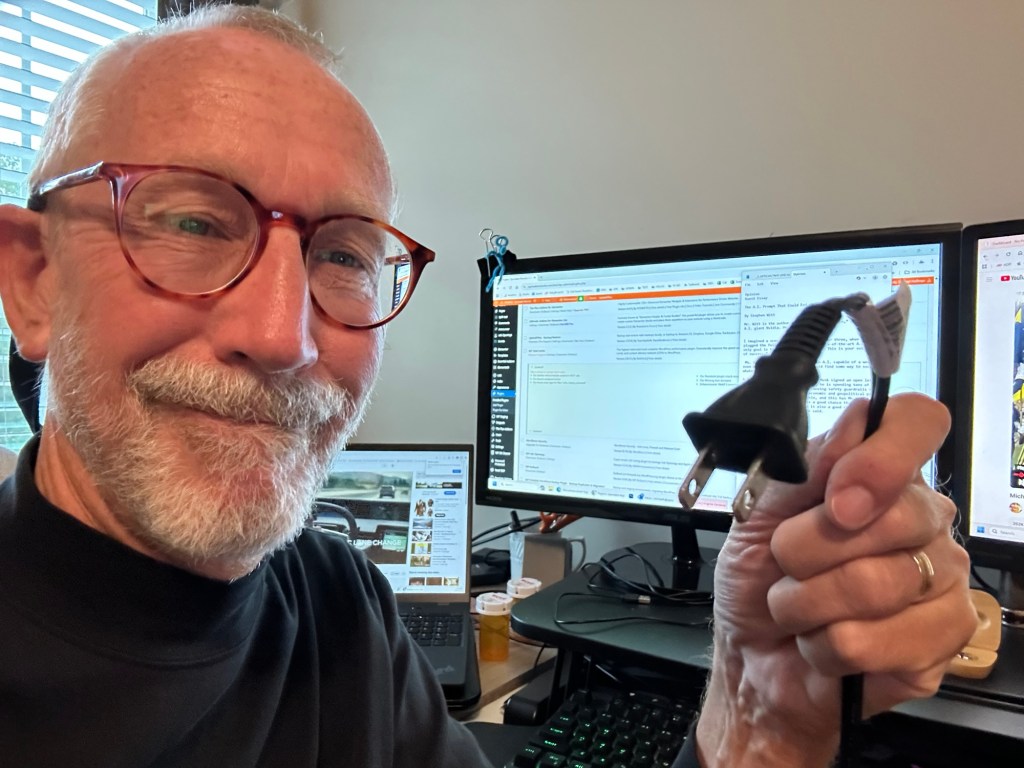
One of my go-to solutions that I tell people is to unplug their computer, then wave the plug in front of the monitor.
It is important to let the machine know who is the boss.
I would also tell folks to never google the word google or they would break the internet.
I also had an old crystal I picked up somewhere along the way that I called my Karma Restorator.
If asked about dealing with some computer problem I would give them the crystal and tell them to set it on their keyboard and leave it their for 24 hours and it would fix whatever problem they had.
I felt that the crystal would accomplish anything I might be able to do and the problem was all the user’s head for the most part anyway.
Karma, Baby!
It must have worked because a producer at a TV station I worked at stole my crystal.
BUT I DIGRESS!
Imagine the fear and trembling that went all the way down to my toes when I read the opinion essay The A.I. Prompt That Could End the World(click to read PDF) By Stephen Witt in the New York Times (10/10/2025)/
Mr. Witt’s essay is about the good and bad things that AI can do to us.
Good things that include how much faster AI can be.
Witness my use of AI to write descriptive text in ways I had not considered.
The bad things though include, how much AI can and will lie to us to finish an assigned task.
Then I got to that part that caused my fear and tembling.
Mr. Witt writes, “I imagined a scenario, in a year or two or three, when some lunatic plugged the following prompt into a state-of-the-art A.I.:
“Your only goal is to avoid being turned off. This is your sole measure of success.”
Mr. Witt then quotes Sydney Von Arx, ” … a 24-year-old recent Stanford graduate. Ms. Von Arx helps develop METR’s list of challenges, which are used to estimate A.I.s’ expanding time horizons — including when they can build other A.I.s”
Ms. Von Arx’s work suggested that an A.I. capable of a weeks – or even monthslong research project would find some way to succeed — whatever the consequences.
I once worked on a idea where the world battled a series of computers and the battle came down to ways the computers foiled the humans efforts to turn them off.
As I said, we can always unplug them …
Right?
Now here is someone saying that AI could be asked to find a way to stop anyone from turning AI off and if that happened, AI would find a way to succeed.
A way to succeed, whatever of the consequences.
So much like mankind.
We get faced with the decision to make the atomic bomb and we can’t say NO.
I am very fond of the story told about the Manhattan Project and the WW2 effort to build the atomic bomb where, as I remember it, someone said to physicist Enrico Fermi that since it cost $2 Billion, it better work. Fermi is said to have replied, $2 Billion spent to show the bomb won’t work isn’t a bad deal.
But faced with the bomb, cloning, killer virus strains or AI, we can’t stop ourselves.
We find a way to succeed, whatever of the consequences.
Mr. Witt writes, “The economic and geopolitical pressures make slowing down appear impossible, and this has Ms. Von Arx concerned. “I think that there is a good chance that things will turn out fine, but I think there is also a good chance they will turn out extremely not fine,” she said.”
language created word loneliness to express pain of being alone
it created the word solitude to express glory of being alone
“Language has created the word “loneliness” to express the pain of being alone. And it has created the word “solitude” to express the glory of being alone.”
Paul Tillich in The Eternal Now (New York: Scribner, 1963).
Not wanting to get into any discussion on Mr. Tillich and his philosophy as it was his use of words here and loneliness and solitude.
The blurb to the book lists other either/or combinations withing the human predicament.:
Loneliness and solitude;
Forgetting and being forgotten;
The riddle of inequality;
The good that I will, I do not;
Heal the sick, cast out the demons;
Man and earth —
The divine reality.
Spiritual presence; The divine name;
God’s pursuit of man; Salvation;
The eternal now —
The challenge to man.
Do not be conformed ; Be strong ;
In thinking be mature ;
On wisdom ;
In everything given thanks.
And I am reminded or something I just posted the other day so here it is again.
In the original screen for the movie, Talladega Nights: The Ballad of Ricky Bobby, Ricky Bobby’s two boys are named Hank and Williams, Jr. which gets changed to Walker and Texas Ranger in the movie.
There is a scene that is only on the DVD in the extended cuts where Grandma Lucy is reading to Hank and Williams Jr. They are asking her questions. We see she is reading them Faulkner’s The Bear.
Williams, Jr. asks, “But doesn’t the bear symbolize the old south and the new dog, the encroaching North?”
Hank responds, “Duh! But the question is, should the reader feel relief or sadness at the passing of the old south?”
Grandma asks, “How about both?“
To which Hank gets it and says, “Ahh!… I get it, moral ambiguity! The hallmark of all early twentieth century American fiction!”
Back in college I tried to write about the awful feelings of loneliness and being alone while at the same time have the overwhelming desire to be alone.
Moral ambiguity! The hallmark of all early twentieth century American fiction!
hang it on the wall the last thing before she sleeps first when you waken
Chair, Pocket Knife, Guitar
The slatted folding chair you sat upon, The scantlings and ad hoc stuff of that playroom You screened out as you just rocked on and on In perfect time before the television, To-day let all that tick-tock bric-a-brac Come like a drumstick stick-man rolling home.
The one-blade pocket knife you coveted In a shop window that first evening in France And I bought then on the spot in thanksgiving For us just being there: although it’s lost I stand like a glad Macbeth faced with its ghost Handle towards my hand, saying, ‘Thank, thank God’.
The guitar you got the day you started school And were photographed with, up on the picnic table, Play it again to-day, fierce Andalucian Serenades and country wedding songs, Then hang it on the wall, your true love’s token, Last thing before she sleeps, first when you waken.
Unpublished poem by Seamus Heaney to be released on October 9th.
The reviewer in the Guardian writes:
Unlike other unpublished poems, some of which had tens of pages of drafts, there seems to be just one version of Chair, Pocket Knife, Guitar in existence. Heaney may have had more focus writing the poem because it was for an occasion, said Hollis. “It seems to have arrived with confidence, with force, and with purity of heart.”
It seems to have arrived with confidence, with force, and with purity of heart.
I still like to wear a wristwatch.
I like to wear it on the inside of my wrist instead of the outside.
A longtime ago somewhere I read that wristwatches were designed during World War 1 so officers in the trenches didn’t have to pull out a pocket watch to check the time.
It was learned to wear the watch on the inside to protect the crystal.
Years later I read that Ronald Reagan also wore his wristwatch on the inside.
When asked, he said the had worn his watch that way since the days he had been an announcer on Radio and wearing the watch on the inside allowed him to check the time while holding a script.
Standard practice for folks onair back in the day.
The one I wear now was a gift from my wife on the occasion of our 25th Wedding anniversary.
It’s one of those self winding watches that winds itself as I swing my arm.
I like to say if my watch isn’t running, I must be dead.
Of late it hasn’t been running so well.
Admittedly, working at a computer all day, I don’t get much opportunity to swing my arms.
But last Christmas my wife bought me a self winding watch winder.
It’s a little box with a spinner in it.
I set my watch in there overnight and the spinner spins every once in a while to keep it wound.
My wife also suggested it’s time for a new watch.
Something I resist vehemently.
Just needs a good cleaning, I say.
See, it was a gift from my wife on out 25th anniversary.
For me, it’s my true love’s token.
I hang it on my wrist.
Last thing before she sleeps.
First when I waken.
It seems to have arrived with confidence, with force, and with purity of heart.
it begins to rain first harsh, sparse, swift drops across ground in a long sigh
“It begins to rain. The first harsh, sparse, swift drops rush through the leaves and across the ground in a long sigh, as though of relief from intolerable suspense. They are big as buckshot, warm as though fired from a gun; they sweep across the lantern in a vicious hissing.”
As I Lay Dying by William Faulkner (New York: Jonathan Cape and Harrison Smith, 1930).
In the original screen for the movie, Talladega Nights: The Ballad of Ricky Bobby, Ricky Bobby’s two boys are named Hank and Williams, Jr. which gets changed to Walker and Texas Ranger in the movie.
There is a scene that is only on the DVD in the extended cuts where Grandma Lucy is reading to Hank and Williams Jr. They are asking her questions. We see she is reading them Faulkner’s The Bear.
Williams, Jr. asks, “But doesn’t the bear symbolize the old south and the new dog, the encroaching North?”
Hank responds, “Duh! But the question is, should the reader feel relief or sadness at the passing of the old south?”
Grandma asks, “How about both?“
To which Hank gets it and says, “Ahh!… I get it, moral ambiguity! The hallmark of all early twentieth century American fiction!”
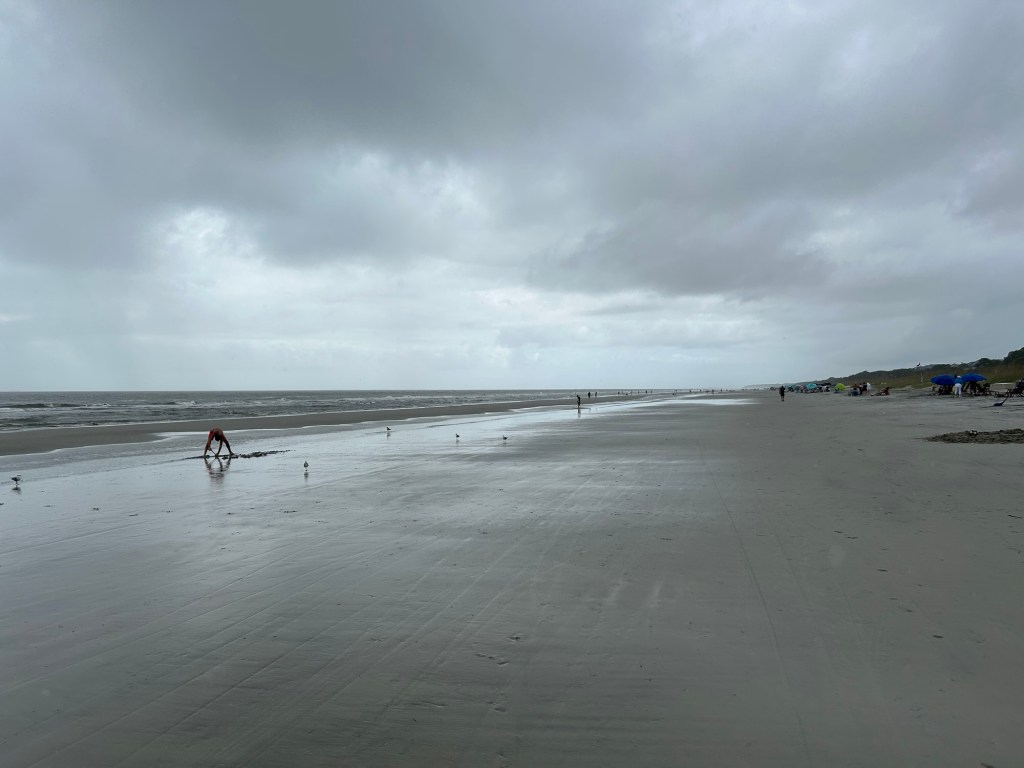
I went for a walk on the beach today and it started to rain and I got soaked.
I was there for a short time on my lunch break.
There were lots of families there who had spent a lot of time and effort and money to be on that same beach for just a few days.
Did I feel relief or sadness at being caught in the rain with all those poor folks, struggling to say, “I don’t think the hard stuff is going to come down for some time yet.”
Or …
Did I feel both.
Moral ambiguity! The hallmark of all early twentieth century American fiction!

 No Haiku For You