implements of war, subjugation – arguments to which kings resort
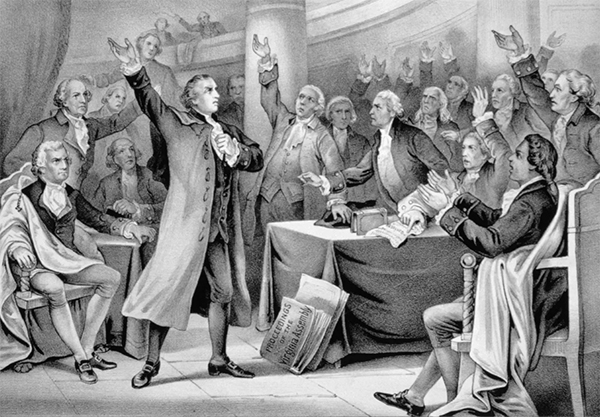
Based on these excepts from the speech known as, Give Me Liberty or Give Me Death by Patrick Henry as published in American Oratory, 1760–1900: Critical Studies and Sources, edited by Gregory Schneider, 18–23 (New York: Oxford University Press, 2000).
Are fleets and armies necessary to a work of love and reconciliation? Have we shown ourselves so unwilling to be reconciled that force must be called in to win back our love? Let us not deceive ourselves, sir. These are the implements of war and subjugation—the last arguments to which kings resort.
It is in vain, sir, to extenuate the matter. Gentlemen may cry, Peace, Peace—but there is no peace. The war is actually begun! The next gale that sweeps from the north will bring to our ears the clash of resounding arms! Our brethren are already in the field! Why stand we here idle? What is it that gentlemen wish? What would they have? Is life so dear, or peace so sweet, as to be purchased at the price of chains and slavery? Forbid it, Almighty God! I know not what course others may take; but as for me, give me liberty or give me death!
According to Wikipedia, Mr. Henry made the speech to the Second Virginia Convention on March 23, 1775, at St. John’s Church in Richmond, Virginia. Henry is credited with having swung the balance in convincing the convention to pass a resolution delivering Virginian troops for the Revolutionary War. Among the delegates to the convention were future United States presidents Thomas Jefferson and George Washington.
According to Edmund Randolph, the convention sat in profound silence for several minutes after Henry’s speech ended.
break the law, let your life be a counter friction to stop the machine
what I have to do is not lend myself to the wrong which I condemn
If the injustice is part of the necessary friction of the machine of government, let it go, let it go: perchance it will wear smooth—certainly the machine will wear out.
If the injustice has a spring, or a pulley, or a rope, or a crank, exclusively for itself, then perhaps you may consider whether the remedy will not be worse than the evil;
but if it is of such a nature that it requires you to be the agent of injustice to another, then, I say, break the law.
Let your life be a counter‑friction to stop the machine.
What I have to do is to see, at any rate, that I do not lend myself to the wrong which I condemn.
From Walden; or, Life in the Woods by Henry David Thoreau (Boston: Ticknor and Fields, 1854).
Or, as it he said, Ralph, what are you doing … out there.
little value in survival if traditions do not survive
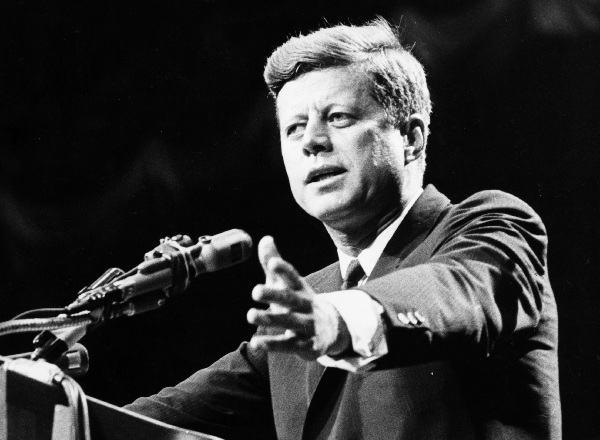
The very word “secrecy” is repugnant in a free and open society; and we are as a people inherently and historically opposed to secret societies, to secret oaths and to secret proceedings.
We decided long ago that the dangers of excessive and unwarranted concealment of pertinent facts far outweighed the dangers which are cited to justify it.
Even today, there is little value in opposing the threat of a closed society by imitating its arbitrary restrictions.
Even today, there is little value in insuring the survival of our nation if our traditions do not survive with it.
And there is very grave danger that an announced need for increased security will be seized upon by those anxious to expand its meaning to the very limits of official censorship and concealment.
That I do not intend to permit to the extent that it is in my control.
And no official of my Administration, whether his rank is high or low, civilian or military, should interpret my words here tonight as an excuse to censor the news, to stifle dissent, to cover up our mistakes or to withhold from the press and the public the facts they deserve to know.
What I wanted was that story that said who plays who in college football and which team is expected to win.
USAToday used to help me out with a story that listed the Top 25 games as picked by their 6 college football reporters.
Each pick was shown by the teams logo.
Took a long time for the story to load online but once it popped, there were all the logos in nice straight lines, usually all matching except when someone went a little crazy and picked, you know, Michigan over OSA last year.
That used to be the lead story on USAToday on Saturdays but this week, I had to search for and it wasn’t easy to find.
Scrolling through the New York Times, I came across and clicked on the article, College football Week 8 projected scores: Model predicts every FBS vs. FBS game, thinking this would tell me what I want to know.
Who wins, who loses today.
What I got was a game by game listing of something called the XMOV, the BETMGMLINE, the XTOTAL and the BETMGMTOTAL.
Most of the XMOV scores were negative numbers.
For a sport where points are score by 1,2,3 and 6, one game showed an XMOV score of -0.5.
I have no clue what I was looking at and in the case of the -0.5 game, does the means San Jose State should win or lose?
I just don’t know.
To paraphrase Grantland Rice, Its not whether you win or lose, but how you bet the game.
Sports betting and the immediacy of the world wide web and the constant presence of the hand held device is beyond and doubt a match up devised, produced and supported by Hell.
But is new or just its overwhelming presence.
Recently I was paging through the memoirs of Alistair McAlpine, a British businessman, politician and author who was an advisor to Prime Minister Margaret Thatcher.
His book is titled, Once a Jolly Bagman and he relates this story of his Father, who was addicted to betting on horse racing.
Television was not much favoured by my father until he discovered that not only could you watch the racing at one racecourse, but by changing channels you could see what was happening on another racecourse at the far end of the country. Within the year my father’s bookmakers at Henley-on-Thames had installed a direct telephone line to my father and his television. Shortly afterwards (undoubtedly aided by the large sums of money my father had spent with him), Sam Cowan, a bookmaker in the then small town of Henley, opened a London office. My father was rather pleased by his telephone, for his calls to the bookmaker were free and he could also listen to what was happening on a third racecourse via the Bookies Blower and the telephone link. The idea that our family should sit over their meals and ‘make’ conversation with each other came to an abrupt halt just before two o’clock on Saturday afternoon, at which time my father moved to the sitting room where he remained, cigar in hand, until five-thirty, switching channels, a telephone tucked under his chin, with the Sporting Life laid across his knees and his head and shoulders shrouded in cigar smoke illuminated by the flickering black-andwhite light of the screen. It is not hard to imagine how much his pleasure was increased when the broadcasts began to be in colour and he could spot by the jockey’s colours how a particular horse, neglected in the race reader’s commentary, was doing.
Dating this from the description would put in the early 1950’s but then he is writing about Great Britain so maybe this was in 1980.
But sports betting and the latest media has been matched up forever.
All through history, a match up devised, produced and supported by Hell.
Witness the movie The Sting where they convince the mark they can intercept horse racing results that are sent by the latest and greatest … telegraph wire.
I just wanted to know who might win today.
I don’t understand the over and under or the xtotal or xmov or anything like that.
Who might win.
Who might lose.
I am so confused.
Some where in my mind is a memory of a Bob Newhart show where Jerry the Dentist wants to make a bet on a football game and he explains the over/under and this and that of sports betting (back in 1978).
Bob listens and finally says something like … “tell you what Jerry. I’ll bet you a quarter.“
looking where program was, is, where we want to be was no other course
“Anything this significant just doesn’t come on a whim,” Kraft said. “You have to have scenarios, and we do. How is this going to go? What if this happened? But looking at where the program was and where it is and where we want to be as a program, I just felt there was no other course.”
Penn State athletic director Patrick Kraft on the firing on the Head Football Coach, James Franklin. (Quoted in the article At Penn State, James Franklin was standing on the edge of a cliff for years. Here’s why by Bruce Feldman and Ralph D. Russo, NYT 10/17/2025)
While the statement is about football, I can find application of that last bit in so many areas of todays life in America.
As voters, if we could only say, you have to have scenarios, and we do.
How is this going to go?
What if this happened?
But looking at where the Country was and where it is and where we want to be as a County, We just felt there was no other course.
Hmmmmmmmmmmmmmmmmmmmmmm
HEY WE CAN SAY THAT!
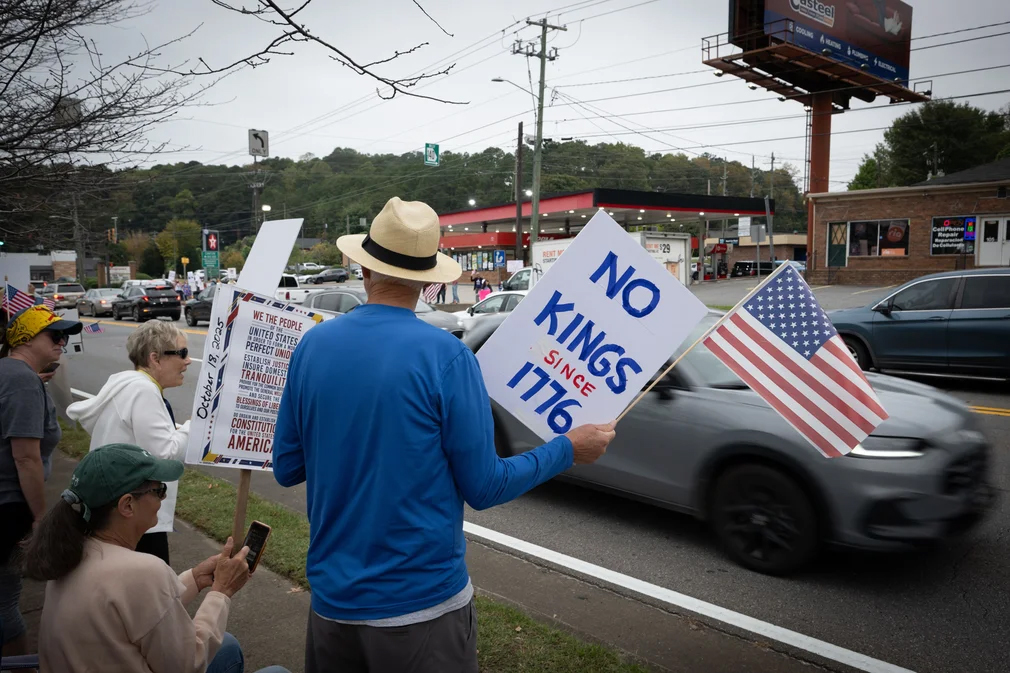
Last time I checked, The Constitution of the United States still starts: WE the PEOPLE.
Admitted I haven’t checked today and you never know what those folks might try.
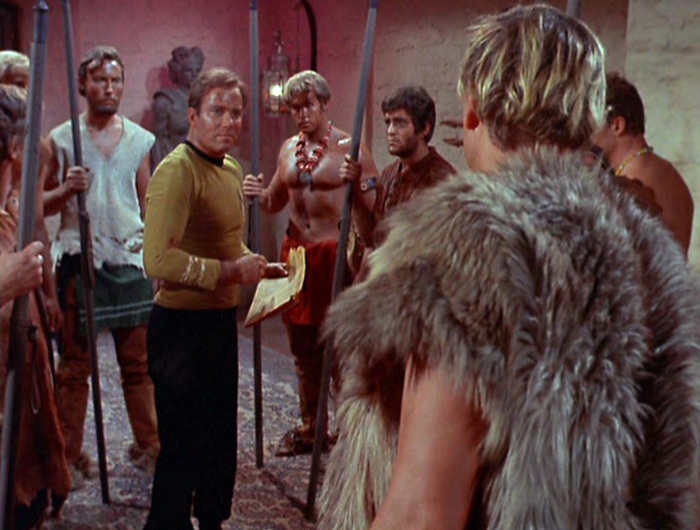
Does anyone else remember the scene from Star Trek, The Omega Glory” (Star Trek: The Original Series, Season 2, Episode 23 – and when I say Star Trek, for myself, I am referring only to the Original Canon of 79 shows, broadcast September 8, 1966 – June 3, 1969) where Kirk explains the Constitution.
The society Kirk and the Crew of the Enterprise come across in outerspace is based on the US Constitution but some how the document was buried in that society’s history and the words were only allowed to be spoken by a very few revered leaders.
In a long speech Kirk grabs their copy of the Constitution and says:
“Hear me! Hear this! Among my people, we carry many such words as this from many lands, many worlds. Many are equally good and are as well respected, but wherever we have gone, no words have said this thing of importance in quite this way. Look at these three words written larger than the rest, with a special pride never written before or since, tall words proudly saying ‘We the People’. That which you call Ee’d Plebnista was not written for the chiefs of kings, or the warriors or the rich or the powerful, but for all the people! Down the centuries, you have slurred the meaning of the words, ‘We the People of the United States, in order to form a more perfect union, establish justice, insure domestic tranquility, provide for the common defence, promote the general welfare, and secure the blessings of liberty to ourselves and our posterity, do ordain and establish this Constitution’. These words and the words that follow were not written only for the Yangs, but for the Kohms as well! They must apply to everyone, or they mean nothing! Do you understand?”
But looking at where the Country was and where it is and where we want to be as a County, We just felt there was no other course.
They must apply to everyone, or they mean nothing!

 No Haiku For You