10.26.2025 – one in sympathy

one in sympathy
with nature, each season in
turn … seems loveliest

Fall on Pinckney Island, SC Oct 26, 2025

The land that has four well-defined seasons cannot lack beauty, or pall with monotony.

Each season brings a world of enjoyment and interest in the watching of its unfolding, its gradual, harmonious development, its culminating graces—and just as one begins to tire of it, it passes away and a radical change comes, with new witcheries and new glories in its train.

And I think that to one in sympathy with nature, each season, in its turn, seems the loveliest.

From Roughing It by Mark Twain (Harper & Brothers: New York, 1913).

Fall on Pinckney Island, SC Oct 26, 2025

10.25.2025 – this office has been

this office has been
a sacred trust and an honor
beyond words, measure

“When people tell me that I became President on January 20th, 1981, I feel I have to correct them. You don’t become President of the United States. You are given temporary custody of an institution called the Presidency, which belongs to our people. Having temporary custody of this office has been for me a sacred trust and an honor beyond words or measure.”

Remarks of President Ronald Reagan at the Republican National Convention, New Orleans, LA (8/15/88).

As a measure of how far things have gone, I am quoting Ronald Reagan.

Truth be told, I didn’t like him very much, but the farther away he gets, the better he looks to me.

Just for this quote alone and the important points Mr. Reagan makes about the office.

And for the recognition of that all important word, temporary.

There seem to be two ends to this story.

That guy in office wins out, history is rewritten, he goes down as the greatest President, The Art of the Deal is given a red cover, is placed in all churches and the little red book becomes required reading for all starting in 4th grade, the Washington Monument comes down and new gold tower is raised in its place and along the way, the United States apologizes to Germany for making them feel bad about WW2.

Or all this is temporary.

The Burgermeister Meisterburger’s picture falls off the wall and is thrown away.

The folks who currently hold offices like the President, The Chief Justice, and the Speaker of the Voice are all remembered as some of the worst office holders in the history of the nation.

And lets be fair here.

That bar to succeed in these offices is low.

When you get the job, you get a rule book called the Constitution of the United States and you follow the rules and you are assured of at least passing grades if not really high marks in the record book of History.

And the Country survives and goes on after a really bad bump in the road.

Doesn’t look like there are other options at this point.

There, for me, is truly no parallel in history to this guy.

And, for me, there is is truly no parallel in fiction to this guy.

Not even Tom Clancy in his wildest novels came up with a scenario like the one we are dealing with.

The closest thing I can come up to match is some of the odder villains in James Bond movies.

But I am telling you this much.

Had you gone to Hollywood with a plot with the evil nemesis of the world would in one week, blow up the minions of his perceived enemies by shooting missiles at motorboats, tear down part of the White House, demand that the Government that he directed pay him $300 Million dollars while releasing cartoons of himself wearing a crown, flying fighter jet, dropping poop on American citizens, you would have been thrown out before your butt hit the leather.

Mr. Reagan looks better and better every day.

10.24.2025 – whole world was watching

whole world was watching
and other nations could not …
help but be impressed

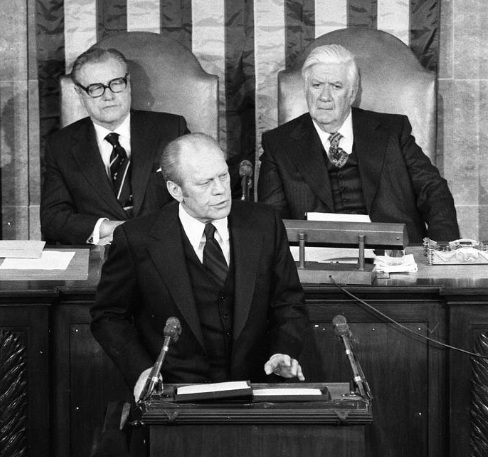
I’ve never been a Nixon-hater, and I felt no pleasure when he resigned.

But if it had to be, I’m glad it happened the way it did.

A president fell and a new president took over, and yet there was no scuffling, no guns, no harsh bickering, no crowds in the streets— not so much as a fistfight.

The whole world was watching, and other nations couldn’t help but be impressed.

After all, when leaders fall, their governments usually collapse as well.

But our transition was orderly and by the book, and this period, as much as anything in our history, showed the strength of our great democracy.

Man of the House : the life and political memoirs of Speaker Tip O’Neill by Tip O’Neill (New York: Random House, 1987).

I have to ask, what has the recent effort to make America great again achieved over this?

About the last 10 years there is little to contribute to writing that this period, as much as anything in our history, showed the strength of our great democracy.

Mr. O’Neill concluded his book with an epilogue titled, What I Believe.

He wrote:

I BEGAN my political career in 1936, on a slogan of “work and wages.” Today, more than half a century later, I’m still a bread-and-butter liberal who believes that, every family deserves the opportunity to earn an income, own a home, educate their children, and afford medical care.

That is the American dream, and it’s still worth fighting for. In my view, the federal government has an obligation to help you along the line until you achieve that dream. And when you do, you have an obligation to help out the next group that comes along.

What a dreamer and what a dream.

Let’s repeat those last two sentences.

The federal government has an obligation to help you along the line until you achieve that dream.

And when you do, you have an obligation to help out the next group that comes along.

Just boil it down to the simple statements that the federal government has an obligation to help you and you have an obligation to help the next group.

Those two statement as much as anything in our history, show the strength of our great democracy.

That is where the focus should be if anyone wants to make America great again.

Speaker Tip O’Neill was Speaker of the House from Gerald Ford to Ronald Reagan and most likely that last of Speaker of House to hold real power in politics.

When he died, President Bill Clinton paid tribute to him, saying, “Tip O’Neill was the nation’s most prominent, powerful and loyal champion of working people… He loved politics and government because he saw that politics and government could make a difference in people’s lives. And he loved people most of all.

AS KIND OF A POSTSCRIPT, Mr. O’Neill also wrote:

God has been good to America, especially during difficult times.

At the time of the Civil War, he gave us Abraham Lincoln.

And at the time of Watergate, he gave us Gerald Ford—the right man at the right time who was able to put our nation back together again.

Nothing like Watergate had ever happened before in our history, but we came out of it strong and free, and the transition from Nixon’s administration to Ford’s was a thing of awe and dignity.

Making an assessment based on the folks now in Government, I think God doesn’t like us much right now.


10.23.2025 – I cried over things

I cried over things
knowing no beautiful things,
not one, not one … lasts

Adapted from:

I cried over beautiful things knowing no beautiful thing lasts.
The field of cornflower yellow is a scarf at the neck of the copper sunburned woman,
The mother of the year, the taker of seeds.
The northwest wind comes and the yellow is torn full of holes,
New beautiful things come in the first spit of snow on the northwest wind,
And the old things go, not one lasts.

Autumn by Carl Sandburg in Chicago Poems as published in The Complete Poems of Carl Sandburg, (Harcourt Brace and Company, New York, 1950).

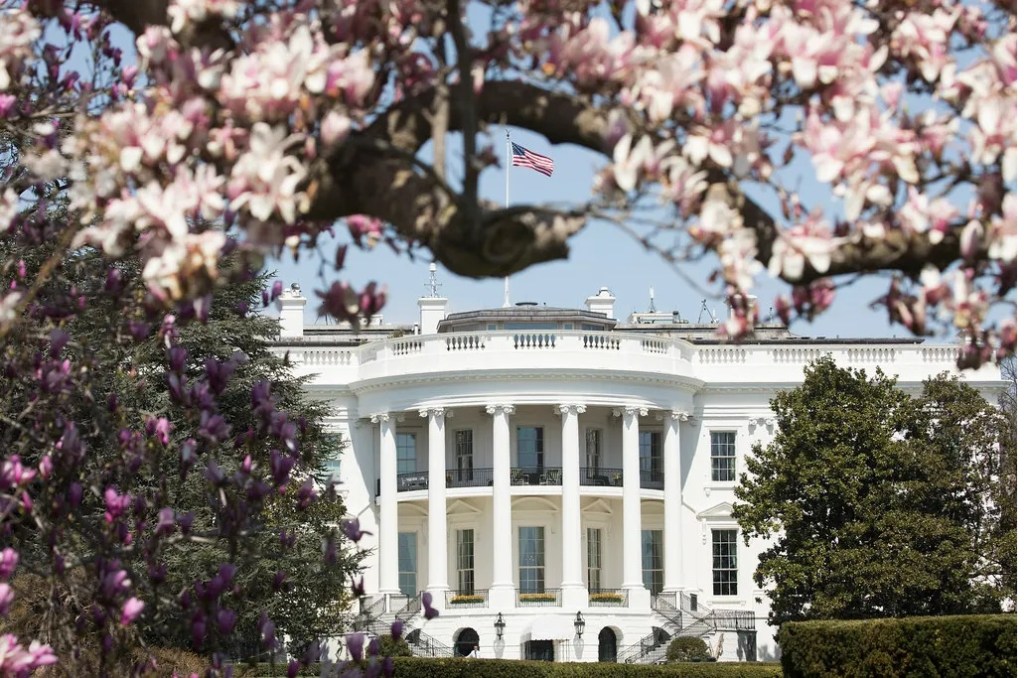
It’s just a building, I know.

And I know it was MASSIVELY renovated under Mr. Truman.

But understand, without much structural attention since being turned over to John Adams and being burned by the Brits in 1812, that building was falling down.

According to wikipedia:

By late 1948, three main options were considered for replacement of the White House:

  • Demolish and rebuild the interior, keeping the exterior walls intact.
  • Demolish the building entirely and construct a new executive mansion.
  • Demolish the building entirely, salvage the exterior walls and rebuild them and a new interior.

Two of the options were DEMOLISH ENTIRELY.

And the decision was made to Demolish and rebuild the interior, keeping the exterior walls intact.

Also from Wikipedia, Historic preservation of buildings during this time was not as strict or defined as it became later. For its time, simply not demolishing the entire structure was deemed “preservation”. Winslow envisioned many of the interior items – from doors, trim, woodwork, and ornamental plaster – would be reused. Most were carefully dismantled, labelled, catalogued, and stored. Much of the paneling was reinstalled in the main public rooms, but other historic elements were simply copied to accommodate increasing cost and time constraints. Many of the original materials that were not deemed of significantly identifiable historic value, such as marble fireplace mantels, or not deemed to be readily reused, such as pipes, were sent to landfills.

So is it the building where Mrs. Adams hung her laundry up in to dry, where Lincoln walked and FDR rolled?

Well not really, but there is this scene in my memory that I read about where Carl Sandburg, visited FDR in what is now the Yellow Room but in that day, was FDR’s study.

Sandburg, according to the story, stood at a window, hand on the window frame, and said something like, “This is where Lincoln stood, looking south to Virginia.”

FDR asked, “How can you know?”

Sandburg responded, “… I can tell.”

That window, the window Mr. Lincoln looked through, the window that Sandberg rested his hand on, that’s still there.

Still there … for now.

10.22.2025 -La mer est tout, son

La mer est tout, son
souffle est pur et sain que
mouvement et amour 

Based on the passage: La mer est tout ! Elle couvre les sept dixièmes du globe terrestre. Son souffle est pur et sain. C’est l’immense désert où l’homme n’est jamais seul, car il sent frémir la vie à ses côtés. La mer n’est que le véhicule d’une surnaturelle et prodigieuse existence ; elle n’est que mouvement et amour ; c’est l’infini vivant, comme l’a dit un de vos poètes. Et en effet, monsieur le professeur, la nature s’y manifeste par ses trois règnes, minéral, végétal, animal.”

From Vingt mille lieues sous les mers : Tour du monde sous‑marin by Jules Verne( Paris : Éditions J. Hetzel & Cie, 1870).

Or … The sea is everything!

It covers seven-tenths of the earth’s surface. Its breath is pure and healthy.

It is the vast desert where man is never alone, for he feels life stirring on all sides.

The sea is only the vehicle for a supernatural and prodigious existence;

it is nothing but movement and love;

it is living infinity, as one of your poets said.

And indeed, Professor, nature manifests itself there in all three of its kingdoms: mineral, vegetable, and animal.”

From Twenty Thousand Leagues Under the Seas: A Tour of the Underwater World by Jules Verne (Paris: J. Hetzel & Co., 1870).

What?

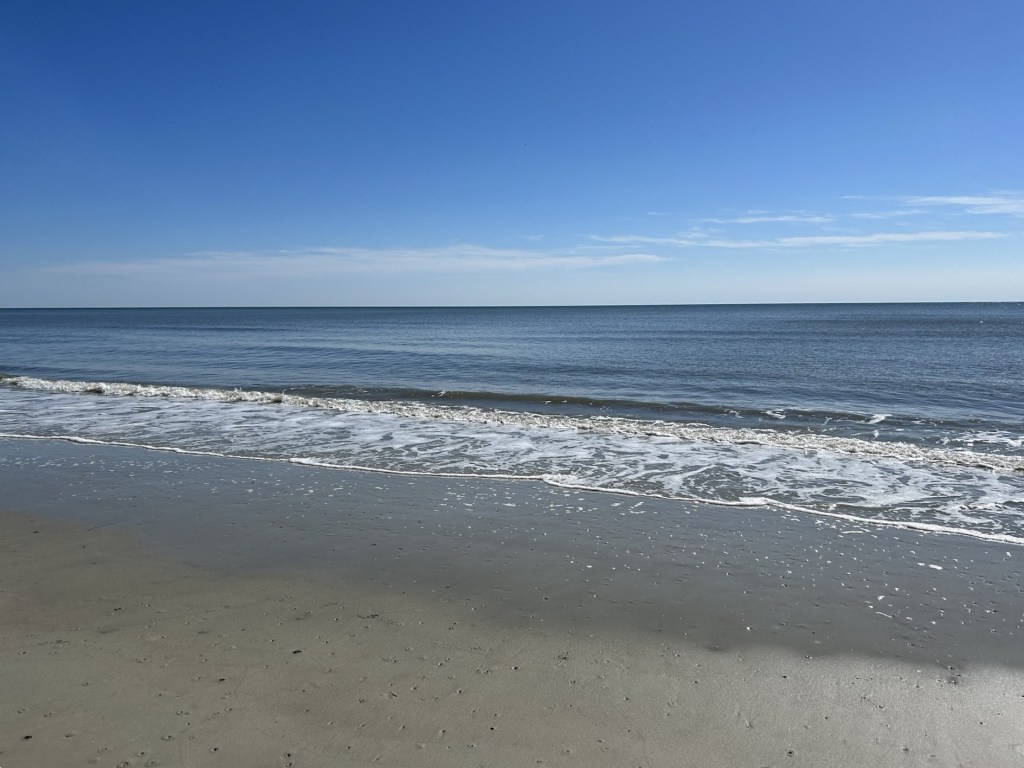
Another excuse to show off that this is where I take my lunch time?

La mer est tout!

The sea is everything!

Elle n’est que mouvement et amour!

It is nothing but movement and love!

And … another excuse to show off that this is where I take my lunch time.