
sea forced us to tell
ourselves property here is
no longer worth much
In the distance, about half a mile away, you can see the outline of the 400 or so buildings in the village of Miquelon. It sits only 2 metres above sea level on the archipelago of Saint-Pierre and Miquelon. Situated off the Canadian coast to the south of Newfoundland, it is an “overseas collectivity” of France, and the country’s last foothold in North America.
“The constraint of no longer being able to build here – of not being sure that we are sufficiently protected from the sea, with storms that are getting stronger and more frequent – forced us to tell ourselves that our property here is no longer worth much,” he says.
From the article, As rising tides eat away at Canada’s Saint-Pierre and Miquelon archipelago, plans to move the historic village to higher ground have divided friends and families By Sara Hashemi
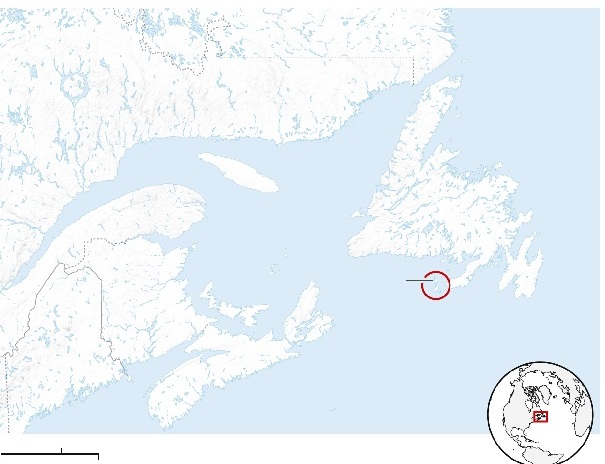
The islands were an overseas territory of the Nazi-controlled regime of Vichy France after the fall of France in World War II, and were liberated a year and a half later by Free French forces in 1941. After the war, the fishing industry continued to languish, and now fish stocks have fallen so low that fishing is severely restricted. Saint Pierre and Miquelon are now trying to diversify their economy into tourism and other areas.
During the early years of World War II, the United States maintained formal relations with Vichy France. Under the Monroe Doctrine, the US was strongly opposed to any change in control of the islands by force. However, Canada (perhaps due to pressure from Winston Churchill) expressed worries about Vichy forces near Canada. De Gaulle realized that Canada might want to capture Saint Pierre and Miquelon (thereby eliminating French territory so close to Quebec), so he secretly planned its seizure by Free France. On Christmas Eve 1941, Free French forces (three corvettes and the submarine Surcouf, led by Rear-Admiral Émile Muselier) “invaded” the islands. The Vichy officials immediately surrendered.
In the late 1950s De Gaulle offered all French colonies political and financial independence. Saint Pierre and Miquelon chose to remain part of France.
I have long been fascinated with the islands of Saint-Pierre and Miquelon and that a legal part of France was off the coast of Newfoundland.
I remember the old joke of why go all the way to Paris when you can go to Quebec and have people be rude to you.
Of course, I would respond why go all the Quebec when you can shop at Jacobsen’s and have people be rude to you.
But you had to live in West Michigan a long time ago to get that joke.
But there it is, islands, ruled by Government of France, right there 13 miles off the coast of Canada.
It was like after the French and Indian War, those Europeans divvied up all the Risk Cards and someone dropped the Saint-Pierre and Miquelon card on the floor.
Conceivably during World War 2, then Nazis could have staged U Boats out of there, if they could have got there in the first place.
Now they are finding that the Atlantic Ocean is creeping in and that ocean front property, as they say, is no longer worth much.
The constraint of no longer being able to build here – of not being sure that we are sufficiently protected from the sea.
Here I sit in what is called the low country of South Carolina.
The pandemic era WORK FROM HOME concept has caused this area to blow up population wise.
The city of Bluffton, where I live had 900 people living here 25 years ago.
It now has 40,000 and more are moving in every day with new developments both for residents and vacationers.
Houses, Town Homes and Apartments turn up before our eyes.
Vacant marsh land overnight is now a golf course.
But the sea is still a problem for us and it pretty much runs the show.
First off, no one gets to live on the coast.
There is only so much of that.
Second, this is still the low country.
At high tide, 50% of the Beaufort County is under water.
As well as cutting back on available dry land, which pretty much was taken over for roads and railway right-of-ways a long time ago, the amount of fresh water here was maxed also a long time ago.
City and County leaders point out almost every day that the limit for water services and road expansion has been reached.
Then the zoning boards approve another 5,000 homes.
On to of that, the entire area could be wiped off the map by a hurricane.
At some point all of this has to come to smash and the folks here will be forced to tell themselves that their property here is no longer worth much.
 No Haiku For You