
mark against your name
marks not that won or lost, but
how you played the game
Adapted from the poem “Alumnus Football” by Grantland Rice as it printed in the book, The Sportlight, (New York: D. Appleton and Company, 1917).
The final stanza goes:
Then came the final whistle,
And the end of all the strife,
And Bill Jones, the brave half-back,
Was carried from the game of life.
But when the Great Scorer comes
To write against your name,
He marks — not that you won or lost —
But how you played the Game.
And it’s that last line, how you played the Game, that comes to mind this morning.
It’s not yet fall, it’s not even Labor Day, but College Football has started and it starts with finding the T shirts and the hats and the memories of past games and past rituals.
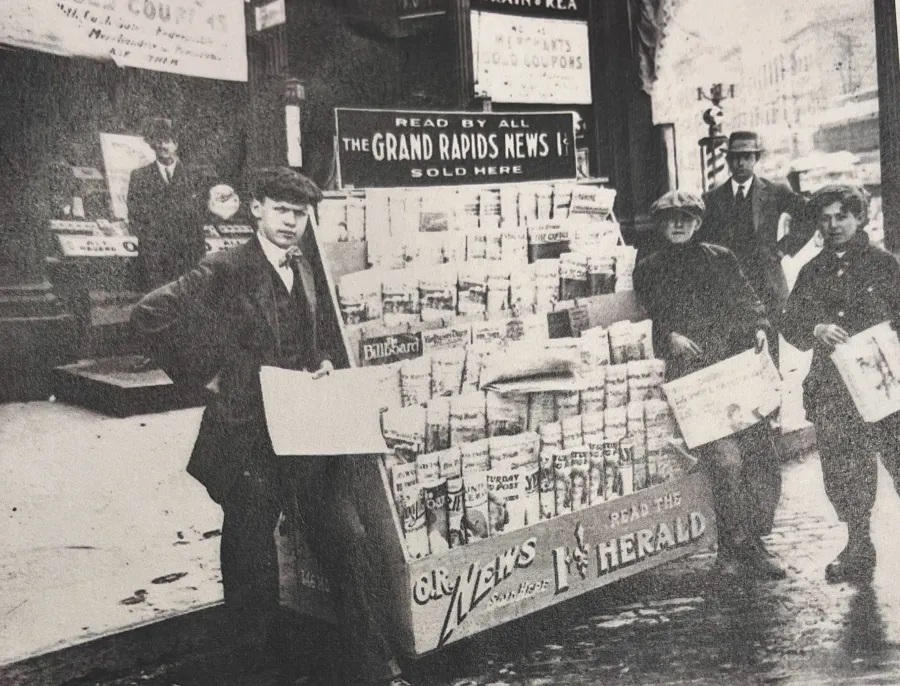
Back in the day, a favorite fall ritual on a Sunday morning after my team won it’s game on Saturday was to drive downtown to Elliott’s News Stand in Grand Rapids, Michigan, where I grew up, and get newspapers from out of town.
Not sure how back then, but you could get newspapers from almost every major American city east of the Mississippi River.
I wanted a New York Times and maybe a Chicago Tribune and if possible, the local paper from whatever town where the team my school had beat on Saturday was located.
My favorite time was when I needed to find editions of the Columbus Post Dispatch or the Lansing State Journal.
I loved reading the viewpoints of my team as written by the other side.
I wanted to read how they played the Game.
I wanted the who, what, where, why and how they played the Game.
In 1995, I had got a Macintosh Performa Computer and a modem and got a free internet access account from something called iserve.net and learned how to access information on the recently created World Wide Web.
I had to use something called a LYNX browser and you only had text and the early websites often had issues not display a lot of coded gobblygok but with a little patience, I found I could get to the few newspapers then online.
The Detroit News was one of them and I could read all their stories about my team at detnews.com.
From such little acorns, giant Oak trees grow.
By the year 2000, I was working in the online world and ALL newspapers were online and I was no longer driving downtown to buy print newspapers.
No one knew it, but the tide had shifted and was going out on print media.
By chance, I started working for a TV station with corporate ties to the Detroit News and I found myself in meetings with the online staff on how we could improve the product.
Occasionally the revenue model would be discussed and how this would all work out but no one saw anything but a bright future.
Readers started using the web and abandoning the print editions because the web version was free.
No worries said the papers, much like someone on the Titanic thinking the big ship couldn’t sink, we can make up the revenue from ads.
After being in online news for 20 years, let me tell you, the only people who made money from online advertising where the people who managed the online advertising.
By 2009, the rug was being pulled out from Newspapers and I watched as more and more of the people I worked with the newspaper side were let go or ‘repurposed’ or made redundant.
This cycle kept going until it caught up with me and I found myself being called into a Tuesday online meeting with an HR rep and told my last would be Friday.
It’s a long story but this was the 2nd time I had this meeting with that company but the 1st time it happened I was offered a way out if I accepted another position in Atlanta, but I digress.
Still, my Sunday Morning ritual continued.
Newspapers continued to wrestle with the revenue models of pay-windows or limited access to free atricles.
I had become accustomed to going to the websites for the Detroit News and the Detroit Free Press and clicking on what articles I could and ignoring those marked SUBSCRIBER ACCESS ONLY.
This morning those links were gone.
This morning almost every article I clicked gave the 1st paragraph and then required me to login as a subscriber.
And I am resistant.
I would pay for those newspapers at Elliott’s.
Why wouldn’t I pay for subscriber access?
If I could answer that question for myself, I would think the Newspapers would be glad to know the answer.
Earlier this week The Atlanta Journal Constitution announced they would no longer print a newspaper.
Their reported numbers are dismal.
According to a New York Times story:
About 40,000 subscribers receive the print newspaper, down from 94,000 in 2020. At its height, in 2004, the paper’s Sunday edition had a circulation of about 630,000. The paper is printed at a facility in Gainesville, Ga., that The Journal-Constitution does not own. About 30 staff members, half of them part-time workers, would lose their jobs as a result of the change, a company spokeswoman said.
…. an ambitious goal of reaching 500,000 paid digital subscribers by the end of 2026, a figure that would make the business sustainably profitable.
The paper is not on a pace to hit that goal. It has about 115,000 total paid subscribers, with 75,000 of those digital-only subscribers, a figure that’s up from about 55,000 at the end of 2023, according to a company spokeswoman.
“The bottom has fallen out of the entire industry,” Mr. Morse said. “Our organic traffic from Google has dropped 40 percent in the last year. Never could have predicted that.”
The folks at the AJC hold to the importance of news saying:
“Everything we’re doing is designed to protect the journalism, to build the best products we can and to get it in front of the most people,” Mr. Morse said.
Now, searching for a description of the yesterday’s game, I came across a handful of stories.
Just about all of them were pre game stories on how to BET THE GAME.
Or they were post game stories about how BETTING ON THE GAME turned out.
If they weren’t on betting, most of the stories were the current puff pieces of the athletes thoughts on Cracker Barrel or Taylor Swift of their favorite online reels.
I don’t have a lot of answers and maybe I am not even sure what the questions might be.
As Andrew Morse, The Atlanta Journal-Constitution President and Publisher, was quoted, “Unless news organizations have the courage to disrupt themselves faster than the marketplace is disrupting the industry, really important institutions that have existed for generations will cease to exist.”
In no small way, I fill a part of the reason this is happening.
But all I wanted to know is how they played the game.
 No Haiku For You