
intellectual
integrity and thoughtful
design is presented
Adapted from the article, “The Smithsonian Changes Its Description of Trump’s Role on Jan. 6” by By Graham Bowley who quoted an official response from The Smithsonian when the National Museum of American History removed some details of the charges President Trump faced when it replaced a display about his two impeachment stating:
“Adhering to principles foundational to our role as the nation’s museum, we take great care to ensure that what we present to the public reflects both intellectual integrity and thoughtful design,” the Smithsonian said.
According to the article:
The new text removed previous references to Mr. Trump’s incitement charge being based on “repeated ‘false statements’ challenging the 2020 election results” and giving a speech that “encouraged — and foreseeably resulted in — imminent lawless action at the Capitol.”
The new label reads: “On Jan. 13, 2021, Donald Trump became the first president to be impeached twice. The charge was incitement of insurrection based on his challenge of the 2020 election results and on his speech on Jan. 6. Because Trump’s term ended on Jan. 20, he became the first former president tried by the Senate. He was acquitted on Feb. 13, 2021.”
The new labeling that went up on Friday also changed the description of President Trump’s first impeachment, in 2019, adding the word “alleged” to a line that now reads: “The charges focused on the president’s alleged solicitation of foreign interference in the 2020 presidential election and defiance of Congressional subpoenas.”
I guess it is lucky for the Smithsonian that the text was printed on just a cardboard placard.
Plaques at the Baseball Hall of Fame are cast in bronze and is a notice outside the hall that information on the plaques WAS CORRECT at the time the plaque was created.
Me and my family has had a long association with the Smithsonian.
When my brother lived just outside Washington, DC, we made twice yearly trips to visit his family and those trips always included the Smithsonian.
When you walked into National Museum of American History the first thing you saw was a giant pendulum demonstrating the rotation of the earth.
Then you saw the original Star Spangled Banner.
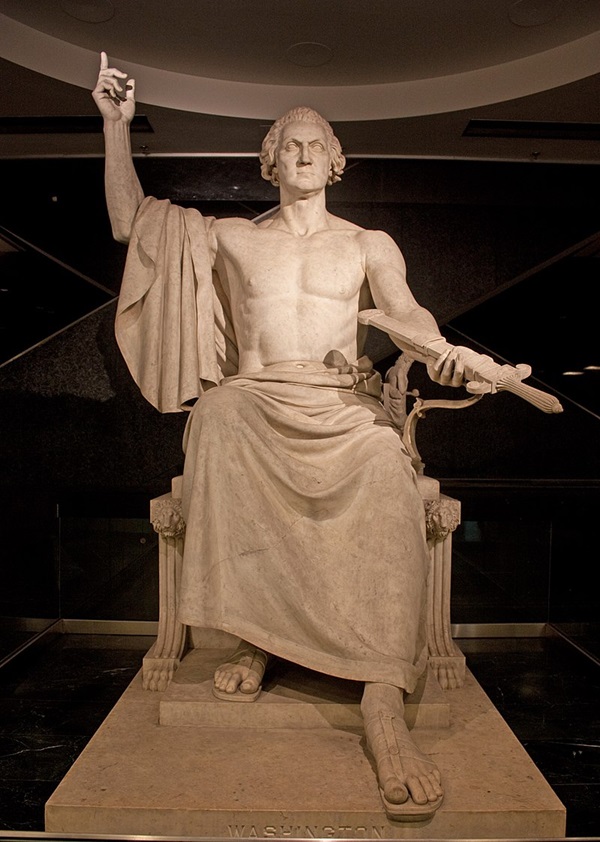
Then you turned left and you saw the statue George Washington, also known as Enthroned Washington, a large marble sculpture by Horatio Greenough commissioned by the United States Congress on July 14, 1832 for the centennial of U.S. President George Washington’s birth on February 22, 1732. Completed in 1840, the statue was soon exhibited in the Rotunda of the United States Capitol and then moved to the Capitol’s east lawn in 1843. Since 1964, it has been in the National Museum of American History. (WIKIPEDIA)
Us little kids just had to laugh at this statue of the half naked George Washington.
That wasn’t unusual.
According again to Wikipedia, “When the marble statue arrived in Washington, D.C. from Italy on July 31, 1841 it immediately generated controversy and criticism on its installation in the rotunda in December 1841. Many found the sight of a half-naked Washington offensive, even comical.”
Official Washington didn’t quite know what to do with this statue so it’s entirely appropriate that it ended up in what some call “The Nation’s Attic.”
At least it has done better that Mr. Greenough statue, The Rescue, that at one time was the steps of the East Front of the United States Capitol that depicted a Native America attacking a settler woman while a Daniel Boone type is about to axe the Native American.
Congress in 1939, in a joint resolution, condemned The Rescue and recommended that it should be “ground into dust.” In 1941, another resolution said it was “an atrocious distortion of the facts of American history and a gratuitous insult” to Native Americans.
The Rescue was removed in 1958 during some renovations and put in the real attic of the Smithsonian out in Silver Springs, Maryland where during a move in 1976, it got dropped by accident and broke into several pieces.
But it isn’t so much the statue I am thinking of today.
It is the inscription on the statue of Washington.
Written by Mr. Greenough, it says in latin,
SIMULACRUM ISTUD
AD MAGNUM LIBERTATIS EXEMPLUM
NEC SINE IPSA DURATURUM
HORATIUS GREENOUGH
FACIEBAT
Which translates to:
Horatio Greenough made this image as a great example of freedom, which will not survive without freedom itself.
An appropriate warning for the Smithsonian if I say so myself.
 No Haiku For You