6.30.2025 – this will reduce the

this will reduce the
deficit, not increase it …
that is simply false

Three times in the past half-century, Republicans have enacted large tax cuts that necessitated significant increases in federal borrowing. Each time they insisted the cuts would drive economic growth, even claiming that the expansion would be so large that the government would collect more tax revenue. Each time, they’ve been proved wrong.

Mr. Trump’s bill would be the fourth iteration of this failed experiment, and some Republicans are still retailing the same fantasies about the consequences. “This will reduce the deficit, not increase it,” Senator John Thune of South Dakota, the Senate majority leader, said last week. That is simply false.

The expected increase in the debt is particularly absurd because the government would borrow much of the money from the same people who got the biggest tax cuts from the bill. Roughly half of the government’s debt typically is sold to American investors, and those investors are disproportionately affluent. When the government borrows from them rather than raising taxes, it is getting the same money from the same people on less favorable terms. Instead of taxing the rich, the government pays them interest.

From The National Debt Is Already Causing Bigger Problems Than People Realize by THE NEW YORK TIMES EDITORIAL BOARD in an opinion piece on June 39, 2025.

The expected increase in the debt is particularly absurd!

I am also struck by the phrase, That is simply false.

In my day, that was called … a lie.

Somewhat along the lines of, we are only departing gang members and drug dealers.

And telling a lie was considered bad.

Bad to tell it.

Worse to get caught telling it.

Today … who cares.

But why no one cares, is beyond me.

6.29.2025 – moral failure for

moral failure for
American society
as a whole … all … each

Adapted from the New York Times article, Catholic Bishops Try to Rally Opposition to Trump’s Immigration Agenda (NYT June 29, 2025), where Elizabeth Dias writes:

Leading Catholic prelates including Cardinal McElroy and Cardinal Joseph W. Tobin of Newark went even further in an interfaith letter to Senate leadership on Thursday night, strongly urging them to vote against the bill entirely.

In their letter they claimed that the bill, which calls for billions of dollars to bolster ICE, would spur immigration raids, harm hard-working families and fund a border wall that would heighten peril for migrants.

“Its passage would be a moral failure for American society as a whole,” the letter states.

The letter was organized by Archbishop John C. Wester of Santa Fe, N.M., who attended an ecumenical protest against the bill last week.

“This draconian, heavy-handed, meanspirited way that the country is dealing with immigrants today, it is not fair, it is not humane, it is not moral,” he said.

“It’s something we have to really be earnest about, and do everything we can within the law to make our voices heard.”

I think that last needs to be repeated.

This draconian, heavy-handed, meanspirited way that the country is dealing with immigrants today, it is not fair, it is not humane, it is not moral.

It’s something we have to really be earnest about, and do everything we can within the law to make our voices heard.

Is that hard to understand?

This is not statement from a national news service not named FOX.

This is a statement in a letter to the United States Senate (as it us understood) from the hierarchy of the Catholic Church in America.

This draconian, heavy-handed, meanspirited way that the country is dealing with immigrants today, it is not fair, it is not humane, it is not moral.

It’s something we have to really be earnest about, and do everything we can within the law to make our voices heard.

Will folks dismiss this as just something from a bunch of liars?

I will wait to see anything similar for organizations like the Southern Baptist Church or Protestant leaders like Franklin Graham.

I will wait, but I won’t hold my breath.

I will add that this would be a moral failure for American society as a whole.

As a WHOLE.

That’s all of us.

As Mr. Lincoln said, “We … will be remembered in spite of ourselves. No personal significance, or insignificance, can spare one or another of us. The fiery trial through which we pass, will light us down, in honor or dishonor, to the latest generation.

That also is worth repeating.

We … will be remembered in spite of ourselves.

No personal significance, or insignificance, can spare one or another of us.

Christians talk about a judgment day.

When that day comes, no personal significance, or insignificance, can spare one or another of us.

Where do you want to line up on that day?

The Last Judgment by Michelangelo – this is on the wall in the Sistine Chapel and Cardinals get to ponder it while selecting the next Pope.

6.28.2025 – eyes of those who fight and

eyes of those who fight and
starve for bread – there is doom, change,
silence, denying

Adapted from the poem, Sea Music, by Babette Deutsch.

There is a place of bitter memories
Dreary and wide and lonely as the sea,
Foaming and moaning; there they come to me
Like wild gulls crying sea-taught monodies:
Iron-winged hours, heavy, heavy with dread;
Dawn after death; the sound of a shut door;
And shining love that has a withered core;
The eyes of those who fight and starve for bread.
There is doom, and change, and silence, and denying;
Memories of these pluck at the heart of me.
And over the bitter roar of the old dumb sea
The air is filled with the noise of wild gulls crying.

I started this morning still at a loss for words.

Wanting, if for the sake of self discipline if nothing else, to write something today I turned to my other project for inspiration.

Over the last year I worked to gather digital versions of every known published James Thurber Cartoon.

When I am at a loss for word, I will go to my Thurber archive and see if there might be a drawing and caption suitable to be adapted to a haiku.

Searching the archive for June 28th, I found that on June 28, 1941, the New Yorker published a drawing with the caption, Miss Gorce is in the embalming game.

That didn’t do much for a haiku.

But when I created my archive, I also did a screen grab of the two page spread of the New Yorker so users could see how New Yorker readers first saw the Thurber drawing.

I found this necessary to show that all Thurber drawings DID NOT just magically appear in books, one after another, but were part of the fabric of the magazine.

Looking at the spread of pages 14 and 15 for June 28th, 1941 edition of the New Yorker, I saw opposite the Thurber drawing a poem by Babette Deutsch.

Never heard of her but liked her poem and thought would do so I search for an online version I could copy and paste into this post and when doing so, came across this poem, Sea Music.

Just yesterday I was bemoaning the fact that I had no words in me to describe how I felt after the highest court in this country decided that the feller in office was a better judge of Justice then they were and here was a poem that described how I felt.

Iron-winged hours, heavy, heavy with dread;
Dawn after death; the sound of a shut door;
And shining love that has a withered core;

Wikipedia reports that: Babette Deutsch was born on September 22, 1895, in New York City. Her parents were of Michael Deutsch and Melanie Fisher Deutsch. She matriculated from the Ethical Culture School and Barnard College, graduating in 1917 with a B.A. She published poems in magazines such as the North American Review and the New Republic while she was still a student at Barnard.

The Poetry Foundation website states: Aligned with the Imagist movement, Deutsch typically composed compact, lyrical pieces using crisp visual imagery. Many of her poems are ekphrastic responses to paintings or other pieces of visual art.

Many of her poems are ekphrastic responses to paintings or other pieces of visual art.

I like that.

Re reading again the lines,

Iron-winged hours, heavy, heavy with dread;
Dawn after death; the sound of a shut door;
And shining love that has a withered core;

All I can say is what a perfect ekphrastic response to our current states of affairs.

6.27.2025 – farewell, friends, farewell

farewell, friends, farewell
I cannot tell you why; but
here I go, goodbye

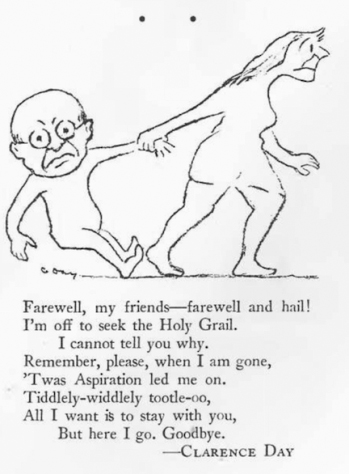
Based on the poem:

Farewell, my friends, farewell and hail;
I’m off to seek the holy grail;
I cannot tell you why;
Remember, please when I am gone,
’twas aspiration led me on;
Tiddly-widdly-tootle-oo,
all I want is to stay with you,
But here I go, goodbye.

The poem, written by Clarence Day, was published in the New Yorker Magazine on Dec 12, 1934, along with an original drawing by Mr. Day.

Day was famous for his Life with Father stories about Turn of the 19th Century New York City.

They were so good that the editor of the New Yorker, Harold Ross, said if he had done nothing more than published Day’s stories, he would have been satisfied with the standing of his magazine.

It was the last bit of Clarence Day published in the New Yorker and Day died a year later.

Clarence Day was also famous for once commenting:

“The world of books is the most remarkable creation of man.

Nothing else that he builds ever lasts. Monuments fall, nations perish, civilizations grow old and die out; and, after an era of darkness, new races build others.

But in the world of books are volumes that have seen this happen again and again, and yet live on, still young, still as fresh as the day they were written, still telling men’s hearts of the hearts of men centuries dead.”

I turn to that today because of the news from Washington.

A feel like a piece of the jenga pile of things that made America, America was pulled out today and the whole thing is coming down.

Suffice it to say I have no words for how I feel because I have no words for how I feel.

I have asked myself often what will cause me to stop writing these writings and having no words may just be the push off the cliff.

I have no words left it seems.

I have questions.

I have questions like, how do people have so much hate inside themselves.

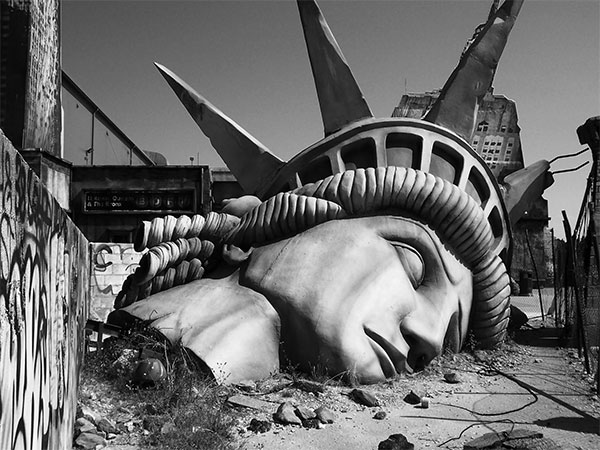
I have questions like, when does the Statue of Liberty come down?

Won’t that be a day to rival the book burnings in Berlin?

But as Mr. Day said, Monuments fall, nations perish, civilizations grow old and die out; and, after an era of darkness, new races build others.

I should not be surprised.

Liberty lasting wasn’t ever in the cards.

For today, we still have books.

The world of books where there are volumes that have seen this happen again and again, and yet live on, still young, still as fresh as the day they were written, still telling men’s hearts of the hearts of men centuries dead.

But they will come for the books next.

Safe money bets, they will come with masks on as they know its wrong and deep down, they will ashamed.

Not enough to stop them.

But enough that they will wear masks.

Shame.

6.26.2025 – a different man

a different man
altogether than one who
began the journey

In his 1st book, The Coming Fury, of his three book centennial history of the United States Civil War, Bruce Catton wrote about Abraham Lincoln and Robert E. Lee:

In a singular way, Lee began his journey more in the mood of Lincoln than in the mood of Davis. Davis had fewer doubts than either of the others.

He knew, broadly, what he was supposed to do, and he knew how to set about it, and he neither knew nor cared what it might cost him.

Lincoln and Lee took more doubts with them — doubts not only about the future but about the precise parts they themselves might have to play.

Each man would say things, in the early stages of this journey, that he would not have said later.

Each man would find the dimensions of the crisis enlarging as he came closer to it, his own probable role growing as the crisis grew; and each man would grow with the crisis itself, shaped by it but at the same time giving shape to it, becoming finally larger than life-size, a different man altogether than the one who began the journey.

The capacity to grow in office is a trait long discussed of American Presidents after leaving office.

Did they grow into the office or … did they fail?

Like so much of accepted historical practices, this question seems to have gone out the window.

What did it all matter if it came to this?

Being President of the United States used to mean something here at home and around the world.

The current administration has lowered the expectations of the office to the level of the Cook County Sheriff as described by Mike Royko in his biography, Boss, of Chicago Mayor Richard Daley when he wrote:

The Cook County Sheriff’s Department was a notorious money pot.

The sheriff’s police were supposed to patrol the roads and residential areas in the sizable unincorporated parts of the suburbs and were empowered to enter any town if local police weren’t doing their job.

They spent most of their time, however, shaking down motorists and making collections at suburban bars and brothels.

Since a sheriff couldn’t succeed himself, most of them got in, got it, and got out.

Few left without being the subject of scandal.

Catton would add of Lincoln and Lee, “Each man would find the dimensions of the crisis enlarging as he came closer to it, his own probable role growing as the crisis grew; and each man would grow with the crisis itself, shaped by it but at the same time giving shape to it, becoming finally larger than life-size, a different man altogether than the one who began the journey.”

The current man if office will also be different.

A lot richer for one thing.

He has got in.

He is getting it.

He will get out … someday.

Different?

Doubt it.

But how about us?

We certainly will be different than we were when we started this journey.