
die with empty hands
and empty pockets, but with
a very full heart
40 years ago, when I went through orientation as a new student in college, my advisor asked me what classes I planned to take outside of my major, US History.
I told him I hadn’t thought much about what else to take and that I didn’t really care.
He stared at me for a second and then kind of exploded, YOU ARE AT THE UNIVERSITY OF MICHIGAN – YOU HAVE THE OPPORTUNITY TO STUDY WITH ANY NUMBER OF GREAT SCHOLARS AND WORLD TOPICS … DON’T YOU DARE NOT CARE.
We sat for a minute in silence.
Me, I was scared to death.
He was most likely bored but he kept looking me in the eye.
He tried again and asked what I liked and somehow we got on the subject of art and I ended up with a minor in History of Art of the Renaissance.
And I have never regretted it.
The Professors and the lectures and even my co students in this field were all wonderful and they really loved what they were studying.
The lectures on the high Renaissance, when I would put away my pencil and just listen, were love stories.
One professor spent a few weeks on the life and work of one Michelangelo Merisi da Caravaggio and the passion of the artist came through in the passion of the professor.
So it was with both some joy and some understanding that I came across the article, Piercing the Shadows of the Pope’s Favorite Painting by Jason Farago (April 24, 2025 – NYT).
Mr. Farago touched on the passion of the art of writing: In some of the grandest churches, Caravaggio endeavored to bring the saints and the angels down from the heavens to earth. But the naturalism had a function that went beyond popular accessibility. Because what matters, what makes Caravaggio so much more than an illustrator, is less the realism of the sacred image than its translation — through the bodies and faces of ordinary people — from the time of the Gospels to now. Into Caravaggio’s time. Into ours.
You could not study the art of Caravaggio with people who understood it and not have it all sink into your core.
Because, some how, it all mattered.
Mr. Farago then writes, quoting Pope Francis:
“Among the great painters, I admire Caravaggio; his paintings speak to me,” Francis said shortly after his election as pope.
During his trips to Rome when he was still the archbishop of Buenos Aires, Francis favored lodgings right near San Luigi dei Francesi. “Every time I came to Rome,” he later said during an address at St. Peter’s, he would seek out one painting in particular. It was the “Calling of St. Matthew,” in the church’s Contarelli Chapel.
“It is the gesture of Matthew that strikes me,” Francis said shortly after his elevation to the papacy. The instinctive lunge for the coins was one he saw in himself. “He holds on to his money as if to say, ‘No, not me! No, this money is mine.’”
You are comfortable, you’re not looking for it, but the calling comes just the same. “Here, this is me, a sinner on whom the Lord has turned his gaze,” the pope continued. “And this is what I said when they asked me if I would accept my election as pontiff.”
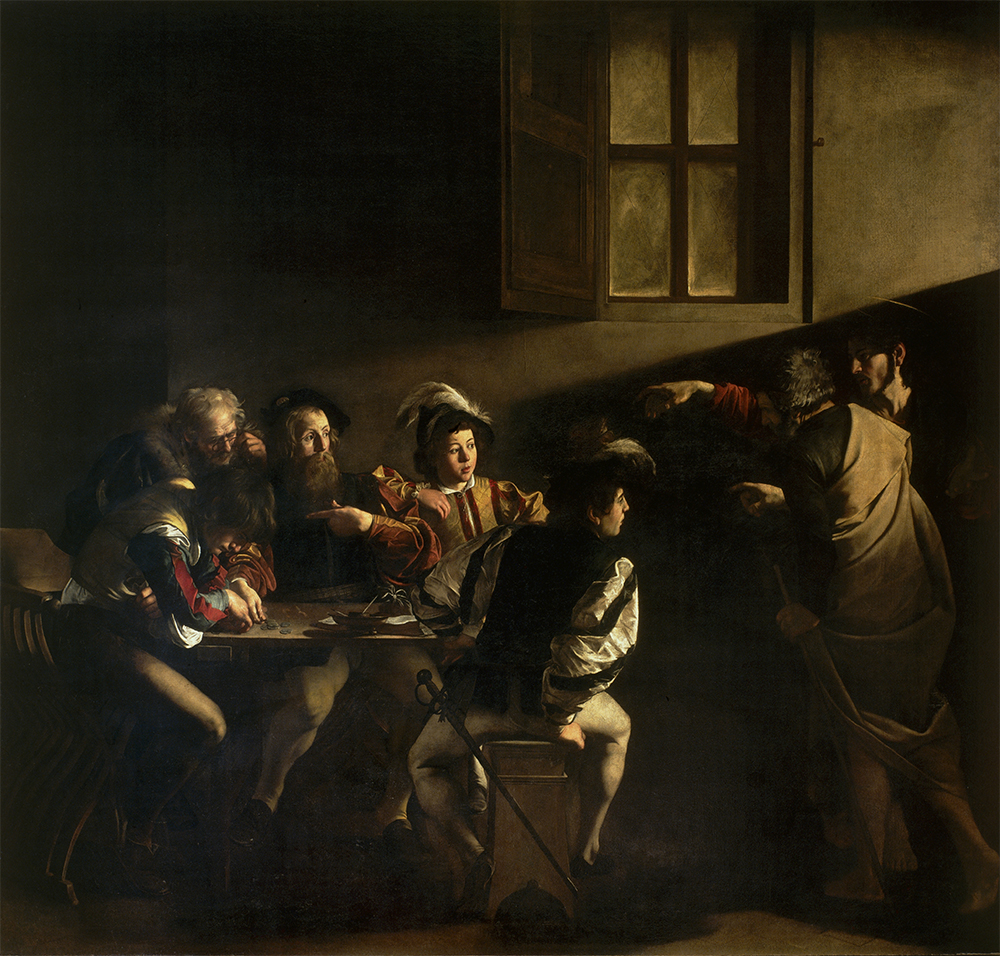
Lets say that again.
“It is the gesture of Matthew that strikes me,” Francis said shortly after his elevation to the papacy.
The instinctive lunge for the coins was one he saw in himself.
He holds on to his money as if to say, ‘No, not me! No, this money is mine.’
You are comfortable.
You’re not looking for it.
But the calling comes just the same.
I found this comment on another website and it fits in nicely.
Pope Francis on Matthew’s conversion story: “That day, when Matthew left his home, said goodbye to his wife, he never thought he was going to come back without money, and concerned about how to have such a big feast to prepare … for him who had loved him first, who had surprised Matthew with something very special, more important than all the money that he had.”
As God surprised Matthew, so would God’s surprises “shake the ground from under your feet and make you unsure. But they move us forward in the right direction. Real love leads you to spend yourself … even at the risk of having your hands empty.”
He referred to St. Francis, his namesake, who “died with empty hands, empty pockets, but with a very full heart … Think well, feel well, do well. Be wise, allow yourselves to be surprised by the love of God.”
Die with empty hands.
Die with empty pockets, but die with with a very full heart …
Think well.
Feel well.
Do well.
Be wise.
Allow yourselves to be surprised by the love of God.

 No Haiku For You