because would be no resistance whatsoever to Hitler’s power
I was there when the Reichstagsbrand [Burning of the Reichstag (House of Parliament) in Berlin, February 27, 1933] occurred, and I remember how difficult it was for people there to understand what was going on.
A friend of mine, Michael Polanyi, who was director of a division of the Kaiser Wilhelm Institute for Physical Chemistry, like many other people took a very optimistic view of the situation.
They all thought that civilized Germans would not stand for anything really rough happening. The reason that I took the opposite position was based on observations of rather small and insignificant things.
What I noticed was that the Germans always took a utilitarian point of view.
They asked, “Well, suppose I would oppose this thinking, what good would I do? I wouldn’t do very much good, I would just lose my influence.
Then why should I oppose it?”
You see, the moral point of view was completely absent, or very weak, and every consideration was simply consideration of what would be the predictable consequence of my action.
And on that basis I reached in 1931 the conclusion that Hitler would get into power, not because the forces of the Nazi revolution were so strong, but rather because I thought that there would be no resistance whatsoever.
You see, the moral point of view was completely absent, or very weak, and every consideration was simply consideration of what would be the predictable consequence of my action.
The moral point of view was completely absent.
Take the latest copy of the New York Times and read out each Trump headline and then say, the moral point of view is completely absent.
According to Wikipedia, Leo Szilard was a Hungarian-born physicist, biologist and inventor who made numerous important discoveries in nuclear physics and the biological sciences. He conceived the nuclear chain reaction in 1933, and patented the idea in 1936.
Together with Enrico Fermi, he applied for a nuclear reactor patent in 1944. He publicly sounded the alarm against the possible development of salted thermonuclear bombs, a new kind of nuclear weapon that might annihilate mankind.
can’t stop a nazi with a lawbook – drop lawbooks … and learn how to fly?
From the book, The Caine Mutiny by Herman Wouk.
Barney Greenwald explains to the officers of the Caine:
” … when all hell broke loose and the Germans started running out of soap and figured, well it’s time to come over and melt down old Mrs. Greenwald — who’s gonna stop them? Not her boy Barney. Can’t stop a Nazi with a lawbook. So I dropped the lawbooks and ran to learn how to fly. Stout fellow. Meantime, and it took a year and a half before I was any good, who was keeping Mama out of the soap dish? Captain Queeg.“
The tried and true standard operating procedure for on DJ Trump is delay delay delay.
His lightning speed blitzkrieg attack on the United States government from within has taken everyone off guard.
To defend ourselves, we run to … the lawbooks.
We run to the lawbooks and expect the other side to play by the rules.
But to the other side, the only rules that matter are the rules that help their side win.
Otherwise its a rule they don’t have to abide by.
To defend ourselves, we run to … the lawbooks.
It is as if we have been run over by a truck and left bleeding in the street and are running to the lawbooks to get a medical treatment.
The time it takes, and the known delaying tactics as well as the disregard for the lawbooks pretty much garruntees that regardless of how the lawbook action turns out, we will have died before any decision is reached.
In their Guest Opinion essay, This Is What the Courts Can Do if Trump Defies Them (New York Times Feb. 16, 2025), Trevor W. Morrison and Richard H. Pildes (Mr. Morrison and Mr. Pildes are both professors of law at N.Y.) write:
Executive branch defiance of the courts is not a simple, one-time-only decision. A prudent court will give the government officials covered by its order multiple opportunities to comply with the order, and will escalate things only when the officials by their own actions (or inaction) make their defiance clear.
Judicial independence and the stability of the rule of law take generations to establish in a credible, durable way. A foolish administration that seeks to defy the courts for short-term political gains or simply to show its “dominance” of other institutions would soon seek shelter from the whirlwind it would undoubtedly unleash.
words meant more before explosion of cinema and television
Adapted from the passage:
“He moves through the work of war poets, novelists and memoirists such as Siegfried Sassoon, Robert Graves and Edmund Blunden. Words meant more back then, before the explosion of cinema and television. Indeed, Fussell writes, ‘Sometimes it is really hard to shake off the conviction that this war has been written by someone.'”
In the article, This Book on World War I Changed How I Think of Nonfiction with the tag line, Paul Fussell’s 50-year-old survey of trench warfare deserves a new generation of readers, by Dwight Garner in the New York Times on Feb. 13, 2025.
I have to love that.
Words meant more back then, before the explosion of cinema and television.
be different from other people – easy … being different
Tell him to be different from other people if it comes natural and easy being different.
So writes Carl Sandburg in his poem, “A Father To His Son.”
It was Dale Carnegie, a man who knew how to win friends, who said, “If you want to be interesting, be interested.”
My Dad was interested in everything.
If that made him a little different, then it was natural and easy for him to be different.
He bought books by the armload and filled our house with books.
He bought records and made tape recordings of music and filled our house with music.
He bought stereo record players and speakers by the boxful and wired up speakers around the house and filled our house with sound.
He bought art by the square yard and covered the walls of our house with original paintings and prints of his favorite Andrew Wyeth.
He wrote in a letter home during World War 2 to his future wife that he ‘liked to live in the WHOLE house,’ no rooms just for show and that is how he lived.
My Dad was interested in everything and to me it made him different from other people.
It was a difference that came natural and easy to Dad.
And for me, he encouraged me to be interested and by extension, different.
(In that respect, he succeeded beyond any dreams.)
But, he didn’t push his interests on me.
He made interesting things available and if I showed interest, he would encourage that interest.
Dad liked historical venues.
He wanted to see them, so we got to see them.
He wanted to see Hartwick Pines State Park up in northern lower Michigan.
So we got to see Hartwick Pines State Park up in northern lower Michigan.
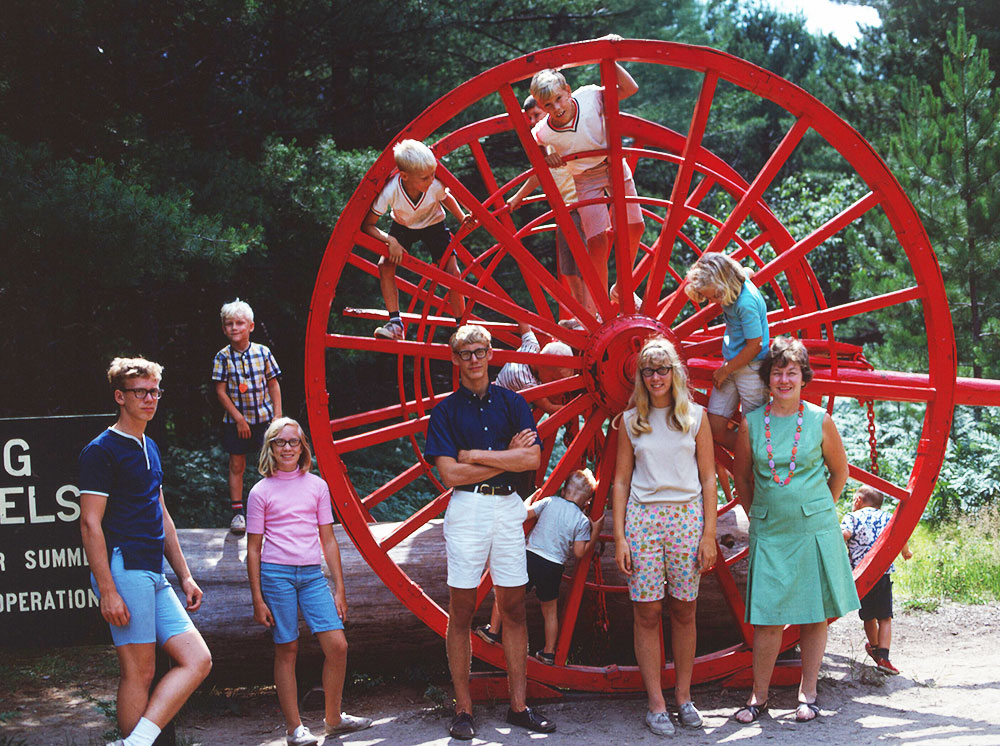
Dad wanted to pose us on a display of the BIG WHEELS used to cart giant White Pines to the lumber yard.
So we posed on the BIG WHEELS as a family.
Some years later, when we were all a little older, Dad thought that a visit to see Hartwick Pines State Park up in northern lower Michigan would be a nice summer day trip.
So we all went to see Hartwick Pines State Park up in northern lower Michigan for a nice summer day trip.
Dad wanted us to pose on the BIG WHEELS.
Notice, this year, Dad is in the picture.
This year, I had shown some in interest in photography.
Dad encouraged my interest.
I had my own camera, a little Kodak.
Dad had his Nikon.
I wanted to use the Nikon.
Dad let me, and I took this family picture on the BIG WHEELS.
I got to use the Nikon.
Dad trusted me.
Though my brothers and sisters look a little bit of the oh-brother-brother-mike-again, I don’t think Dad minded too much.
Even when the picture came back from the lab and it was evident that I need to work on my focus skills.
He would have found that interesting.
Happy birthday to my Dad.
105 today!
Here is the complete poem by Mr. Sandburg.
A Father To His Son
A father sees his son nearing manhood. What shall he tell that son? “Life is hard; be steel; be a rock.” And this might stand him for the storms and serve him for humdrum monotony and guide him among sudden betrayals and tighten him for slack moments. “Life is a soft loam; be gentle; go easy.” And this too might serve him. Brutes have been gentled where lashes failed. The growth of a frail flower in a path up has sometimes shattered and split a rock. A tough will counts. So does desire. So does a rich soft wanting. Without rich wanting nothing arrives. Tell him too much money has killed men and left them dead years before burial: the quest of lucre beyond a few easy needs has twisted good enough men sometimes into dry thwarted worms. Tell him time as a stuff can be wasted. Tell him to be a fool every so often and to have no shame over having been a fool yet learning something out of every folly hoping to repeat none of the cheap follies thus arriving at intimate understanding of a world numbering many fools. Tell him to be alone often and get at himself and above all tell himself no lies about himself whatever the white lies and protective fronts he may use against other people. Tell him solitude is creative if he is strong and the final decisions are made in silent rooms. Tell him to be different from other people if it comes natural and easy being different. Let him have lazy days seeking his deeper motives. Let him seek deep for where he is born natural. Then he may understand Shakespeare and the Wright brothers, Pasteur, Pavlov, Michael Faraday and free imaginations Bringing changes into a world resenting change. He will be lonely enough to have time for the work he knows as his own.
Carl Sandburg, in The People Yes as published in The Complete Poems of Carl Sandburg, by Carl Sandburg, Harcourt, Brace, New York, 1950.
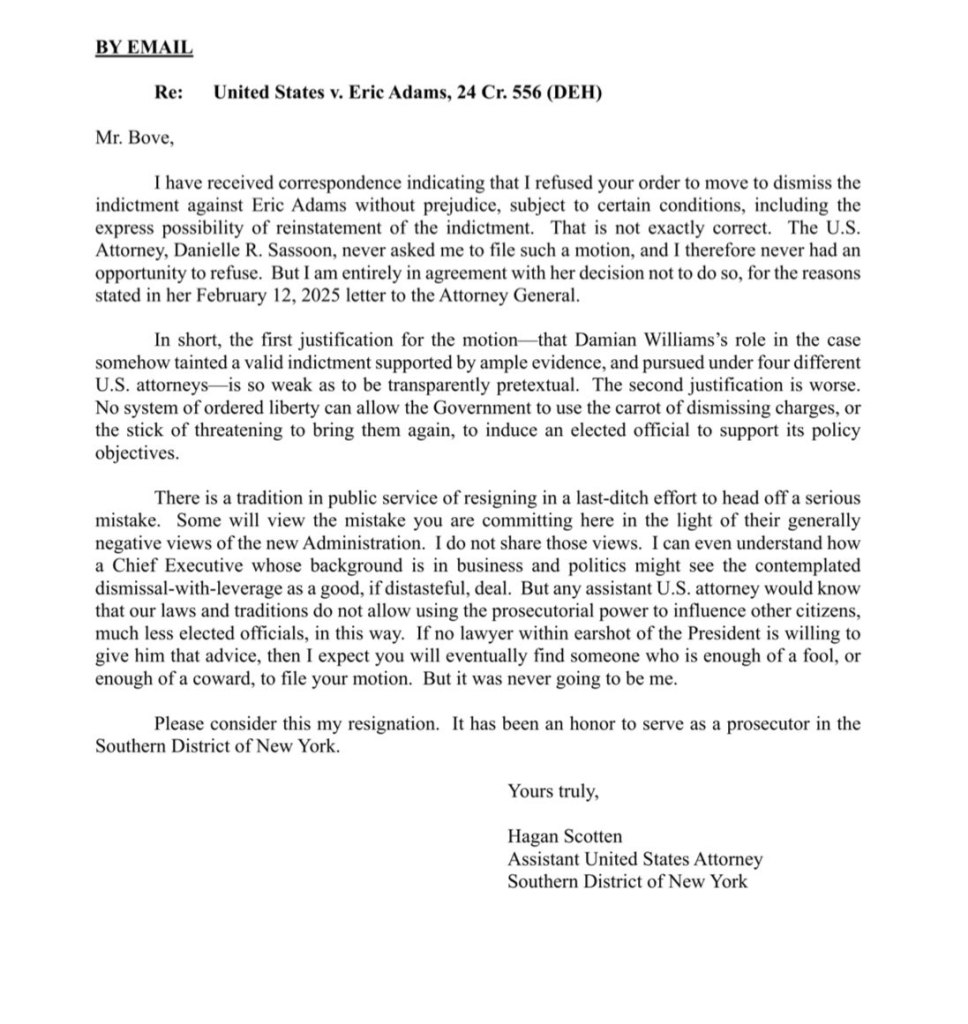
enough a fool or coward will file but never going to be me
“If no lawyer within earshot of the President is willing to give him that advice, then I expect you will eventually find someone who is enough of a fool, or enough of a coward, to file your motion. But it was never going to be me.”
From the resignation letter of Hagan Scotten, Assistant United States Attorney for the Southern District of New York.
The New York Times reports that “Mr. Scotten served three combat tours in Iraq as a U.S. Army Special Forces Officer and earned two Bronze Stars. He graduated from Harvard Law School and clerked for Chief Justice John G. Roberts Jr. of the U.S. Supreme Court, and for Brett M. Kavanaugh before he, too, became an Supreme Court justice.
A Southern District spokesman declined to comment on Mr. Scotten’s resignation.”
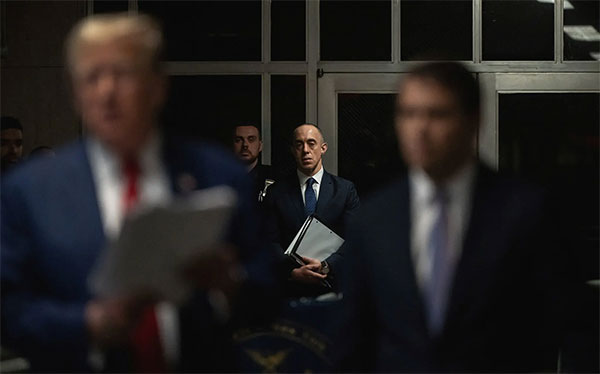
PORTRAIT OF A COWARD
As Huck Finn said, “Right is right, and wrong is wrong, and a body ain’t got no business doing wrong when he ain’t ignorant and knows better.”


 No Haiku For You