shadows of the bikes low blue lustre tardy and soft inrolling tide
Adapted from Sketch by Carl Sandburg in Chicago Poems as published in The Complete Poems of Carl Sandburg, (Harcourt Brace and Company, New York, 1950).
The shadows of the ships Rock on the crest In the low blue lustre Of the tardy and the soft inrolling tide.
A long brown bar at the dip of the sky Puts an arm of sand in the span of salt.
The lucid and endless wrinkles Draw in, lapse and withdraw. Wavelets crumble and white spent bubbles Wash on the floor of the beach.
Rocking on the crest In the low blue lustre Are the shadows of the ships.
headset microphone for speech recognition, you wear this on your head ….
I remember reading once that one of the most asked questions at the MicroSoft Help Desk was “Which key is … ‘any key?'”
As in the instruction, “Press any key.”
I was goofing around with my MicroSoft powered laptop to make sure my headphones were connected so I could take part in an online meeting when this prompt popped up.
I was fascinated to read that in their instructions for connecting a head set, those nice people at MicroSoft felt it necessary to further the identification of a Headset Microphone by pointing out that “you wear this on your head.”
All this talk about AI and computers being smarter than humans.
Seems like the bar is kinda low as is the a computers opinion of us humans as well.
misanthropy plus anger characteristic bleak fatalism
In 1930, James Thurber published a book of drawings titled The Last Flower.
In Thurber’s New Yorker Obituary, EB White wrote. “Although he is best known for “Walter Mitty” and “The Male Animal,” the book of his I like best is “The Last Flower”. In it you will find his faith the renewal of life, his feeling for the beauty and fragility of life on earth.
One week after publication, Life magazine ran a two spread of the drawings and captions under the headline, Speaking of Pictures … Thurber draws a parable on War, that told the story of The Last Flower.
Right now, today, I need a shot of faith the renewal of life, and in a feeling for the beauty and fragility of life on earth.
This is the Life Magazine introduction to the drawings.
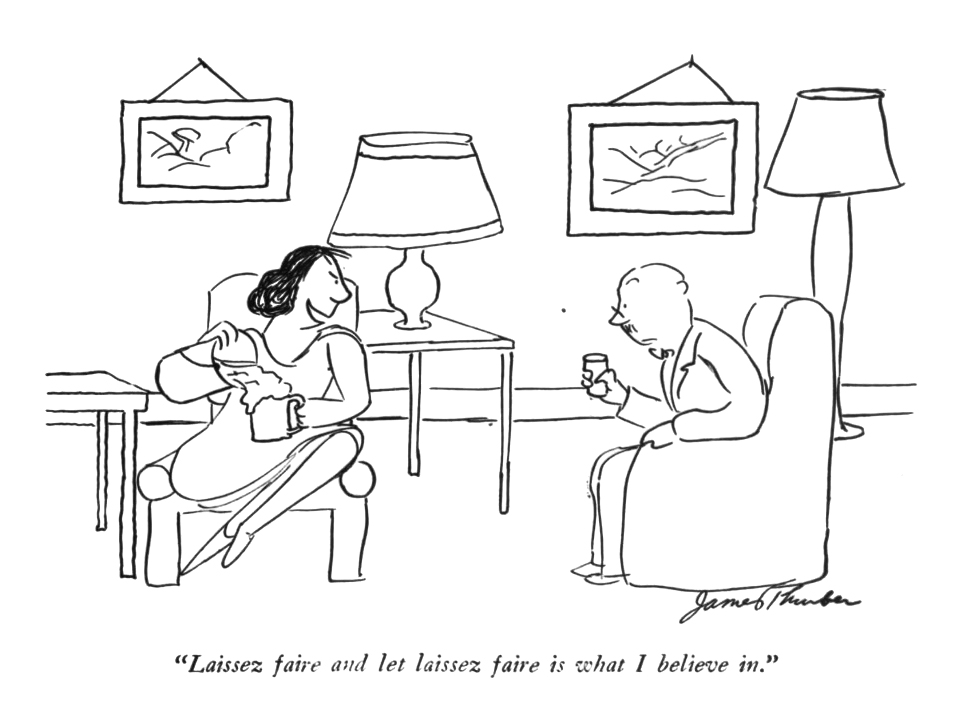
The world of James Thurber is a stark soggy word of predatory women, bald bitter little men and melancholy hounds. Created idly on memo pads, long ignored by the New Yorker and doubtfully put into print in 1931, the Thurber cosmology has since been hailed as the creation of a high satirical intelligence. Art critics applaud his economy of line, call him a successor to Picasso and Matisse.
Beneath his cynicism Thurber is an intense, compassionate liberal. When war exploded in Europe he was moved to produce a “parable in pictures,” packed with his characteristic misanthropy plus anger plus a certain bleak fatalism. At his request Harper & Brothers withheld another Thurber volume then ready for release and rushed The Last Flower ($2) into print. Published on Nov. 17, it is sure to land on many a Christmas tree. Below are some of the 50 drawings from the book, with Thurber captions.
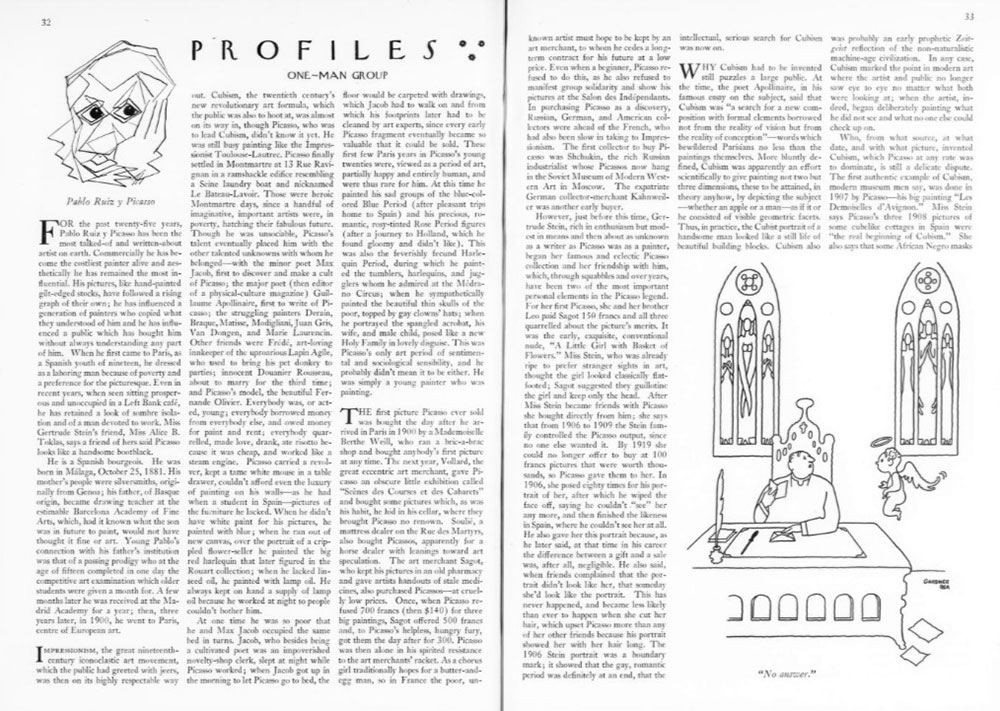
what if James Thurber sketched Pablo Picasso from life … what would he have seen?
Thurber in 1939 was half blind and Picasso was, well, Picasso.
I can wonder, how did Thurber see him?
Happy to say that for the New Yorker profile, One Man Group, written by Janet Flanner about Mr. Picasso we know what it would look like and here it is.
Here is how it appeared in the New Yorker …
I am reminded of Gertrude Stein telling Mr. Picasso that his portrait of her did not look like her …





 No Haiku For You