11.30.2024 – happiness – sadness

happiness – sadness
feel tragic optimism
even in the same hour

Tragic optimism means acknowledging, accepting and even expecting that life will contain hardship and hurt, then doing everything we can to move forward with a positive attitude anyway.

It recognizes that one cannot be happy by trying to be happy all the time, or worse yet, assuming we ought to be.

Rather, tragic optimism holds space for the full range of human experience and emotion, giving us permission to feel happiness and sadness, hope and fear, loss and possibility — sometimes in the same day, and even in the same hour.

From the New York Times Opinion piece, How to Keep Going Amid the Chaos by Brad Stulberg.

According to his NYT Times bio, Mr. Stulberg is the author of “Master of Change: How to Excel When Everything Is Changing, Including You; Embracing Life’s Instability with Rugged Flexibility―a Practical Model for Resilience.” He writes about mental health and excellence.

Mr. Stulberg closes with:

At a moment when it can seem that all is lost, we’d be wise to embrace tragic optimism, wise hope and wise action.

In this we recognize we can exert our agency, even if limitedly, even if only in increments, however we can.

These attitudes and skills, and our willingness to adopt and practice them, are essential to not only our individual resilience but that of our communities.

We need both now.

Is Mr. Stulberg writing about America right now?

Is Mr. Stulberg writing about University of Michigan football?

Is Mr. Stulberg writing about … both?
11.29.2024 – seeking to advance

seeking to advance
a revolutionary
transvaluation

In his opinion essay, “The Moral Challenge of Trumpism,” David Brooks quotes a Mr. Damon Linker who writes:

“Trumpism is seeking to advance a revolutionary transvaluation of values by inverting the morality that undergirds both traditional conservatism and liberal institutionalism. In this inversion, norms and rules that counsel and enforce propriety, restraint and deference to institutional authority become vices, while flouting them become virtues.”

For me, this simple but wonderful use of words hits at what I feel about the incoming administration.

Mr. Brooks expands on the idea of “norms and rules that counsel and enforce propriety, restraint and deference to institutional authority become vices, while flouting them become virtues.” writing:

What does heroism look like according the MAGA morality? It looks like the sort of people whom Trump has picked to be in his cabinet. The virtuous man in this morality is self-assertive, combative, transgressive and vengeful. He’s not afraid to break the rules and come to his own conclusions. He has contempt for institutions and is happy to be a battering force to bring them down. He is unbothered by elite scorn but, in fact, revels in it and goes out of his way to generate it.

In this mind-set, if the establishment regards you as a sleazeball, you must be doing something right. If the legal system indicts you, you must be a virtuous man.

In this morality, the fact that a presidential nominee is accused of sexual assault is a feature, not a bug. It’s a sign that this nominee is a manly man. Manly men go after what they want. They assert themselves and smash propriety — including grabbing women “by the pussy” if they feel like it.

In this worldview, a nominee enshrouded in scandal is more trustworthy than a person who has lived an honest life. The scandal-shrouded nominee is cast out from polite society. He’s not going to run to a New York publisher and write a tell-all memoir bashing the administration in which he served. Such a person is not going to care if he is scorned by the civil servants in the agency he has been hired to dismantle.

Now comes my point.

I know so many folks who say something along the line of “… I voted for Trump, but I don’t go along with all these things he says or does.”

See there is this train.

I don’t like the train.

I don’t like where the train is going.

I don’t like the accommodations on the train.

I don’t like the schedule the train runs on.

I don’t even like the color of the train or the arrangement of the seating or how I get my tickets on the train.

BUT they serve a really good lunch on the train on Tuesdays so I buy and ticket to ride the train.

I might get my lunch, but I get everything else, including ending up where that train is headed when I bought my ticket and provided the means for the train to operate.

As Mr. Brooks writes, “… character is destiny.”

11.28.2024 – constitute and frame

constitute and frame
just and equal Laws, offices
for general good

The Mayflower Compact

Agreement between the Settlers at New Plymouth, 1620

In the name of God, Amen.

We whose names are underwritten, the loyal Subjects of our dread sovereign Lord King James, by the grace of God of Great Britain, France, and Ireland King, Defender of the Faith, &c. Having undertaken for the glory of God, and advancement of the Christian Faith, and honor of our King and Country, a Voyage to plant the first Colony in the Northern parts of Virginia; do by these presents solemnly and mutually, in the presence of God and one another, covenant, and combine ourselves together into a civil body politick, for our better ordering and preservation and furtherance of the ends aforesaid; and by virtue hereof do enact, constitute, and frame such just and equal Laws, Ordinances, acts, constitutions, and offices from time to time, as shall be thought most meet and convenient for the general good of the Colony; unto which we promise all due submission and obedience.

In witness whereof we have hereunto subscribed our names at Cape Cod the 11. of November, in the year of the reign of our sovereign Lord King James, of England, France, and Ireland, the eighteenth, and of Scotland the fifty-fourth, Anno Domini 1620.

On this Thanksgiving Day, 2024, I feel like we can give thanks for the 247 years of this country and the 403 years since the signing of the Mayflower Compact.

Thanks for years past and what for the years to come?

On the 300th anniversary of the signing of the Mayflower, then Governor of Massachusetts, Calvin Coolidge said:

But the really wonderful thing was that they had the power and strength of character to abide by it and live by it from that day to this. Some governments are better than others. But any form of government is better than anarchy, and any attempt to tear down government is an attempt to wreck civilization.

Bet you a quarter ‘Silent Cal’ never ever thought his words … any attempt to tear down government is an attempt to wreck civilization. … would end up being a warning for his country.

11.27.2024 – what makes a Nazi?

what makes a Nazi?
inability to respect
rights of fellow men

The evil characteristic that makes a Nazi a Nazi is his utter inability to understand and therefore to respect the qualities or the rights of his fellow men. His only method of dealing with his neighbor is first to delude him with lies, then to attack him treacherously, then beat him down and step on him, and then either kill him or enslave him.

Address at Ottawa, Canada on August 25, 1943 by President Franklin D. Roosevelt.

He went on to say:

We spend our energies and our resources and the very lives of our sons and daughters because a band of gangsters in the community of Nations declines to recognize the fundamentals of decent, human conduct.

And he closed with:

Some day, in the distant future perhaps—but some day, it is certain—all of them will remember with the Master, “Thou shalt love thy neighbor as thyself.”

Above all else, FDR was very astute in his study of his fellow man and his fellow Americans.

Something tells me that if he were alive today he would not be too surprised of the rise of the Right wing.

Not too surprised but maybe a little hurt that those feelings could survive.

As he said in the middle of this speech, “I am everlastingly angry only at those who assert vociferously that the four freedoms and the Atlantic Charter are nonsense because they are unattainable. If those people had lived a century and a half ago they would have sneered and said that the Declaration of Independence was utter piffle.”

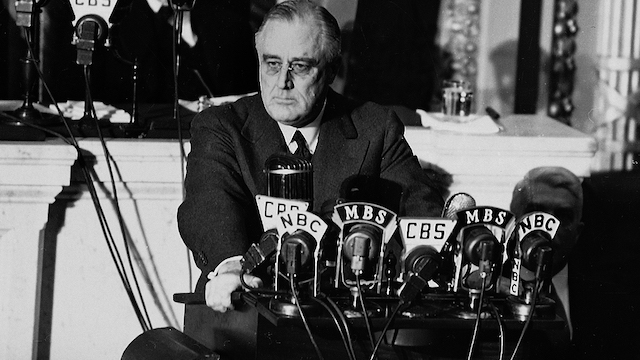
“I address you, the members of the 77th Congress, at a moment unprecedented in the history of the Union,” said President Franklin D. Roosevelt as he started his message to the joint session of Congress, Jan. 6, 1941. Also visible are Speaker Sam Rayburn, left, and Vice President John N. Garner. (AP Photo/George R. Skadding)

11-26-2024 – little bites of air

little bites of air
covered with a sugar glaze
oh those krispy kremes

Strategically placed by the checkout at The WalMart, a half dozen box of Krispy Kreme doughnuts fell into my cart and wound up at home this past weekend.

Like time passing.

Like sands in the hour glass.

Like the rise and fall of the tide.

Here today and gone tomorrow.

Just a memory, where they really year.

One bite and an explosion of sweet in your mouth.

Second bite and maybe the sense of flecks of glaze on your tongue and the hint of something fluffy beyond the sweet.

Third bite and 4th bite and its gone.

Was it ever there?

If it was for the glaze on my fingertips I would have doubts.

Just little bites of air, covered in a sugar glaze.

Oh those Krispy Kremes.

Total pleasure and I can rationalize any guilt.